Monthly Archives: April 2012

This is a wonderful blog entry from an Australian teacher.  Elke pointed out the roles of our lives are intertwined and are connected dualistic compartments. They complete our lives acknowledging the dualistic nature of being human. We bring the life experiences as a parent to the classroom and reciprocate by using the life experience gleaned from the classroom as parents. Our life story is a rich experiential tapestry lived in the moment as we learn along side our students. Not only is learning messy, it is rewarding and energizing.

elketeaches's avatarelketeaches

I love Alfie Kohn. I stumbled on his work when I had my first child and bought lots of parenting books to read. His book Punished by Rewards: The Trouble with Gold Stars, Incentive Plans, A’s, Praise, and Other Bribes made me rethink parenting techniques and has also had an impact on how I have taught and how I want to teach in the future.

It is painful sometimes to hear my son tell me how he was rewarded with something at school for being good, kind, smart or tidy.  Hey!  You’re a good, kind, smart & tidy kid just because that’s who you are, because it gives you intrinsic value, because it makes you feel good to be good, to be kind etc.  Yeah, yeah, I know I don’t want to be a kill-joy, my son likes the rewards because he sees other kids value these rewards.  I just…

View original post 186 more words

What Does it Mean to Be in Control?

I arrived in Seattle today and it is raining. I am attending a Circle of Trust retreat based on the writing and work of Parker Palmer. We share stories and look at the lives we live. Today, I shared a story about my fear of flying and its underlying source. This ends up being a humourous story in the end and revealed something I am only beginning to understand.

Recently, Kathy and I flew from Edmonton to Portland. After arriving in Vancouver late, we rushed across airport and just made the Portland connection. The doors were closed before we had our seat belts fastened. I settled in, we climbed to altitude, the captain came on the intercom and announced words fearful fliers do not want to hear, “Folks there is inclement weather en route and there will be turbulence.” We did hit turbulence. It was not the worst I have experienced, but it was bad enough to create apprehension for me. Kathy calmly explained, “It is similar to a school bus on a gravel road.” I was not impressed and continued to suffer. As the turbulence died down, I reflectively asked a question: “What is causing me to feel this way?” Just as I was beginning to explore this intriguing question, we hit another patch of turbulence. Already engaged in an answer seeking mode, I realized I was moving my feet like I was working the pedals in a car. My fear of flying is largely based on a lack of control. When the flight moved past the turbulence, I mentioned this to Kathy who suggested one of us needed to get a pilot’s license to resolve the problem. We were able to laugh. The good news is today I had a relatively good and relaxed flight to Seattle. Being aware of a potential cause, is important and asking that first question was important.

This is not the first time I used this strategy. Driving to a meeting in November, I did the same thing when I grew anxious about the meeting.  I asked myself what made me feel the way I did and realized a lack of feeling in control of the meeting and its agenda was at the heart of my anxiety. I was able to relax and remain poised during the meeting. The lack of control existed in my mind as an imagined narrative I held to be true. I had not mentally rehearsed or visualized how I would handle what I assumed would be a confrontational situation. This was my normal way of dealing with these situations. The result that day was a quieter, more relaxed mind and body; better prepared actually by not preparing the old-fashioned way. Retreats, like the one I am attending this weekend offer opportunities to explore the internal landscape in a different way than normally done in the busyness of my daily life. From a leadership perspective, if a person is always going off the deep end emotionally, how can that be effective leadership? The time to reflect and spend time attending to one’s inner landscape is an essential, but overlooked aspect of true leadership.


Qualities of a Learning Community

What did the World Cafe events reveal? The concept of community, in some form, was the most repeated quality of what engaged people in their learning. There were many descriptors for a community of learning. One that stood out was the community of learning being safe. Safe learners feel comfortable stepping out of their comfort zone and stretching to learn. This could be called the “Goldilocks Paradigm.” Learning is not too hard causing arresting stress; not too easy allowing boredom to prevail; just right, adding to the edges of knowledge the student possesses.

One discussion led to an interesting revelation about the use of technology and what it contributes to a safe learning experience. As a strategy, it might be better suited for older students, but has potential across a range of ages and abilities from upper elementary and beyond. Video and audio files allow for use of pause and rewind, reinforcement of key concepts, time for mindful reflection and response, and opportunities for anonymous questions. The group was clear this should not replace the face-to-face interactions vital to learning, but could provide opportunities for interactions to develop in addition to the teacher-student relationship, such as valuable peer-to-peer connections. In an increasingly digital world, students and teachers can support each others learning outside the existing temporal and spatial restrictions associated with school as a building to attend on school days. School becomes more than a space and the online capacity expands the potential rather than diminishing it. Physical attendance coupled with other points of contact i.e. blogs, online forums, and video formats provide exciting potential for what a safe learning community can mean.

The conversation about community, learning, and the role of multiple points of contact in the learning community resonated with my own learning experiences. I use a variety of digital formats in my learning at Gonzaga i.e. electronic blackboard, wikis, and blogs. They reveal the reality that learning is not place- or time-focused. It is ongoing with multiple points of contact essential to the shifting landscape of what school is and can become. The Khan Academy is a useful Math resource for some students and Selman Khan, its designer, has employed self-directed learning features by Selman Khan in the design of this site. He makes use of the advantages discussed in our group-connections, time for reflection, and anonymity, and makes learning safe..

Winery (Napa Valley)

The picture of the little chapel reminded me of when I was young and living in Northern Alberta. It was a treat to go for a day to Dunvegan Provincial Park. There was a small church there. More recently, Kathy and I visited the five missions in San Antonio and the Chapel in the Rock overlooking Sedona, AZ. There is a peacefulness when you sit in these small chapels that is hard to find anywhere but in nature itself.

mikibong's avatarmiki bong

View original post

Paradox of Community

Several themes emerged in the World Cafe conversations about learning and an important one was community. The group used various connotations for community and qualities to describe community, but this theme resonated throughout the mindful and reflective conversations.

The concept of team often served as a corollary for community. Teams strive towards common goals in sports, business, or education. A component of successful teams is ‘shared vision.’ Rather than leadership being vested in a person or a small group of people in a hierarchical structure, successful teams have the anchor of a vision and share the values that support the vision. A critical first question in a learning environment would be “What vision and values energize learning?” The common goal and energy bring to life the acronym: Together Everyone Achieves More [TEAM]!

Humans share. It reveals who we are and what is important to us individually and allowing us to connect to the collective. We are affirmed as others listen. The World Cafe group suggested sharing was central to learning by revealing what is important and what is learned. The sharing may reveal gaps in learning or reveal more than one way to solve a problem and learn. Sharing in a safe environment, or community, focuses learning past the expert knowledge of one person, the teacher, and shifts it to the broader collective. Risks are more readily undertaken because there is support, and everyone can both teach and learn. We live in an increasingly complex world where the paradox of teacher and learner calls strongly for sharing.

The idea of connectivity arose several times. A complexity of today’s world is a burgeoning need to connect with others in both new and traditional ways. We face paradox as we seek community. Community is no longer defined solely by where we live, as in a digital world, connections are made across the globe and communities shaped in radical ways. This encourages different and emerging views of community: where we live, where we work, and, how we connect.

Community suggests  paradox. The World Cafe group felt being face-to-face with others was essential at times, but suggested face-to-face might include digital platforms such as video conferencing or Skype. A benefit of on-line instruction is the ability to pause a video or audio file, reflect on material, take notes, and return to earlier points in the file. We cannot pause teachers in real-time to repeat exactly what was said, but we can in the digital world. Wise, prudent, and mindful use of technology serves learning if safely implemented. How do we use technology in traditional classrooms? What role can it or should it play in moving learning beyond the walls of the traditional and sometimes outmoded classroom?

Healthy, vibrant, and safe communities give time and space for solitude. A common criticism of school and classroom scheduling is the lack of reflection time for teachers and students. Busyness is the order of the day in schools and classrooms. Time is necessary for learners to process the reams of available information to connect it to subject matter and make it meaningful. We observed this in the four World Cafe sessions; there were times when the room was quiet, as people processed and reflected on the questions or comments. Community brings us together and, at the same time, paradoxically allows personal space and time.

Today, while on Facebook, I noticed someone had posted a beautiful picture of tulips. That picture reminded me of the lovely pictures of tulips in Holland Malou had posted on her site. Take the time to visit her site and the wonderful pictures she has taken of her home in Holland and throughout Europe..

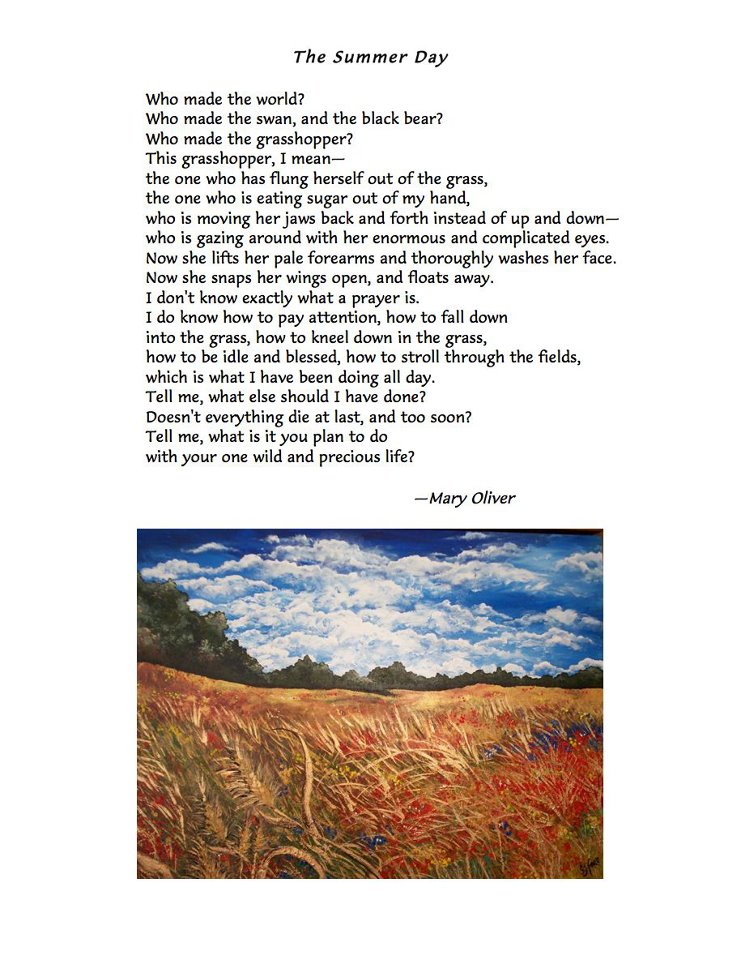
A Summer Day by Mary Oliver

One of my favourite poets is Mary Oliver. Here is one of her poems called A Summer Day. After a weekend of not great weather, it was a timely poem to receive, read, and reflect upon. Mary Oliver, through her poetry, poses such great questions and asks us to take time to enjoy our life. It is the only life we have. Live it well.

A year ago,  I was in an increasingly  dark place. There was little positive in certain aspects of my life. A question emerged: “What is my lot in life?” I quickly realized I was trying to change things I had little or no control over instead of focusing on what I did control in life, living in the moment and being present. I undertook a journey that began with the question, “Who am I?” I completed a directed studies course on mindfulness focused around the question, “What is there about mindful practice that can help me live a fuller, richer life in each moment?” I read Thomas Merton, Parker Palmer, Thich Nhat Hanh, and others on the subject of mindfulness. I attended spiritual retreats and meditated. I posted an entry entitled Connectivity + Synchronicity = Love. Connecting with me the important first step. Yesterday, the synchronicity continued when this blog posting found is way into my life.

Read what Marie posted. I am still a work in progress, but the ways I have used to date are immensely helpful. Take care.

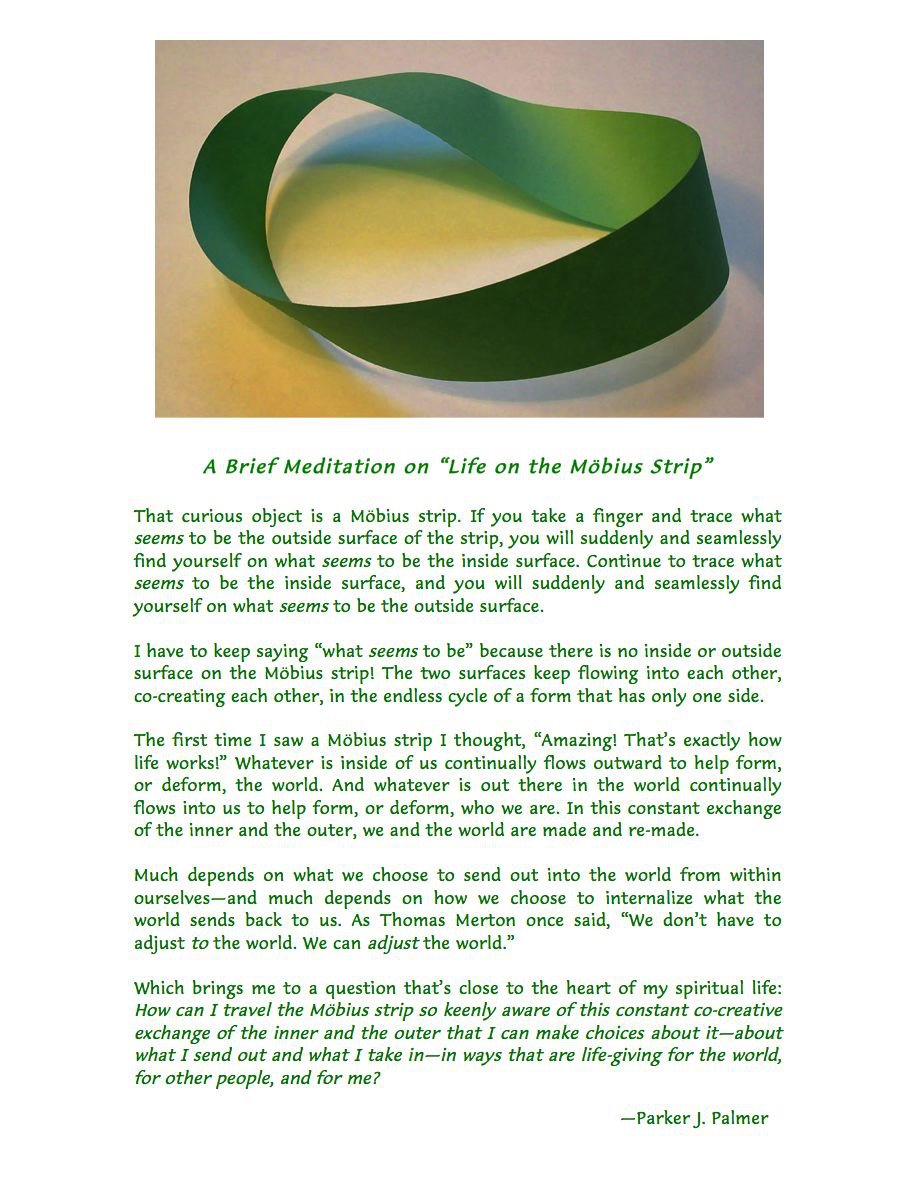
Mobius Strip Meditation By Parker Palmer

Parker Palmer is one of my favourite authors. He writes about spending time looking in and making one self whole. The mobius strip provides a metaphor for the rhythm and flow that occurs when we take time to stop, look in, and show each of us what is important and makes us whole. Please take time to read this wonderful passage.

The Heart of a Teacher

A colleague from Gonzaga sent me this video and fit the World Cafe conversations about learning, the best environment for learning to occur within, and the changing face of education in the 21st Century.

The video is Heart of a Teacher. I apologize for using a link and not the video upload, but I did not have the latter uploaded yet and wanted to get this out there.

I need to add this is another first; there are three postings today.