Monthly Archives: April 2012

Community and Servant-Leadership

Community has been a recurring theme throughout the World Café conversations and events, with many descriptors alluding to communal practices and relationships needed for learning to happen. Reciprocity, connection, supportive, affirmation, and other words expressing interactions suggest community. The summary posters of the March 17, 2012 World Café Event confirmed this recurring theme of community and the table posters, to being posted, also bear this out. The theme of community is important not just in learning, but in life itself. Without community, can life and learning be as meaningful?

Parker Palmer recently shared in a Facebook posting: “Community does not mean living face-to-face with others—it means never losing the awareness that we are connected with each other…”

The servant-leadership conference I attend in Portland reinforced that, although community continually evolves, as a value it can remain intact. Here are some examples.

Professor Shann Ferch, from Gonzaga, spoke about the “beloved community” that the late Martin Luther King so eloquently referred to. It is the necessity to see each other, including oppressors and those who have done harm to us, as human. Dr. Ferch also quoted Viktor Frankl: “We are made to turn outward, toward another human being to whom we can love and give ourselves. … Only when in service of another does a person truly know his or her humanity.”

We easily dismiss these references to community as the extreme and needed actions and words of those in different settings. After all, Dr. King led the Civil Rights movement in its halcyon days and paid the ultimate sacrifice. Dr. Frankl survived the atrocities of concentration camps during World War II. What do their experiences have to do with simply getting through the day?

Kirk Young, a colleague from Gonzaga, elaborated on what could be understood as community in the form of a value. The communities we choose to belong to share one common ingredient: intimacy. Ferdinand Tonnies, a German sociologist, used the word gemeinschaft and described this form of community as “a tighter and more cohesive social entity. [It is] exemplified in family and kinship” suggesting when humans gather in community, intimate experiences are shared. Members share the good, the bad, and grow together towards common purposes, thus are mission driven. Values and mission serve as glue for community.

Father John Dear, a Jesuit priest, proposed in The Rebel Jesus, a second, mostly unnoticed miracle occurred during the Sermon on the Mount: the forming of community. Community allowed people to see the human nature of each other as Jesus instructed those closest to him to organize the large group (some believe well over 5,000 people) into small, more intimate groupings of about 50 people. Father Dear suggested that in these small communities, people interacted differently and shared as they made connections with those now close to them. People were no longer strangers; because moments before they were simply part of a large and increasingly hungry throng. In contemporary parlance, they were statistics.

By witnessing the humanity in each other, we form community and share intimacy without fear. Our humanity is the one thing we share with others and through it, we find purpose to gather and create community around the universality of human values and the value of humans.
What Has Blogging Done for Me?

I went back and checked my first blog posting of February 2011. Blogging began as a tentative venture and, at times, I felt apprehensive, unsure of my writing and topics. Over time, there is a different feeling in my writing, perhaps simply finding my voice in this medium. The Internet provides a new forum for publishing. We can publish and then edit.

The reversal of publishing and editing roles was a challenge. I want a high quality product when I post for others to read. In those early months, some people advised me that just being out there and taking the risk to be less than perfect was enough. That goes against the grain for me. Recently, I explored and read other blogs with regularity which pushed me to look at other people’s postings and ask questions. Were other bloggers posting with little concern for grammar, spelling, and clarity of message? The answer is an unequivocal, “No!” I toured, read, and saw others’ passion and was impressed with the professionalism with which they approached blogs featuring everything from text to  mostly visual to all points in between.

I  felt I had something to offer and the blogosphere served a purpose. I enjoy both learning and traveling. It is affirming and energizing to read others’ entries, communicate on them, and receive responses. Pictorial essays people provided took me back to my childhood in Northern Alberta, reading encyclopedias for fun. Even a die-hard hockey fanatic would not venture out when it was -50 degrees below zero with a wind chill. In a pre-TV and computer era, books served as a window to the world. Blogs with pictures of faraway places i.e. Fort Lauderdale, Miami, and Yosemite take me back to the living room in Rycroft reading an encyclopedia and exploring the world.

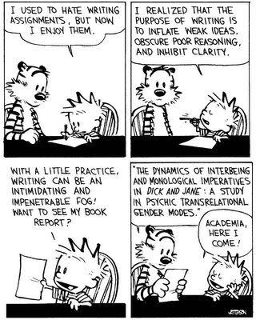
I am enjoying blogging and I think, most of the time, I am finding it a space that fits my communication. On those occasions, when I slip into dull, pedantic, or obtuse writing, point me back to this cartoon.

I do tend to stray and can become this writer.

This is an interesting posting and it struck a personal chord on two levels. Several months ago, someone asked me what I was going to do when I finished my doctorate. These types of questions are the domain of those who think humans have any control and certainty in planning the future. I was also completing an independent study course on mindfulness and it confirmed the absolute need to dwell on what we know is certain: living in the present moment. Being present, in each moment, is its own reward and is as thrilling as it gets. Well said Kayla.

Kayla Cruz's avatarGen Y Girl

Of all the annoying questions I’m asked on a daily basis, I think my favorite has to be this one…

“Where do you want to be in five years?”

My response?

“Wherever Ryan Gossling is.”

JK…that’s where I want to be NOW. Not in five years 😀

No but seriously, this question really upsets me.

You see, I’ve always been an obsessive compulsive planner. Three years ago, I would have been able to answer that question down to the kind of toilet paper I’d be using in five years. At 18 I thought I knew exacly what I wanted to do with my life. I thought I knew exacly what kind of job I wanted and I thought I had met the guy I would marry. We were going to have really pretty babies.

Seemed like a pretty good plan to me. Only, it wasn’t.

Throughout college I found that my interests changed…that there were so…

View original post 374 more words

Light Reading

While on holidays I read My Invented Country: A Memoir by Isabel Allende. It was a chance reading as I purchased the book at a second-hand store. Once I began reading it, I could not put it down and finished it in one sitting. A line that stood out was “I can’t pretend to know what part of my memory is reliable and how much I’ve invented, because the job of defining the line between them is beyond my ability. I have read that the mental process of imagining and that of remembering are so much alike that they are nearly indistinguishable.”  We imagine the life we live as much as we live the life we live.

Isabel Allende recounted her love for the poetry of Pablo Neruda. My favourite Pablo Neruda poem is Ode to My Socks. This is the last stanza: The moral of my ode is this:/beauty is twice beauty/and what is good is doubly good/when it is a matter of two socks/made of wool in winter. I remind students, when they write poetry, reveal the ordinary as the extraordinary. The knitting of socks was an act of love as was the wearing of the socks.

Kathy picked up a book by Paulo Coelho knowing how much I enjoy this particular author’s books. A line about life and its meaning is “A strange transformation began to take place: now that she had the bird and no longer needed to woo him, she began to lose interest. The bird unable to fly and express the true meaning of his life began to waste away and his feathers to lose their gloss; he grew ugly; and the woman no longer paid him any attention, except by feeding him and cleaning out his cage.” With meaning in life, we discover beauty and fulfillment or, perhaps, they discover us.

Paolo Coelho spent time touring Europe including Spain and one result was his best-known book, The Alchemist. Spain was the homeland of a poet I enjoy, Antonio Machado. The following lines are from his poem, Cantares: “Traveller, the road is only/your footprint, and no more; /traveller, there’s no road, /the road is your travelling. /Going becomes the road/and if you look back/you will see a path/none can tread again.

There is never a shortage of great reading. We only have to find it.

These are such outstanding images I wanted to share them with anyone who happened to visit my blog.

mikibong's avatarmiki bong

View original post

Politics as Usual

We are in the midst of a provincial election and I find myself in a quandary of who to vote for. This is an essential question and served as a catalyst for examining the issues. The concerns that emerged are the inability of politicians to stop using catch phrases, stop making illogical promises, and stop thinking all the electorate do not get it.

Danielle Smith, the leader of the Wildrose Alliance, claimed her party, if they formed the government, would act as servant-leaders. Her logic is that they would serve the interests of the people of Alberta. Robert Greenleaf proposed the ultimate test of servant-leadership is the growth of those most marginalized within an organization or society. What would Ms. Smith do for those who have the least, live on the street, are undereducated, and lack access to supports they require to grow as people? Several days later she promised, when a surplus budget was achieved, her government would pay each Albertan $400/year. What does that do for those who are most needy? I submit, if the roughly $1.2 billion that amounts to was used to upgrade, not close, schools in settings with the greatest need and further transformed them into community hubs to provide a broad range of social, health, and educational supports for people in those communities, there would be money left. For those living on the streets, allocate resources to responsible charities to help people in need. There would still be money left. When a similar enticement was sent out some years ago, I turned it over to a charity but not everyone is able or willing to do that. I believe governments, modeling true servant-leadership, have mechanisms to effectively develop and distribute resources. Moreover, I can only think of a handful of politicians who deserve the label of servant-leaders. Liberal Senator Romeo Dallaire and former Conservative MP Doug Roche, come to mind. Surely, Ms. Smith is not suggesting she and her party fit that mold?

Premier Alison Redford made promises, as well. She seems to have fallen out of favour with some media people and is taking a bit of a hit. My concerns are about building a number of schools and refurbishing others. Besides asking where the money will come from, what happened to the concept of transformative education? That term suggests the possibility of real conversations about public education happening at and with the grassroots in this province. Are politicians not aware of a growing trend towards alternative, private, and home school decisions made by families in this province? It seems to go unnoticed by politicians and bureaucrats alike. What does this trend mean to the future of public education? This question is long overdue; and we need to consider it and develop real, meaningful dialogue around it. If we consider the increasing usage of technology in our lives, do schools have to be buildings or is that, in some cases, an outmoded way of thinking? Surely, Ms. Redford and her party do not think they are promising anything transformative in public education? Keep in mind, there are other areas requiring transformation. What would transformation of education, health care, social services, and environmental stewardship look like in this province?

The most likely candidates for the Premier’s office make promises, use catch phrases, and will spend money and resources in ways that perpetuate the status quo. Both are nominally politically conservative, but what are they trying to conserve? I want to conserve things, too—the environment, public education, affordable, accessible health care, and a social support system working for all citizens of Alberta. This conservation assumes a different view of community, leadership, conversation, and resource development. No politician or media shill has the right to say they speak for all Albertans until they have spoken to all Albertans. When did that happen? Will it ever happen?

What Was not Said at the World Cafe Events

I intentionally let the World Cafe Events and results lay fallow to provide reflective space so new ideas could emerge. What surprised me was it was not what was said explicitly, but what went unsaid—no reference to the importance of subject matter in learning and teaching was made. I considered this and arrived at possible explanations.

First, perhaps the group saw the area of expert subject knowledge as unimportant. This is the most unlikely assumption. There were educators in the conversations and I imagine they think this is important. Teachers  train to deliver material in specific subject areas. I have a Physical Education major and a French minor. I chose those areas and, while I no longer actively teach either subject on a regular basis, I enjoy both and feel they contribute positively to my teaching. I cannot generalize my experiences or conclusions to the work of all teachers, but one still could see it as important to teachers, as professionals.

Second, it could be, in education, life-long learning is a given; by definition educators are life-long learners. This is also hard to generalize, but I can speak from personal experience. Currently, I teach Science, Social Studies, and English Language Arts in a multi-grade junior high classroom. I consciously chose to shift from earlier subject area training. To be personally successful and for student success, I actively and purposefully upgrade. There is evidence teachers  serve as models of life-long learning for students when they engage in life-long learning themselves. A question here is, “What does life-long learning mean in this context? Is it different from other professions and work settings?” Defining life-long learning is hard to do. so my conclusions are, at best, specific to me and my experience.

Third, and I think the most likely explanation is based on the adage, “Students care how much you know as a teacher, if they know how much you care about them as people.” The ethic of care in education might be more important than it is given credit for. The World Cafe group acknowledged that mastery was based on meaningful and purposeful learning that prepared and motivated students to learn. Those observations suggest subject matter is important but, at the same time, a real focus on qualities such as communication, compassion, reciprocity, community, affirmation, mutualism, etc. require greater attention. It is easy to dismiss these characteristics as soft, but educational luminaries, Nel Noddings, Deb Meier, and Parker Palmer, have pointed out these are challenging and critical aspects of teaching and learning. Mike Seymour devoted the book Educating for Humanity to building healthy, vibrant, and truly democratic communities in schools. These purported ‘soft’ qualities build positive environments with relational trust and commitment only found in true community (a link to an article by Anthony Bryk) and suggests we should know students, their parents, and our colleagues. Engaging in and building caring, compassionate, and supportive relationships is hard work, but worthwhile. Why do we avoid this effort?

My reflections led to a hypothesis that teachers are expert in chosen subject matter and, when given choice, do continuously work at life-long learning. This means deep, mufti-layered, nuanced learning as opposed to superficial simple attendance to the latest fad. To make real differences, adults should care enough about students individually and collectively to reach and grow beyond themselves. This carries a responsibility with it that educators need to learn about students, their needs, and their environments outside school walls. That is relational and commits teachers, by the nature of a variety of choices, to be learners and co-creators of knowledge with students, families, and community.

An Extraordinary World

I am reading a book called The Radical Christian Life by Joan Chittister. A line that stood out was “spend our time well, to contemplate the divine in the human, to treat everything in the world as sacred. We need the wisdom of stewardship.” I recalled the Buddhist concept of the extraordinary explained by Thich Nhat Hanh. A story he recounted was about an oak tree at Plum Village. Attendees stop and literally become tree huggers as they hug that tree and admire its splendour. With small actions, humans move from seeing themselves as part of the world not separate and superior to the world we share with all of Creation. There are things and times I take for granted.

We regularly drive the Yellowhead Highway between Prince George and Edmonton. Recently, I realized it is extraordinary. Each trip we pass Mount Robson. Sometimes it is shrouded in clouds. Other times, it looks like this. It is always spectacular.

We observe wildlife: bear, elk, deer, goats, bald eagle etc. Last summer, I took a picture of two black bear feeding along the side of the road. They seemed quite unaware of my presence.

We took a picture of an Inukshuk in Jasper National Park. An Inukshuk is an Inuit symbol reminding us others were there before or that we are on the right path. It is an excellent reminder of the need to stop, reflect on the world, and take stock of our role in the world. It is an extraordinary place.

I was reminded of the extraordinary nature of the world as I read Malou’s blog entry. She wrote about tulips in Holland. Tulips might seem ordinary to people who see them everyday just like driving through the Rocky Mountains has been to me. When I mindfully, attentively observe the world and become aware of it, its breathtaking beauty is readily revealed.

Godly Play: A Setting for Eloquent Questions?

A question was posed about the role of eloquent questions and how they might apply to the concept of Godly Play. I chose to flesh out my thinking on eloquent questions in that context. Eloquent questions lead inquiry into what is important within a community and  shared by a community, big or small. Access to the wisdom of past generations gained through questions posed by members of a group. Gadamer in Truth and Method suggested the prudence and eloquence derived from eloquent questions “gives the human will its direction, is the concrete universality represented by the community of a group, a people, a nation. … [Therefore, its] youth demands images for its imagination and for forming its memory.”

I am not expert on the concept of Godly Play, but the questions posed by children in that setting could be understood as eloquent questions. Eloquence, as it relates to language, suggests capacity to articulate questions about those things that are important and people are curious about in their lives. Yes, it could mean being persuasive and convincing, but I think as it applies to inquiry, eloquence has to do with articulating questions crucial to the existence and survival of the group. With this curiosity and wonder, children participating in Godly Play are encouraged to ask wondering questions and are provided with open-ended response time. This last description suggests there is time to consider answers and, over time, to reconsider them.

Gadamer proposed that prejudice guides understanding, but we are aware of the prejudice and the role it plays in understanding. An open-minded stance allows people  awareness of their prejudices or personal agendas and not be attached to them. We stay open to accepting new evidence and there is a constant maturing of views and understanding of the world. This stance brings to mind the Buddhist concept of the Beginner’s Mind which Senryu Suzuki defined as “in the beginner’s mind there are many possibilities.” Children benefit from the beginner’s mind and constantly seek to make sense of the world while remaining open to the many possibilities the emerging world holds for them.

This openness and questioning stance leads to the prudence or wisdom that is important to the existence of the group, not only in its present form, but recognizable with each ensuing generation. St. Thomas Aquinas considered prudence in this sense as benevolent and based upon a supernatural good. The community hopes that the children, through their inquiry, will gain the prudence and wisdom to sustain the community through the rhetoric and the words they speak and the intent of their actions. Prudence is not driven by self-interest. That is deceit and cunning. Prudence takes the form of actions that would be well-intended and for the greater good.

Although I lack in-depth expertise in both eloquent questions and Godly Play, Godly Play does seem to encourage children to ask eloquent questions to better understand their community and grow with their community in a prudent way.