Monthly Archives: May 2012

Junior High Creative Writing Activity: A Fractured Fairy Tale

Children hear and read fairy tales at a young age. When they reach late elementary and junior high school age, they can explore and discover inconsistencies in fairy tales i.e. Goldilocks breaks into the Bears’ house and vandalizes it. Here is a creative writing activity in the form of a parody.

This is the most popular creative writing activity in our junior high class. This plan has worked well for me as a junior high teacher, but I think could be used with upper elementary students. I think it can be modified and meet the needs of younger and older students.
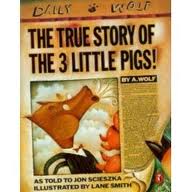
We use Jon Sczieska’s The True Story of the Three Little Pigs by A. Wolf as a model of a parody.

The unit plan includes:

Process

Reading the story to the class and brainstorm differences between the original and this version? Most students are familiar with the original story of The Three Little Pigs, but have it on hand if someone is unfamiliar with the story.

What fairy tales are students familiar with? Brainstorm and create a list. What parodies of fairy tales are they familiar with? Have they seen Shrek? What makes Shrek different from other fairy tales? Students may recognize Shrek as a parody of the genre and has features and structure of a fairy tale while it spoofs the genre in various ways.

What twists can be used to rewrite a fairy tale i.e roles of antagonist and protagonists or plot events? Some examples students have shared include what if the third little pig refused his siblings refuge to teach them a lesson where would they stay?  Could the pigs organize a pig posse to run the wolf out-of-town?  Would they have become ‘ham jam’?  What about the story from the wolf’s perspective?  What if the wolf were a vegan?

What other fairy tales are students familiar with?  Brainstorm and make a list. This helps students choose a fairy tale to rewrite. Choose a familiar fairy tale and brainstorm ways to ‘fracture.’ We have used Cinderella. The list can offer starters for students and could also be used in the parody of another fairy tales. What if…

  • Cinderella has beautiful step sisters?
  • The prince cannot dance?
  • Cinderella is a homebody who likes to cook, sew, and clean and is not interested in attending the ball?
  • The magic wand is defective and does not get the spell right?
  • Cinderella does not want to get married?
  • Cinderella wants a car and not a carriage?
  • Etc…

Brainstorm elements fairy tales share and create a graphic organizer to hand out. Some features have included:

  • Once upon a time…
  • Good vs. evil
  • Beautiful heroine and handsome prince
  • Magic/supernatural
  • Personification
  • …live happily ever after
  • Etc…

Students can ‘fracture’ a fairy tale and change stories in unexpected, clever, and humourous ways by altering characters, modifying language, using a modern context, etc. The fairy tales still remain true to their original forms despite changes.

Here are sites to find fairy tales or refresh memories about the fairy tales students choose: Story Nory, Grimm’s Fairy Tales, and Ivy Joy. Some sites include other genres i.e. fables. Stick to fairy tales as they are well-suited for this project.

Students include an outline or web and a rough draft. Peers or teachers can proofread the story so students can edit.

Final Product

A picture book format is popular. The authors of the picture book can read to their stories to younger students.

Words of caution

  • This is not a yearlong project
  • Students  need to choose something of a manageable length.
  •  Usually the audience is younger. Students should use appropriate language and images, keep the book short i.e 20 pages, and use large font.

Assessment

I use this activity to assess creative writing, sharing orally, and finding appropriate images for the story and the audience. As well, there are brainstorming, proofreading, and editing.

Questions

What engaging writing activities do other teachers use in their classrooms? What changes can be used for older and younger students? What other assessment purposes can you think of for this type of activity?
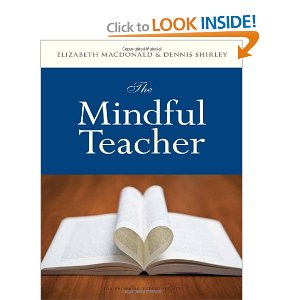
The Mindful Teacher by Elizabeth MacDonald and Dennis Shirley

Last year, I was in a challenging situation and sought a path to continue my teaching and learning journey. Elizabeth MacDonald and Dennis Shirley wrote a book called The Mindful Teacher. I read the book during September 2011.

A thesis was teachers feel alienated working in a system where few “possibilities remain for ethical, caring teachers to hone their craft and to inspire their students with the sheer joy and delight that is found in learning” (p. 2). The authors used teacher stories and personal reflections obtained through The Mindful Teacher Project which involved public school teachers in Boston. MacDonald and Shirley cautioned this was not “a recipe that can be followed, or  a ‘silver bullet’ … it is a form of teaching that is informed by contemplative practices and inquiry that enables teachers to interrupt their harried lifestyles, come to themselves through participation in collegial community of inquiry and practice, and attend to aspects of their classroom instruction and pupils’ learning that ordinarily overlooked in the press of events” (p. 4).

As I read the book, I realized how inattentive I had grown in classroom instruction and about personal growth. Collegial mindfulness has not appeared in a conventional sense, but I discovered alternative spaces i.e. daily meditation, spiritual retreats, World Café Events, and blogging which filled some of the void. I try to pay closer attention to “Who is the self that teaches” advocated by Parker Palmer. I completed a guided study into mindfulness in daily life. Each aspect added mindfulness previously absent in my life.

Amazon Books

Gains: I  have slowed down, reflect more often, and try respond and not react. It is a journey and that is why we call it practice. Each school day, I spend 20-30 minutes meditating. When I am flustered in the classroom, and it happens, I try close my eyes, take a deep breath, and clear my mind before I respond. I refer to those successful moments as the new Ivon. An important gain was teaching is a calling, a vocation. As I read, I was reminded of that.

Questions: What do we do when adults do not trust between one another and that appears irreparable? I assume the authors wrote the book due to a perceived need by the authors. I imagine there are environments lacking trust. What do we do then?

Recommendation: This is short, easy read filled with stories and ideas. From a veteran teacher perspective, it helped me tend to long overdue internal work. A new teacher could use ideas to shape their career. I would recommend it for all teachers and, when done, find a group and have open, joyful, non-judgmental conversations. What brought you to teaching and learning?

The Contract – A word to the led by William Ayot

And in the end we follow them-

not because we are paid, not because we might see some advantage,

not because of the things they have accomplished,

not even because of the dreams they dream

but simply because of who they are:

the man, the woman, the leader, the boss

standing up there when the wave hits the rock,

passing out faith and confidence like life jackets,

knowing the currents, holding the doubts,

imagining the delights and terrors of every landfall;

captain, pirate, and parent by turns,

the bearer of our countless hopes and expectations.

We give them our trust. We give them our effort.

What we ask in return is that they stay true.

With leaders who are at times pirates, we can colour outside the lines and think outside the box. Organizations, institutions, and communities want leadership.  Exploration of past times included pirates who navigated new and treacherous waters and helped find new nautical paths past the visible horizons. Yesterday, someone told me a recent comment I made about a need to name school and community values was received with openness and yet I felt that openness was not reflected by the group. Leadership is speaking one’s truth while honouring truths of others. It is a respectful rather than  ‘relativism gone wild.’ What can each voice add to the conversation? It is lonely and dangerous being a pirate without others helping in the navigating.

This is a great TED speech by Sir Ken Robinson. It is about the 4th or 5th time I have seen it or a variation on the speech. If we are killing creativity among children and the high point of creative thought is in Kindergarten, what do we need to do to make schools and learning a space of creative learning and expression? The time has arrived for a true conversation about learning in the 21st Century. Have we killed the creative spirit of teachers? This is an important question in the conversation.

Kayla Cruz's avatarGen Y Girl

I watched this video yesterday and it completely blew me away.

Do yourself a favor and WATCH IT! 

This man is honest, funny, a straight up genius and his accent is awesome.

“Creativity expert Sir Ken Robinson challenges the way we’re educating our children. He champions a radical rethink of our school systems, to cultivate creativity and acknowledge multiple types of intelligence.”

Ted Ideas Worth Spreading

Should we all be doing what we love? Yes. Is school the only way to get us there? No. We need to educate people in  a way that promotes creativity and passion in our work so that we don’t end up bitter and miserable. Life’s too short.

Thanks to my twitter peeps @shawmu and @knealemann for bringing this to my attention 😀

View original post

For All the Children

Learning, school, education, or life lived; whatever we choose to call the enterprise it is important we live the words of Gary Snyder.

The rising hills, the slopes,

of statistics

lie before us.

the steep climb

of everything, going up,

up, as we all

go down.

In the next century

or the one beyond that,

they say,

are valleys, pastures,

we can meet there in peace

if we make it.

To climb these coming crests

one word to you, to

you and your children:

stay together

learn the flowers

go light

The line which draws my eye and means so much to me, as a teacher and learner, is the one about statistics. Each year, I spend time with the Grade 9 class discussing the average student and the potential absurdity of the concept. Students realize there might, in fact, not be such a person. It might only be the ‘mean of the average.’ In our classroom, is a poster of Einstein. Several years ago, a student asked who the person in the poster was and I answered by saying it was my Dad. I do resemble him, or like to think I do, with the wild hair and idiosyncrasies. We refer to Einstein as Mr. P.’s Dad. His quotes are a marvel and the one I feel fits with the Gary Snyder poem is:

We must take care and insure the stories of each person who lives life is fully heard. We are not numbers. We are the stories come to life. We should always ask, “What makes the number relevant?”

The Space Should Be Bounded and Open

I believe paradox is essential for educational transformation. Parker Palmer described paradox as a creative tension or “a way of holding opposites together that creates an electric charge that keeps us awake” in his book The Courage to Teach. He argued “the poles of a paradox are like the poles of a battery: hold them together, and they generate the energy of life, pull them apart, and the current stops flowing…and we become lifeless.” I elaborated on paradox in my posts Abundant Community and Paradox of Community. I propose paradox be used to revitalize the institution we call school and the conversations about this necessary enterprise.

Parker Palmer in The Courage to Teach presented six paradoxes and identified ways in which they could serve us in the classroom through pedagogical design. I believe they serve educators and their communities as foundations for conversations and a long overdue transformation.

The first paradox is “the space should be bounded and open.” School cannot be a one size fits all approach, but it cannot be a chaotic, wide-open system. There are many ways to understand school from home schooling to traditional. In between, there is diversity. Is school a building? Could it be a virtual gathering? Could it be a combination? Rigid boundaries should be replaced by flexible boundaries. If they do, then we can ask, “What serves the child?” What serves the community?”

Over the next while, I will look at each paradox, and explore how they lead conversations towards transformation.

I think this is a thought-provoking question. It is possible conversation, like community, is in the midst of being redefined, but we should take care and retain the intimacy each brings into our lives. I felt a  kinship as I read this posting. Kathy and I, after almost 40 years, try to find time for each other. We always made time, and continue to do so, for each other. It is what makes a relationship healthy.

broadsideblog's avatarBroadside

This recent think-piece in The New York Times argues that we have:

At home, families sit together, texting and reading e-mail. At work executives text during board meetings. We text (and shop and go on Facebook) during classes and when we’re on dates…

We’ve become accustomed to a new way of being “alone together.” Technology-enabled, we are able to be with one another, and also elsewhere, connected to wherever we want to be. We want to customize our lives. We want to move in and out of where we are because the thing we value most is control over where we focus our attention. We have gotten used to the idea of being in a tribe of one, loyal to our own party.

One of the rituals my husband and I enjoy is my driving him to the commuter train station in the morning. It’s only about 10 minutes door…

View original post 442 more words

This is an amazing set of pictures. Even though this would be impossible for me to attempt, this blog brings it into my life. Thank you guys.

Fire by Judy Brown

This poem sat on my desk for the past week and Silence motivated me to share what silence, as space, provides in our lives.

What makes a fire burn

is space between the logs,

a breathing space.

Too much of a good thing,

too many logs

packed in too tight

can douse the flames

almost as surely

as a pail of water would.

So building fires

requires attention

to the spaces in between

as much as the wood.

When we are able3 to build

open spaces

in the same way

we have learned to pile on the logs,

then we can come to see how

it is fuel, and absence of the fuel

together, that makes fire possible.

We only need lay a log

lightly from time to time.

A fire

grows

simply because the space is there,

with openings

in which the flame

that knows just how it wants to burn

can find its way.

https://i0.wp.com/upload.wikimedia.org/wikipedia/commons/0/0f/Campfire_Pinecone.png

Silence offers the space between words in our life; a pause, momentary silence for reflection, and a soft, gentle breath of air adding life to our words.

I am following with a wonderful poem that echoes this thought-provoking piece by Francesca.

Francesca Zelnick's avatarWords/Love

I’m not afraid of silence. Some people are, and so they fill the world with superfluous sounds. They look upon silence as an absence, a void. But that’s not what silence is. It is not emptiness.

He told me that he felt badly for the elderly couple sitting a few tables down. They were eating without conversation. “They’ve run out of things to say to each other.” Their silence made him sad.

But I thought it was kind of beautiful, the way comfort made room for quiet. I have felt this a few times in my life. I have sat with so much love and understanding between us that words have been unnecessary. Not everything needs to be said.

Some days I feel stuck in repetition. I have spoken these words before. I will say them all again, over and over, for the rest of my life. If I were…

View original post 416 more words