Category Archives: Community

Dreamers

I thought about some violence we experience in the world. The last few days it is that theme that has drawn me in my writing.

The word compassion comes from sharing a love of something and the suffering that comes from sharing. The word companion comes from sharing a meal, usually on a journey with others.

We have more in common than makes us different. It is differences that make us unique. The ancient concept of common sense (sensus communis) was what a community shared and held in common, to be passed on to the next generation.

With violence, what do we think we are passing on to the next generation? I would like to think we pass on the good we have in common, the sharing of things we love and suffer with, and we will stop for a meal with each other in times we feel strife.

New emerges and we replace what is outdated and unnecessary, but more remains than we replace when we are mindful and attentive to the world we share.

We are dreamers,

Imagining what might be,

Wondering what could be,

Wondering, “who do we share with?”

In suffering and loving,

Experiencing (com)passion.

In moments of passion,

We share with one another,

Delighting us in one moment,

In the next, suffering together

(Com)panions sharing our daily bread.

Sand Castles

Children live in each moment. Their inexperience allows them to be in a world that seems novel. They build sand castles in those moments. As adults we think we lose that ability to build our sand castles.

Being mindful and present to the world and others is a way of building sand castles, perhaps in some metaphoric way. How can I think about this person and that thing differently? How do I bring less suffering and pain to the world in understanding “differences make a difference?” Unlike children, adults often understand differences as threats.

It reminds me of Tolstoy‘s quote: “if you want to be happy, be.”

A child, playing in sand,

Building sand castles,

Absorbed in that moment.

The world is immediate,

Demanding one be present,

To embedded in this very moment.

As a child,

We know nothing different,

Our castles are real and momentous.

To outgrow our castles,

That is a tragedy,

To lose being mind(ful).

Let me return to that world,

To build castles in the sand,

As only a child can.

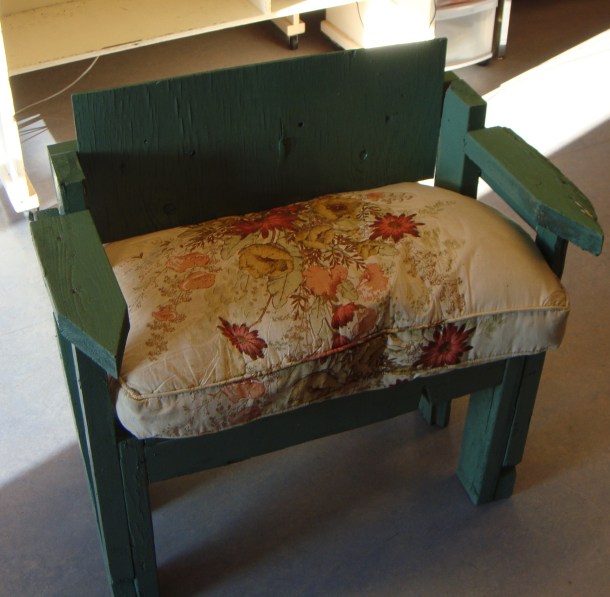
When I taught, the Grade 7 students built chairs for Science class. A criterion was they had to use recycled materials. They always built terrific chairs with little help from adults.

Anarchy

I felt a touch of sadness the last few days of school. I think it goes back to my first year teaching. The students told me they wanted school to continue into the summer. My last year teaching students sent me off with the message it was not the content that was meaningful, but the life lessons they learned.

Etymologically, anarchy comes from repeatedly new beginnings. Thought of that way, each new beginning is an opportunity to dance.

Rumi said “We rarely hear the inward music, but we’re all dancing to it nevertheless,
directed by the one who teaches us, the pure joy of the sun, our music master.” New beginnings are a dance that we do not always hear the music to.

As an end draws near,

Beginnings emerge,

In the anarchy of living.

One is drawn,

Not by the familiar,

By mystery.

In silent moments,

Stillness calls,

Reaching deep into one’s soul.

In silent moments,

The unseen radiates,

Touching one’s spirit.

Mystery lurks,

Pointing the way,

Deep wonder draws one forward.

Eloquence of Ambiguity

Language matters. Yesterday, I read a post on an educational blog. Essentially, the person argued that “data driven education” was stupid and education was “child driven.” I accept children make choices about what they learn. As a teacher, I used data, including their choices, to inform how I taught.

What I understood demeaned anyone who spoke differently than this person. It is in pluralism and diversity the essence of eloquent ambiguity that we appreciate the world and receive gifts.

Most people accept a world that is grey and their language appreciates the eloquence of ambiguity. Language has a way of fixing things as if they were more permanent. It is the capacity of humans to interpret and re-interpret that brings forth the elegance of the world.

Appreciate the world as it is

It does not arrive pre-packaged.

Embrace uncertainty and ambiguity

Let its eloquence emerge.

Open your heart

Receive unimaginable beauty.

There are no pat answers

Only an internal compass that guides you.

This is a path in Waterton Lakes National Park. A person only sees a short distance ahead when walking a path. What comes next is uncertain.

Peace

Source: Peace

It is the end of a long day. I was up at 3:00 our time and on the plane at 6:00, getting into Oxford, Ohio tonight at about 6:30. Heather shared this post on her site, Wildflower Women, the other day.

Peace is not something to be imposed. It is something we discover when we reach over the fence and talk to our neighbours. It is when we build bridges to other people we do not yet know.

Leigh at Not Just Sassy on the Inside shared this version of Hallelujah. It is beautiful and haunting. Enjoy.

Walk Your Path

We each walk our own path. Others can walk beside us, hold our hand, and be there. What they cannot do is live our lives.

I thought about traveling today, as I prepare for my trip tomorrow. It brought several quotes to mind about the paths we travel and what that means.

“Don’t walk behind me; I may not lead. Don’t walk in front of me; I may not follow. Walk beside me and be my friend.” Camus

“It’s your road, and yours alone. Others may walk it with you, but no one can walk it for you.” Rumi 

“Pursue some path, however narrow and crooked, in which you can walk with love and reverence.” Thoreau

The reflecting led me to look through some notes and this poem emerged.

Walk it so may be glorious.

Your courage is your truth

Let it shine a light on the path.

Discover beauty in what you give

Let it be the path you seek.

Walk at your pace

Be present in the world.

Walk with your story

Follow the questions of your quest.

Find a space to catch a glimpse of yourself

It is a space to dance, sing, and live.

Be vulnerable in that space

It is makes you who you are.

This is a path at Sunwapta Falls in Jasper National Park. We walked down to the see the falls and Kathy took the picture as I walked back up. The roots and people walking wove a pattern and story into the path.

Think Different

This poem, writen by Rob Siltanen, was part of an early Apple advertising campaign. He was a creative director for the company.

It stands out for me, because it echoed a phrase that emerged from my dissertation: “Differences make a difference.” It is in difference we discover what makes us each exceptional. Without the differences, we blend into an indistinguishable mass mere copies of one another. Worse yet, we might only copy the worst of the people we see succeeding.

The poem reminds of the Michelangelo quote: “Every block of stone has a statue inside it and it is the task of the sculptor to discover it.”

To be a teacher, is to inspire and allow each student to discover who they are. It is to be mindful and sensitive to what makes each of them different. It is to both serve and lead at the same time. It is to be different one’s self, as a teacher. How else could a teacher inspire?

The misfits.

The rebels.

The troublemakers.

The round pegs in the square holes.

The ones who see things differently.

They’re not fond of rules.

And they have no respect for the status quo.

You can praise them, disagree with them, quote them,

glorify or vilify them.

About the only thing you can’t do is ignore them.

Because they change things.

They invent. They imagine. They heal.

They explore. They create. They inspire.

They push the human race forward.

Maybe they have to be crazy.

How else can you stare at an empty canvas and see a work of art?

Or sit in silence and hear a song that’s never been written?

Or gaze at a red planet and see a laboratory on wheels?

And while some may see them as the crazy ones,

While we see genius.

Because the people who are crazy enough to think

they can change the world, are the ones who do.”


A Vision

I am preparing to go to Miami of Ohio to attend a writing retreat. It is a curriculum theory called currere, which is the root word for curriculum and is an infinitive verb meaning to run the course of one’s life.

Currere overlaps with the methodology, hermeneutic phenomenology I used in my writing my dissertation. The two are reflective, explore one’s lived-experiences, and interpret them as data . After a person reflects on a lived-experience, they imagine how it might inform their teaching. They create a vision of the past and future in a way to create a vision for the present.

William Pinar compared this process to photographs that gain clarity as they develop. I had not used the method, but referenced Dr. Pinar’s work and he was on my dissertation committee.

Part of the process of preparing has been to use the method of currere. As I wrote, read, and reflected this Wendell Berry poem came into my view. Even though I am not teaching, I wanted to create a vision of what the wisdom might be like. As a young teacher, I can envision having used the process as a way to survive, to be still, enrich my teaching and student learning, and creating a memory native to my teaching. As Wendell Berry says, it was a paradisal dream. Hard work never is. It is its own reward.

If we will have the wisdom to survive,

to stand like slow-growing trees

on a ruined place, renewing, enriching it,

if we make our seasons welcome here,

asking not too much of earth or heaven,

then a long time after we are dead

the lives our lives prepare will live

here, their houses strongly placed

upon the valley sides, fields and gardens

rich in the windows. The river will run

clear, as we will never know it,

and over it, birdsong like a canopy.

On the levels of the hills will be

green meadows, stock bells in noon shade.

On the steeps where greed and ignorance

            cut down

the old forest, an old forest will stand,

its rich leaf-fall drifting its roots.

The veins of forgotten springs will have

            opened..

Families will be singing in their fields.

In the voices they will hear a music

risen out of the ground. They will take

nothing from the ground they will not

            return,

whatever the grief at parting. Memory,

native to this valley, will spread over it

like a grove, and memory will grow

into a legend, legend into song, song

into sacrament. The abundance of this

            place,

the songs of its people and its birds,

will be health and wisdom and indwelling

light. This is no paradisal dream.

Its hardship is its possibilities.
In Those Years

Adrienne Rich points out the paradox of living in community and being a person. It is in community that we uplift each other. It can be easy to forget about the you and the we that makes up community in the midst of what we perceive as our personal struggles. When that happens, we can find ourselves reduced to individuals and I.

We try to live a personal life and it is the only one we can bear witness to. It is in remembering our personal life carries an ethical responsibility for others, even those who we do not know. It is in locking elbows and holding hands with one another we overcome the tyranny and terror that strikes at us. The weather is not personal. It is something we share with each other.

In those years, people will say, we lost track
of the meaning of we, of you
we found ourselves
reduced to I
and the whole thing became
silly, ironic, terrible:
we were trying to live a personal life
and yes, that was the only life
we could bear witness to

But the great dark birds of history screamed and plunged
into our personal weather
They were headed somewhere else but their beaks and pinions drove
along the shore, through the rags of fog
where we stood, saying I.

Anne Murray performed a song called Good News. It seems appropriate on a day filled with heartbreak and loss for many in the world.

The Prayer of St. Francis

Today is a special day in our lives. 41 years ago, Kathy and I were married. We chose The Prayer of St. Francis was one of our readings and have a simple plaque on our bedroom wall of the prayer.

The prayer is a reminder of how we affect the world, beginning with those closest to us. It is a reminder of how being mindful and present are essential in relationships.

Lord, make me an instrument of your peace.
Where there is hatred, let me bring love.
Where there is offense, let me bring pardon.
Where there is discord, let me bring union.
Where there is error, let me bring truth.
Where there is doubt, let me bring faith.
Where there is despair, let me bring hope.
Where there is darkness, let me bring your light.
Where there is sadness, let me bring joy.
O Master, let me not seek as much
to be consoled as to console,
to be understood as to understand,
to be loved as to love,
for it is in giving that one receives,
it is in self-forgetting that one finds,
it is in pardoning that one is pardoned,
it is in dying that one is raised to eternal life.