Category Archives: Education

pedagogy of the oppressed by Paulo Freire

I read pedagogy of the oppressed by Paulo Freire during my undergraduate experience and return to it as a source of reflection and when I write. Similar to Parker Palmer, Paulo Freire left an indelible mark on my life’s practice. Education is an uplifting, liberating experience which shines light on each step Antonio Machado described: “Wanderer, your footsteps are the road, and nothing more; wanderer, there is no road, the road is made by walking.” Freire’ s contention was everyone can act as an agent in their learning thus freeing them and transforming the world they live in.

Freire used the Portuguese word conscientização which “refers to learning to perceive social, political, and economic contradictions and to take action against the oppressive elements of reality” (17).   Humans become mindful of and present in the world and act to transform it. Freire used a banking metaphor and described traditional education where  knowledge is deposited into students. Teachers and the system act oppressively in determining what is important to learn. Freire felt education uplifted people and their learning. “Liberation is a praxis: the action and reflection of men and women upon their world in order to transform it” (p. 60).  Learning occurs when  compliance and conformity are rejected in favour of dialogue based on love which allows each human to name their world and what is of value in it. The student is a teacher and student; the teacher both student and teacher.

Questions: What can we do to truly bring a new pedagogical structure into our schools and communities of learning? What function would school play in this pedagogical structure? What is dialogue based on love?  What role do educators and communities play in liberation education?

Recommendation: I love the book. It is a challenging, but I return to it often and find something new each time. Today, I became aware of the following: “Concepts such as unity, organization, and struggle are immediately labeled as dangerous. … These concepts are dangerous—to the oppressors” (p. 122). What does this mean in supposedly modern, liberated, and affluent societies?

A second point was the similar language used by Freire and Martin Buber. There is a shared understanding of respectful dialogue using the words I and Thou to describe the uplifting, liberating, loving dialogic process.

Freire, P. (1993). pedagogy of the oppressed. (M. B. Ramos, Trans.).  New York: Continuum.

Haiku Haven

Each year, we learn about Haiku in our classroom. I was fortunate this year. We began the process during the fall when the Harvest Moon was in full glory. Driving to work in the morning, the Moon would be sitting above the horizon or in the evening it appeared as a rich, orange orb almost asking me to reach and touch it. I also drove through the Rockies just before the school year began and Mount Robson was in full majesty with a tiny wisp of cloud.

It had been several years since I heard a student say, “Poetry is stupid. My dad says it is a waste of time” or words to that effect. This year I heard it. I even had one parent tell me it was a waste of time. I calmly pointed out writing out poetry, in general, is the practice of choosing the right word and Haiku takes this one step further, at least I think it does. What I left unsaid, but is worthy of saying, poetry is always present, is part of being mindful, and being in the world.

Those mornings and evenings I observed the moon I found words pressing forward and asked to be shared. I wrote these on the whiteboard as an exercise of being mindful and present.

Majestically,

Touching endless sky above

Roots firmly grounded.

Greetings and adieu

Sun and Moon sharing the sky

Guides my morning drive.

Enjoy Saturday.

Friday Morning’s Thought

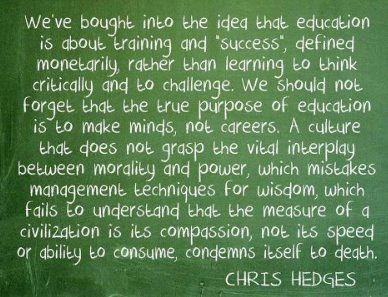
I received this from someone yesterday and thought I would share it. Public education is in need of a make over. What does that mean? That is a hard question to answer without a new conversation and a pause to fully understand what our children need. Here is a starter. Chris Hedges is a Pulitzer Prize winning author and a source of this quote is George Takei the actor who played Sulu in Star Trek. I am not a Trekkie, but I like this quote. The points that stand out are the purpose of education, the interplay between power and morality, and the need for wisdom. I follow several on-line forums about leadership. Even there, the leadership experts frequently confuse knowledge, information, and wisdom often using those words loosely and interchangeably. Wisdom emerges from values named and held within community–sensus communis or common sense. What passes from generation to generation is its common sense, what it holds and names as values in a society. This takes a compassionate conversation which is rare.

Take care and enjoy those you come in contact with today.

leading and learning: Lets value individual creative teachers.

leading and learning: Lets value individual creative teachers..

This is a rather lengthy article written by a New Zealand based educator. I think it fits with a previous reblog of video featuring Sir Ken Robinson called The Educational Revolution: Why Schools Kill Creativity.

Read, watch, and weep. A lack of creativity and resulting innovation is killing public education with sameness. Let us all do it one way is the current creed. What can we do about it? It is high time we invited a new conversation to emerge.

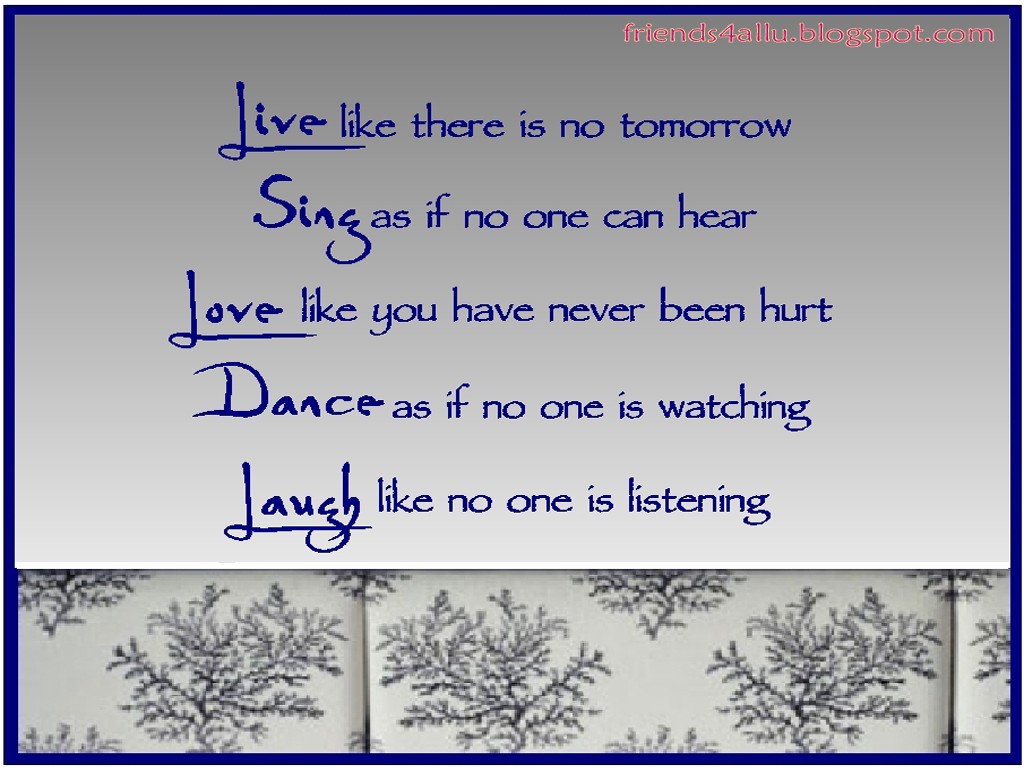
Dance Like No One is Watching

Children do this so well; adults, not so much. Enjoy your day.

I hear conflicting stories about who to attribute this quote. Somewhere I heard or read that Satchel Paige, the Hall of Fame pitcher, said this in response to questions about his phenomenal longevity in the game.

You gotta do what you gotta do to be what you are!

Fragmentation

Fragmentation.

This is an interesting, albeit American-based view of the charter system and the overall fragmentation issue of public education. I am not an advocate of reform. That tends to tinker at the edges. I advocate transformation. This requires new conversations at the grassroots. What does public education mean to you, your family, and the community you live in?

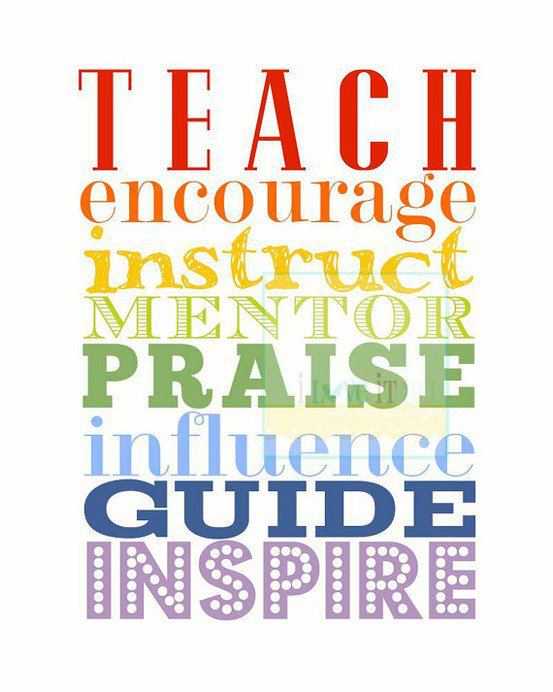
Words for Teachers and Learners at Heart

This fell into my world yesterday and I thought it might be a good share. It is certainly something to reflect on as we begin each day in our various roles of learning and teaching.

A Blog Experiment

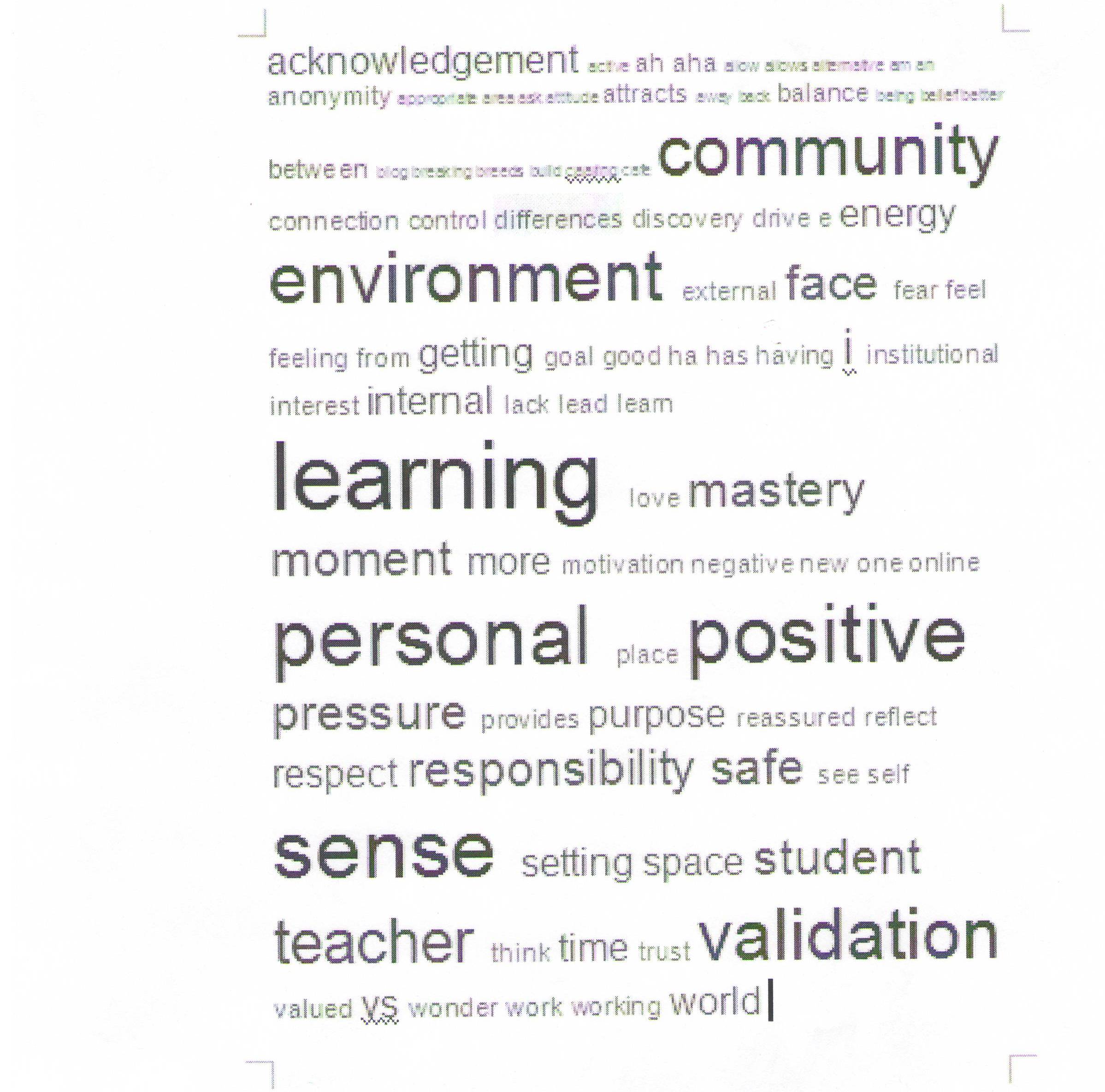
I am using software called NVivo. Essentially, I use it to organize and summarize qualitative data. One cool feature is the ability to create a word cloud. I am experimenting with that feature and using the image facility on my laptop. I summarized some World Cafe events we held in February and March. The results were simply outstanding. The only fly in the ointment was I had to scan the picture and lost the colour.

The overarching question we created our conversation around was: “What engages us in learning?

February 4, 2012

Think of a time that you feel was a high point in your learning. This would have been a time you felt most alive, effective, and engaged in the learning process. Describe how you felt. What made this possible?

February 18, 2012

“Without being humble, describe what you value most about yourself. How does this contribute to the experience of learning for you? What setting does this seem to flourish best in? What would attract you to that setting?”

March 3, 2012

What encourages us to continue learning and see learning as important in our lives?

Questions emerged. I thought the most interesting was an absence in the data. What about teacher expertise in subject area or technical knowledge? It could be these are unstated but assumed necessary. Or it could be that the relational aspect, the art of teaching, is so important to this group of people the technical and subject knowledge is secondary.  What do others think about this?

John Lennon’s Advice on Education

I wonder what education might look like if we followed this simple advice each day for every person who walked in the door’s of our schools?

Imagine a world where we could be happy, responsible, and not deny others their opportunities?

Chair Building

I use this lesson plan as an activity in the Grade 7 Science Structure and Forces unit. The students work in pairs.

  • Students draw a plan for the chair design.
  • Concepts to Include might include corrugation, lamination, and triangulation; design considerations such as arches, beams, trusses, and columns; and show an understanding of what fastening techniques for this design i.e. friction fit, mass, and glue, staples, rope, tape (within reason), or nails or screws (within reason).
  •  Consider properties i.e. stability, brittleness, ductility, hardness, plasticity, compression, and tensile strength.  Students need to consider deformation, structural stress, structural fatigue, and possible structural failure. What are internal forces (mass of materials) and external forces (load on the chair).
  • What role do aesthetics play i.e. symmetry and appearance? What is the chair used for?
  • Students use recycled material i.e. cans, plastic containers, and cardboard (boxes, tubing, and pieces).
  • Students construct and track changes. The original chair design might be altered depending on material availability, functionality, and durability.  They should test the chair as they build.
  • I limit class time to 2-3 classes. Most materials are found at home and students can receive help from family, friends, or neighbours.
  • I email parents and tell them they are consultants, who can offer expertise, guidance, and time unavailable in the classroom. Parents are good about insuring students do the lion’s share.

Students are innovative. One student included pop bottle (he told me it was for pop) holders in the arms of a deck chair. Another student gathered discarded pizza boxes after hot lunch and used those.

Assessment is a rubric. A criterion is I test the chair. Its ability to hold my 250 pounds, give or take, is part of the challenge. Only one chair collapsed under my mass. It lacked support.

This is a Grade 7 project, but I think other can modify it for other grade level needs. Students can work in pairs.

Cautionary note: I allow nails, screws, and tape as fasteners, but within reason. The first time I did this activity a student built a nail chair. He used so many nails it is doubtful they were recycled.

Here are some examples of this year’s chairs.

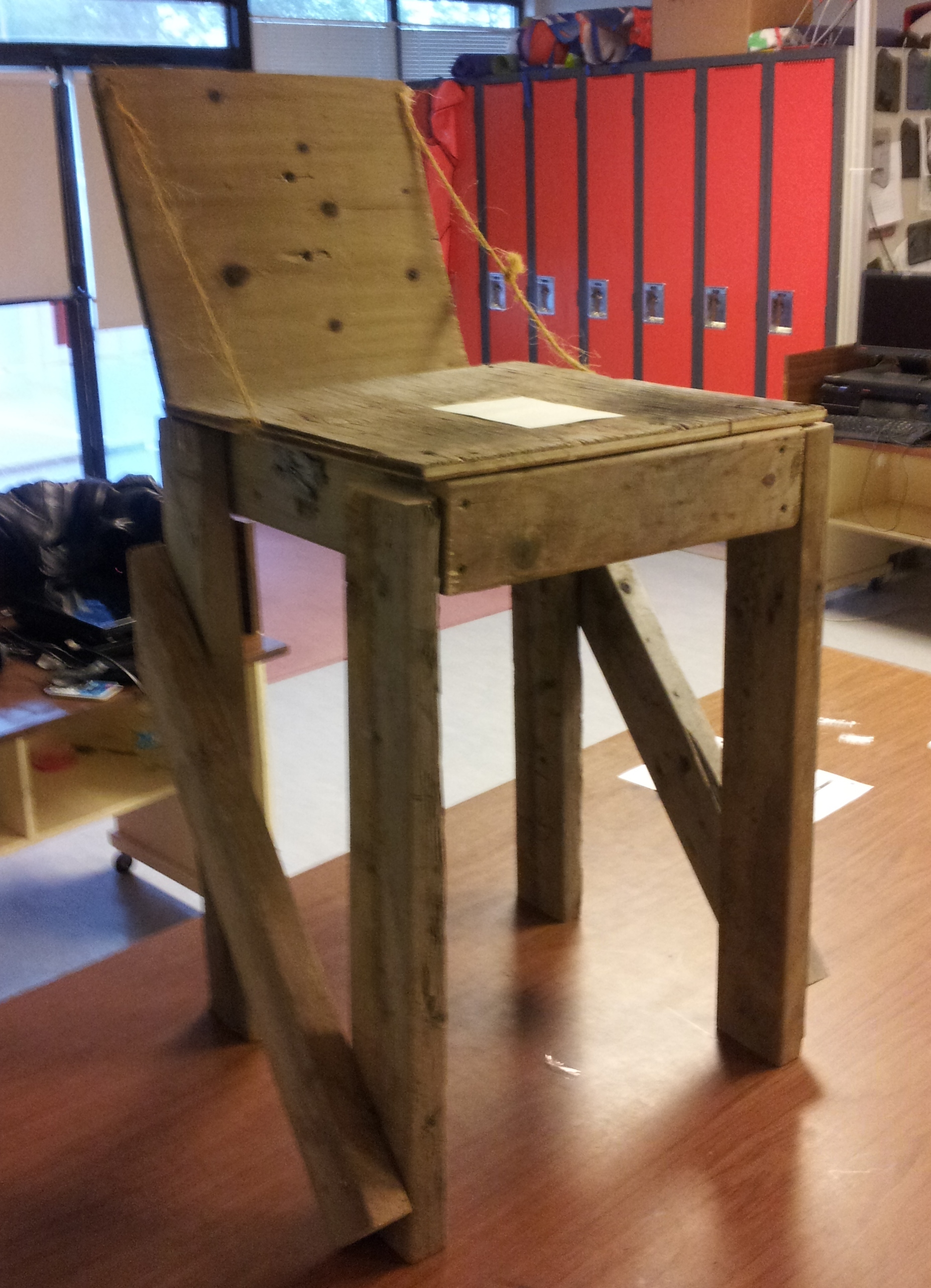
This chair is made from used pressure treated lumber and plywood. The back folds forward and the student used baling twine he got from the farm as the hinges.

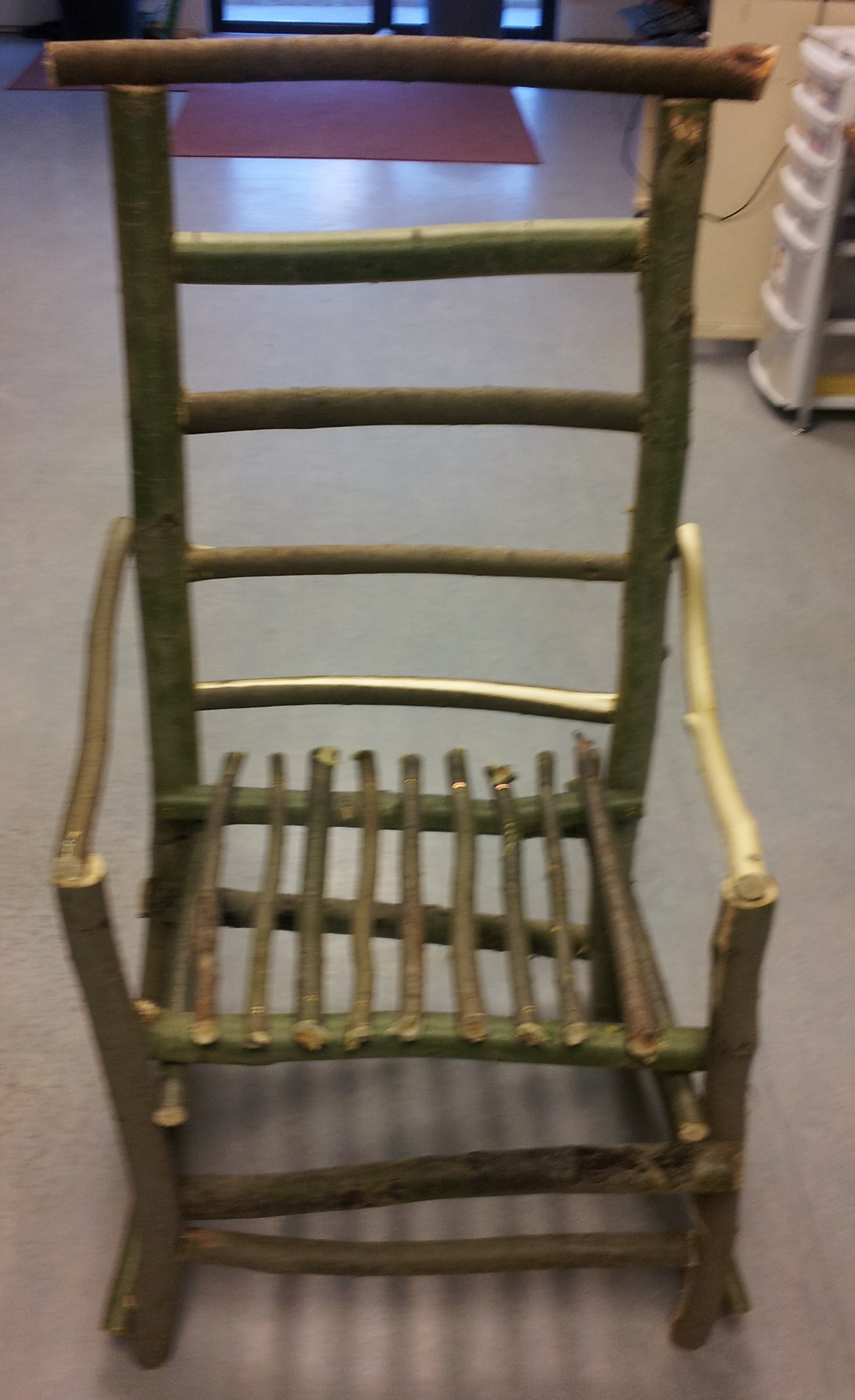
This chair is constructed from willow. The willow qualified as recyclable as the students were going to have to dispose of the willows when they cleared underbrush anyway. The only thing missing is a cushion. These students could go into business selling yard furniture.

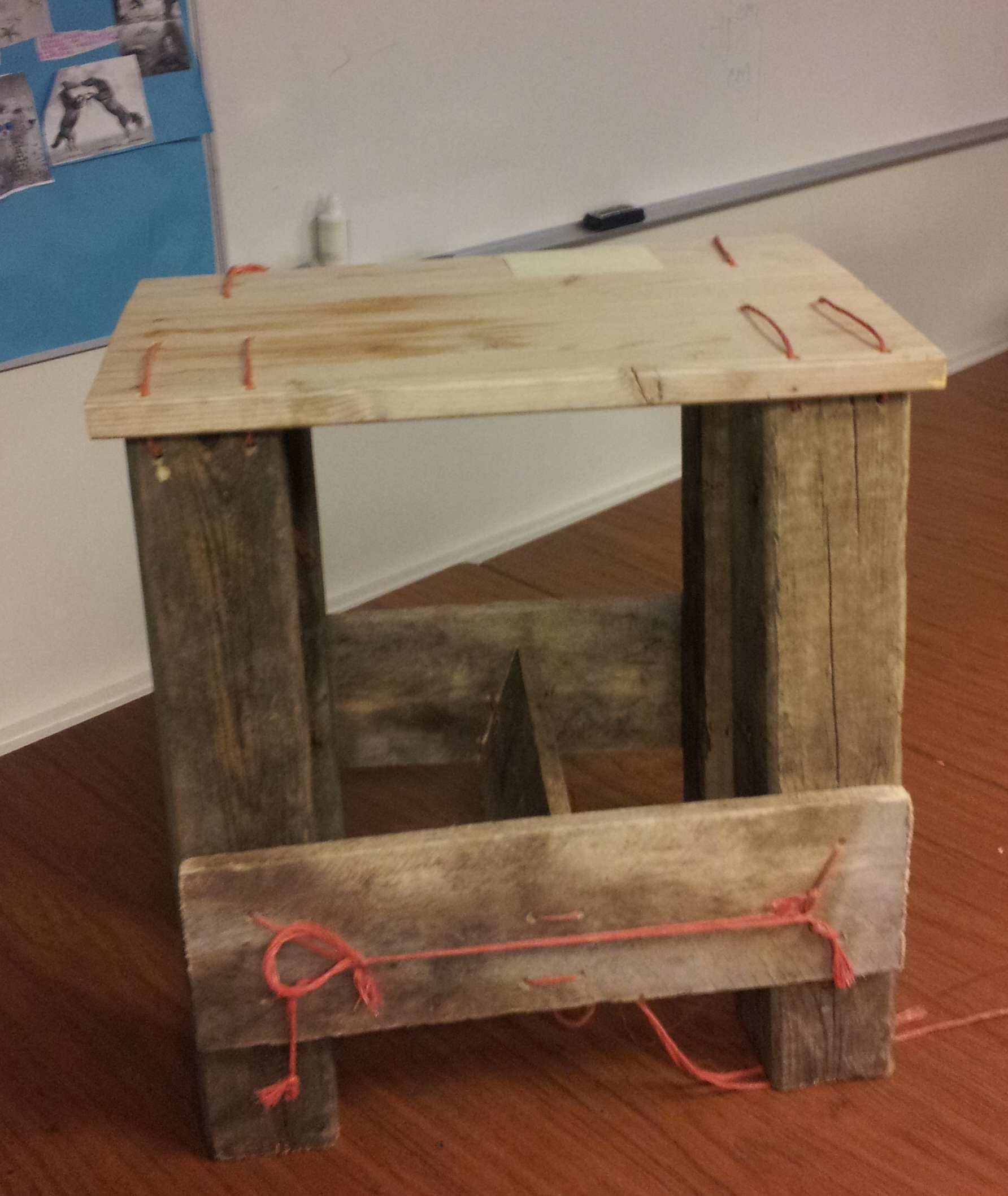
Although this stool did not have triangles for stability, the centre piece helped in that respect. When I sat on the stool, it was wobbly, but with my mass it became less so. The students used baling twine as the only fasteners. One of them has horses and these were available.

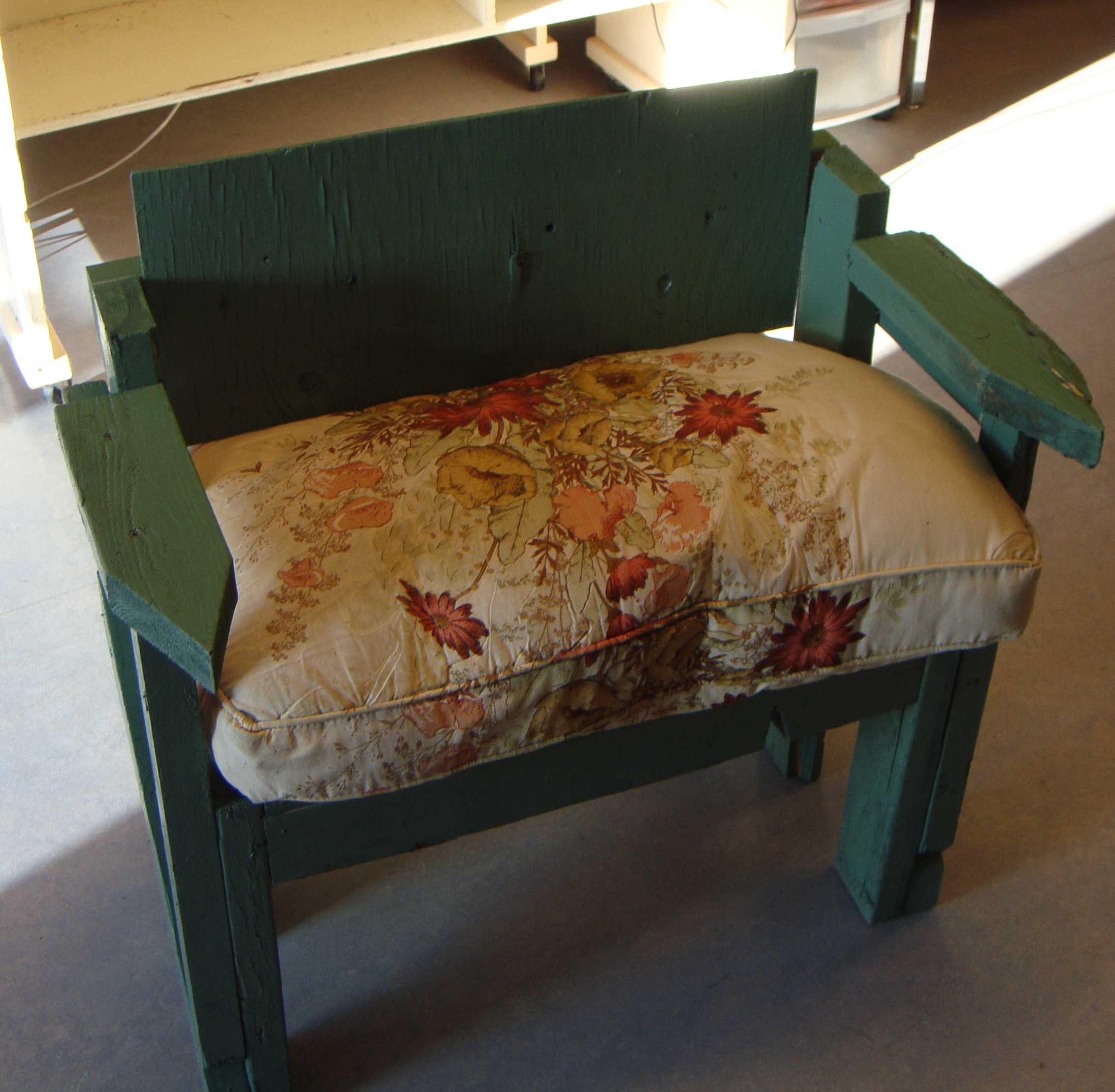
This chair is built from recycled wood and a discarded cushion. The students gathered the wood from the neighbourhood and a neighbour helped. He drilled tap holes for the screws.