Category Archives: Education

Whales Forever

This is not about whales per se. Several years ago, my Grade 8 class struggled with the simple machines unit in Science. I proposed an alternative assessment route. Instead of writing a test, they could apply their learning and build a complex machine. They were all over it, but I had to come up with something and began a search of the Internet. I found an idea called Whales Forever and modified it to fit my needs. It has been a success ever since.

1. Whales become stranded on beaches around the world and Whales Forever is concerned with the survival rate of beached whales. This environmental organization rescues whales and returns them to open water quickly so they will not perish. Whales Forever announced a contest for Grade 8 students to create a prototype machine which would safely lift a stranded whale onto a hover craft so it could be transported back to open water as it receives medical treatment.

2. Students design and build a machine which with a minimum mechanical advantage (MA) of 4. The machine consists of at least two simple machines. Mechanical advantage is calculated output force divided by the input force.

3. The machine will lift the whale a height of 10 cm and lower it 5 cm onto the simulated hovercraft. The whale is simulated by a resealable plastic bag filled with marbles or sand. Students can hand position the ‘whale’ in a harness which is part of the system to begin the lifting process.

4. Students sketch exploratory labelled diagrams of their chosen design including measurements indicating critical components i.e. simple machines used, gears, and drive trains. They provide mechanical advantage calculations.

5. Students use available materials i.e. desks, stools, tables, retort stands. Last year, a student used a Meccano set and this year students used K’Nex. They are not allowed to use a motorized system. They use planes, levers, pulleys, screws, wheel and axles, and perhaps a wedge.

6. Students give a written reflection outlining the strengths and weaknesses of their design including written suggestions for improvement.

7. Students make a 4 minute presentation to the board of directors of Whales Forever.

I use a rubric and assess the design including diagrams, the effectiveness of the prototype, the reflection, and the presentation.

Here are some examples of this year’s products.
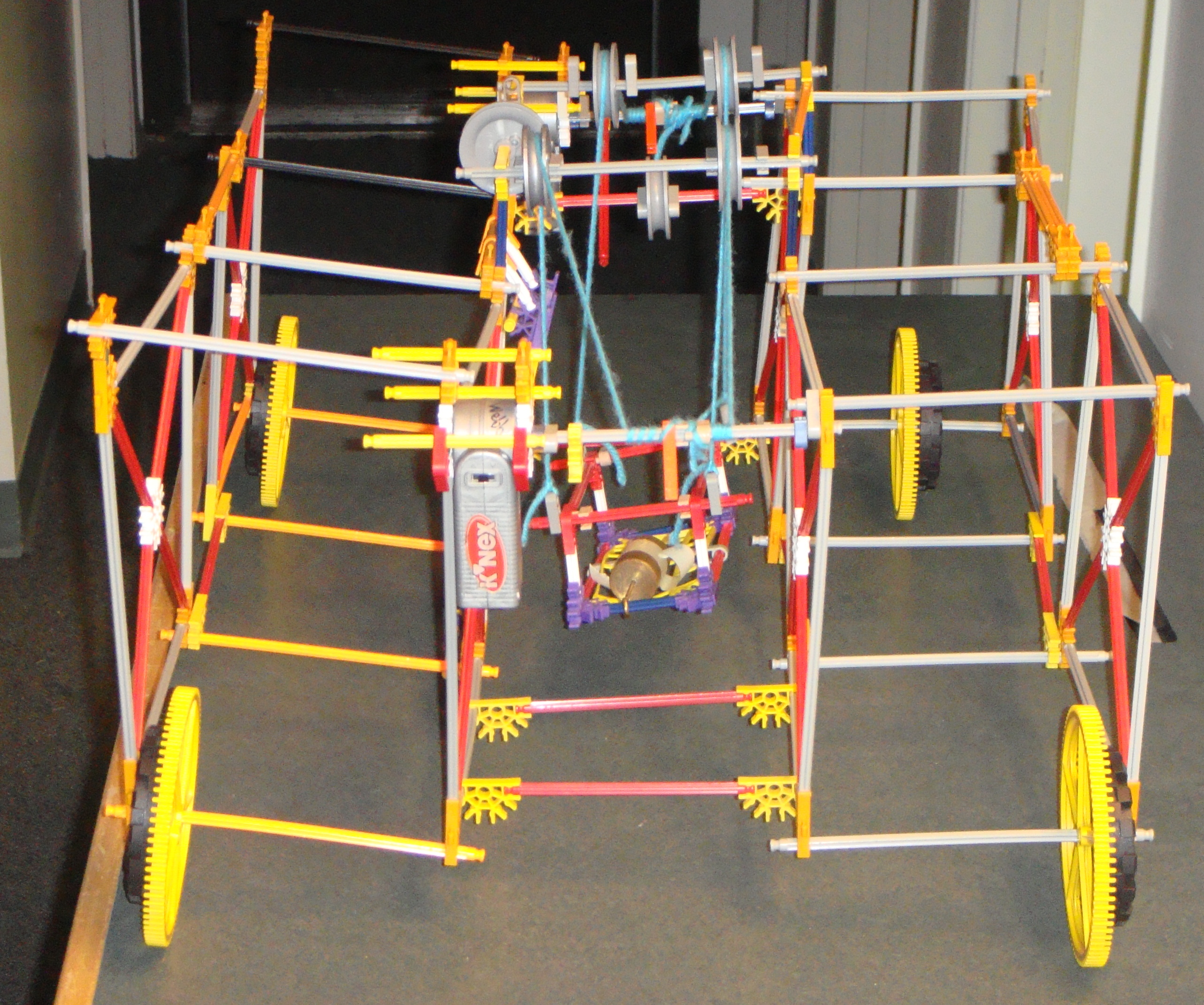
Whale Saver constructed from K’Nex. You can see the harness on this one. It had a mechanical advantage of about 15. The one challenge with the K’Nex is hooking up the scale. It took some maneuvering.
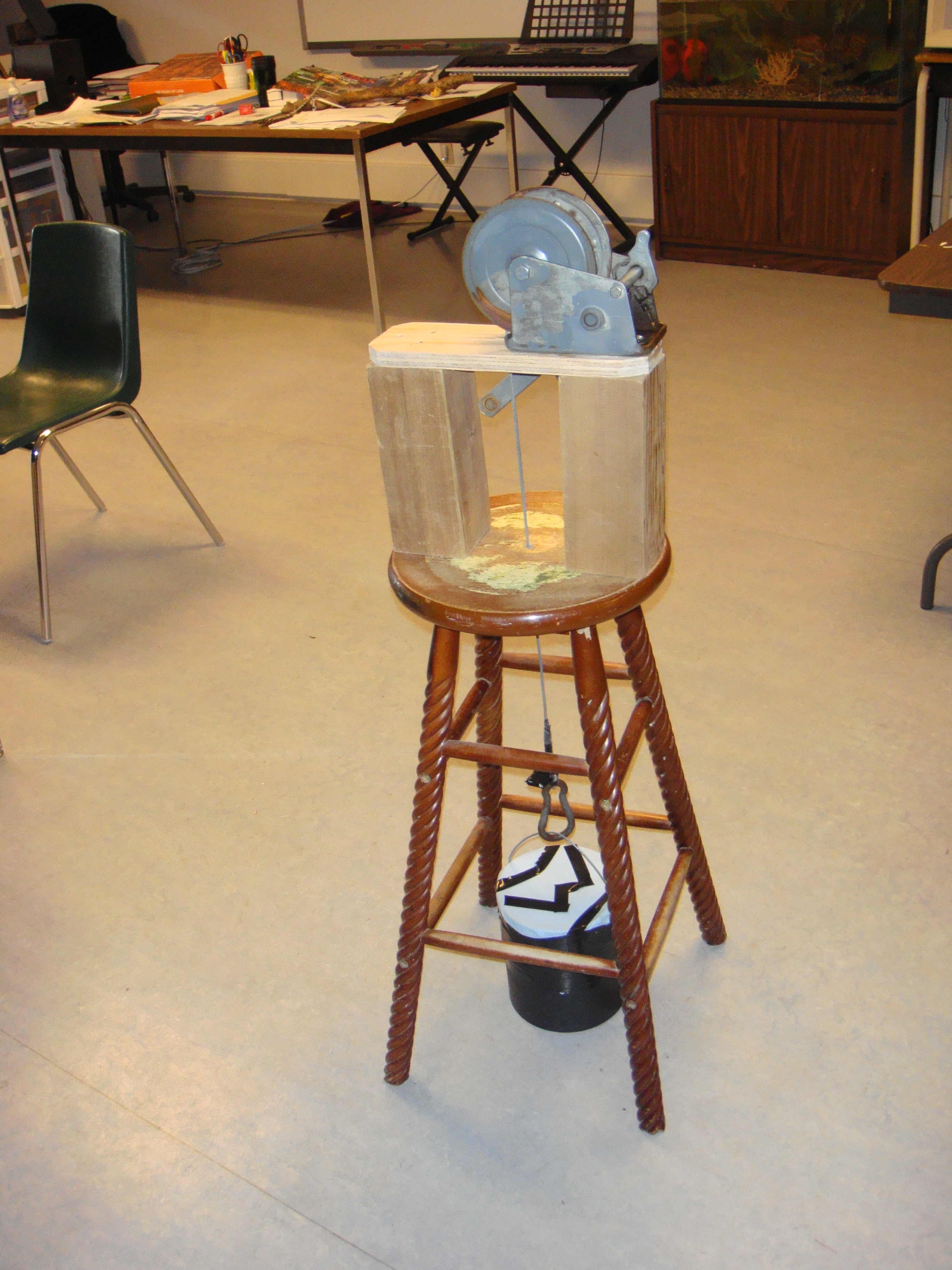
This one was homemade. It had a mechanical advantage of 20.
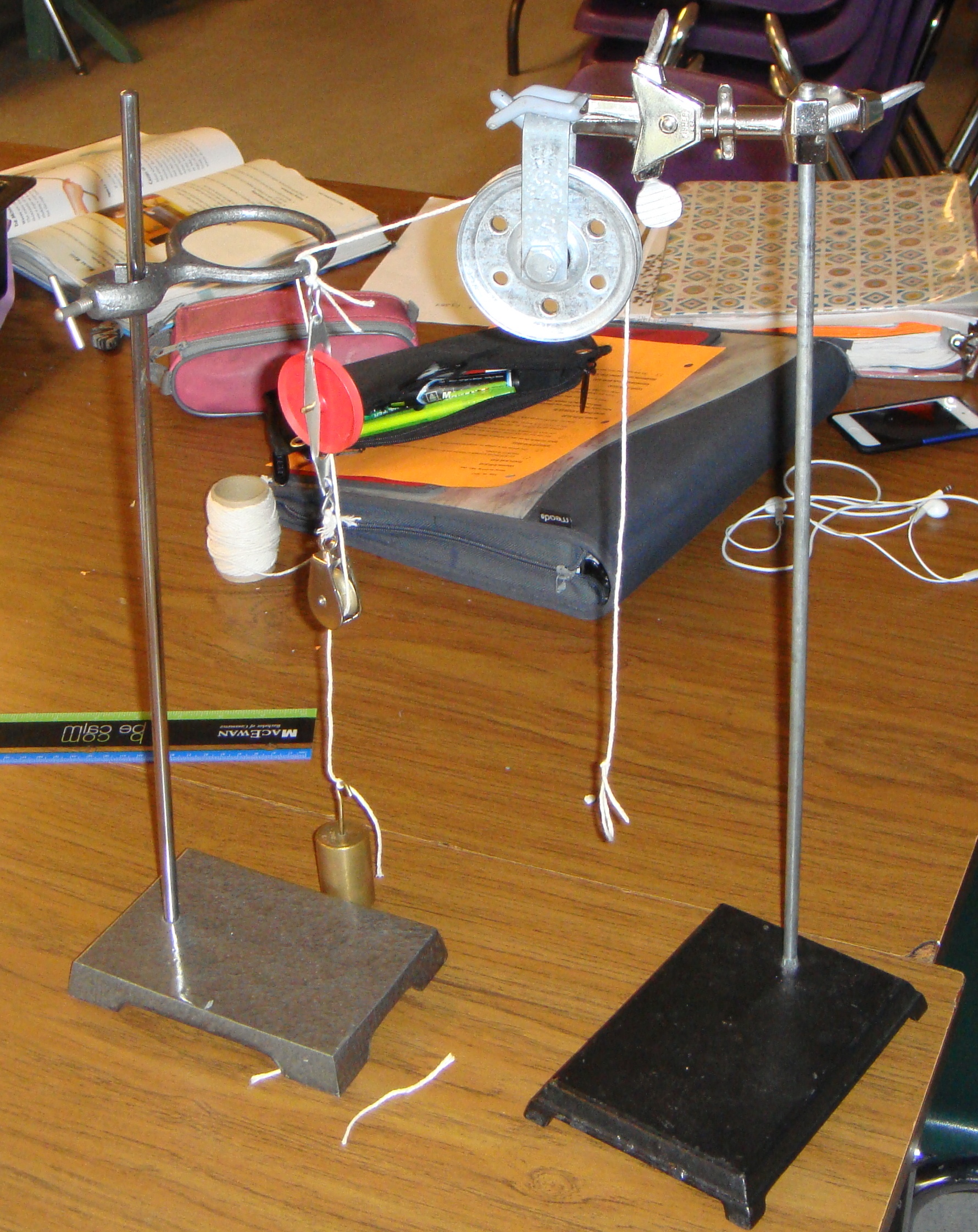
These students used materials from the classroom primarily. It had a mechanical advantage of about 8 or 9.
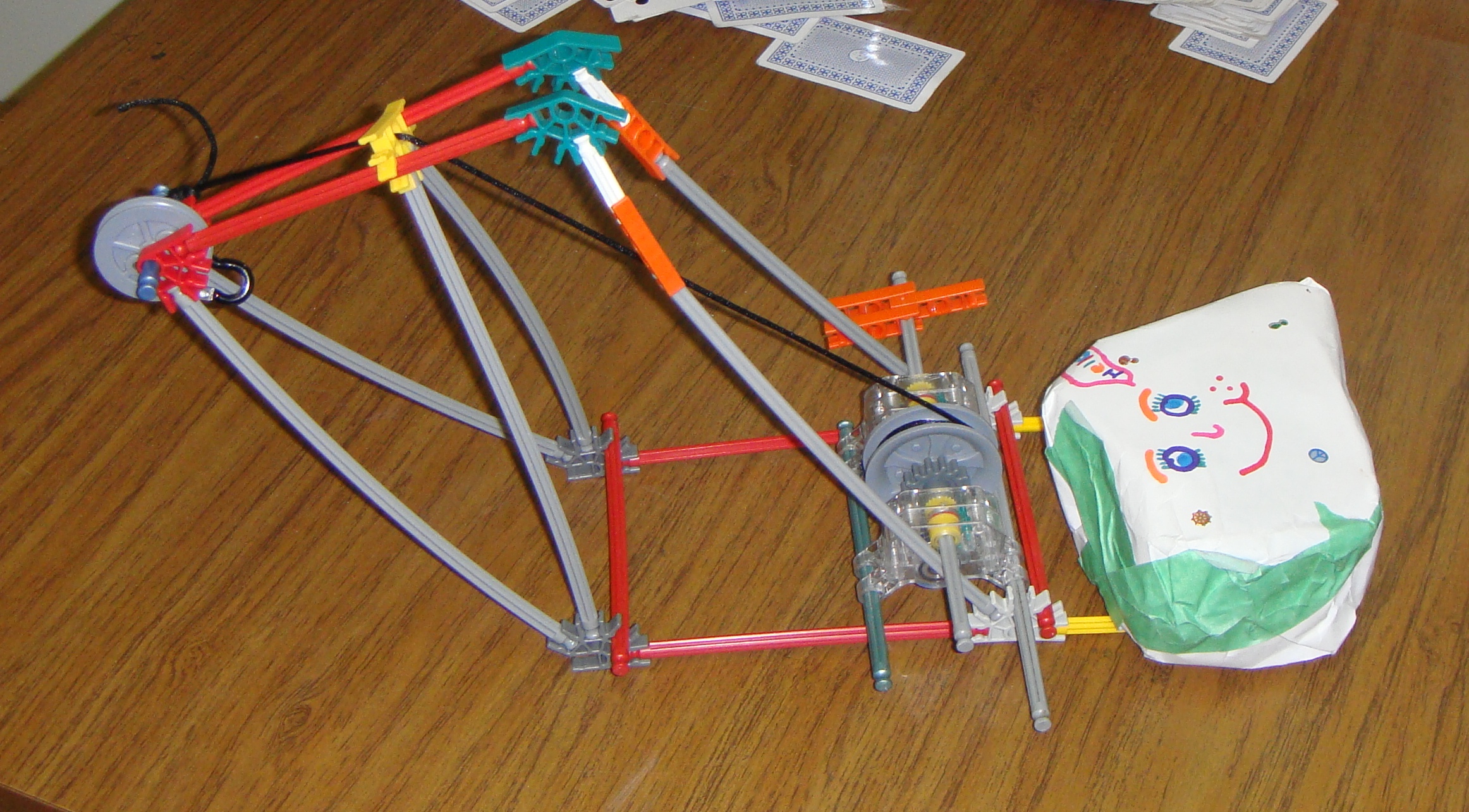
This was another K’Nex design. The thing on the right is a rock wrapped in paper with a face on it. The rock countered the weight of the whale as it was lifted. This machine had a mechanical advantage of about 10.

Blueberries | Jamie Vollmer

Blueberries | Jamie Vollmer.

This is worth reading. It fell into one of my email boxes this morning. In theory, I agree with the idea that we cannot, as teachers, return our students like Mr. Vollmer could return his blueberries. Fundamentally though, there is still a problem. In the province of Alberta. there are over 25% of students who will not finish high school. Those are the ones who leave our schools. What about those who do not leave and finish? There are still some amongst them who are on the margins and school has not served well. The 25% is an average.What about students who live in First Nation communities, in the inner city, or face any number of other life issues?

Education needs an overhaul. There is a genuine need for a different conversation and not sticking our heads in the sand. Please take a few minutes to read.

Diane Ravitch is a leading American educator. Although what happens south of the border is not important to us, this article poses a great question. Who is advantaged; those with resources or those without resources? Servant-leadership, which is lost in education, asks the leader to serve those around him or her and help them grow. That focus increases for the most disadvantaged. When will politicians, bureaucrats, and technocrats allow teachers in the classroom to become leaders who serve students and the community?

dianeravitch's avatarDiane Ravitch's blog

Mitt Romney launched his foray into education by visiting the Universal Bluford charter school in West Philadelphia, an impoverished, largely African-American neighborhood. He went to tout his plan for vouchers and charters as the new civil rights crusade of our era.

While there, thinking he was in friendly territory, he made some unfortunate remarks. First, he asserted that class size wasn’t important. That is no doubt the advice he had received from his advisors, who like to claim that having a “great teacher” is far more important than class size reduction. Then, he advised his listeners that one of the keys to education success is to be a child of a two-parent family. He got called out on both comments.

A music teacher rebuked him on the class size issue, saying: “I can’t think of any teacher in the whole time I’ve been teaching, over 10 years — 13 years —…

View original post 292 more words

There are excellent points in this article, but some areas of concern. The role of students, educators, and school provided insight into a different way of thinking about education. I disagree with the premise that administrators are a separate group, although they seem to be. Are administrators not educators themselves? I once met a retired educator who when I was introduced as a teacher and had something in common with her, she responded, “Oh, I was a principal” making it sound like I was inferior by remaining a classroom teacher. In recent years, I have witnessed this desire among many teachers to escape the classroom. We are teachers first.  If not educators, what is our role? What about children who needs help? What do we do to raise them up? I think this article is a starting point for a conversation.

Jabreel Chisley's avatarCooperative Catalyst

Education is something that is vital to the existence of a country where financial prosperity is something that is universally longed for. This is because that in order to reach financial prosperity one must reach a level of knowledgeable prosperity that unlocks the true innovator within them. However, if our countries goal is to allow for everyone to reach a level of financial prosperity then its time for us to sit down and come up with a dedicated pathway to delivering education with equality, equity, loyalty, and dignified passion in mind. If this is our goal then it is time for us to do away with the days where our educational system is balanced on the practice of every child left behind and every teacher for themselves. The time has come where we must push forward, with dignified loyalty, professional reservation, and universal respect for the student, the classroom, and…

View original post 933 more words

Words for the Wise – Partie Deux

Words for the wise was a product of an incident yesterday. I was left exasperated, exhausted, and feeling somewhat unintelligent. I calmed down and found the wisdom shared by Winnie the Pooh helpful in creating a new lesson plan for today’s poetry time, but, first, let me explain the back story from yesterday.

About two months ago, a student brought their scooter to school and was riding it up and down the sidewalk in front of the building we occupy. Our school is located in what was a commercial building our school division acquired. There is no space to scooter in the front of the building, because there is a sidewalk and a parking lot immediately in front of the building. Usually, both are busy so it is an unsafe pastime. Second, students must wear proper equipment i.e. approved helmet, knee pads, and elbow pads. The young man in question is proficient, or so I have been told, so he took the equipment rule as a problem. Frankly, I would to, if I was any good at riding my scooter.

Yesterday, another student brought their scooter to school. While I was occupied, two students, including the aforementioned young man noted, borrowed the scooter and rode it in the parking lot and on the sidewalk while others watched. I was angry; that is the polite way of putting it. I gave some students credit. They recalled explicit instructions about the conditions a scooter could be used i.e. equipment, supervision, and location. Others had forgotten, but it was more likely a situation they were not listening for any number of reasons. This morning I received an email from the young man’s parent saying he informed her he could ride the scooter out back. I am not sure where out back is, because there is no place to ride out back. He left out the equipment and supervision.

Listening, which I think is essential to being responsible for one’s actions and words, seems limited to what a person wants. We listen when we are motivated by words or sounds that are we want to hear. I think that might be human nature. We lack mindfulness and being in the present moment. As luck would have it, sitting on my desk was a William Stafford poem entitled Listening. We had a great conversation after reading it, reflection time, and sharing in pairs.

Listening

My father could hear a little animal step,

or a moth in the dark against the screen,

and every far sound called the listening out

into places where the rest of us had never been.

More spoke to him from the soft wild night

than came to our porch for us on the wind,

we would watch him look up and his face go keen

till the walls of the world flared, widened.

My father heard so much that we still stand

inviting the quiet by turning the face,

waiting for a time when something in the night

will touch us too from that other place.

Thank you William Stafford. Winnie, I was brave and strong enough to tell my students I was listening, but I cannot always do what they want. I simply do not have the power some days and am smart enough to recognize this.

Daily Poetry Lesson Idea

I set aside 30 minutes each day for poetry. A typical lesson plan for junior high or middle school might be as follows:

  • Read the poem and have the students follow along as they listen to it for the first time.
  • Read or ask students to read the poem a second time. Students listen for words, phrases, or elements which catch their ear.
  • Students quietly take a few minutes to highlight or underline key words, phrases, or literary elements.
  • Students quietly share the key words, phrases, or literary elements with one or two classmates. Did they enjoy the poem? Why or why not? I ask them for specific responses. It sucks or was interesting needs support.
  • We come together and share. What stood out? What literary elements did the poet use and what did they add to the poem?
  • What were the literal and figurative messages of the poem?

Students are invited to share their favourite poems.  One student shared Do Not Go Gentle into that Good Night by Dylan Thomas and another Mr. Nobody by Walter de la Mare. I used the latter poem for a conversation about responsibility.

Students sometimes are reluctant to write poetry. I use Pablo Neruda’s Ode to My Socks as an example of a poem about a mundane object, a pair of socks, and how this poem transforms the socks with rich and vibrant language, similes, and metaphors into something quite extraordinary. A person needs to read or be read this poem to appreciate what makes socks worthy of an ode by a Nobel Prize winner and how everyday objects become subjects for poetry.

When we read The Road not Taken by Robert Frost, the students worked in triads and created collages about the themes they found in this classic poem. The end products were well thought out.

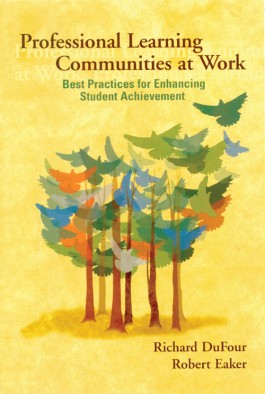
Professional Learning Communities at Work by Dufour and Eaker

I read Professional Learning Communities by Richard Dufour and Robert Eaker several years ago and attended conferences about the concept. We implemented Professional Learning Communities (PLC) in our school with early, but unsustainable success.

Thesis: The authors proposed “the most promising strategy for sustained, substantive school improvement is developing the ability of school personnel to function as professional learning communities” (p. xi).  Professionally, educators need awareness of emerging research to fuel personal learning and support student learning. Communities form and they foster “mutual cooperation, emotional support, and personal growth as [people] work together to achieve what they cannot accomplish alone” (p. xii). Teachers safely move from isolation and risks are taken extending personal and collective learning when a PLC is effectively implemented, integrated, and supported in a school.

CharacteristicsThis is an annotated version, but successful and sustainable PLCs have six characteristics:

  • Shared mission or purpose, shared vision or what we hope to become, and shared values guiding the process. Shared mission advertises purpose outward. Shared vision energizes staff. Values are personal and community attitudes, behaviours, and commitments which are normalized over time.
  • Collective inquiry fuels the process. What do we want to change? What ways are things as they are challenged? There is collective conversation and personal reflection. The latter is the oxygen that breathes new life into the dialogue and provides fuel through new questions.
  • Collaborative teams provide renewal. Collaboration acknowledges the dysfunctional nature of communities. What do we do when there are dissenting voices and disagreement? What value will we name here?
  • Action and experimentation are always in evidence. “Even seemingly chaotic activity is preferred to orderly, passive inaction” (p. 27). Teachers experiment with emergent ideas making innovation essential in a PLC.
  • Everyone commits to continuous improvement. Questions emerge and are actively sought out, but there are touchstones principles such as “What is our fundamental purpose?”
  • With continuous improvement and action orientation there is an iterative process in the form of quantitative, qualitative, or mixed research. The object is to shake up the status quo and find new ways of safely supporting both staff and students. What are we doing that we want to change? (pp. 25-29)

Questions: Who has had success in implementing a PLC in their school or jurisdiction? What were the important takeaways including what worked and what did not work? What did you do to overcome the bumps along the way? What can a school starting or restarting the process do to sustain energy and get early work done successfully while recognizing the achievements even when they are small?

Recommendation: The book is about 300 pages, but is an easy read. The authors synthesized leadership literature inside education i.e. Lezotte, Sergiovanni, and Fullan and outside education i.e. Bennis, Senge, and Deal and Kennedy and saved some reading.

I recommend the book for those ready, willing, and patient enough for a transformative journey. The process requires time and immediate classroom benefits to sustain it. Cultural change is messy and requires leadership, perhaps previously untapped in education. Effective support and communication are required for sustainable, successful results to emerge. Early conversations focused on mission, vision, values and normative behaviours are uncomfortable, but necessary. My questions attempt to flesh out these concerns, as we are embarking on this journey again.

I know schools in Canada, the USA, and internationally have successfully implemented PLCs and I want to draw on the experience and wisdom already in place. I am looking for process and product, but not a cookie cutter formula per se. I look forward to hearing from many of you.

Dufour, R. and Eaker, R. (1998). Professional learning communities at work: Best practices for enhancing student achievement. Bloomington IN: National Educational Services.

Trough by Judy Brown

I spent the past few days examining where I am in my life’s calling as a teacher. I was in a trough for a while and it is nice to start climbing out and see the horizon over the edge of the waves. Personal vision formed around and by named values is essential to fulfillment. I am grateful I had people listen and wait for me to speak. The trough is a quiet place and I was able to gather my thoughts, reflect, and regain some passion through their patience and kindness.

There is a trough in waves,

a low spot

where horizon disappears

and only sky

and water are your company.

And there we lose our way

unless

we rest, knowing the wave will bring us

to its crest again.

There we may drown

if we let fear

hold us within its grip and shake us

side to side,

and leave us flailing, torn, disoriented.

But if we rest there

in the trough,

in silence,

being with the low part of the wave,

keeping

our energy and

noticing the shape of things,

the flow,

then time alone

will bring us to another place

where we can see

horizon, see the land again,

regain our sense

of where

we are,

and where we need to swim.

Several months ago, I posted an entry called the Mindful Teacher. I suggested there was a need for added fuel for the fire that is my vocation and gives me voice through teaching and learning. Since then, I matured and realize the silence is the oxygen that also helps to breathe life into the fire. It serves as the wisdom, compassion, and prudence offsetting my passion. Without the space, the silence, I become a flickering flame burning out before my time.

Why School by Mike Rose

Why School: Reclaiming Education for All of Us by Mike Rose was a follow-up read to his earlier book Lives on the Boundaries. The latter book explored, in an autobiographical way, Mike Rose’s ascent from growing up in a working class neighbourhood with little support for education at home. He found support from educators along the way and became an educator himself. Professor Rose used a similar biographical method in the current book and explored the purpose of education, different views of intelligence, learning, and knowledge, and the humbling, yet hopeful work, that results from learning.

The general thesis examined a need for a new conversation about the role of public education, one “not dominated by a language of test scores and competitiveness” (p. 4). Professor Rose presented a case for a good education being designed to help us make sense of the world. He argued that parents historically “sent their kids to school for many reasons: intellectual, social, civic, ethical, and aesthetic. Historically, these justifications for schooling have held more importance. Not today” (p. 4). If these reasons no longer hold a time-honoured place in educating our children, then it begs, “What is the purpose of school?”

Questions: What purpose does school serve in a democratic society? I find the object of school reform is not to change school or its purpose, but to simply layer one more fad on an already overloaded system which is ill-equipped to handle it. The result is we are failing many, serving few, and leaving a huge hole in the middle. What should school reformation or transformation look like? I believe this requires a conversation about purpose of school and its structure. Is the present hierarchical, industrial-age model a suitable mechanism to deliver education in the early 21st Century?

Recommendation: I enjoyed the book. It is short and easy to read. Professor Rose provides a view which is different from the mainstream educational reformer and challenges the reader with questions and not answers. I would recommend it to anyone searching for a different view of educational reform.

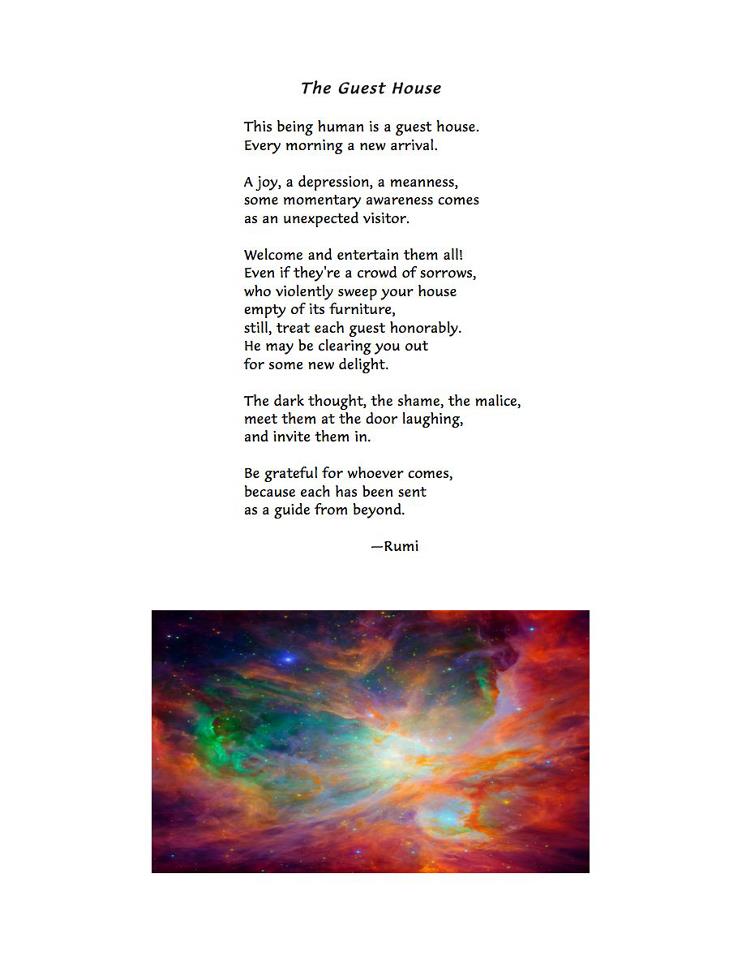
The House Guest by Rumi

I was going through my various accounts and Parker Palmer posted this on Facebook. After a challenging week, I read it and realized this was what my week had been like, very up and down. What do I say to those emotions which temporarily move in and shake my confidence? Or what do I say to those emotions which mislead me with their false promise of all things gold and glittery?

Thank you to Parker Palmer for this sharing.