Category Archives: Hope

Peace Studies Conference

Several people reached out asking about the outcome of my presentation at the International Peace Research Association Conference (IPRA) in Ngāmotu, Aotearoa (New Plymouth, New Zealand). The title of the presentation was entitled Re-imagining Teacher Education: An Andragogy of Hope, Peace, and Nonviolence. There was 20-30 people in the room and I received positive feedback at the end of my presentation, during meals, and since the conference. People asked for the slide show and we talked about changes they might make in their teaching. For example, one instructor in an education program said they would try to have students, after degree and post-graduate, sit in dialogic circles with the subject in the middle. For those familiar with my posts, I take this from Parker Palmer. Parker proposes this as a way to have the disciplines, which he refers to as big stories, guide each of our little stories. As a result the subject, nonviolence education, comes alive. The person suggested this was a small change. I understand it as transforming what they and their students are doing. It runs against the grain in education, including at the post-secondary level.

As I reflected, I realized I was preaching to the choir. In that room, we are all reading out of the same hymnal. The excitement in those rooms and in conversations is challenging to replicate outside the rooms when I engage with others, particularly gatekeepers in teacher education. My “intellectual interests” are known by these people, yet there is no attempt to ask me to prepare syllabi for a full-blown course or a mini-syllabi to integrate into a co-taught a methods class e.g. Social Studies. Essentially, it is important for me to enter a liminal space between the theoretical, abstract work I have done for the past few years and prepare syllabi to present to gatekeepers. It is the transition from preaching to the choir and making myself vulnerable to people saying no to what I propose.

On the surface, this looks like an easy proposition. Who doesn’t think nonviolence education is a good idea? Despite thinking it fits well, people’s understanding of schools and what they are for are entrenched in a neo-liberal, capitalist world. My first published article used systems thinking by Peter Senge. One of the five disciplines is mental models, which are closely held beliefs that form one’s worldview of how they understand reality. Mental models are shared by groups of people. Schools are largely unchanged from when I attended. The mental models of what school is and is for are entrenched. People push back when I say this, but change is superficial e.g. projectors and screens as opposed to blackboards (shows you how old I am), hardly transformational. Teachers prescribe the layout of the classroom and who sits where and how seating is configured. This extends from K-12 and beyond. There are pockets where things are done differently, but they are isolated and treated as one offs. Without going into this, I speak from experience.

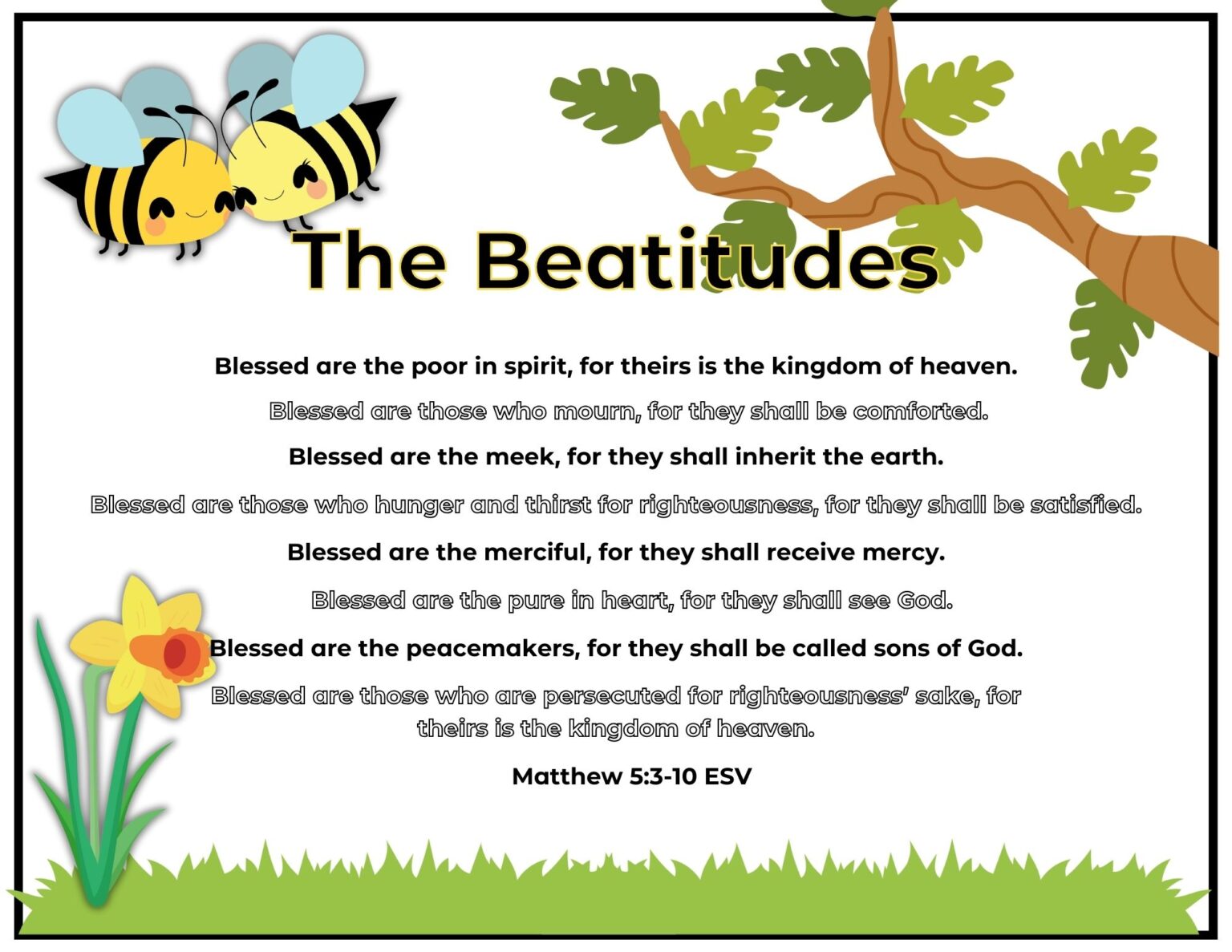
The university I contract to (I am not tenure track and never will be) is a private, Christian school. Again, on the surface, it would look promising in terms of a viable partnership. They share posters with Faculty and administration are aware of my intellectual interests, yet they have made no offers to bring me on board to see how we might integrate this with current curricula in the Faculty of Education. Part of my efforts is grounded in my Catholic faith, including from the Sermon on the Mount giving rise to the Beatitudes. When I walk around the campus, I observe posters sharing the Beatitudes. How does this inform my next step as I try to convince people not in the choir that this is worthwhile and timely?

I intend to prepare several syllabi for different contexts. One will be for the university I currently contract to, based on its Christian ethos. Another will be for a small, private university with Lutheran roots that promotes itself as nondenominational. A third will be for the University of Alberta, a large publicly funded secular university. They do have an Anglican and Catholic college attached to the University of Alberta. If there is anyone out there who has ideas and connections to tap into, let me know. I need all the help I can get.
Below is a video by Maria Muldaur called Yes, We Can! A number of other female artists accompany her e.g. Joan Baez. The song has a twofold purpose for me. First, it is about making a change for a better world. To resist oppression in all its forms: poverty, war, climate injustice, etc. Second, it is about me having faith that somehow I can do this.

As Relevant as Ever

I am headed to New Zealand to present at an International Peace Conference and have been thinking of resistance so needed today. Music, poetry, and art play a significant role in resisting violence, including that imposed by governments and other institutions that are supposed to protect.

One of the first albums I bought was The Freewheelin’ Bob Dylan. I was about 16-years old and I still have the album. It is iconic with songs like Blowin’ In the Wind (melody based on a spiritual called No More Auction Block), Masters of War, A Hard Rain’s a-Gonna Fall, Oxford Town about resistance to desegregation in the American South, and Talkin’ World War III Blues. Dylan covered Lead Belly’s version of I Shall Be Free.

Talkin’ World War III Blues is my favourite song on the album. Dylan was at his best in the spontaneity of the song and it fits with the talking blues genre. In I Shall Be Free, he sings about making love to Elizabeth Taylor. Even in the early 60’s a was a way to avoid the reality that hung over the world was to turn to popular culture as a distraction from the threats of nuclear war.

About the same time, I wrote a poem in school. I know Mr. P. writes poetry is hard to imagine for my students. The poem was about the tragedy of war and it stole lives in absolute ways whether through death or through the physical and psychic damage done to those who were forced into service in a war they did not understand. Many of those who died or were left deeply scarred with the trauma of war were from the African American population, which was about 12% of the American population at the time. Their deaths alone represented about 25% of the casualties, so statistically overrepresented. The personal narratives within their families and communities can not be quantified.

The poem I wrote as a teenager is below.

Win or Lose: What Difference Does it Make?

A game–

Darwin misunderstood,

No great thing to win.

War and it language!

Bells ringing hollow,

Men, women, children gone!

Woe! vanquished losers and winners;

Humans, vanquished in every sense–

Thriving on dividing.

Resenting conquerors,

Rebuilding ruins–

On countless graves.

Morally rudderless,

Blaming the fallen,

Beggaring humans.

Homes on streets,

Hollowing souls–

What war brings?

Innocence dying–

Prryhric victories,

What war brings?

Comrades fallen,

Enemies vanquished–

Proving nothing.

Will we learn?

I pray

For human survival.

Educating as a Vocation of Hopefulness

I borrow a bell hooks’ quote for my title. Educating is offering a gift of hope, reminding me of a Mary Oliver poem about sorrow: “It took me years to understand that this, too, was a gift.” I learned teaching did not guarantee learning. A student needs to trust a teacher and the hope offered today may take years to realize if ever. The teacher, me, missed the mark and did not go back to understand what that meant

Michelle visits my blog from time to time and what she shares complements my posts. It has been awhile since I posted, so her recent visit led me to look at her posts again. I do regardless of intent to post. The Jane Goodall quote reminds me of one by Elie Wiesel: “The opposite of love is not hate, it’s indifference.” Apathy and indifference are synonyms, so the words are somewhat interchangeable.

Hope has been a frequent part of my recent scholarship and emerges from my life. The Prayer of St. Francis was a reading at our wedding and I have a simple plaque to remind me of what it means in my life. I turn to it in moments where doubt and despair find their way into my life to recite “Lord, make me an instrument of your peace … Where there is despair, hope.”

School can be an unhappy place for many students. In some schools, 60-80% of students are labeled as unwilling and/or unable to learn. When this happens, students lose hope, they become cyphers, and are erased or treated as disposable. Consider the language we direct at others in terms of illegal immigrants, illegal aliens, collateral damage, etc. as if humans are somehow illegal or, as casualties of war, are just a byproduct of being in the wrong place at the wrong time. It is an indictment of those who hold power and the “pathologies of power” (Paul Farmer) that exist in this world. Farmer wrote about his experiences treating Haitians with AIDS, including many women who contracted the disease due to macho posturing of men in a hierarchical society.

The rest of the Prayer of St. Francis is appropriate to reflect upon in considering offering love instead of hate, joy instead of sadness, and being instruments of peace to overcome the indifference and apathy that appears in the language of power and its pathologies. I am an imperfect person who hardly qualifies as a great Christian or Catholic, but the words of the Peace Prayer resonate for me in today’s day to offer hope to others through educating.

In my presentations and articles, I often share Emily Dickinson‘s poem as she reminds me how fragile hope can be. To be accepted, it needs to be offered repeatedly as an authentic gift.

“Hope” is the thing with feathers –

That perches in the soul –

And sings the tune without the words –

And never stops – at all –

And sweetest – in the Gale – is heard –

And sore must be the storm –

That could abash the little Bird

That kept so many warm –

I’ve heard it in the chillest land –

And on the strangest Sea –

Yet – never – in Extremity,

It asked a crumb – of me.