Category Archives: Progressive Education

Human Resources – A Poem

I often wonder about the language of the workplace. We refer to students as clients and staff in schools as human resources. Reminded me of a song from my youth, The Five Man Electrical Band. They wondered about the increased proliferation of signs and wrote a short note to Jesus about it while stopping in at a church along the way. Enjoy!

A human resources expert appeared

out of a shroud

mist-like.

I recoiled

What’s wrong?

Pleasantly enough asked

seemed off somehow

May be a sinister tone?

Did I say the wrong thing?

Or things?

I wonder

didn’t get the job

not even interviewed for that matter, plus

I got a security escort

wasn’t the first time

Human resources, you say.

Humph

I have questions

to hell with yours

I’ll ask mine

Are we compatible?

Can we date?

Where are humans mined?

do they mind?

What are they worth?

Raw and finished versions

Where is the human factory?

Are they reliable?

Can I get a warranty?

Can you exploit them?

or do they have a mind of their own?

do they mind?

Can we drill for them?

Do they fit in a pipe

To ship them, not smoke them

Do they depreciate?

Like a car, factory, or another normal asset?

a write-off?

or right off?

She seemed confused

perplexed perhaps

That must not have been in the book

I guess?

Tough to get a job

As a human being,

Not a human resource.

No offense intended to human resources people. You have a job to do. I guess.

A Blog Experiment

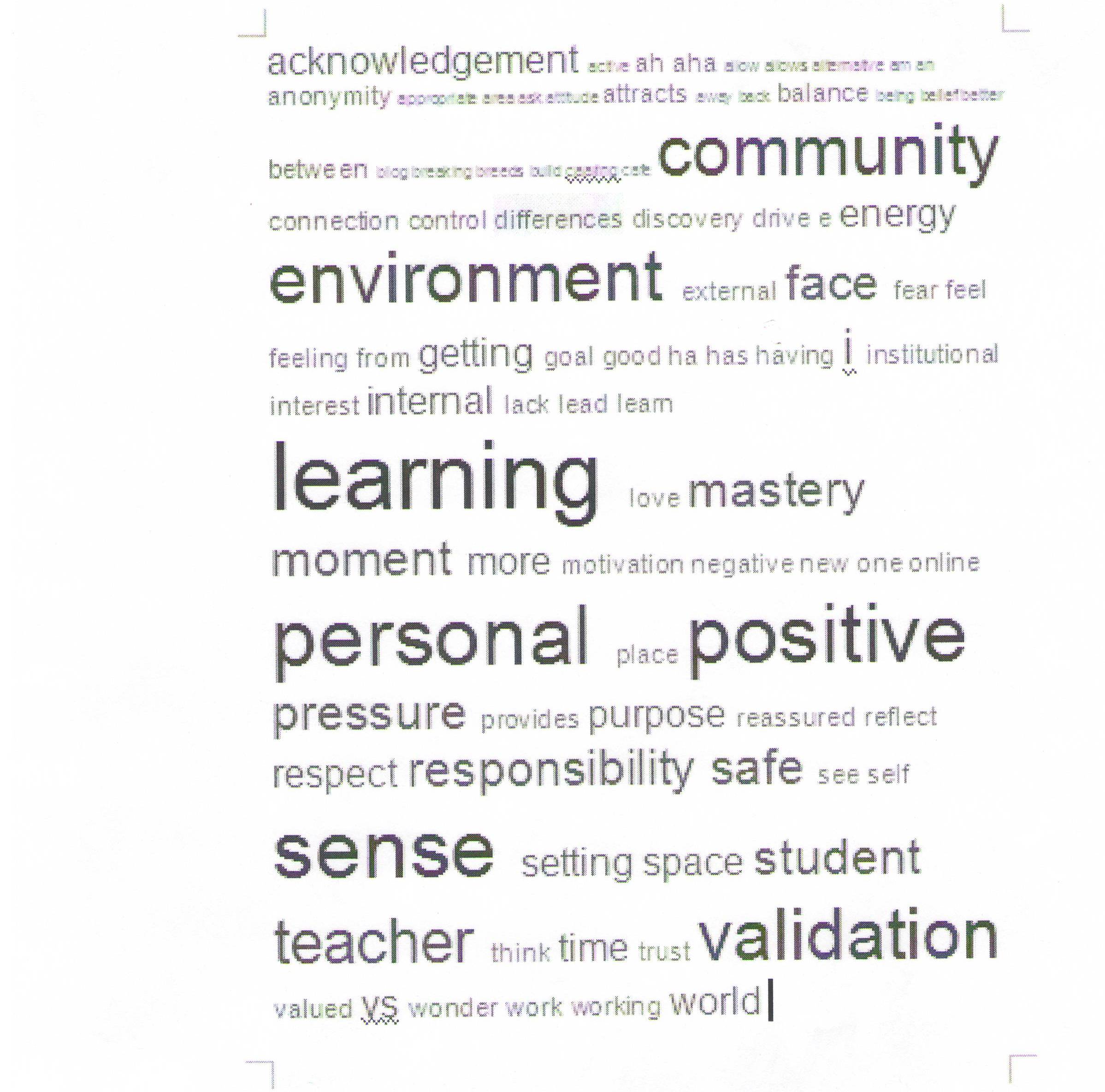
I am using software called NVivo. Essentially, I use it to organize and summarize qualitative data. One cool feature is the ability to create a word cloud. I am experimenting with that feature and using the image facility on my laptop. I summarized some World Cafe events we held in February and March. The results were simply outstanding. The only fly in the ointment was I had to scan the picture and lost the colour.

The overarching question we created our conversation around was: “What engages us in learning?

February 4, 2012

Think of a time that you feel was a high point in your learning. This would have been a time you felt most alive, effective, and engaged in the learning process. Describe how you felt. What made this possible?

February 18, 2012

“Without being humble, describe what you value most about yourself. How does this contribute to the experience of learning for you? What setting does this seem to flourish best in? What would attract you to that setting?”

March 3, 2012

What encourages us to continue learning and see learning as important in our lives?

Questions emerged. I thought the most interesting was an absence in the data. What about teacher expertise in subject area or technical knowledge? It could be these are unstated but assumed necessary. Or it could be that the relational aspect, the art of teaching, is so important to this group of people the technical and subject knowledge is secondary.  What do others think about this?

John Lennon’s Advice on Education

I wonder what education might look like if we followed this simple advice each day for every person who walked in the door’s of our schools?

Imagine a world where we could be happy, responsible, and not deny others their opportunities?

Leadership Is a Conversation – Harvard Business Review

Leadership Is a Conversation – Harvard Business Review. Here is an excellent article form Harvard Business Review. Leading is about a conversation. Leaders need to recognize the importance of listening mindfully and attentively otherwise their role is one of management.

Are educators ready for this? Conversations are much harder work than using glib commentary.

Blueberries | Jamie Vollmer

Blueberries | Jamie Vollmer.

This is worth reading. It fell into one of my email boxes this morning. In theory, I agree with the idea that we cannot, as teachers, return our students like Mr. Vollmer could return his blueberries. Fundamentally though, there is still a problem. In the province of Alberta. there are over 25% of students who will not finish high school. Those are the ones who leave our schools. What about those who do not leave and finish? There are still some amongst them who are on the margins and school has not served well. The 25% is an average.What about students who live in First Nation communities, in the inner city, or face any number of other life issues?

Education needs an overhaul. There is a genuine need for a different conversation and not sticking our heads in the sand. Please take a few minutes to read.

Diane Ravitch is a leading American educator. Although what happens south of the border is not important to us, this article poses a great question. Who is advantaged; those with resources or those without resources? Servant-leadership, which is lost in education, asks the leader to serve those around him or her and help them grow. That focus increases for the most disadvantaged. When will politicians, bureaucrats, and technocrats allow teachers in the classroom to become leaders who serve students and the community?

dianeravitch's avatarDiane Ravitch's blog

Mitt Romney launched his foray into education by visiting the Universal Bluford charter school in West Philadelphia, an impoverished, largely African-American neighborhood. He went to tout his plan for vouchers and charters as the new civil rights crusade of our era.

While there, thinking he was in friendly territory, he made some unfortunate remarks. First, he asserted that class size wasn’t important. That is no doubt the advice he had received from his advisors, who like to claim that having a “great teacher” is far more important than class size reduction. Then, he advised his listeners that one of the keys to education success is to be a child of a two-parent family. He got called out on both comments.

A music teacher rebuked him on the class size issue, saying: “I can’t think of any teacher in the whole time I’ve been teaching, over 10 years — 13 years —…

View original post 292 more words

There are excellent points in this article, but some areas of concern. The role of students, educators, and school provided insight into a different way of thinking about education. I disagree with the premise that administrators are a separate group, although they seem to be. Are administrators not educators themselves? I once met a retired educator who when I was introduced as a teacher and had something in common with her, she responded, “Oh, I was a principal” making it sound like I was inferior by remaining a classroom teacher. In recent years, I have witnessed this desire among many teachers to escape the classroom. We are teachers first.  If not educators, what is our role? What about children who needs help? What do we do to raise them up? I think this article is a starting point for a conversation.

Jabreel Chisley's avatarCooperative Catalyst

Education is something that is vital to the existence of a country where financial prosperity is something that is universally longed for. This is because that in order to reach financial prosperity one must reach a level of knowledgeable prosperity that unlocks the true innovator within them. However, if our countries goal is to allow for everyone to reach a level of financial prosperity then its time for us to sit down and come up with a dedicated pathway to delivering education with equality, equity, loyalty, and dignified passion in mind. If this is our goal then it is time for us to do away with the days where our educational system is balanced on the practice of every child left behind and every teacher for themselves. The time has come where we must push forward, with dignified loyalty, professional reservation, and universal respect for the student, the classroom, and…

View original post 933 more words

Observational Poems : Touching the World : Deep Underground Poetry Community

Observational Poems : Touching the World : Deep Underground Poetry Community.

I was just surfing and came across this poem. Mindfulness is a universal concept and is not the sole domain of Buddhists or mystics. I find it ironic that the wave of scientific theory which pushed mindfulness out of the western practice was called the Enlightenment. Who or What did it enlighten? Mindfulness and scientific thought are complementary practices which make each other whole.

Innovation – A Poem by Ivon

As I drove to work this morning, I considered the phrase “thinking outside the box.” I wonder, “Is the most apt description for innovative or creative thinking?”

When I am inside the box can I really see outside and look around effectively? I could just be hanging on for dear life. Or, when I am outside the box, can I see inside? When I wrote my candidacy paper, I interviewed the first principal of our unique, alternative school and he provided an appropriate metaphor for innovative and creative organizations-a corral fence. I wrote the following poem and tried to capture what I think he meant.

Innovate

A fence

with railings

see in or out

allow perspective.

Flow and rhythm

information in; information out

nourish

enrich

affirm

recycle

breathe and flex.

Part of a whole

complex, yet simple

reach beyond my world

one piece of a puzzle.

Present

to our self

to the world.

Never box me in.

This fit with a song I heard by Ben Harper called With my Own Two Hands. He used to front a band called the Innocent Criminals and that drew me to his music. Enjoy this creative artist.

Professional Learning Communities at Work by Dufour and Eaker

I read Professional Learning Communities by Richard Dufour and Robert Eaker several years ago and attended conferences about the concept. We implemented Professional Learning Communities (PLC) in our school with early, but unsustainable success.

Thesis: The authors proposed “the most promising strategy for sustained, substantive school improvement is developing the ability of school personnel to function as professional learning communities” (p. xi).  Professionally, educators need awareness of emerging research to fuel personal learning and support student learning. Communities form and they foster “mutual cooperation, emotional support, and personal growth as [people] work together to achieve what they cannot accomplish alone” (p. xii). Teachers safely move from isolation and risks are taken extending personal and collective learning when a PLC is effectively implemented, integrated, and supported in a school.
CharacteristicsThis is an annotated version, but successful and sustainable PLCs have six characteristics:

  • Shared mission or purpose, shared vision or what we hope to become, and shared values guiding the process. Shared mission advertises purpose outward. Shared vision energizes staff. Values are personal and community attitudes, behaviours, and commitments which are normalized over time.
  • Collective inquiry fuels the process. What do we want to change? What ways are things as they are challenged? There is collective conversation and personal reflection. The latter is the oxygen that breathes new life into the dialogue and provides fuel through new questions.
  • Collaborative teams provide renewal. Collaboration acknowledges the dysfunctional nature of communities. What do we do when there are dissenting voices and disagreement? What value will we name here?
  • Action and experimentation are always in evidence. “Even seemingly chaotic activity is preferred to orderly, passive inaction” (p. 27). Teachers experiment with emergent ideas making innovation essential in a PLC.
  • Everyone commits to continuous improvement. Questions emerge and are actively sought out, but there are touchstones principles such as “What is our fundamental purpose?”
  • With continuous improvement and action orientation there is an iterative process in the form of quantitative, qualitative, or mixed research. The object is to shake up the status quo and find new ways of safely supporting both staff and students. What are we doing that we want to change? (pp. 25-29)

Questions: Who has had success in implementing a PLC in their school or jurisdiction? What were the important takeaways including what worked and what did not work? What did you do to overcome the bumps along the way? What can a school starting or restarting the process do to sustain energy and get early work done successfully while recognizing the achievements even when they are small?

Recommendation: The book is about 300 pages, but is an easy read. The authors synthesized leadership literature inside education i.e. Lezotte, Sergiovanni, and Fullan and outside education i.e. Bennis, Senge, and Deal and Kennedy and saved some reading.

I recommend the book for those ready, willing, and patient enough for a transformative journey. The process requires time and immediate classroom benefits to sustain it. Cultural change is messy and requires leadership, perhaps previously untapped in education. Effective support and communication are required for sustainable, successful results to emerge. Early conversations focused on mission, vision, values and normative behaviours are uncomfortable, but necessary. My questions attempt to flesh out these concerns, as we are embarking on this journey again.

I know schools in Canada, the USA, and internationally have successfully implemented PLCs and I want to draw on the experience and wisdom already in place. I am looking for process and product, but not a cookie cutter formula per se. I look forward to hearing from many of you.

Dufour, R. and Eaker, R. (1998). Professional learning communities at work: Best practices for enhancing student achievement. Bloomington IN: National Educational Services.