Category Archives: Synchronicity

Are You Okay, God?

I read Seven Lessons of Chaos by John Briggs and David Peat last summer. They used a koan about a ‘hole in the whole’ describing what we do when we analyze things and lose the mystery of the wholeness in life. We break life and its events down, analyze them, and forget to put all the pieces back and lose something vital in the connectedness to the world, leaving a “hole in the whole.” Humans attempt to explain the mystery of life and not embrace it and the richness of our existence. Mystery and spirituality work together. We cannot intellectually explain the fullness and mystery of life. Thomas Merton and Shunryu Suzuki spoke of this attempt as human arrogance.

A former student took this picture, again with pretty straightforward phone technology, and the beauty, the richness, and the wholeness it conveyed is powerful. It reminded me of the song we learned as children There is a Hole in My Bucket. The hole in the clouds or bucket could be there for a reason we do not understand. Despite the potential arrogance, I wrote a short poem that might explain the hole.

Sprinting, scrambling, scurrying

Hoping, praying

Feeling hard, cold raindrops

Burning through my clothes

Smelling rain and fear.

Suddenly, blue and gold in the blackness

A light shone

A candle gently flickering.

I whispered, “Thank God!”

I am startled by a voice

“Are you OK, Ivon?”

“I think so.”

“Is that you God?”

“Is the hole to find my way?”

“By the way, thanks for asking. Are you OK?”

A pause

I thought a heard a smile

A sigh for sure, before

“I am now.”

Silence returned

Not falling, just silent

Embracing, reassuring, supporting,

Opening my eyes,

I looked up

I was home

A light shone through the window,

A second haven

Warm, well-lit, welcoming

With voices asking, “Are you OK?”

Saying, “We were worried.”

I wonder if we ever wonder if God is OK?

We should ask every now, and

Listen quietly in the storm for an answer,

It is there.

This is a post from Torbs Lindgren at Slappshot. We seem to share a love of hockey, ice hockey that is.

Torbs provided a great story about teacher who learned from her students and helped them find their way in life. Torbs also honoured me in the preface of the story.

Humility

I am reading Wayne Muller‘s Sabbath: Restoring the Sacred Rhythm of Rest. He shared the following: “The word humility, like the word human, comes from humus, or earth. We are most human when we do no great things. … We are simply dust and spirit–at best loving midwives, participants in a process much larger than we. … We are granted the tremendous blessing of knowing that we do very little at all by ourselves” (p. 176).

He closed that chapter with a short, tongue-in-cheek poem by Robert Aitken Roshi who examined more closely humility and the role of soil in the human condition:

When people praise me for something

I vow with all being

to return to my vegetable garden

and give credit where credit is due.

Butterfly

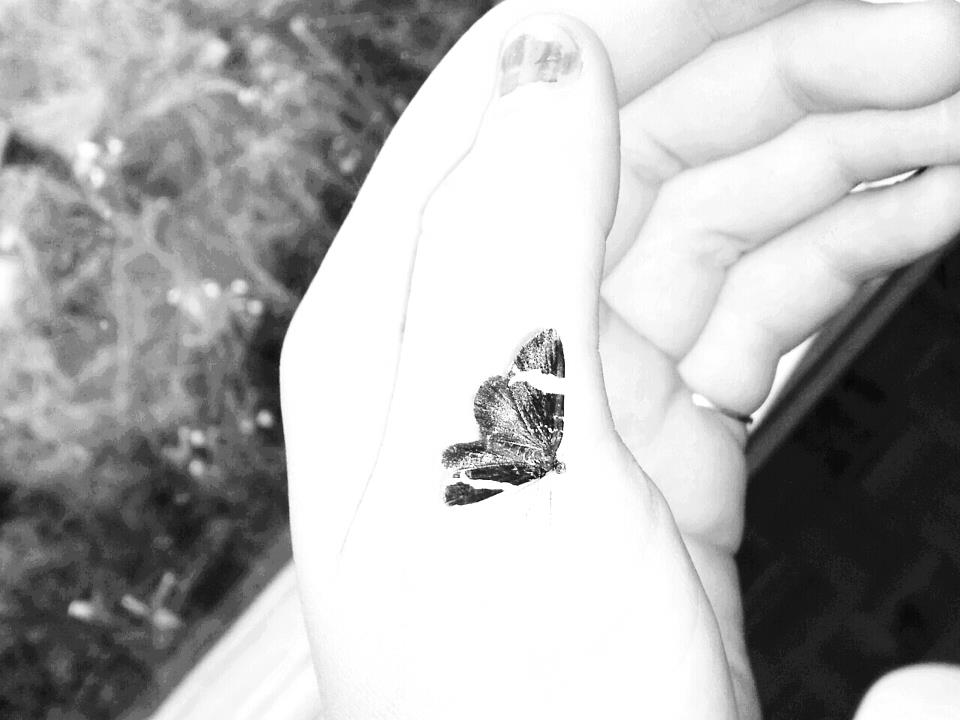
One of my students took these pictures and allowed me the privilege of posting them along with a Haiku. She is using her new phone and this butterfly felt drawn to her finger and hand.

Rest on my finger

Unifying quietly

The peaceful soul rests.

stop on the way home

butterfly rests on human

pause on the journey.

The Rules for Being Human

This showed up today. It is true, old, and universal.

I thought I would only blog briefly this morning, but too much has come across my screen. I love the Mark Twain quote provided below the video. Both moms and dads do learn a lot more after their children are adults. Kathy and I do not get many chances for the boys, Marc, Yves, and Luc, and physically share with us due to distances, but on Friday we went for supper. It was a belated Mother’s Day and an early Father’s Day. Thank you Marie for the great reblog.

When I was a boy of fourteen, my father was so ignorant I could hardly stand to have the old man around. But when I got to be twenty-one, I was astonished at how much the old man had learned in seven years.  – Mark Twain

ivonprefontaine's avatar

Father Day’s

I subscribe to a daily meditation written by Father Richard Rohr. a Franciscan priest.I talk and write about the concept of common sense, which I understand as local and global. Father Rohr cast it from a theological perspective, I think the explanation provides an insight gained without reading Gadamer’s Truth and Method. I believe there is a universal truth or common sense (Vico called this sensus communis), something that makes us all brothers and sisters bringing us together in community. I think Father Rohr offers an explanation though his meditation on Father’s Day helping us to live in community each day. Certainly, Rilke does.

“It is this sense that founds community” (Gadamer, 1989, p. 19).

Gadamer, H-G. (1989). Truth and method. (J. Weinsheimer & D. G. Marshall, Trans.).  New York: Continuum.

Catch only what you’ve thrown yourself, all is

mere skill and little gain;

but when you’re suddenly the catcher of a ball

thrown by an eternal partner

with accurate and measured swing

towards you, to your center, in an arch

from the great bridgebuilding of God;

why catching then becomes a power–

not yours, a world’s.

–Rainier Maria Rilke

Words for Teachers and Learners at Heart

This fell into my world yesterday and I thought it might be a good share. It is certainly something to reflect on as we begin each day in our various roles of learning and teaching.

Poetry Arises

To begin the day in a quieter, peaceful, and wiser place, I meditate each morning. .Elizabeth Myhr commented about creativity in her writing. She “does not jump into creativity. Creativity bumps into her on its way through the world.” As I sat, I realized I was writing poetry in my mind. Words, phrases, and images were floating in a stream. I recognized I felt calmer and quieter in those moments.

Francesca Zelnick offered advice in a recent post. She suggested, when ideas emerge or bump up against me as I move through life, write them down. I did and edited later. Here is the product.

Sit quietly,

5:30

AM.

Can’t sleep

wait

listen

pay attention

be patient

meditate

contemplate

focus on breath.

Gently return

to a quiet space

solitude

like a river

single words

phrases form

metaphors arise

images appear

in the current.

Discover a gentle smile

on the corners of lips

face softens.

Fresh day

creates space

for voice

words observed

soul speaks

asks to be heard.

Tranquil,

bump into creative moment

Poetry written.

Enjoy!

Words for the Wise – Partie Deux

Words for the wise was a product of an incident yesterday. I was left exasperated, exhausted, and feeling somewhat unintelligent. I calmed down and found the wisdom shared by Winnie the Pooh helpful in creating a new lesson plan for today’s poetry time, but, first, let me explain the back story from yesterday.

About two months ago, a student brought their scooter to school and was riding it up and down the sidewalk in front of the building we occupy. Our school is located in what was a commercial building our school division acquired. There is no space to scooter in the front of the building, because there is a sidewalk and a parking lot immediately in front of the building. Usually, both are busy so it is an unsafe pastime. Second, students must wear proper equipment i.e. approved helmet, knee pads, and elbow pads. The young man in question is proficient, or so I have been told, so he took the equipment rule as a problem. Frankly, I would to, if I was any good at riding my scooter.

Yesterday, another student brought their scooter to school. While I was occupied, two students, including the aforementioned young man noted, borrowed the scooter and rode it in the parking lot and on the sidewalk while others watched. I was angry; that is the polite way of putting it. I gave some students credit. They recalled explicit instructions about the conditions a scooter could be used i.e. equipment, supervision, and location. Others had forgotten, but it was more likely a situation they were not listening for any number of reasons. This morning I received an email from the young man’s parent saying he informed her he could ride the scooter out back. I am not sure where out back is, because there is no place to ride out back. He left out the equipment and supervision.

Listening, which I think is essential to being responsible for one’s actions and words, seems limited to what a person wants. We listen when we are motivated by words or sounds that are we want to hear. I think that might be human nature. We lack mindfulness and being in the present moment. As luck would have it, sitting on my desk was a William Stafford poem entitled Listening. We had a great conversation after reading it, reflection time, and sharing in pairs.

Listening

My father could hear a little animal step,

or a moth in the dark against the screen,

and every far sound called the listening out

into places where the rest of us had never been.

More spoke to him from the soft wild night

than came to our porch for us on the wind,

we would watch him look up and his face go keen

till the walls of the world flared, widened.

My father heard so much that we still stand

inviting the quiet by turning the face,

waiting for a time when something in the night

will touch us too from that other place.

Thank you William Stafford. Winnie, I was brave and strong enough to tell my students I was listening, but I cannot always do what they want. I simply do not have the power some days and am smart enough to recognize this.