Category Archives: Writing

Innovation – A Poem by Ivon

As I drove to work this morning, I considered the phrase “thinking outside the box.” I wonder, “Is the most apt description for innovative or creative thinking?”

When I am inside the box can I really see outside and look around effectively? I could just be hanging on for dear life. Or, when I am outside the box, can I see inside? When I wrote my candidacy paper, I interviewed the first principal of our unique, alternative school and he provided an appropriate metaphor for innovative and creative organizations-a corral fence. I wrote the following poem and tried to capture what I think he meant.

Innovate

A fence

with railings

see in or out

allow perspective.

Flow and rhythm

information in; information out

nourish

enrich

affirm

recycle

breathe and flex.

Part of a whole

complex, yet simple

reach beyond my world

one piece of a puzzle.

Present

to our self

to the world.

Never box me in.

This fit with a song I heard by Ben Harper called With my Own Two Hands. He used to front a band called the Innocent Criminals and that drew me to his music. Enjoy this creative artist.

Uncertaintly Not a Cat Person

Let me admit, “I am not a cat person.” Cats view me as a scratching post and someone to annoy, but we once owned a cat or maybe she owned us. She was beyond unique as feline characters go. This is the story of how she captured us.

We lived across the Fraser River from McBride in the Robson Valley of British Columbia. Our dog was agitated that evening as an early winter storm descended upon us with all its wrath. She insisted on going in and out of the house. Kathy suggested I check and see if a coyote had come down from hillside into the backyard. Armed with a .22 caliber rifle, I went outside accompanied by the dog. The snowfall was heavy and the wind was blowing it around to the point I could not see the trees at the back of the yard. I decided there was nothing of real interest and turned back to the house.

I stopped momentarily to tap snow from the roof of the dog house. When I did, a kitten shot out and ran across the backyard to the willow stand and some derelict buildings to the side of the house. I followed and saw it enter one of the old buildings, but was not dressed to continue my search. I returned to the house and Kathy asked what I had seen. When I replied that is was kitten she wanted to know where it was. I pointed out I was not suitably dressed. She put on a parka and boots and went out to look for the kitten. Kathy returned with a tiny black and white bundle that was none too happy. We closed the door, released the kitten, and she immediately escaped under the couch to avoid the dog who thought this was a potential playmate. Kathy put a bowl of warm milk with broken up bread just under the edge of the couch so it was out of reach of the dog, but accessible to the cat. We left the cat there for the night, put the dog in the bedroom with us, and went to bed listening to the howling wind.

The next morning dawned beautiful. We had a layer of fresh snow, a brilliant blue sky, and a sharp cold feel in the air. Kathy went to put the dog out and there was a flash of black as the kitten shot out the door, across the backyard, and found refuge under the hay shed. To keep hay from getting wet from the marshy piece of land we sat on, the floor of the shed was elevated above the grond. We could see the kitten and it could see us, but it was not coming out.

Kathy, an innovative farm girl, got a bowl of milk and bread and put it 3-4 feet or about a meter in front of the shed and stood on the front lip of its floor. She did not wait long. The kitten tentatively edged out and began to lap up the milk. Engrossed and oblivious to its surroundings, the cat was vulnerable and Kathy pounced and recaptured our future cat.

We owned the cat for about 4 years. I was never her scratching post. She would come and sit with me in my easy chair in the living room to watch TV. She was always tiny never getting beyond the size of large kitten. We think she was abandoned, likely part of a litter, to die. A newborn would be easy prey for coyotes, quickly starve, and dehydrate. In the cold weather of early winter, she would not have lasted much longer. Besides being tiny and my only feline friend, she was odd in other ways. Her best friend, besides me, was the dog. They played, ate, and slept together. When not sleeping with the dog, the cat tucked her forehead on the floor, put her butt in the air, and in that odd position slept. When company visited, she disappeared. One visitor knew we had a cat, because her allergies flared up instantly upon arrival. The cat reappeared when the door closed behind any visitor.

To this day, I remain skeptical of cats and their intentions towards me, because they still mistreat me. Having said this, I am not certain I was not once owned by a cat and enjoyed it.

ivonprefontaine's avatar

I was driving to school this evening and David Francey, a wonderful Canadian singer, was on the I-Pod singing The Waking Hour. Kathy and I have attended several of his concerts. He has a wonderful line in that song: “The heart that’s breaking never makes a sound.” It resonated. I wrote poetry many years ago and, today, I found poetry anew.

Set the backpack down

The mountain is high

The peak obscured

The path terrifying

Share my load

Trust

Be right

Be true

Will they hear?

Without spoken words

Speak my truth

Invite

Carried alone

The backpack is too heavy

Lighten

Strengthen

Back straight,

Shoulders square,

Head held high.

Walk with me

Share my load

Killing Weasels – A Legend

My mother tells a story about her mother, my Mémère, which is French for Grandmother. The family lived in a cabin and had a homestead on the Lesser Slave Lake when my mother was growing up. The cabin had a dirt floor which needed sweeping regularly. People tell me a dirt floor is swept so things spilled on it are not packed down into the dirt and to reduce vermin.

Mémère was sweeping when, quick as a flash, a weasel ran across the floor. She, Mémère  that is, moved her bottom hand adeptly up the broom handle much like a baseball player would to hold a bat and, without missing a beat, took a mighty swing that would have made even Casey proud. My mother recalls how the weasel was accommodating and hopped just a bit  so he was above the floor. The broom head connected, the weasel flew across the room, and struck the wall solidly. It fell unmoving to the floor and Mémère returned to her sweeping as if nothing had happened. She quietly instructed my mother to remove the weasel and throw him into the yard for the dogs or cats.

My mother says it was an everyday event and was treated as such. It was just another day on the little homestead on the Lesser Slave Lake.

Junior High Creative Writing Activity: A Fractured Fairy Tale

Children hear and read fairy tales at a young age. When they reach late elementary and junior high school age, they can explore and discover inconsistencies in fairy tales i.e. Goldilocks breaks into the Bears’ house and vandalizes it. Here is a creative writing activity in the form of a parody.

This is the most popular creative writing activity in our junior high class. This plan has worked well for me as a junior high teacher, but I think could be used with upper elementary students. I think it can be modified and meet the needs of younger and older students.
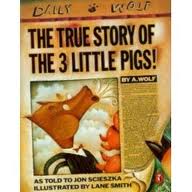
We use Jon Sczieska’s The True Story of the Three Little Pigs by A. Wolf as a model of a parody.

The unit plan includes:

Process

Reading the story to the class and brainstorm differences between the original and this version? Most students are familiar with the original story of The Three Little Pigs, but have it on hand if someone is unfamiliar with the story.

What fairy tales are students familiar with? Brainstorm and create a list. What parodies of fairy tales are they familiar with? Have they seen Shrek? What makes Shrek different from other fairy tales? Students may recognize Shrek as a parody of the genre and has features and structure of a fairy tale while it spoofs the genre in various ways.

What twists can be used to rewrite a fairy tale i.e roles of antagonist and protagonists or plot events? Some examples students have shared include what if the third little pig refused his siblings refuge to teach them a lesson where would they stay?  Could the pigs organize a pig posse to run the wolf out-of-town?  Would they have become ‘ham jam’?  What about the story from the wolf’s perspective?  What if the wolf were a vegan?

What other fairy tales are students familiar with?  Brainstorm and make a list. This helps students choose a fairy tale to rewrite. Choose a familiar fairy tale and brainstorm ways to ‘fracture.’ We have used Cinderella. The list can offer starters for students and could also be used in the parody of another fairy tales. What if…

  • Cinderella has beautiful step sisters?
  • The prince cannot dance?
  • Cinderella is a homebody who likes to cook, sew, and clean and is not interested in attending the ball?
  • The magic wand is defective and does not get the spell right?
  • Cinderella does not want to get married?
  • Cinderella wants a car and not a carriage?
  • Etc…

Brainstorm elements fairy tales share and create a graphic organizer to hand out. Some features have included:

  • Once upon a time…
  • Good vs. evil
  • Beautiful heroine and handsome prince
  • Magic/supernatural
  • Personification
  • …live happily ever after
  • Etc…

Students can ‘fracture’ a fairy tale and change stories in unexpected, clever, and humourous ways by altering characters, modifying language, using a modern context, etc. The fairy tales still remain true to their original forms despite changes.

Here are sites to find fairy tales or refresh memories about the fairy tales students choose: Story Nory, Grimm’s Fairy Tales, and Ivy Joy. Some sites include other genres i.e. fables. Stick to fairy tales as they are well-suited for this project.

Students include an outline or web and a rough draft. Peers or teachers can proofread the story so students can edit.

Final Product

A picture book format is popular. The authors of the picture book can read to their stories to younger students.

Words of caution

  • This is not a yearlong project
  • Students  need to choose something of a manageable length.
  •  Usually the audience is younger. Students should use appropriate language and images, keep the book short i.e 20 pages, and use large font.

Assessment

I use this activity to assess creative writing, sharing orally, and finding appropriate images for the story and the audience. As well, there are brainstorming, proofreading, and editing.

Questions

What engaging writing activities do other teachers use in their classrooms? What changes can be used for older and younger students? What other assessment purposes can you think of for this type of activity?