The Frog

The frog does not drink up the pond in which he lives. source: Teton Sioux Proverb image: Eddie Two Hawks, Image Collection, The Frog

The local is important in how we live life and experience our environments. Sometimes, we look at the world and it seems larger than the world we experience, as it most immediately. We can never fully know the world, but we can know most the world we live in most immediately. It is imperative to not spoil that world. When each community fulfills its ethical and practical role, this overlaps others’ roles, feeding the whole.

Source: The Frog

The Lessons of Water

David Wagoner wrote this wonderful poem that encourages us to watch nature and learn from it. Regardless of one’s faith, we receive gifts that act as teachers for our living.

When we watch water, we can see and hear its story and that can guide our behaviours. Nature is not separate from us, but a part of us that was shared with us so we might care for it and pass it on to the next generations.

The best way to conduct oneself may be observed in the behavior of water. —Tao te ching

When given a place to wait, it fills that place
By taking the shape of what contains it,
Its upper surface poised and level,
Absorbing, accepting what it can as lightly
Or heavily as it does itself. If pressed
Down, it will offer back in all directions
Everything it was given. If chilled, it will shatter
Daylight and whiten to stars, will harden and sharpen
And turn unforseeably dazzling. Neglected,
It will disappear, being transformed and lifted
Into thin air. Or thrown away, it will gather
With other water, which is all one water,
And rise and fall, regather and go on rising
And falling the more quickly its path descends
And the more slowly as it wears that path away,
To be left awhile, to stir for the moon, to wait
For the wind to begin again.

Compassionate Vulnerability

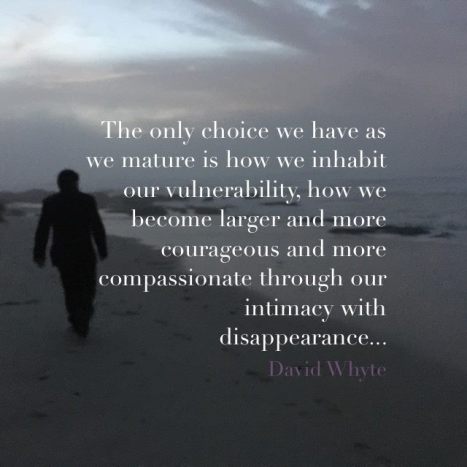
I enjoy David Whyte’s poetry and have attended workshops involving it. Living vulnerably is the only way to live. Living does not come with risk-free instructions. It can only happen with love that emerges as we each live our life fully.

Wildflower Women's avatarWildflower Women

12495176_1327003080659025_4392972375624230765_n

What does it mean to be more compassionate through our intimacy with disappearance? To me it means that we become braver as we surf the ever-flowing tide of loss and renewal in our lives. We are able to choose whether we will shut our heart off to love and compassion, opting instead to live a fear-based life. Or we can choose to live with openhearted vulnerability. Being vulnerable can be frightening! We inherently know that when we make ourselves vulnerable we also open ourselves up to hurt, loss, and sorrow.  When we choose vulnerability we are in a way honoring our soul by allowing for growth to be a bigger, more courageous, and compassionate human being. Without knowing the darkness we can never fully live in our light.

It happens to all of us when we step off into this thing called living. Some people choose to shut down when…

View original post 216 more words

School Prayer

The second stanza of this poem is a great message for the world today. When we hate, we take something out of the world. The world is a place in need of love, humility. wonder, and peace.

Diane Ackerman writes a wonderful poem that offers insight into the world and with. John Dewey suggested the world is not separated into objective or subjective worlds, but is a continuous forming and conversing between the two we each engage in moment-to-moment.

What would happen if this prayer and poem began each day for us and our children?

In the name of the daybreak
and the eyelids of morning
and the wayfaring moon
and the night when it departs,

I swear I will not dishonor
and my soul with hatred,
but offer myself humbly
as a guardian of nature,
as a healer of misery,
as a messenger of wonder,
as an architect of peace.

In the name of the sun and its mirrors
and the day that embraces it
and the cloud veils drawn over it
and the uttermost night
and the male and the female
and the plants bursting with seed
and the crowning seasons
of the firefly and the apple,

I will honor all life
—wherever and in whatever form
it may dwell—on Earth my home,

and in the mansions of the stars.

This is what life is all about…dance

Picture from:  Pinterest

Source: This is what life is all about…dance

When I read the title and looked at the image, it reminded me of the Satchel Paige quote: “Work like you don’t need the money. Love like you’ve never been hurt. Dance like nobody’s watching.”

When we live life to the fullest, we can find so much without looking for it. It finds us. When we remaind mindful, life and alls its manifestations show themselves to us.


Shedding our Skin

Just as a snake sheds its skin, we must shed our past over and over again –  Jack Kornfield

Source: Shedding our Skin

We live with traditions, personal and societal, that often confound us and act as screens over our eyes. Finding ways to reveal our prejudices and knowing they exist, is a hard job. It is not essential to give them up. Gadamer argued that our prejudices allow us to navigate the world we live in from moment-to-moment; however, when they obstruct us and keep us from ethical behaviour, it becomes important to shed them.

When we acknowledge our prejudices and ourselves as historical beings, this takes the form of a question that can guide mindful and aesthetic reflections.

Adios

When we say good-bye to something or someone, the word means more than we say. We hold thoughts and images of what and who we leave behind. Our work, when we say Adios, is incomplete. We recall the memories of things and people we left behind, as we said and waved good-bye. The memories bring smiles, tears, shrugs, and frowns, among other features, to our face and body.

When we say good-bye, there is always something and someone calling us back, perhaps only in our mind as we reach out. The space fills with questions about what we left and a sense of wondering about what is happening with that thing or that person.

Naomi Shihab Nye captured the essence of good-bye as it rolls off our tongues and as we tap our fingers marroed to it. Thoughts and images fill our minds as we reflect on what that word, regardless of language, might mean.

It is a good word, rolling off the tongue;

no matter what language you were born with

use it. Learn where it begins,

the small alphabet of departure,

how long it takes to think of it,

then say it, then be heard.

Marry it. More than any golden ring,

it shines, it shines.

Wear it on every finger

till your hands dance,

touching everything easily,

letting everything, easily, go.

Strap it to your back like wings.

Or a kite-tail. The stream of air behind a jet.

If you are known for anything,

let it be the way you rise out of sight

when your work is finished.

Think of things that linger: leaves,

cartons and napkins, the damp smell of mold.

Think of things that disappear.

Think of what you love best,

what brings tears into your eyes.

Something that said adios to you

before you knew what it meant

or how long it was for.

Explain little, the word explains itself.

Later perhaps. Lessons following lessons,

Life’s most persistent and urgent question

LIfe lived through questions is important. It opens up new paths forward, rather than closing down the routes forward.

Live & Learn's avatarLive & Learn

martin-luther-king


Source: Apple.com landing page (Jan 18, 2016)

View original post

Quotatio: Martin Luther King

Photo post by @georgebost.

Source: Quotatio: Martin Luther King

A person always has to keep moving. The key might be opening up one’s senses to the world and the universe as we move forward.

ON HOW TO PICK AND EAT POEMS

Phyllis Cole-Dai wrote this wonderful poem that offers so much advice about how to live life more fully. When I stand still and just am in the moment, it is there that I can live most fully. Poems grow there and, just like finding something wonderful in nature, we can bow to it as we read it and let it soak in.

Stop whatever it is you’re doing.
Come down from the attic.
Grab a bucket or a basket and head for light.
That’s where the best poems grow, and in the dappled dark.

Go slow. Watch out for thorns and bears.
When you find a good bush, bow to it, or take off your shoes.
Then pluck. This poem. That poem. Any poem.
It should come off the stem easy, just a little tickle.
No need to sniff first, judge the color, test the firmness.
You’ll only know it’s ripe if you taste.

So put a poem upon your lips. Chew its pulp.
Let its juice spill over your tongue.
Let your reading of it teach you
what sort of creature you are
and the nature of the ground you walk upon.
Bring your whole life out loud to this one poem.
Eating one poem can save you, if you’re hungry enough.

When birds and deer beat you to your favorite patch,
smile at their familiar appetite, and ramble on.
Somewhere another crop waits for harvest.
And if your eye should ever light upon a cluster of poems
hanging on a single stem, cup your hand around them
and pull, without greed or clinging.
Some will slip off in your palm.
None will go to waste.

Take those you adore poem-picking when you can,
even to the wild and hidden places.
Reach into brambles for their sake,
stain your skin some shade of red or blue,
mash words against your teeth, for love.
And always leave some poems within easy reach
for the next picker, in kinship with the unknown.

If you ever carry away more than you need,
go on home to your kitchen, and make good jam.
No need to rush, the poems will keep.
Some will even taste better with age,
a rich batch of preserves.

Store up jars and jars of jam. Plenty for friends.
Plenty for the long, howling winter. Plenty for strangers.
Plenty for all the bread in this broken world.