Tag Archives: education

pedagogy of the oppressed by Paulo Freire

I read pedagogy of the oppressed by Paulo Freire during my undergraduate experience and return to it as a source of reflection and when I write. Similar to Parker Palmer, Paulo Freire left an indelible mark on my life’s practice. Education is an uplifting, liberating experience which shines light on each step Antonio Machado described: “Wanderer, your footsteps are the road, and nothing more; wanderer, there is no road, the road is made by walking.” Freire’ s contention was everyone can act as an agent in their learning thus freeing them and transforming the world they live in.

Freire used the Portuguese word conscientização which “refers to learning to perceive social, political, and economic contradictions and to take action against the oppressive elements of reality” (17).   Humans become mindful of and present in the world and act to transform it. Freire used a banking metaphor and described traditional education where  knowledge is deposited into students. Teachers and the system act oppressively in determining what is important to learn. Freire felt education uplifted people and their learning. “Liberation is a praxis: the action and reflection of men and women upon their world in order to transform it” (p. 60).  Learning occurs when  compliance and conformity are rejected in favour of dialogue based on love which allows each human to name their world and what is of value in it. The student is a teacher and student; the teacher both student and teacher.

Questions: What can we do to truly bring a new pedagogical structure into our schools and communities of learning? What function would school play in this pedagogical structure? What is dialogue based on love?  What role do educators and communities play in liberation education?

Recommendation: I love the book. It is a challenging, but I return to it often and find something new each time. Today, I became aware of the following: “Concepts such as unity, organization, and struggle are immediately labeled as dangerous. … These concepts are dangerous—to the oppressors” (p. 122). What does this mean in supposedly modern, liberated, and affluent societies?

A second point was the similar language used by Freire and Martin Buber. There is a shared understanding of respectful dialogue using the words I and Thou to describe the uplifting, liberating, loving dialogic process.

Freire, P. (1993). pedagogy of the oppressed. (M. B. Ramos, Trans.).  New York: Continuum.
leading and learning: Lets value individual creative teachers.

leading and learning: Lets value individual creative teachers..

This is a rather lengthy article written by a New Zealand based educator. I think it fits with a previous reblog of video featuring Sir Ken Robinson called The Educational Revolution: Why Schools Kill Creativity.

Read, watch, and weep. A lack of creativity and resulting innovation is killing public education with sameness. Let us all do it one way is the current creed. What can we do about it? It is high time we invited a new conversation to emerge.

Beginning of the Year Poetry

I wanted something a little different for the beginning of the year. We had new students and sometimes new students find it difficult those first few days to introduce themselves and share something about themselves with others who are better established. We are an alternative school environment. Some students have been with us since Grade 1 and are now in junior high. Without realizing it, returnees form groups and new students are slightly intimidated by the tightness that has formed despite everyone’s best efforts. I tried a poetry activity and it worked very well.

1. I used a Kahlil Gibran quote from The Prophet:

“Say not, “I have found the truth,” but rather, “I have found a truth.”
Say not, “I have found the path of the soul.” Say rather, “I have met the soul walking upon my path.”
For the soul walks upon all paths.
The soul walks not upon a line, neither does it grow like a reed.
The soul unfolds itself like a lotus of countless petals.”

The quote served as a conversational anchor. I read it out loud a couple of times. Students re-read it, highlighted words or questions that emerged, discussed their reflective findings in pairs, and finally we shared with the group. What did this passage mean? What was the theme? We talked about self-knowledge and truths. I refer to Parker Palmer in my classroom so students had discussed the idea of holding one’s own truth while respecting the truths of others.

2. Students prepared a small poster. I asked them to include two poems, some pictures of activities they enjoyed, some quotes they thought helped describe who they were, and their name proudly displayed in the centre of the poster.

3. Initially, I wanted a free verse poem and a cinquain poem. The former was too abstract for some students so changed allowing some flexibility with another formula poem i.e cinquain, diamond, or acrostic. This helped considerably. Even though I teach in a multi-grade setting, with three junior high grades, this struggle with abstraction was not based on grade level only. There were some older children who struggle with the free verse and younger children who did not.

4. Each child put their poster about who they were on the bulletin board and it has remained there all year. An interesting note is, when corners of posters have come loose on the bulletin board, students take time to tack them back up carefully even if it is not their poster.

For those unfamiliar with the pattern poems I referenced above, here are some instructions and examples.

How to Write a Cinquain

There are two methods:

Line 1 – a one word title
Line 2 – a 2 word phrase that describes your title or you can just use two words
Line 3 – a 3 word phrase that describes an action about your title or just actions words
Line 4 – a 4 word phrase that describes a feeling about your topic or just feeling words
Line 5 – one word that refers back to your title

Line 1 – two syllables
Line 2 – four syllables
Line 3 – six syllables
Line 4 – eight syllables
Line 5 – two syllables

Example

Ivon

Mr. P

teach, learn, enjoy

It is my calling

Teacher

How to Write a Diamond Poem

Method

Line 1 – a one word noun
Line 2 – 2 adjectives that describe the noun
Line 3 – 3 verbs that the noun does
Line 4 – 4 things (nouns) that the top noun and the bottom noun has
Line 5 – 3 verbs that the bottom noun does
Line 6 – 2 adjectives that the describes the bottom noun
Line 7 – a one word noun that is opposite the top noun

Example

cat
furry, silky
sleeping, purring, meowing
tail,   fur,    tongue,   collar
barking, playing, licking
friendly, big
dog

How to Write Acrostic Poems?

Acrostic is an easy poetry formats to use with young writers.

It can be about any subject, written in different ways, but the simplest form is to put the letters that spell your subject down the side of your page. When you have done this then you go back to each letter and think of a word , phrase or sentence that starts with that letter and describes your subject, and give out your hidden message that’s contained in this format, that can run forwards, or backwards.

Example

I ngenious

V irtue

O mniscient (or so students think)

N octurnal

Words for Teachers and Learners at Heart

This fell into my world yesterday and I thought it might be a good share. It is certainly something to reflect on as we begin each day in our various roles of learning and teaching.

Human Resources – A Poem

I often wonder about the language of the workplace. We refer to students as clients and staff in schools as human resources. Reminded me of a song from my youth, The Five Man Electrical Band. They wondered about the increased proliferation of signs and wrote a short note to Jesus about it while stopping in at a church along the way. Enjoy!

A human resources expert appeared

out of a shroud

mist-like.

I recoiled

What’s wrong?

Pleasantly enough asked

seemed off somehow

May be a sinister tone?

Did I say the wrong thing?

Or things?

I wonder

didn’t get the job

not even interviewed for that matter, plus

I got a security escort

wasn’t the first time

Human resources, you say.

Humph

I have questions

to hell with yours

I’ll ask mine

Are we compatible?

Can we date?

Where are humans mined?

do they mind?

What are they worth?

Raw and finished versions

Where is the human factory?

Are they reliable?

Can I get a warranty?

Can you exploit them?

or do they have a mind of their own?

do they mind?

Can we drill for them?

Do they fit in a pipe

To ship them, not smoke them

Do they depreciate?

Like a car, factory, or another normal asset?

a write-off?

or right off?

She seemed confused

perplexed perhaps

That must not have been in the book

I guess?

Tough to get a job

As a human being,

Not a human resource.

No offense intended to human resources people. You have a job to do. I guess.

A Blog Experiment

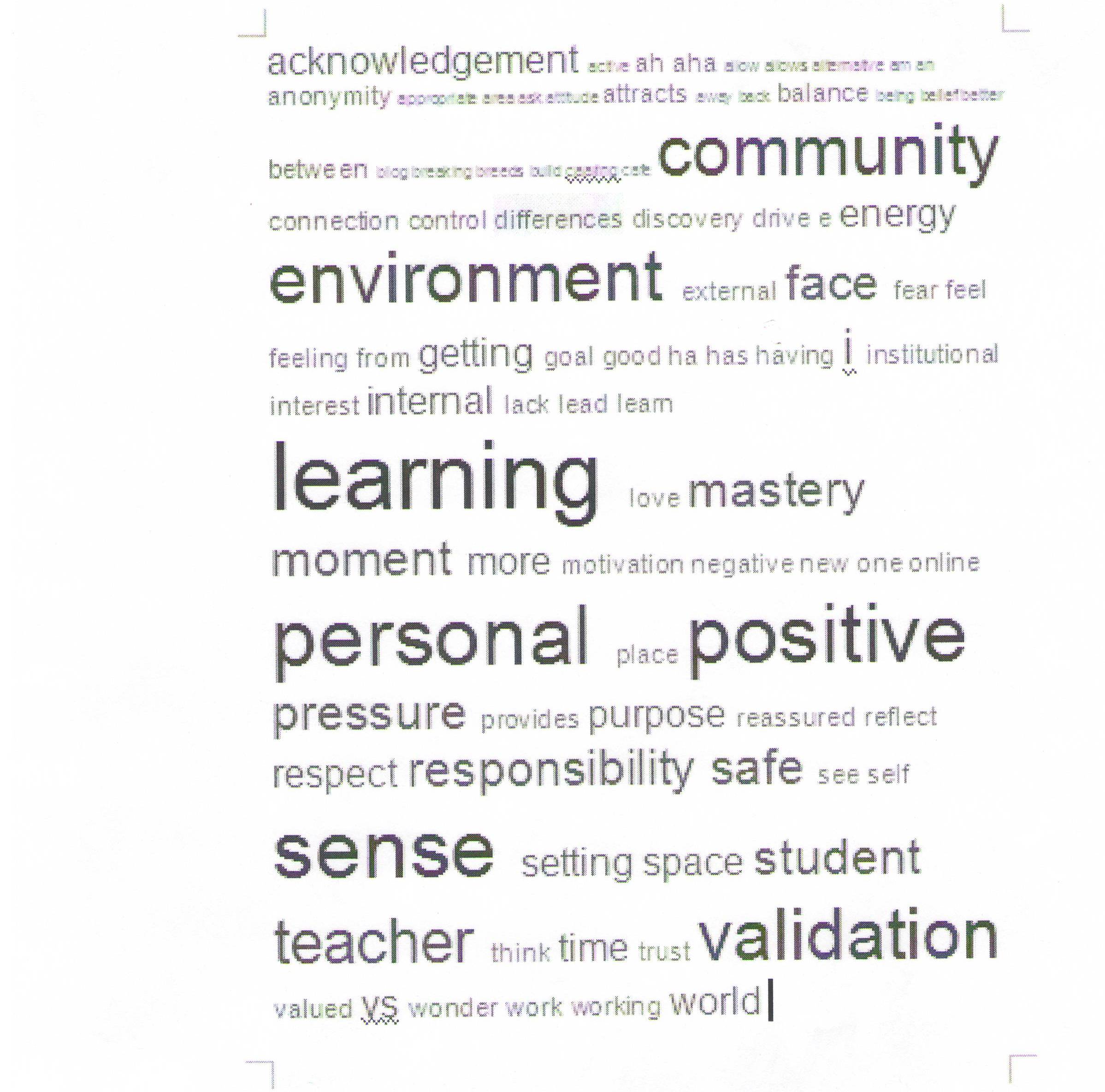
I am using software called NVivo. Essentially, I use it to organize and summarize qualitative data. One cool feature is the ability to create a word cloud. I am experimenting with that feature and using the image facility on my laptop. I summarized some World Cafe events we held in February and March. The results were simply outstanding. The only fly in the ointment was I had to scan the picture and lost the colour.

The overarching question we created our conversation around was: “What engages us in learning?

February 4, 2012

Think of a time that you feel was a high point in your learning. This would have been a time you felt most alive, effective, and engaged in the learning process. Describe how you felt. What made this possible?

February 18, 2012

“Without being humble, describe what you value most about yourself. How does this contribute to the experience of learning for you? What setting does this seem to flourish best in? What would attract you to that setting?”

March 3, 2012

What encourages us to continue learning and see learning as important in our lives?

Questions emerged. I thought the most interesting was an absence in the data. What about teacher expertise in subject area or technical knowledge? It could be these are unstated but assumed necessary. Or it could be that the relational aspect, the art of teaching, is so important to this group of people the technical and subject knowledge is secondary.  What do others think about this?

John Lennon’s Advice on Education

I wonder what education might look like if we followed this simple advice each day for every person who walked in the door’s of our schools?

Imagine a world where we could be happy, responsible, and not deny others their opportunities?

Chair Building

I use this lesson plan as an activity in the Grade 7 Science Structure and Forces unit. The students work in pairs.

  • Students draw a plan for the chair design.
  • Concepts to Include might include corrugation, lamination, and triangulation; design considerations such as arches, beams, trusses, and columns; and show an understanding of what fastening techniques for this design i.e. friction fit, mass, and glue, staples, rope, tape (within reason), or nails or screws (within reason).
  •  Consider properties i.e. stability, brittleness, ductility, hardness, plasticity, compression, and tensile strength.  Students need to consider deformation, structural stress, structural fatigue, and possible structural failure. What are internal forces (mass of materials) and external forces (load on the chair).
  • What role do aesthetics play i.e. symmetry and appearance? What is the chair used for?
  • Students use recycled material i.e. cans, plastic containers, and cardboard (boxes, tubing, and pieces).
  • Students construct and track changes. The original chair design might be altered depending on material availability, functionality, and durability.  They should test the chair as they build.
  • I limit class time to 2-3 classes. Most materials are found at home and students can receive help from family, friends, or neighbours.
  • I email parents and tell them they are consultants, who can offer expertise, guidance, and time unavailable in the classroom. Parents are good about insuring students do the lion’s share.

Students are innovative. One student included pop bottle (he told me it was for pop) holders in the arms of a deck chair. Another student gathered discarded pizza boxes after hot lunch and used those.

Assessment is a rubric. A criterion is I test the chair. Its ability to hold my 250 pounds, give or take, is part of the challenge. Only one chair collapsed under my mass. It lacked support.

This is a Grade 7 project, but I think other can modify it for other grade level needs. Students can work in pairs.

Cautionary note: I allow nails, screws, and tape as fasteners, but within reason. The first time I did this activity a student built a nail chair. He used so many nails it is doubtful they were recycled.

Here are some examples of this year’s chairs.

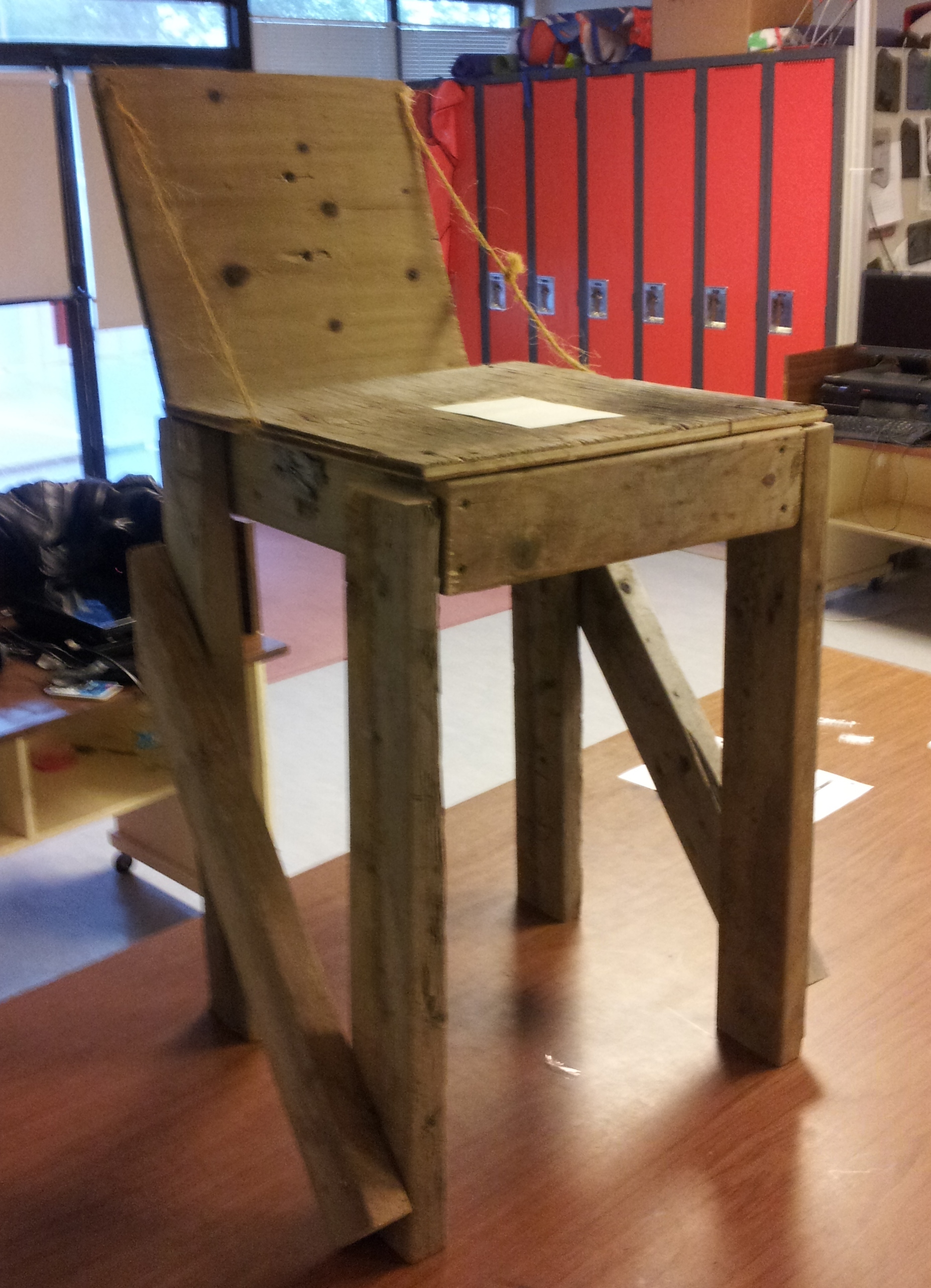
This chair is made from used pressure treated lumber and plywood. The back folds forward and the student used baling twine he got from the farm as the hinges.

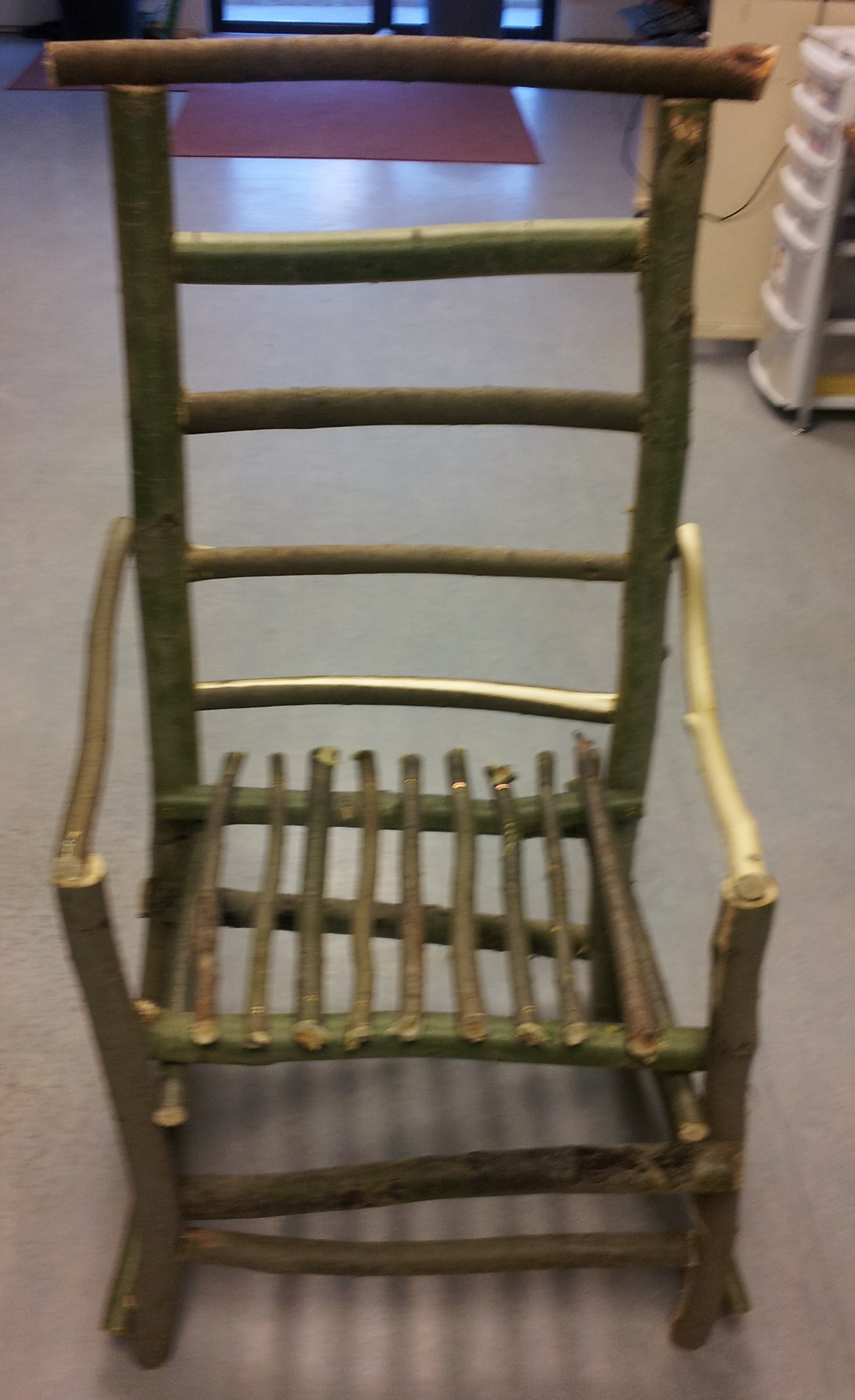
This chair is constructed from willow. The willow qualified as recyclable as the students were going to have to dispose of the willows when they cleared underbrush anyway. The only thing missing is a cushion. These students could go into business selling yard furniture.

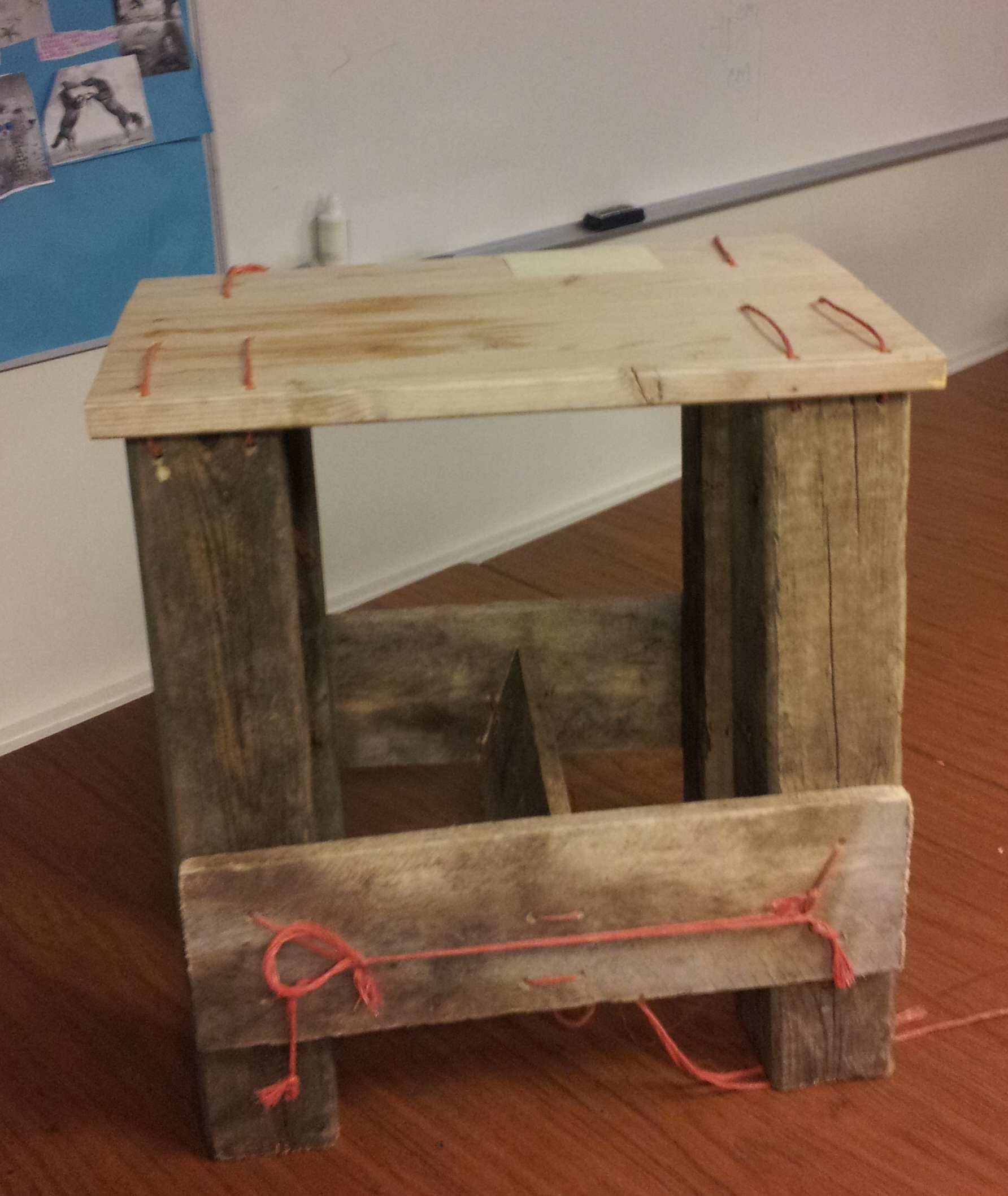
Although this stool did not have triangles for stability, the centre piece helped in that respect. When I sat on the stool, it was wobbly, but with my mass it became less so. The students used baling twine as the only fasteners. One of them has horses and these were available.

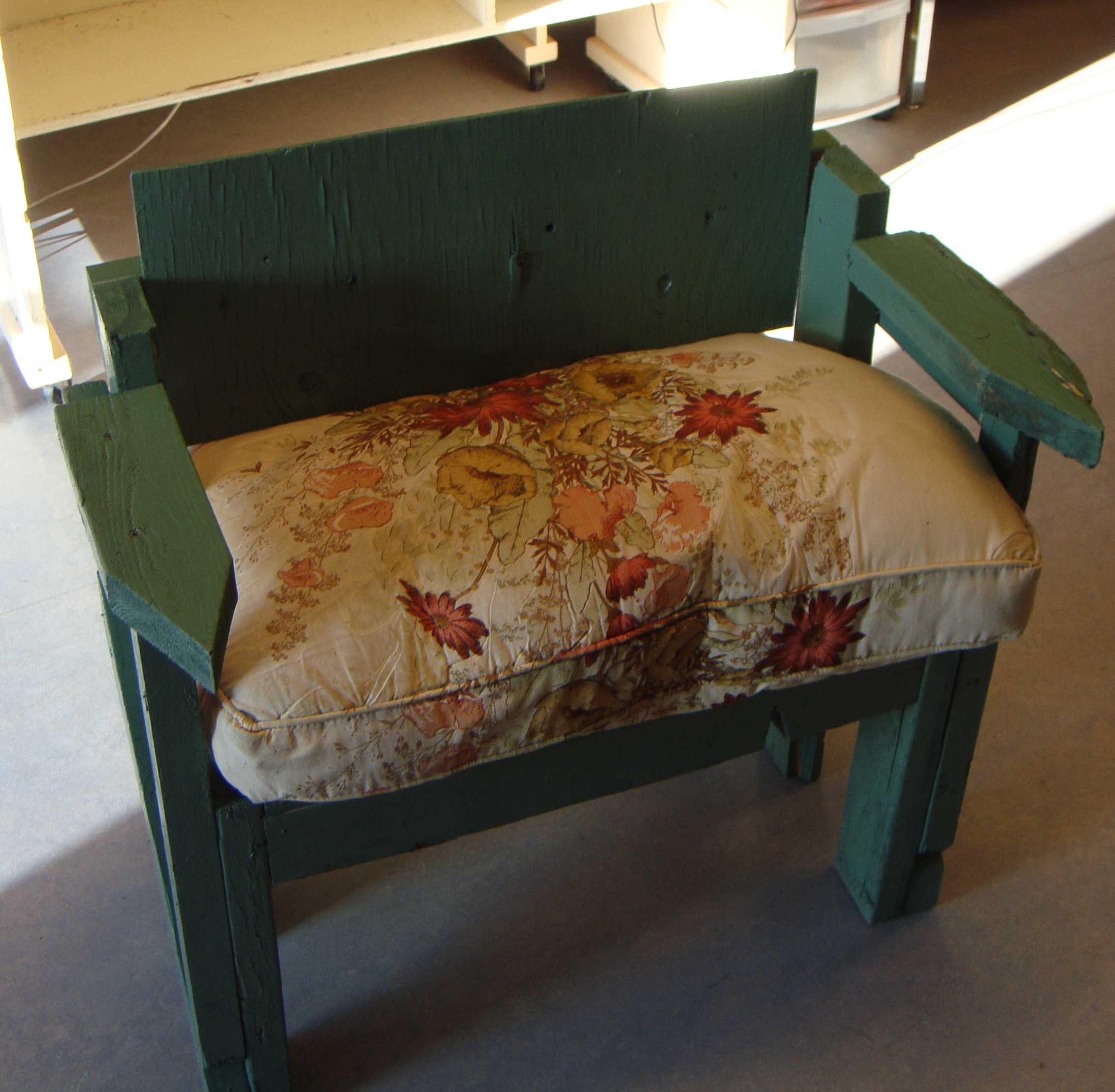
This chair is built from recycled wood and a discarded cushion. The students gathered the wood from the neighbourhood and a neighbour helped. He drilled tap holes for the screws.

Whales Forever

This is not about whales per se. Several years ago, my Grade 8 class struggled with the simple machines unit in Science. I proposed an alternative assessment route. Instead of writing a test, they could apply their learning and build a complex machine. They were all over it, but I had to come up with something and began a search of the Internet. I found an idea called Whales Forever and modified it to fit my needs. It has been a success ever since.

1. Whales become stranded on beaches around the world and Whales Forever is concerned with the survival rate of beached whales. This environmental organization rescues whales and returns them to open water quickly so they will not perish. Whales Forever announced a contest for Grade 8 students to create a prototype machine which would safely lift a stranded whale onto a hover craft so it could be transported back to open water as it receives medical treatment.

2. Students design and build a machine which with a minimum mechanical advantage (MA) of 4. The machine consists of at least two simple machines. Mechanical advantage is calculated output force divided by the input force.

3. The machine will lift the whale a height of 10 cm and lower it 5 cm onto the simulated hovercraft. The whale is simulated by a resealable plastic bag filled with marbles or sand. Students can hand position the ‘whale’ in a harness which is part of the system to begin the lifting process.

4. Students sketch exploratory labelled diagrams of their chosen design including measurements indicating critical components i.e. simple machines used, gears, and drive trains. They provide mechanical advantage calculations.

5. Students use available materials i.e. desks, stools, tables, retort stands. Last year, a student used a Meccano set and this year students used K’Nex. They are not allowed to use a motorized system. They use planes, levers, pulleys, screws, wheel and axles, and perhaps a wedge.

6. Students give a written reflection outlining the strengths and weaknesses of their design including written suggestions for improvement.

7. Students make a 4 minute presentation to the board of directors of Whales Forever.

I use a rubric and assess the design including diagrams, the effectiveness of the prototype, the reflection, and the presentation.

Here are some examples of this year’s products.

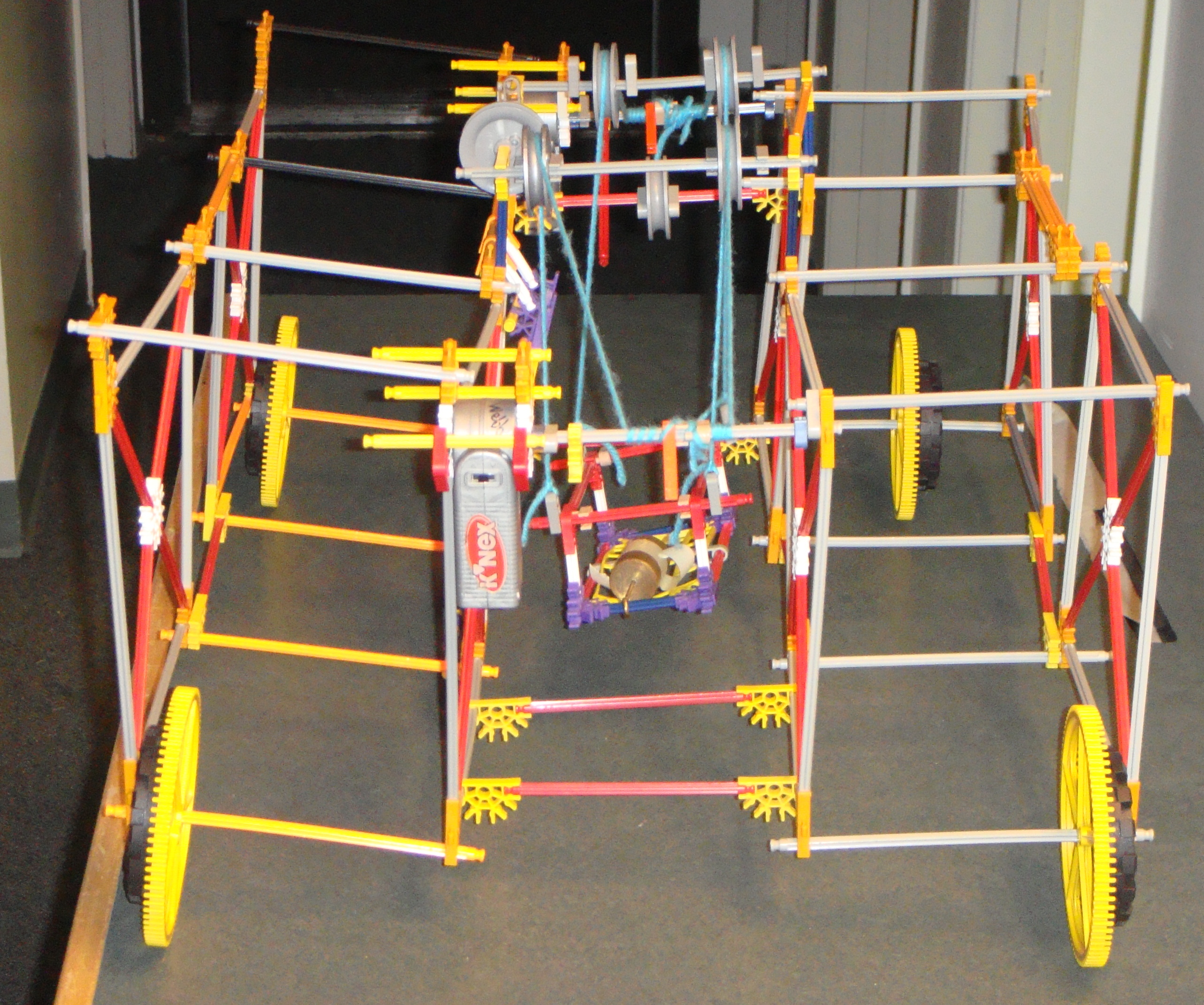
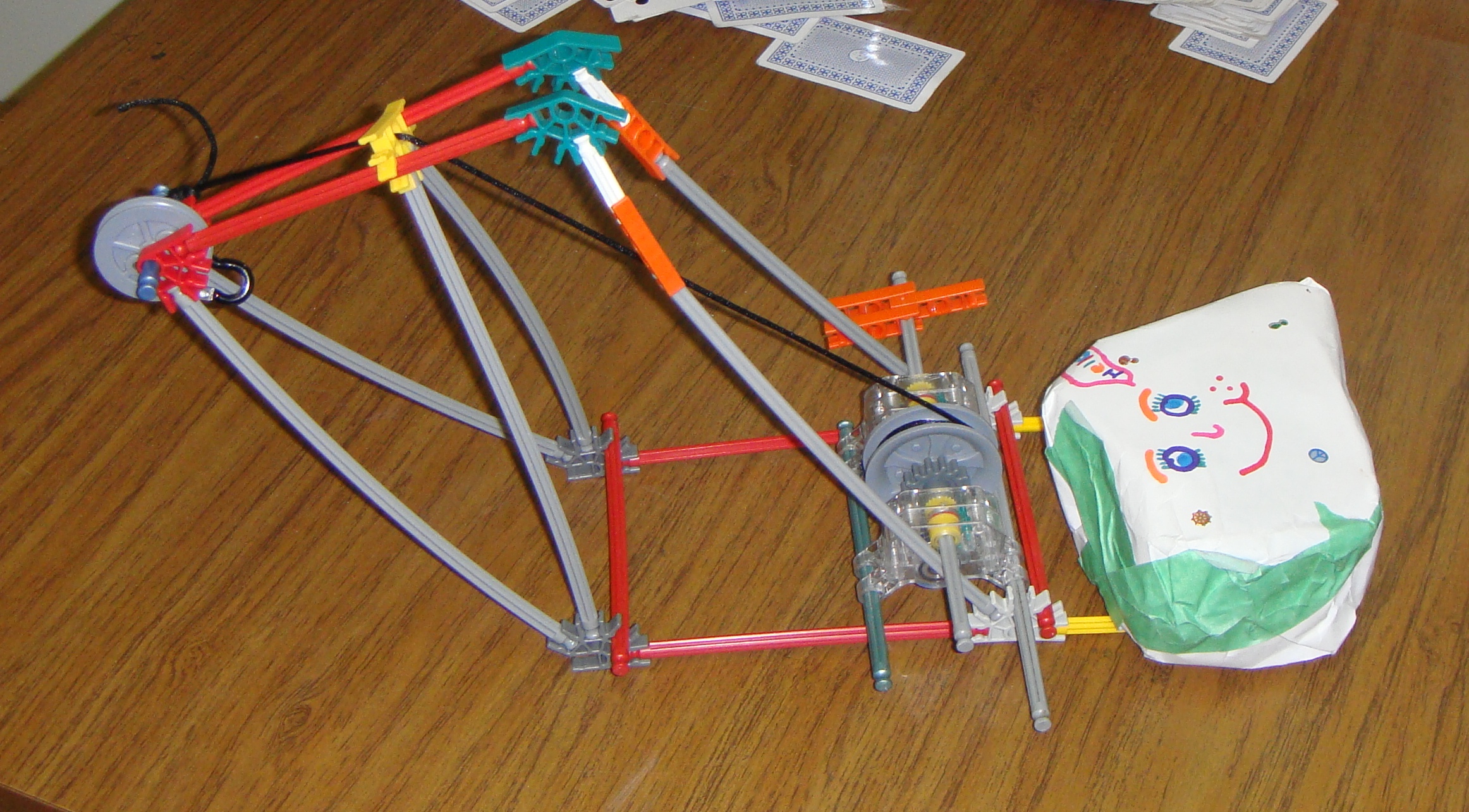
Whale Saver constructed from K’Nex. You can see the harness on this one. It had a mechanical advantage of about 15. The one challenge with the K’Nex is hooking up the scale. It took some maneuvering.

This one was homemade. It had a mechanical advantage of 20.

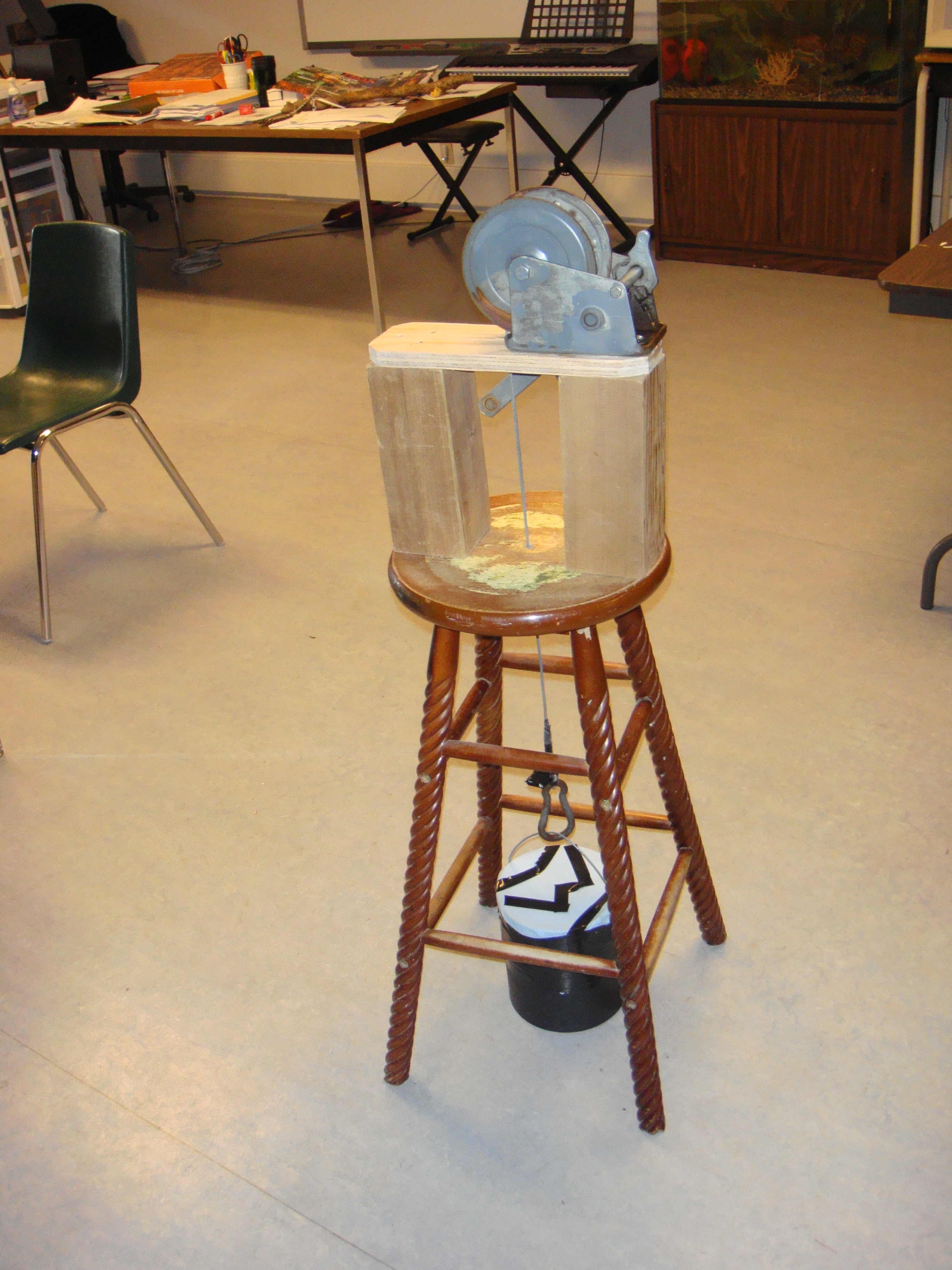
These students used materials from the classroom primarily. It had a mechanical advantage of about 8 or 9.

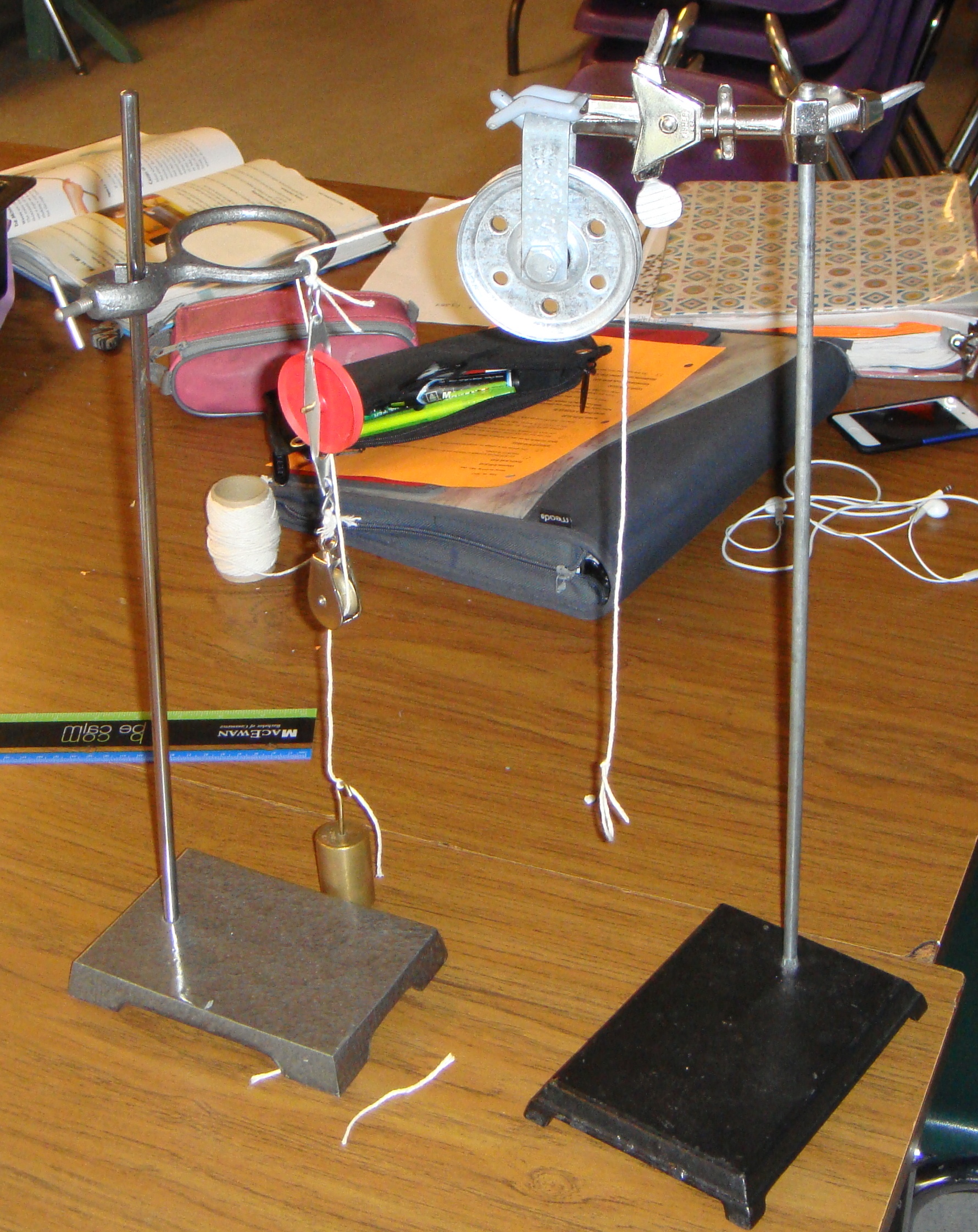
This was another K’Nex design. The thing on the right is a rock wrapped in paper with a face on it. The rock countered the weight of the whale as it was lifted. This machine had a mechanical advantage of about 10.

Blueberries | Jamie Vollmer

Blueberries | Jamie Vollmer.

This is worth reading. It fell into one of my email boxes this morning. In theory, I agree with the idea that we cannot, as teachers, return our students like Mr. Vollmer could return his blueberries. Fundamentally though, there is still a problem. In the province of Alberta. there are over 25% of students who will not finish high school. Those are the ones who leave our schools. What about those who do not leave and finish? There are still some amongst them who are on the margins and school has not served well. The 25% is an average.What about students who live in First Nation communities, in the inner city, or face any number of other life issues?

Education needs an overhaul. There is a genuine need for a different conversation and not sticking our heads in the sand. Please take a few minutes to read.