Tag Archives: education

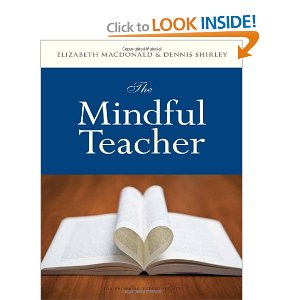
The Mindful Teacher by Elizabeth MacDonald and Dennis Shirley

Last year, I was in a challenging situation and sought a path to continue my teaching and learning journey. Elizabeth MacDonald and Dennis Shirley wrote a book called The Mindful Teacher. I read the book during September 2011.

A thesis was teachers feel alienated working in a system where few “possibilities remain for ethical, caring teachers to hone their craft and to inspire their students with the sheer joy and delight that is found in learning” (p. 2). The authors used teacher stories and personal reflections obtained through The Mindful Teacher Project which involved public school teachers in Boston. MacDonald and Shirley cautioned this was not “a recipe that can be followed, or  a ‘silver bullet’ … it is a form of teaching that is informed by contemplative practices and inquiry that enables teachers to interrupt their harried lifestyles, come to themselves through participation in collegial community of inquiry and practice, and attend to aspects of their classroom instruction and pupils’ learning that ordinarily overlooked in the press of events” (p. 4).

As I read the book, I realized how inattentive I had grown in classroom instruction and about personal growth. Collegial mindfulness has not appeared in a conventional sense, but I discovered alternative spaces i.e. daily meditation, spiritual retreats, World Café Events, and blogging which filled some of the void. I try to pay closer attention to “Who is the self that teaches” advocated by Parker Palmer. I completed a guided study into mindfulness in daily life. Each aspect added mindfulness previously absent in my life.
Amazon Books

Gains: I  have slowed down, reflect more often, and try respond and not react. It is a journey and that is why we call it practice. Each school day, I spend 20-30 minutes meditating. When I am flustered in the classroom, and it happens, I try close my eyes, take a deep breath, and clear my mind before I respond. I refer to those successful moments as the new Ivon. An important gain was teaching is a calling, a vocation. As I read, I was reminded of that.

Questions: What do we do when adults do not trust between one another and that appears irreparable? I assume the authors wrote the book due to a perceived need by the authors. I imagine there are environments lacking trust. What do we do then?

Recommendation: This is short, easy read filled with stories and ideas. From a veteran teacher perspective, it helped me tend to long overdue internal work. A new teacher could use ideas to shape their career. I would recommend it for all teachers and, when done, find a group and have open, joyful, non-judgmental conversations. What brought you to teaching and learning?

For All the Children

Learning, school, education, or life lived; whatever we choose to call the enterprise it is important we live the words of Gary Snyder.

The rising hills, the slopes,

of statistics

lie before us.

the steep climb

of everything, going up,

up, as we all

go down.

In the next century

or the one beyond that,

they say,

are valleys, pastures,

we can meet there in peace

if we make it.

To climb these coming crests

one word to you, to

you and your children:

stay together

learn the flowers

go light

The line which draws my eye and means so much to me, as a teacher and learner, is the one about statistics. Each year, I spend time with the Grade 9 class discussing the average student and the potential absurdity of the concept. Students realize there might, in fact, not be such a person. It might only be the ‘mean of the average.’ In our classroom, is a poster of Einstein. Several years ago, a student asked who the person in the poster was and I answered by saying it was my Dad. I do resemble him, or like to think I do, with the wild hair and idiosyncrasies. We refer to Einstein as Mr. P.’s Dad. His quotes are a marvel and the one I feel fits with the Gary Snyder poem is:

We must take care and insure the stories of each person who lives life is fully heard. We are not numbers. We are the stories come to life. We should always ask, “What makes the number relevant?”

The Space Should Be Bounded and Open

I believe paradox is essential for educational transformation. Parker Palmer described paradox as a creative tension or “a way of holding opposites together that creates an electric charge that keeps us awake” in his book The Courage to Teach. He argued “the poles of a paradox are like the poles of a battery: hold them together, and they generate the energy of life, pull them apart, and the current stops flowing…and we become lifeless.” I elaborated on paradox in my posts Abundant Community and Paradox of Community. I propose paradox be used to revitalize the institution we call school and the conversations about this necessary enterprise.

Parker Palmer in The Courage to Teach presented six paradoxes and identified ways in which they could serve us in the classroom through pedagogical design. I believe they serve educators and their communities as foundations for conversations and a long overdue transformation.

The first paradox is “the space should be bounded and open.” School cannot be a one size fits all approach, but it cannot be a chaotic, wide-open system. There are many ways to understand school from home schooling to traditional. In between, there is diversity. Is school a building? Could it be a virtual gathering? Could it be a combination? Rigid boundaries should be replaced by flexible boundaries. If they do, then we can ask, “What serves the child?” What serves the community?”

Over the next while, I will look at each paradox, and explore how they lead conversations towards transformation.

To parents who follow my blog, this is a great place for ideas on books and Math lesson plans. Darlena has spaced out ideas throughout her blog and it is worth exploring for ideas which support your child’s learning at home. In our unique environment, the LA and Math ideas will be helpful

I enjoyed this critique of Daniel Pink’s book and will read the book. Earlier. Another blog suggested the work emanating from another book by this author, A Whole New Mind, was important to educators and thinkers. Bear in mind, Daniel Pink is not an educator and his last real job, from his website, was as a political speechwriter.

I agree Alfie Kohn, who taught school, or Carol Dweck, a psychologist focusing on motivation, and her book Mindset: The New Psychology of Success,  are invaluable resources for educators.

I think a different understanding unschooling movement is extreme home schooling. Deb Meier acknowledged, in an interview, home schooled children are some of the best socialized children she has met. I think unschooling is an unfortunate descriptor and natural learning, experience-based learning, or independent learning might be less misleading. Instead of discarding the concept, consider questions about education and school’s purpose in the 21st Century. I think there is room for reasonable alternative models in a progressive and increasingly diverse world.

And A Second One Showed Up

Really, it was not me unless…

Some days you just have to have some fun!

One I Could Not Resist

A student posted this on Facebook and it reminded me of students, our sons, and, heaven forbid, even me.

Really, it was not me!

Learning Trajectories, Adult Learning, and Blogs

Last week, I spoke to a colleague about blogging and a professional development project she is undertaking. She is to blog between learning sessions, but she finds this difficult. She feels she is putting herself out there and prefers to write well and coherently with a fully edited product to publish at then end. She is concerned less is expected in the digital world when it comes to adult learning and is uncomfortable with the public exposure of her work under the new norms.

Etienne Wenger wrote about learning trajectories and adult learning in Communities of Practice: Learning, Meaning, and Identity. He proposed newcomers in organizations require time to learn on the job and essentially make mistakes on an “inbound trajectory.” I would extend this to learning in the rapidly changing digital era we live and work in. Inbound learning trajectories also affect veteran, savvy teachers just beginning their use of social media. Wenger alluded to learning as a series of social activities that included support found in and through friendship, intimacy, families, gaming, creative production, and work. My friend pointed out “Old habits die hard. What about spelling? What about grammar? What about the coherency of the message?”

Adults require safe environments for learning, particularly in times of rapid and unabated change. John Murray in Supporting Effective Teacher Learning in American Schools suggested externally driven forms of professional development currently used in schools need change.  Mentors that offer time and non-judgmental support for teachers in applying new technologies are an important step in the delivery and acceptance of embedded professional development in schools. Dovetailing this thinking with inbound learning trajectories is logical in creating safe, supportive adult learning communities.

The etymological roots of technology includes words such as art, craft, and technique and referred specifically to grammar. The writing of blogs is an art and craft. I advised my colleague to hone her craft, perfect the technique, and be an artisan, and actively read, follow, and respond to blogs. Turn to people she trusts whether they are physically or digitally present. Stay true to what you value i.e. good grammar, good spelling, and coherent messages. I use these principles and feel I am slowly moving forward. The blogs I follow, including those on my Blogroll, are well done and professional. It is not enough to just be “out there” for me. I am doing it my way and finding others publishing similarly.

Lessons Learned

I  discovered quickly teaching was about learning more than it was about teaching. Teaching and learning form a paradox. I taught a Grade 4 class for the first four months of my teaching career. What did I learn in those four months?

Students want adults to care about them. This came about in an odd fashion. I wanted students to learn and insisted they complete homework. One particular student rarely did. The result was he stayed after school for a 1/2 hour for help. It only took a few minutes and he would ask for help. He would stand by the desk where he remained for the duration. Once there, he rarely needed my help. What he seemed to need was the feeling an adult cared enough to take time, help him, and, more importantly, be there specifically for him.

Students want adults to know them and eagerly share their stories. When I told them I coached and played various sports, they seized the opportunity and recounted their exploits and activities. I listened during lunch, at recess on the playground, and during class while they shared about their lives. I learned about their families, vacations, and pets. Part of caring was letting them tell me their stories knowing they were heard.

Students wanted to know who I was. My father-in-law passed away that year after a long illness. When I knew I would be away, I sat down with the students, told them about my loss, and I would be away, but I was coming back. The last point was important to them. I was someone important to them, they wanted to know I was coming back, and that I was OK. They wanted to care about adults too, and my story helped made that possible.

Students want to have fun. One day I noticed two large rocks on a classroom counter and asked what they were doing there. A student informed me they were for the rocks and minerals unit in the Science. I returned to my instruction, but after a few minutes, I paused and asked, “Has anyone seen the Rolling Stones?” No one had, but I insisted I had and could produce them live at that very moment. The students doubted me. I picked up the rocks, rolled them across the floor, and proudly proclaimed, “There are the Rolling Stones!”  Every  time an adult came in the room, the students insisted I produce the Rolling Stones for our visitors. They loved coming to school. It was fun.

I wonder how often teachers sit down and recall the ways children taught them? I try now and then. I come away feeling good about what we can learn from the ones we teach.

Subversive Seuss?

Fact is stranger than fiction. Charles Adler, in an op-ed column “We don’t need no ‘educrats'”, pointed out the sometimes subversive nature of Dr. Seuss. There is more to the story than Mr. Adler revealed in his article and a more detailed account is at “Yertle the Turtle Deemed ‘Too Political’ for Fragile Canadian Children.”

I am impressed with the dedicated bureaucratic representative of Prince Rupert [British Columbia] School District who acted to make sure susceptible elementary students were not corrupted by the seditious literature of a beloved, albeit radical, children’s author. After all, those small, impressionable beings will enroll in university level classes to learn about Paulo Freire‘s critical theory or Leonardo Boff‘s liberation theology and we could have a more just, humane world to live in. When I grow up, can I be paid to sit in an ivory tower and be out of touch with the real world? The jurisdiction representative stated “It’s a good use of my time if it serves the purpose of shielding the children from political messaging.” Oh my God, political messaging; what next? What is he talking about?

There is a larger context. The British Columbia Teacher’s Federation and the province of British Columbia are involved in a bitter labour dispute. The teacher was not reading a book to students in the classroom, but the quote was taken by a teacher to a meeting with management.

If there is a political statement being made here, it is in the impact on children’s learning. The book’s line “I know up on top you are seeing great sights, but down here on the bottom, we too should have rights” points to those with the least. Dr. Seuss spoke to the greatest measure of servant-leadership. What growth do we see in those with the greatest needs? When will someone speak for the children and serve and lead at the same time? Will adults need to grow up first so that growth can be fulfilled and measured? Neither side gets a pass here.

Part of the problem for children’s learning is the use of polarizing language in the dispute. Do the children care if there is a management side or teacher side? Are adults locked in a political game replete with childish behaviours to gain real or imagined political advantage while using children as pawns? This suggests questions, not answers. Are these not someone’s children? What are parents doing? What does this say about the state of public education? We talk a good story in education and say all the right things, but I am embarrassed and angry, as an educator and as a citizen in a purportedly democratic country, when I read articles of this nature. What drew us to this vocation? Or is it just a job now? What are the qualities exemplified by great teachers: compassion, caring, collaboration, etc? Are we living up to those when we talk and act this way?

Mr. Adler has this mostly right. What is missing is the following question, “When was the last time some people were in a classroom, rolled up sleeves, and taught children?”