Tag Archives: eloquent questions

A Blog Experiment

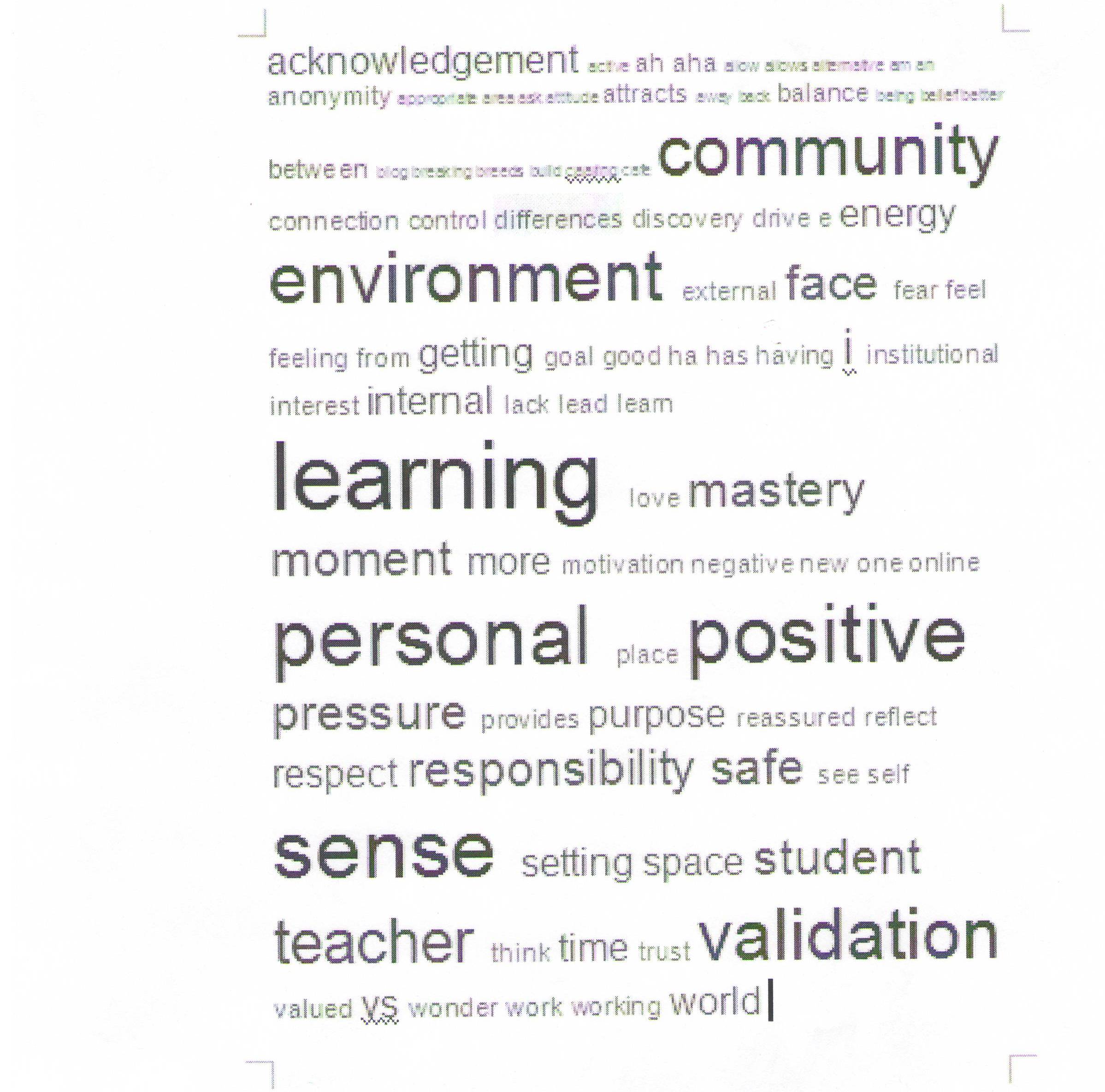
I am using software called NVivo. Essentially, I use it to organize and summarize qualitative data. One cool feature is the ability to create a word cloud. I am experimenting with that feature and using the image facility on my laptop. I summarized some World Cafe events we held in February and March. The results were simply outstanding. The only fly in the ointment was I had to scan the picture and lost the colour.

The overarching question we created our conversation around was: “What engages us in learning?

February 4, 2012

Think of a time that you feel was a high point in your learning. This would have been a time you felt most alive, effective, and engaged in the learning process. Describe how you felt. What made this possible?

February 18, 2012

“Without being humble, describe what you value most about yourself. How does this contribute to the experience of learning for you? What setting does this seem to flourish best in? What would attract you to that setting?”

March 3, 2012

What encourages us to continue learning and see learning as important in our lives?

Questions emerged. I thought the most interesting was an absence in the data. What about teacher expertise in subject area or technical knowledge? It could be these are unstated but assumed necessary. Or it could be that the relational aspect, the art of teaching, is so important to this group of people the technical and subject knowledge is secondary.  What do others think about this?

John Lennon’s Advice on Education

I wonder what education might look like if we followed this simple advice each day for every person who walked in the door’s of our schools?

Imagine a world where we could be happy, responsible, and not deny others their opportunities?

Leadership Is a Conversation – Harvard Business Review

Leadership Is a Conversation – Harvard Business Review. Here is an excellent article form Harvard Business Review. Leading is about a conversation. Leaders need to recognize the importance of listening mindfully and attentively otherwise their role is one of management.

Are educators ready for this? Conversations are much harder work than using glib commentary.

Innovation – A Poem by Ivon

As I drove to work this morning, I considered the phrase “thinking outside the box.” I wonder, “Is the most apt description for innovative or creative thinking?”

When I am inside the box can I really see outside and look around effectively? I could just be hanging on for dear life. Or, when I am outside the box, can I see inside? When I wrote my candidacy paper, I interviewed the first principal of our unique, alternative school and he provided an appropriate metaphor for innovative and creative organizations-a corral fence. I wrote the following poem and tried to capture what I think he meant.

Innovate

A fence

with railings

see in or out

allow perspective.

Flow and rhythm

information in; information out

nourish

enrich

affirm

recycle

breathe and flex.

Part of a whole

complex, yet simple

reach beyond my world

one piece of a puzzle.

Present

to our self

to the world.

Never box me in.

This fit with a song I heard by Ben Harper called With my Own Two Hands. He used to front a band called the Innocent Criminals and that drew me to his music. Enjoy this creative artist.

Professional Learning Communities at Work by Dufour and Eaker

I read Professional Learning Communities by Richard Dufour and Robert Eaker several years ago and attended conferences about the concept. We implemented Professional Learning Communities (PLC) in our school with early, but unsustainable success.

Thesis: The authors proposed “the most promising strategy for sustained, substantive school improvement is developing the ability of school personnel to function as professional learning communities” (p. xi).  Professionally, educators need awareness of emerging research to fuel personal learning and support student learning. Communities form and they foster “mutual cooperation, emotional support, and personal growth as [people] work together to achieve what they cannot accomplish alone” (p. xii). Teachers safely move from isolation and risks are taken extending personal and collective learning when a PLC is effectively implemented, integrated, and supported in a school.

CharacteristicsThis is an annotated version, but successful and sustainable PLCs have six characteristics:

  • Shared mission or purpose, shared vision or what we hope to become, and shared values guiding the process. Shared mission advertises purpose outward. Shared vision energizes staff. Values are personal and community attitudes, behaviours, and commitments which are normalized over time.
  • Collective inquiry fuels the process. What do we want to change? What ways are things as they are challenged? There is collective conversation and personal reflection. The latter is the oxygen that breathes new life into the dialogue and provides fuel through new questions.
  • Collaborative teams provide renewal. Collaboration acknowledges the dysfunctional nature of communities. What do we do when there are dissenting voices and disagreement? What value will we name here?
  • Action and experimentation are always in evidence. “Even seemingly chaotic activity is preferred to orderly, passive inaction” (p. 27). Teachers experiment with emergent ideas making innovation essential in a PLC.
  • Everyone commits to continuous improvement. Questions emerge and are actively sought out, but there are touchstones principles such as “What is our fundamental purpose?”
  • With continuous improvement and action orientation there is an iterative process in the form of quantitative, qualitative, or mixed research. The object is to shake up the status quo and find new ways of safely supporting both staff and students. What are we doing that we want to change? (pp. 25-29)

Questions: Who has had success in implementing a PLC in their school or jurisdiction? What were the important takeaways including what worked and what did not work? What did you do to overcome the bumps along the way? What can a school starting or restarting the process do to sustain energy and get early work done successfully while recognizing the achievements even when they are small?

Recommendation: The book is about 300 pages, but is an easy read. The authors synthesized leadership literature inside education i.e. Lezotte, Sergiovanni, and Fullan and outside education i.e. Bennis, Senge, and Deal and Kennedy and saved some reading.

I recommend the book for those ready, willing, and patient enough for a transformative journey. The process requires time and immediate classroom benefits to sustain it. Cultural change is messy and requires leadership, perhaps previously untapped in education. Effective support and communication are required for sustainable, successful results to emerge. Early conversations focused on mission, vision, values and normative behaviours are uncomfortable, but necessary. My questions attempt to flesh out these concerns, as we are embarking on this journey again.

I know schools in Canada, the USA, and internationally have successfully implemented PLCs and I want to draw on the experience and wisdom already in place. I am looking for process and product, but not a cookie cutter formula per se. I look forward to hearing from many of you.

Dufour, R. and Eaker, R. (1998). Professional learning communities at work: Best practices for enhancing student achievement. Bloomington IN: National Educational Services.

Paradox in Educational Transformation – 2

I believe the second paradox proposed by Parker Palmer works in concert with the first paradox. “The space should be hospitable and ‘charged'” while being bounded and open. People “feel free to speak, but their speaking is always guided towards the topic … the open space is liberating [as it is] inviting, as well as safe and open” (p. 77). The negotiated contract is a covenant built through trusting and honest relationships where participants find their voices. “The space must also be charged. … No special effects are required to create this charge – it comes with the territory. We only need fence the space, fill it with topics of significance and refuse to let anyone evade or trivialize them” (p. 78).

I believe lessons learned from Finland’s educational experience, therefore the topics of significance here, was recognizing public education is a fundamental human right for each child and providing equal and unfettered opportunity for each child. Through open and safe conversation, implementation strategies uniquely suited to each community is revealed. People respectfully share their views in a safe, bounded, expansive, and invigorating space where they feel welcomed and honoured. The space honours each person’s truth as each person, in turn, respects the truths of others.

What can we do to create this space?

Reference

Palmer, P.  (2007). The Courage to teach: Exploring the inner landscape of a teacher’s life. San Francisco: Jossey-Bass.

Do Not Go Gentle Into That Good Night – Dylan Thomas

I sat quietly this morning after another poor night’s sleep. Initially, my ‘monkey mind’ chattered and cast blame to roil the waters and it difficult to find calm. Slowly, my mind became quieter and ideas flowed more easily. First, I asked, “What is causing these uneasy feelings?” I turn to that question more often in times of discomfort and dis-ease and I am often surprised by the answers.

I posted last night about my growing belief a different culture and conversation is needed for educational transformation. We need ‘safe containers’ for conversation about real and lasting change to occur. The change will not duplicate another educational model or be ordered from on high. We serve community needs and needs of children. I am fortunate. I learned and taught in just such a setting alongside colleagues, parents, children, and community members and real change happened through wonderful conversation. The words learned and taught signify a feeling that I rarely felt what we did was work. Life is transient and this place no longer exists except as a cherished memory.

I read a posting through a group I follow on LinkedIn about saying good-bye. The author quoted Dr. Seuss and I know the social commentary this subversive children’s author provided. The message was when the end comes we need to celebrate the accomplishments that led to that ending.  Mark Anielski, an economist, suggested teachers should conduct satisfaction surveys as students graduate, even between grades. When something or someone changes, and this is life, we should celebrate it as a new chapter in life. I can choose the positive over the negative and make a difference in the world I choose as Gen Y Girl suggested. After all, I am not a tree.

Yesterday, a Grade 7 student brought the Dylan Thomas poem in the title to school and asked if I would share it with the class. I asked what it meant to this Grade 7 student, but got no clear answer. I wondered what metaphor of life it offered me? Dylan Thomas wrote it for his dying father, but that is not my case. I sat quietly and the lines “Do not go gentle into that good night” and “Rage, rage against the dying of the light” did offer a life metaphor. When something good changes, my response is critical. Is it one of blame or fault? Was I silenced, or did I choose silence? Did I excommunicate my self. A sad lament of death I see as a request to live my life fully. I lose what I allow to be taken. Is it possible to raise one’s voice in silent protest? I think so, but it is not a silence of retreat, despair, and oppression.

I sat and waited for my inner teacher to share my truth while honouring the truth of others. I leave you with the poem. Choose your metaphor. I choose one of celebration otherwise I live a death, instead of life, due to my choices.

Do not go gentle into that good night,
Old age should burn and rage at close of day;
Rage, rage against the dying of the light.

Though wise men at their end know dark is right,
Because their words had forked no lightning they
Do not go gentle into that good night.

Good men, the last wave by, crying how bright
Their frail deeds might have danced in a green bay,
Rage, rage against the dying of the light.

Wild men who caught and sang the sun in flight,
And learn, too late, they grieved it on its way,
Do not go gentle into that good night.

Grave men, near death, who see with blinding sight
Blind eyes could blaze like meteors and be gay,
Rage, rage against the dying of the light.

And you, my father, there on the sad height,
Curse, bless me now with your fierce tears, I pray.
Do not go gentle into that good night.
Rage, rage against the dying of the light.

The Contract – A word to the led by William Ayot

And in the end we follow them-

not because we are paid, not because we might see some advantage,

not because of the things they have accomplished,

not even because of the dreams they dream

but simply because of who they are:

the man, the woman, the leader, the boss

standing up there when the wave hits the rock,

passing out faith and confidence like life jackets,

knowing the currents, holding the doubts,

imagining the delights and terrors of every landfall;

captain, pirate, and parent by turns,

the bearer of our countless hopes and expectations.

We give them our trust. We give them our effort.

What we ask in return is that they stay true.

With leaders who are at times pirates, we can colour outside the lines and think outside the box. Organizations, institutions, and communities want leadership.  Exploration of past times included pirates who navigated new and treacherous waters and helped find new nautical paths past the visible horizons. Yesterday, someone told me a recent comment I made about a need to name school and community values was received with openness and yet I felt that openness was not reflected by the group. Leadership is speaking one’s truth while honouring truths of others. It is a respectful rather than  ‘relativism gone wild.’ What can each voice add to the conversation? It is lonely and dangerous being a pirate without others helping in the navigating.

Seeing the Ordinary as Extraordinary

During a recent conversation with an acquaintance, we discussed the concept of seeing the ordinary as if it were extraordinary. She commented, “If we could do that, imagine the joyfulness in the world!” I try observing the world through this lens and some days I catch a glimpse of the extraordinary elements of my life. Let me offer examples of this joyousness and its synchronous nature.

I listen to a wonderful little radio station, CKUA. When I get in the car, it is on and I usually pay at least superficial attention to the songs. I love Blues, Soul, and Gospel music and on three particular mornings I was welcomed into my car by great music. On Thursday, Lead Belly sang Grey Goose; on Friday Nina Simone sang Feeling Good; and on Saturday, Commander Cody and the Lost Planet Airmen sang Oh, Mama, Mama. I confess I was not feeling upbeat Friday when Nina Simone came on, but I was aware of the generous message and found space to feel better. Each song appealed to me and seemed to sooth a restless and weary soul.

Saturday morning I met with three friends and, during the conversation, we talked about my blog. One person commented it seemed two different people wrote at times. I pointed out some postings are academic and fit with my doctoral journey. When I write about a need for Eloquent Questions in Education, my voice is, hopefully, more scholarly. When I share about a paralyzing fear of heights in Images to Provoke Thoughts, I try to personalize and humanize the self, Ivon, who writes, but my complexity is revealed. I explained Kathy proofreads and edits many postings. She does an amazing job of cleaning up conventions and keeping the message on track. I am challenged to acknowledge and express my gratefulness, as well as I should.

Frequently, I take for granted both the complexity of my self and who I am, and the important, sustaining relationships in my life, rendering them ordinary. Both are extraordinary and help me observe and understand the self when I contemplate, “Who is the self that teaches?” Parker Palmer offered this question and I try to extend it further to ask, “Who is the self that lives this life?” I think these are critical questions because, without self-awareness, what possibility of transformation exists? I follow Cooperative Catalyst and they posted Why Transformation May Hit a Snag: Observations from the Field. Two questions emerged from the article for me, both about self-awareness. First, what am I doing to transform my self? Second, what values guide this transformational process? Gandhi proposed, “Be the change you want to see in the world.” Being aware and present to my self and those who matter most in my life are essential steps. Some days are better than others and the ordinary becomes extraordinary.

21st Century Renaissance in Education

Will we be 21st Century Renaissance people? This question emerged from a recent conversation with a Grade 8 Social Studies class. We discussed a broad, nuanced, and emergent worldview.

Specialization and expertise are not the calling cards of success. Adaptation and transformation are at the heart of contemporary education. Transformation is not just a synonym for change and is reflective of  dramatic and systemic change. I understand transformation as a mindful, incremental process producing real change over time framed around evolving eloquent questions. What change do we need? New conversations about reimagining education producing compassionate leaders for a 21st Century Renaissance. What role will education play in helping young people become the leaders of this Renaissance? Is public education capable of transformation? Are there leaders capable of bringing forth tomorrow’s leadership? What will education of this nature look like?

Renaissance is rebirth and a time of metamorphosis and transformation. What emerges from the chrysalis stage? Ideas mature and become capable of further adaptation.  Human endeavour requires rich, inclusive conversations for profound change to occur instead of  superficial patching what the outdated models that exist. We need to prepare the soil for transformative conversations focused on eloquent questions where answers are not assumed before the conversation and invite diverse views during the course of the conversational journey.