Tag Archives: mindfulness

Reading and Blogging

I love to read a good book. I feel I have conversation with the author. As Carl Sagan suggested, I hear the voice of the author. It is the same with blogs. Each time I read a blog, look at its pictures, or both, I feel I am listening to the person share something special about their life with me and the world. Blogs break both the shackles of time and space.

I am grateful.

One glance at a book and you hear the voice of another person -perhaps someone dead for thousands of years. Across the millenia, the author is speaking, clearly and silently, inside your head, directly to you. Writing is perhaps the greatest of human inventions, binding together people, citizens of distant epochs, who never knew one another. Books break the shackles of time.

~Carl Sagan

You Reading This, Be Ready by William Stafford

To be present and aware in the world is a rare gift. Here is a gift from William Stafford.

Enjoy.

Companions – by Ivon

I occasionally forget what got me where I am today. I follow a blog called Slappshot and its author poses questions. Recently, he asked, “What’s your line of work and if you could choose another career…what would it be?

I responded, “I would not want to change anything, but, if I could keep everything else in tact, I want to be a professional hockey player.” You see what I have is very good. Yes, I struggle with things each day, but around me there are people who care and this poem is for them. I am learning to focus on the positive in life instead of the negative.

 Each morning

Awaken

Tentatively step forward

Discover voice

Discover meaning

That which nourishes, waters, and heals the soul

With those who stand with you

For you

By you

Share the journey

Break bread

Mutual, Reciprocal, Companionship

A refuge in each other

Speak mindfully, heartfully, graciously

Hear mindfully, heartfully, graciously

Your self and the other present.


The Gift of Love – John Lennon


We’ve got this gift of Love, but Love is like a precious plant. You can’t just accept it and leave it in the cupboard or just think it’s going to get on by itself. You’ve got to keep watering it. You’ve got to really look after it and nurture it.

~John Lennon

Paradox in Nature

I found these picture of a small lake in the Crowsnest Pass when I was looking at the pictures I posted at A Time to Listen. Nature is a spectacular and paradoxical part of creation and I hope this is revealed in the following.

Green, aqua, granite

Nature draws from her palette

Drawing me to her.

Water cascading

Suddenly appears out of rock

Disappears again.

Calmness and chaos

Nature speaks in paradox

Harmony emerges.

A Time to Listen – Visually and Poetry

Kathy and I travel. We spend time during the summer touring Alberta, British Columbia, Saskatchewan, and adjoining American states. This summer we are revisiting Waterton Lakes National Park as part of my rehab. We travel through this area regularly and it brings back great memories.

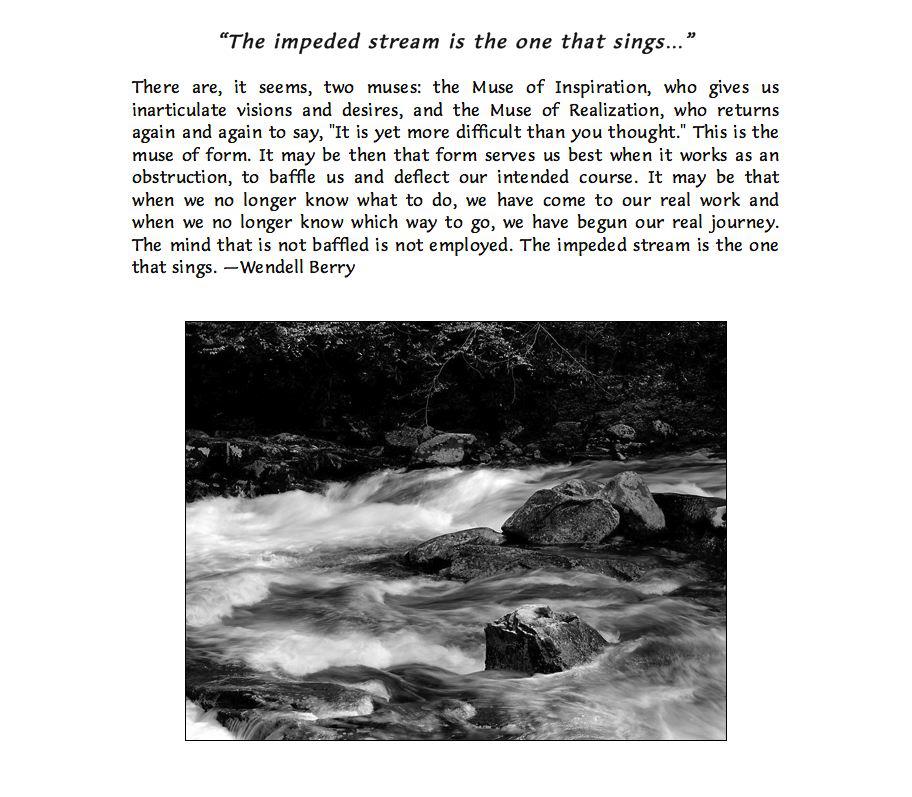
On one trip, we stopped at a provincial park just above Lundbreck Falls. Recently, I went through pictures of the Crowsnest River downstream and it reminded of what I notice and don’t notice in life. Wendell Berry wrote a beautiful piece: The Impeded Stream is the One that Sings. I realized I  heard the river before I saw it. I recalled the life around the river: cottonwood fluff flying, flowering wild rose, insects pollinating, and a musky smell perhaps of a bear recently by. The river is a living instrument sharing a song to others forming a web of life.

I read Wendell Berry’s words while reliving the picture and was inspired to write a Haiku.

Observe life’s current

Pausing, listening, caring

Present with my self.

Autobiography in Five Short Chapters by Portia Nelson

A medical practitioner I visit once a week to try resolve some issues with chronic, physical pain was the source of this wonderful, insightful poem. Whether physical, emotional, spiritual, or intellectual, I fall into habits and absolve my self of responsibility f or my actions.
Autobiography in Five Short Chapters
Chapter 1
I walk down the street.
There is a deep hole in the sidewalk.
I fall in.
I am lost … I am helpless.
It isn’t my fault.
It takes forever to find a way out.
Chapter 2
I walk down the same street.
There is a deep hole in the sidewalk.
I pretend I don’t see it.
I fall in again.
I can’t believe I am in the same place.
But it isn’t my fault.
It still takes a long time to get out.
Chapter 3
I walk down the same street.
There is a deep hole in the sidewalk.
I see it is there.
I still fall in … it’s a habit.
My eyes are open.
I know where I am.
It is my fault.
I get out immediately.
Chapter 4
I walk down the same street.
There is a deep hole in the sidewalk.
I walk around it.
Chapter 5
I walk down another street.
 
~ Portia Nelson ~

Teachers as Storytellers

Think of the people we call teachers, not just in classrooms but in every facet of our lives. A quality they share is storytelling. They connect with our hearts and minds. We laugh, cry, yell, and carry on in every imaginable way with them. We remember them not because of what they taught us, but what they revealed about themselves and helped us discover about our self.

The best teachers are the best storytellers. We learn in the form of stories.

~Frank Smith

The Violence of Modern Life

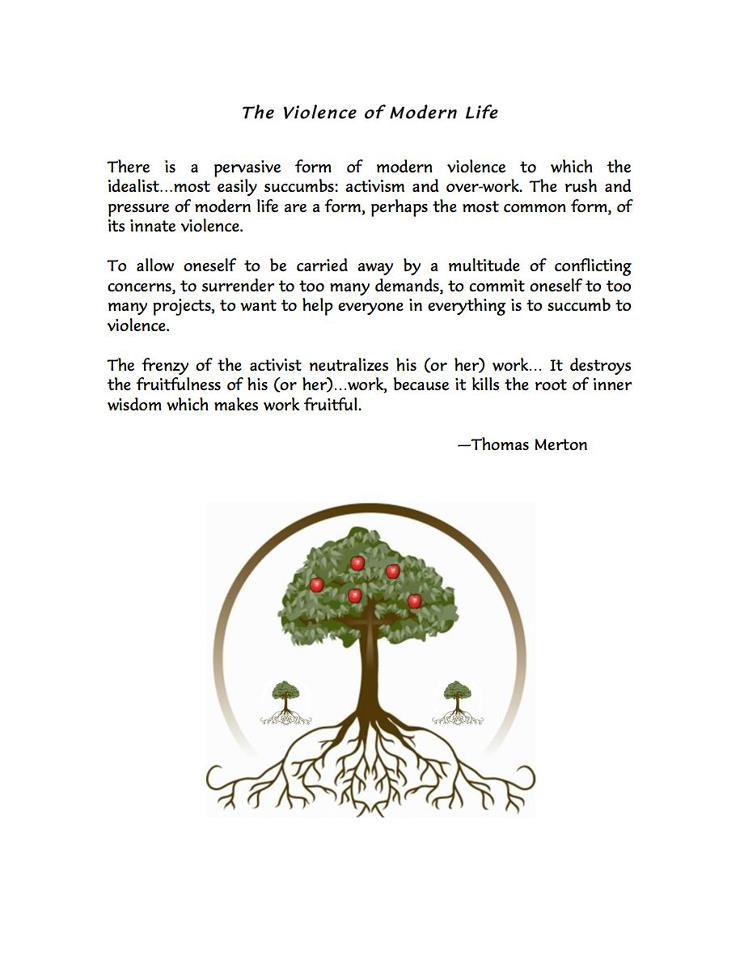
Thomas Merton is one of my favourite authors and spiritual thinkers. He offered a radical definition of violence. This sounds like the opposite of multi-tasking, single-tasking. I hope I can do better as I move forward and take time to listen to the inner teacher and its wisdom.

Parker Palmer shared this with those of us who follow him on Facebook.

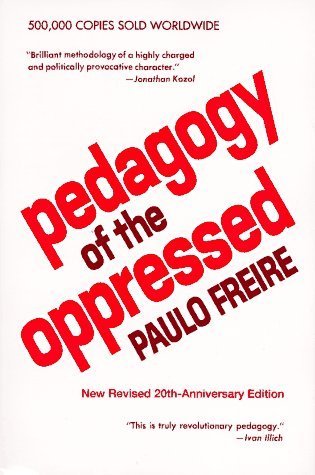
pedagogy of the oppressed by Paulo Freire

I read pedagogy of the oppressed by Paulo Freire during my undergraduate experience and return to it as a source of reflection and when I write. Similar to Parker Palmer, Paulo Freire left an indelible mark on my life’s practice. Education is an uplifting, liberating experience which shines light on each step Antonio Machado described: “Wanderer, your footsteps are the road, and nothing more; wanderer, there is no road, the road is made by walking.” Freire’ s contention was everyone can act as an agent in their learning thus freeing them and transforming the world they live in.

Freire used the Portuguese word conscientização which “refers to learning to perceive social, political, and economic contradictions and to take action against the oppressive elements of reality” (17).   Humans become mindful of and present in the world and act to transform it. Freire used a banking metaphor and described traditional education where  knowledge is deposited into students. Teachers and the system act oppressively in determining what is important to learn. Freire felt education uplifted people and their learning. “Liberation is a praxis: the action and reflection of men and women upon their world in order to transform it” (p. 60).  Learning occurs when  compliance and conformity are rejected in favour of dialogue based on love which allows each human to name their world and what is of value in it. The student is a teacher and student; the teacher both student and teacher.
Questions: What can we do to truly bring a new pedagogical structure into our schools and communities of learning? What function would school play in this pedagogical structure? What is dialogue based on love?  What role do educators and communities play in liberation education?

Recommendation: I love the book. It is a challenging, but I return to it often and find something new each time. Today, I became aware of the following: “Concepts such as unity, organization, and struggle are immediately labeled as dangerous. … These concepts are dangerous—to the oppressors” (p. 122). What does this mean in supposedly modern, liberated, and affluent societies?

A second point was the similar language used by Freire and Martin Buber. There is a shared understanding of respectful dialogue using the words I and Thou to describe the uplifting, liberating, loving dialogic process.

Freire, P. (1993). pedagogy of the oppressed. (M. B. Ramos, Trans.).  New York: Continuum.