Tag Archives: nature

Lost

I sometimes feel lost in the world, without bearings. David Wagoner counseled that when we feel lost to stop and listen to the world, as if it were the forest and a powerful stranger able to speak to us.

When I stop and pray, I ask someone for help, but, if I rush on, without listening, the prayer cannot be answered. I pose a question that I cannot answer. Prayer is not just speaking. My heart opens and receives what is returned to me.

Is it in the form of words? Or, is it the gentle breath that is hardly perceptible? When I am mindful and listen to listen, I intuitively sense differences. Mindfulness becomes an attentive and sensitive way of life, as opposed to just happening.

Stand still. The trees ahead and bushes beside you
Are not lost. Wherever you are is called Here,
And you must treat it as a powerful stranger,
Must ask permission to know it and be known.
The forest breathes. Listen. It answers,
I have made this place around you,
If you leave it you may come back again, saying Here.
No two trees are the same to Raven.
No two branches are the same to Wren.
If what a tree or a bush does is lost on you,
You are surely lost. Stand still. The forest knows
Where you are. You must let it find you.
Wild Geese

Mary Oliver is one of my favourite poets. I find her poems call me to spend time, reflect quietly, and read them anew many times. I think what I consistently get out of her poetry is that we are not alone in the world.

We live together, but it is not just a human world. It is a world full of other beings, objects, and roles that shape our lives and we, in turn, shape the world. Most of the time, our relationships with the world, others, and things is unconscious. The world exists out there somewhere in taken-for-granted ways.

When we are mindfull and present, we notice the world. Mary Oliver uses the words harsh and exciting, but we are not accustomed to the novelty that continuously emerges and, when it calls, it seems harsh. As we live more fully, the world calls to us and we hear it. The harsh sounds help us remain attuned to the world.

The world excites us with its refreshing newness. We discover the extraordinary in the ordinary; what we have taken-for-granted.

You do not have to be good.

You do not have to walk on your knees

For a hundred miles through the desert, repenting.

You only have to let the soft animal of your body

love what it loves.

Tell me about despair, yours, and I will tell you mine.

Meanwhile the world goes on.

Meanwhile the sun and the clear pebbles of the rain

are moving across the landscapes,

over the prairies and the deep trees,

the mountains and the rivers.

Meanwhile the wild geese, high in the clean blue air,

are heading home again.

Whoever you are, no matter how lonely,

the world offers itself to your imagination,

calls to you like the wild geese, harsh and exciting . . .

over and over announcing your place

in the family of things.

Angels In Your Head

“You wouldn’t believe what once or twice I have seen.  I’ll just tell you this: only if there are angels in your head will you ever, possibly, see one.”  – Mary Oliver I consider eagles…

Source: Angels In Your Head

Mimi writes about eagles being a spirit animal and her good fortune in having 46 of them guide her on her walks. We live in Alberta where bald eagles fly over the east slopes of the Rocky Mountains as they migrate from their winter and summer nesting areas. When we visit the farm, we see the Rockies from the highway and a pair nested there each spring and fall. For us, it was a rare sighting.

Last weekend, we drove home from a birthday party west of Edmonton. As we drove, there was a bald eagle in the ditch. I think it is unusual to see them this far east of the Rockies and it might be that spring is arriving a bit early.

Mary Oliver’s quote at the top calls us to be mindful and attentive. Every now and then, we see the unexpected, as if we had angels in our heads. In those moments, we sense that something is different, and not just see, and turn in the right direction.

nature is never finished. – robert smithson

out walking with the kinders we happened upon a white swan happy and in between seasons. the same as us.

Source: nature is never finished. – robert smithson

When I saw the title of Beth‘s post and read her poem, I thought what a profound moment. Nature has many stories to tell us and many ways of telling them that leave a mystery in each story. We are always between the moments and seasons that desribe the beauty of nature and who we are becoming.

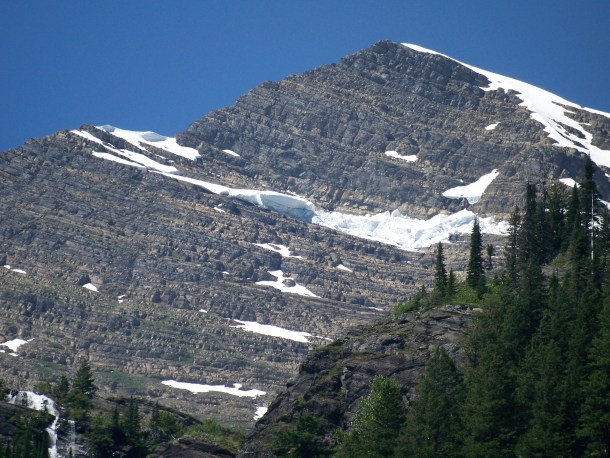
Several years ago, I took a picture of a mountain face. I did not have any idea why I took. It just spoke to me, like the swan in Beth’s poem. I used the picture in a presentation about eco-ethics, after I read an article about geologists who use the striations of a mountain to allow it to tell them its story, knowing it can never be completely told.

When I look at that picture, the mountain tells an even less complete story. The mystery in the story is what draws me back to the picture and maybe is what drew me, without knowing that, when I took the picture.

Mountain's Layers

Prayer to Mansur Al-Hallaj

Source: Prayer to Mansur Al-Hallaj

Prayer is about listening to the world and is part of an internal conversation. The Sufi prayer is about listening closely. Each stanza of the poem begins with a word that entreats God guide me in sensing the world more deeply, not as something I hear, but as something all my senses are able to engage with.

We think of leadership as action and speech, but it is about sensing the world in a sensitive and mindful manner. Leadership is about a conversation and the questions we ask. It opens up space where there are no preconceived answers and followers can be part of conversation and lead, as well. Leadership and its communication is about community, a gathering of people who do not always agree, but hold something in common.

Types of Rose Flower by Color – Red Rose Bud

Hold fast to dreams For if dreams die Life is a broken-winged bird That cannot fly. Dreams by Langston Hughes

Source: Types of Rose Flower by Color – Red Rose Bud

When I taught, I used this poem and Mother to Son written by Langston Hughes. The two poems carry deep thematic meanings about living life, having dreams to follow, and not making excuses when we come up short. I found that for junior high students these themes were important and helped them focus on how they were becoming adults.

Dreams give us a way to imagine we can figuratively fly in life. Mother to Son reminded us that it was not always easy to follow those dreams.

The red rose buds in the pictures add to the imagery about how fragile dreams are in real-time. We need to nurture them and bring them to life as we feed them.

Hold fast to dreams

For if dreams die

Life is a broken-winged bird

That cannot fly.

Hold fast to dreams

For when dreams go

Life is a barren field

Frozen with snow.

The Other Kingdoms

Mary Oliver writes such wonderful poetry, even when it looks like prose. I find a depth in the words and spaces that calls me to reflect upon the cultural and personal constraints that surround me. Certainly, I need those constraints. They guide me through the moment-to-moment actions of my daily life. I need those words that help me make sense of the most immediate world that I often take-for-granted.

What if I lived in the north? I would need those many words and an awareness of what the snow told me to survive. I read today that mother orangutans spend 7-8 years with each offspring. During that time, the mothers appear to teach the ways of life necessary for the offspring’s survival. I say appear, because we cannot communicate with them well enough to know with certainty. There is something mystical about that existence that cannot be fully grasped. So even in the orangutan world, there is a culture and communication that helps them negotiate their terrain instinctively.

I love the line “Their infallible sense of what their lives are meant to be.” Just like the lilies of the field, those other kingdoms exist in ways that allow the world that includes us to grow sweetly wild, when we are attentive and mindful to the world.

Consider the other kingdoms. The
trees, for example, with their mellow-sounding
titles: oak, aspen, willow.
Or the snow, for which the peoples of the north
have dozens of words to describe its
different arrivals. Or the creatures, with their
thick fur, their shy and wordless gaze. Their
infallible sense of what their lives
are meant to be. Thus the world
grows rich, grows wild, and you too,
grow rich, grow sweetly wild, as you too
were born to be.

Looking for the Differences

Tom Hennen wrote about the differences that can fill our senses each day. Sometimes, humans do not notice what is different as differences can hide in nooks and crannies of our daily lives. When we do sense the differences, they can excite our senses and call us to take care around them. In their daily existences, these things are “royalty in their own country.”

The words thing and objects used in the poem can be replaced by persons and subjects. How many people do we miss and avoid, because they look, speak, and act differently? There is a strangeness in the royalty of the other that calls upon us to question not them, but our self.

Hans-Georg Gadamer suggested that when some one or something different shows itself humans pull up short. Jacques Derrida and Emmanuel Levinas wrote that when the stranger appears at the door the host is faced with a paradox of unconditional responsiblity and risk. When we greet the stranger and what is different, we do so with uncertainty. The words host, hospitality, and hostile share etymological roots. We cannot know in advance who and what strangers represent when we greet them, but in Abrahamic tradition (Judaism, Christianity, and Islam), the host is responsible for the care and well-being of that stranger.

Perhaps in being attentive and mindful to the world we exist in, we can better serve the stranger and what is strange when they appear.

I am struck by the otherness of things rather than their sameness.

The way a tiny pile of snow perches in the crook of a branch in the

tall pine, away by itself, high enough not to be noticed by people,

out of reach of stray dogs. It leans against the scaly pine bark, busy

at some existence that does not need me.

It is the differences of objects that I love, that lift me toward the rest

of the universe, that amaze me. That each thing on earth has its own

soul, its own life, that each tree, each clod is filled with the mud of

its own star. I watch where I step and see that the fallen leaf, old

broken grass, an icy stone are placed in exactly the right spot on the

earth, carefully, royalty in their own country.

Sonnet XIV from The Sonnets To Orpheus by Rainer Maria Rilke

Reblogged on WordPress.com

Source: Sonnet XIV from The Sonnets To Orpheus by Rainer Maria Rilke

The last two stanzas challenge us to think about whether our roles are submissive and passive affairs or ones where we have some mastery and active choice. My mother used to tell us that we had free choice and had to accept responsibility for the consequences of those choices. She told us we are not empty vessels created by God, whatever that belief is, but responsible people with free choice.

The liberty of others and their choices constrains our personal liberty. Without differences, life would be a boring space without room for creativity and growth, a moving to the surface that is fraught with potential challenges.

Similar to the plants in Rilke‘s poem, we face obstacles and constraints. We exist and flourish within those constraints when we find the proper paths to live lives fully. It is no easy task, but one that can bring great fulfillment. When care for and tend to those paths, our lives become filled with vigour, often flourishing because of the lessons learned from finding those paths.

The Frog

The frog does not drink up the pond in which he lives. source: Teton Sioux Proverb image: Eddie Two Hawks, Image Collection, The Frog

The local is important in how we live life and experience our environments. Sometimes, we look at the world and it seems larger than the world we experience, as it most immediately. We can never fully know the world, but we can know most the world we live in most immediately. It is imperative to not spoil that world. When each community fulfills its ethical and practical role, this overlaps others’ roles, feeding the whole.

Source: The Frog