Tag Archives: Parker Palmer

Two Toasts by Parker Palmer

I find it interesting how when we need something to help us it falls into our laps or our Facebook folder. Parker Palmer is one of my favourite authors and thinkers. He is also a very good poet. I needed this poem today. It was not busy, but I sensed I needed quiet and space to let the words form. I began a 24 hour run with three meetings scheduled and spent most of my day in front of the computer completing ‘necessary paperwork’. I felt fried at the end of the day and, as I drove home, I thought of this wonderful poem that Parker Palmer shared on Facebook. It calmed me and I found myself at peace at the various lights and stops on the way home.

.

The Woodcarver

When I walk in nature and see the panoramic creation, I recall this is a gift. Each day I am present and stop to meet what is there, is a day I move beyond my ego. I am grateful for simply being . It is the greatest gift.

The Woodcarver

Khing, the master carver, made a bell stand

Of precious wood. When it was finished,

All who saw it were astounded. They said it must be

The work of spirits.

The Prince of Lu said to the master carver:

“What is your secret?”

 ***

Khing replied: “I am only a workman:

I have no secret. There is only this:

When I began to think about the work you commanded

I guarded my spirit, did not expend it

On trifles, that were not to the point.

I fasted in order to set

My heart at rest.

 ***

After three days fasting,

I had forgotten gain and success.

After five days

I had forgotten praise or criticism.

After seven days

I had forgotten my body

With all its limbs.

 ***

“By this time all thought of your Highness

And of the court had faded away.

All that might distract me from the work

Had vanished.

I was collected in the single thought

Of the bell stand.

 ***

“Then I went to the forest

To see the trees in their own natural state.

When the right tree appeared before my eyes,

The bell stand it also appeared in it, clearly, beyond doubt.

All I had to do was to put forth my hand

And begin.

***

“If I had not met this particular tree

There would have been

No bell stand at all.

“What happened?

My own collected thought

Encountered the hidden potential in the wood;

From this live encounter came the work.

Which you ascribe to the spirits.”

***

Palmer, P. J. (2004). A hidden wholeness: The journey toward an undivided life. San Francisco: Jossey-Bass.

Parker Palmer attributed his source as The Way of Chuang Tzu by Thomas Merton and published by The Abbey of Gethsemani in 1965.

Heading Home – Haiku Haven

Kathy and I head home after a great month in Spokane and at Gonzaga. I enjoy my time here and find the “pause that refreshes.” Part of this is paying forward which happens and the flow of time within this relational space. I see paying forward as a circle. Yesterday, we said good-bye to a colleague on his way home. He reminded me I lent him one of my papers his first summer here and how much that meant to him at a time he was ready to pack it in. I told him my first experience here was similar and someone reached out to me. I find the same thing in virtual community. It is harder to carry on conversations and build relationships, but I find a qualities that are unmistakeably human: care, reciprocity, and trust. I am grateful for the daily support I receive in each form of relationship.

Hearts open in time

The reward is worth the wait

We listen deeply.

A place of comfort

The circle invites us in

Its safe reach shelters.

Community calls

Alchemy not formula

Companionship grows.

I found this quote at Circle Toward Wholeness  and it speaks to the circular nature of life and how gifts are constantly received and returned. The quote can also be found at Unitarian Universalist and Circle Fellowship in a more linear form.

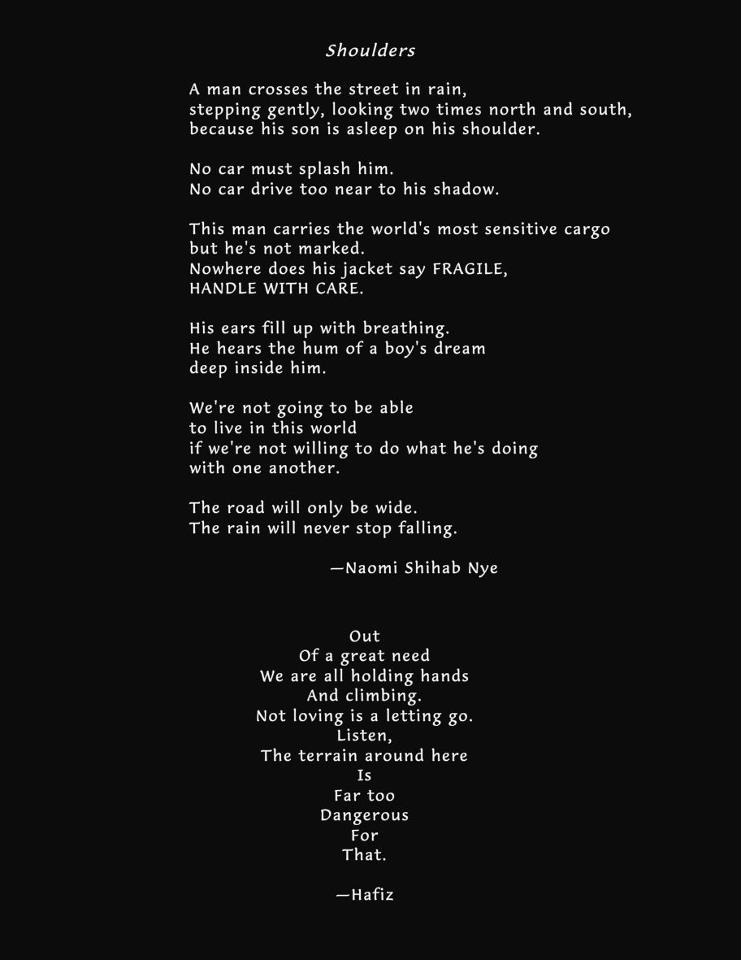
Shoulders by Naomi Shihab Nye and Out of Great Need by Hafiz

I finished reading Healing the Heart of Democracy by Parker Palmer. It is a wonderful book and, even though he wrote it from an American perspective, it has many universal messages. These poems focus on a message we are in life together-we share, reciprocate, appreciate.

I am reaching the point of settling into the dissertation process. My theme is technology, its implications in learning, mindful practices, and the role of leadership in the use of technology. Today, the responses I received from yesterday’s post, Inspiring Blog Award, was evidence that various social media offer opportunities to build digital community. Gonzaga has a journal club for its doctoral students. We find research articles, read them and summarize key points, and present our understanding as they relate to leadership. I presented one about Virtual Communities of Practice today. A key point is reciprocity or the giving and receiving of gifts. This is not a material gift, but one demonstrated through appreciation for the other when they post or say something online. I was able to share I saw the reciprocity and appreciation fully today. You are part of an emerging phenomenological study.

These poems are for you.

Tuned In and Fired Up

I mentioned this book in Culture of Peace and Angry Young Poet. It was worth a read. I start with a haiku which emerged from the book.


Who stretches the teacher?

Journey into their essence

Reveal the learner.

I read Tuned In and Fired Up by Sam Intrator for two reasons: as a teacher and as a graduate student preparing for the dissertation process. Sam contributes to the work of the Centre for Courage and Renewal which based on Parker Palmer’s writings and thinking.

The book is enjoyable, informative, and motivating. Teachers need to take time and pause, reflect upon, and recall the reasons they were called to teaching. There are alchemical moments of discovery we artfully use and define teacher, students, and subject. It is surreal and its magic can never be underestimated as the three blends into a single whole and respects individual integrity.

Part of the magic in this book is Mr. Quinn, the teacher. He took risks and students tuned in and fired up to his genuine presence. Parker Palmer, in The Courage to Teach, suggested “teaching is always done at the most dangerous intersection of personal and private life” (p. 18). Mr. Quinn’s teaching was learning and realized he could wrong. The magical aspect takes a teacher onto the boundary and, then, into uncharted waters. Good teachers take that risk and students sense it.

Towards the end Sam cited William Ayers: “Since teaching is always a search for better teaching, I am still in a fundamental sense becoming a teacher. I am stretching, searching, and reaching toward teaching” (p. 134). This is a virtuous cycle of learning-teaching-learning to infinity.

Sam leaves the reader with an incredible list of those things teachers can reflect upon and use according to their setting. Many are well-known: cultivate rapport with students, compete tenaciously for their attention, and spark their desire to create. Others were ones I felt were lesser known: embrace your role as a performer, tap into their senses, and acknowledge boring. That last one is challenging. At the adolescent level, treat them like they are becoming adults.

Questions: A concern expressed by Sam was a need for genuine collaboration. What practices do you use in your workplace or learning that foster collaboration between adults? If you teach, what ways do you include students?

Recommendation: I loved the book and let me leave you with just two ways. It was easy to read without losing meaning. Sam used simplexity and achieved his aims. Second, he left a thorough recipe without the quantities. I need to figure those out with students and subject.

Intrator, S. M. (2003). Tune in and fired up: How teaching can inspire real learning in the classroom. New Haven, CT: Yale University Press.

Palmer, P. J. (2007). The courage to teach: Exploring the inner landscape of a teacher’s life. San Francisco: Jossey-Bass.


In My Haste to Post I Forgot the Title

It was an interesting day. In the midst of it, Parker Palmer posted a poem by Wendell Berry on Facebook. It is a special day when Parker posts a poem by Wendell Berry, Mary Oliver, or himself. The poem was How to Be a Poet (to remind myself). Wendell Berry is low tech and uses a typewriter to craft his words. Parker pointed to an aspect of the poem’s message: “Shun electric wire/Communicate slowly/Live a three-dimensional life.”The slow of life is worth something. It lets us be the person we are most fully.

Later, I began to think about two songs by two artists I enjoy and have seen multiple times live. Guy Clark sings The Carpenter and John Wort Hannam sings With the Grain. Both songs are rich with the metaphors of living a three-dimensional life. It is no coincidence the topic is that of a carpenter in both cases. It is about true to one’s self and living a life with value.

Sabbath

Silence, solitude, sacred

A mountain’s strength

The sky’s expanse

A lake mirrors

Words of wisdom

Spoken so softly.

Disconnect to reconnect

Listen that silent sacred space

The inner teacher beckons

Be present

Wisdom revealed

Let it heal, repair

A single thread at a time

The web of life so fragile.

Questions emerge

Hold gently

Live their mystery

They answer only when ready

Until then they lie dormant

Ready when ready

Embrace life as it is.

I salute you and take my leave for a few hours. Have a wonderful 16th of July.

The 4th of July – An Outsider’s Perspective

Kathy and I spend part of our summers in Spokane and other places south of the US-Canada border. The first time we experienced the Fourth of July, the celebration, camaraderie, and heart-felt patriotism readily evident amazed me.Whatever differences Americans have with each other, are set aside for this day and more. The 4th begins several days before and lasts several days after the 4th. I use the code. One doesn’t say the phrase; saying the 4th is enough. Have a Good 4th means something more than just have a good day.

One summer, in Portland, celebrations continued for several days after the 4th with fireworks displays in the river valley. Another year, we met a family in Yellowstone who had just left Mount Rushmore where about 250, 000 people gathered for the 4th. In Canada, that requires every member of some provinces or territory gather and, sometimes, more invitations need to be sent out to reach that number.

I glanced through Parker Palmer’s latest book, Healing the Heart of Democracy, and found a passage from Leonard Cohen’s song, Democracy. I have listened to this song many times, but re-seeing the words made rethink their meaning, with a beginner’s mind. I often wondered if Cohen portrayed American democracy in a negative light, but seeing the words again I saw something different. It is a hopeful message acknowledging the messiness and awkwardness of democracy at work and that America is a place where the democratic experiment is still happening. America is a place where family exists in the broadest sense and the heart is full and open to democracy.

Imagine if you could make the 4th an every day event, engage everyone, and export the message of hopefulness, patriotism, and democracy well and fully lived, based on the model of the 4th? What a world we would live in!

It’s coming to America first,

the cradle of the best and the worst.

It’s here they got the range

and the machinery for change

and it’s here they got the spiritual thirst.

It’s here the family’s broken

and it’s here the lonely say

that the heart has got to open

in a fundamental way:

Democracy is coming to the U.S.A

This is a picture of some early fireworks we took on the 3rd, 2012.

Have a great 4th

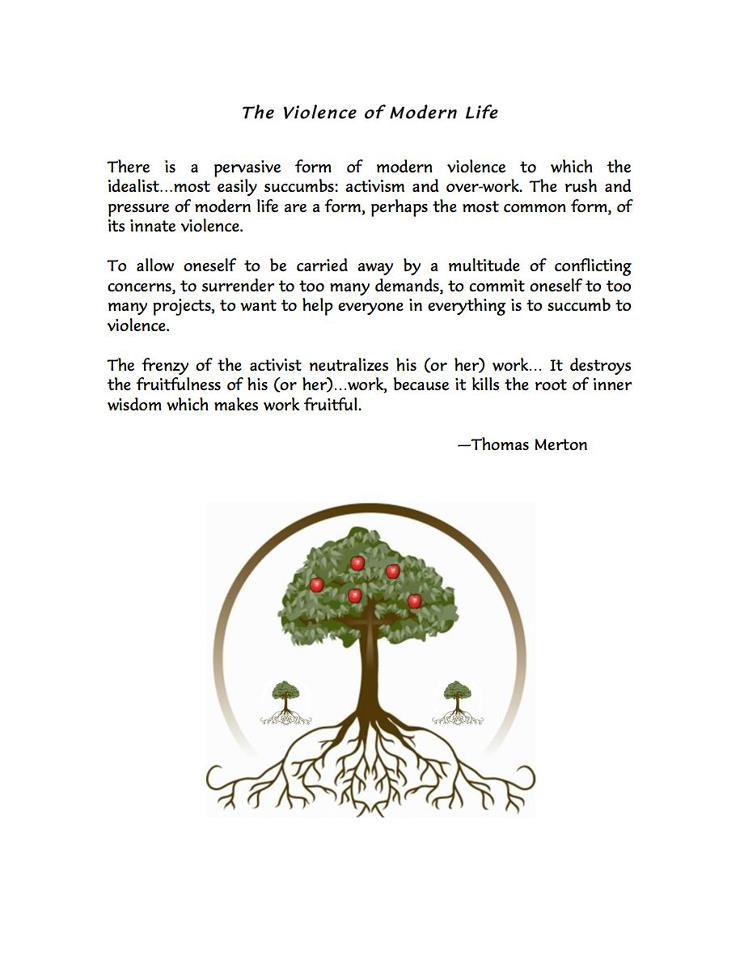
The Violence of Modern Life

Thomas Merton is one of my favourite authors and spiritual thinkers. He offered a radical definition of violence. This sounds like the opposite of multi-tasking, single-tasking. I hope I can do better as I move forward and take time to listen to the inner teacher and its wisdom.

Parker Palmer shared this with those of us who follow him on Facebook.

pedagogy of the oppressed by Paulo Freire

I read pedagogy of the oppressed by Paulo Freire during my undergraduate experience and return to it as a source of reflection and when I write. Similar to Parker Palmer, Paulo Freire left an indelible mark on my life’s practice. Education is an uplifting, liberating experience which shines light on each step Antonio Machado described: “Wanderer, your footsteps are the road, and nothing more; wanderer, there is no road, the road is made by walking.” Freire’ s contention was everyone can act as an agent in their learning thus freeing them and transforming the world they live in.

Freire used the Portuguese word conscientização which “refers to learning to perceive social, political, and economic contradictions and to take action against the oppressive elements of reality” (17).   Humans become mindful of and present in the world and act to transform it. Freire used a banking metaphor and described traditional education where  knowledge is deposited into students. Teachers and the system act oppressively in determining what is important to learn. Freire felt education uplifted people and their learning. “Liberation is a praxis: the action and reflection of men and women upon their world in order to transform it” (p. 60).  Learning occurs when  compliance and conformity are rejected in favour of dialogue based on love which allows each human to name their world and what is of value in it. The student is a teacher and student; the teacher both student and teacher.

Questions: What can we do to truly bring a new pedagogical structure into our schools and communities of learning? What function would school play in this pedagogical structure? What is dialogue based on love?  What role do educators and communities play in liberation education?

Recommendation: I love the book. It is a challenging, but I return to it often and find something new each time. Today, I became aware of the following: “Concepts such as unity, organization, and struggle are immediately labeled as dangerous. … These concepts are dangerous—to the oppressors” (p. 122). What does this mean in supposedly modern, liberated, and affluent societies?

A second point was the similar language used by Freire and Martin Buber. There is a shared understanding of respectful dialogue using the words I and Thou to describe the uplifting, liberating, loving dialogic process.

Freire, P. (1993). pedagogy of the oppressed. (M. B. Ramos, Trans.).  New York: Continuum.

Beginning of the Year Poetry

I wanted something a little different for the beginning of the year. We had new students and sometimes new students find it difficult those first few days to introduce themselves and share something about themselves with others who are better established. We are an alternative school environment. Some students have been with us since Grade 1 and are now in junior high. Without realizing it, returnees form groups and new students are slightly intimidated by the tightness that has formed despite everyone’s best efforts. I tried a poetry activity and it worked very well.

1. I used a Kahlil Gibran quote from The Prophet:

“Say not, “I have found the truth,” but rather, “I have found a truth.”
Say not, “I have found the path of the soul.” Say rather, “I have met the soul walking upon my path.”
For the soul walks upon all paths.
The soul walks not upon a line, neither does it grow like a reed.
The soul unfolds itself like a lotus of countless petals.”

The quote served as a conversational anchor. I read it out loud a couple of times. Students re-read it, highlighted words or questions that emerged, discussed their reflective findings in pairs, and finally we shared with the group. What did this passage mean? What was the theme? We talked about self-knowledge and truths. I refer to Parker Palmer in my classroom so students had discussed the idea of holding one’s own truth while respecting the truths of others.

2. Students prepared a small poster. I asked them to include two poems, some pictures of activities they enjoyed, some quotes they thought helped describe who they were, and their name proudly displayed in the centre of the poster.

3. Initially, I wanted a free verse poem and a cinquain poem. The former was too abstract for some students so changed allowing some flexibility with another formula poem i.e cinquain, diamond, or acrostic. This helped considerably. Even though I teach in a multi-grade setting, with three junior high grades, this struggle with abstraction was not based on grade level only. There were some older children who struggle with the free verse and younger children who did not.

4. Each child put their poster about who they were on the bulletin board and it has remained there all year. An interesting note is, when corners of posters have come loose on the bulletin board, students take time to tack them back up carefully even if it is not their poster.

For those unfamiliar with the pattern poems I referenced above, here are some instructions and examples.

How to Write a Cinquain

There are two methods:

Line 1 – a one word title
Line 2 – a 2 word phrase that describes your title or you can just use two words
Line 3 – a 3 word phrase that describes an action about your title or just actions words
Line 4 – a 4 word phrase that describes a feeling about your topic or just feeling words
Line 5 – one word that refers back to your title

Line 1 – two syllables
Line 2 – four syllables
Line 3 – six syllables
Line 4 – eight syllables
Line 5 – two syllables

Example

Ivon

Mr. P

teach, learn, enjoy

It is my calling

Teacher

How to Write a Diamond Poem

Method

Line 1 – a one word noun
Line 2 – 2 adjectives that describe the noun
Line 3 – 3 verbs that the noun does
Line 4 – 4 things (nouns) that the top noun and the bottom noun has
Line 5 – 3 verbs that the bottom noun does
Line 6 – 2 adjectives that the describes the bottom noun
Line 7 – a one word noun that is opposite the top noun

Example

cat
furry, silky
sleeping, purring, meowing
tail,   fur,    tongue,   collar
barking, playing, licking
friendly, big
dog

How to Write Acrostic Poems?

Acrostic is an easy poetry formats to use with young writers.

It can be about any subject, written in different ways, but the simplest form is to put the letters that spell your subject down the side of your page. When you have done this then you go back to each letter and think of a word , phrase or sentence that starts with that letter and describes your subject, and give out your hidden message that’s contained in this format, that can run forwards, or backwards.

Example

I ngenious

V irtue

O mniscient (or so students think)

N octurnal