Tag Archives: Parker Palmer

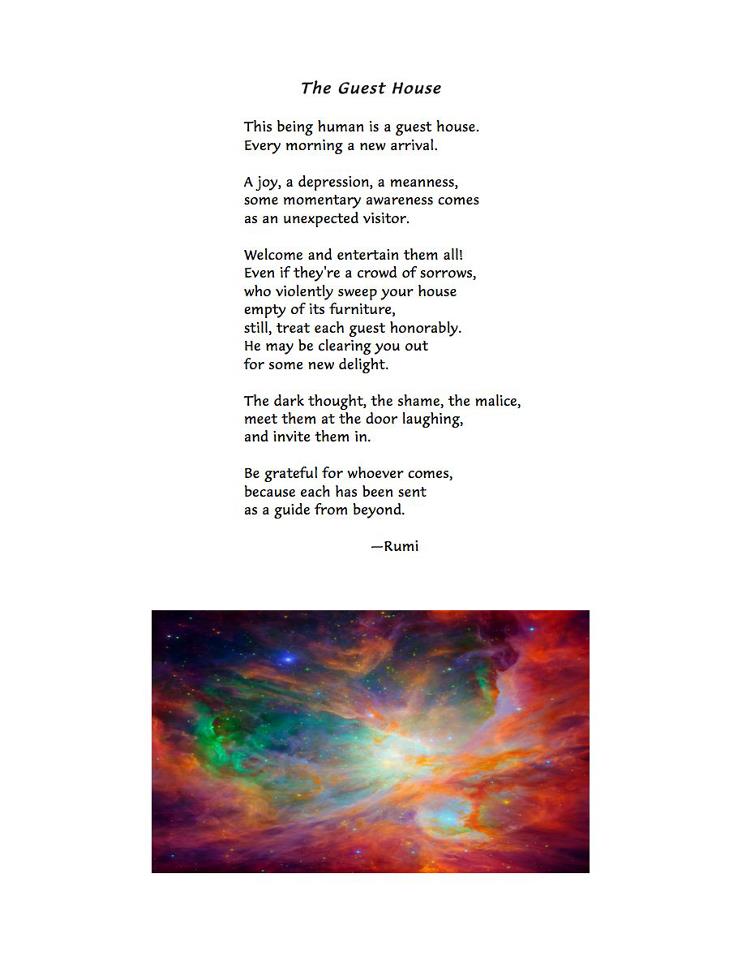
The House Guest by Rumi

I was going through my various accounts and Parker Palmer posted this on Facebook. After a challenging week, I read it and realized this was what my week had been like, very up and down. What do I say to those emotions which temporarily move in and shake my confidence? Or what do I say to those emotions which mislead me with their false promise of all things gold and glittery?

Thank you to Parker Palmer for this sharing.

Paradox in Educational Transformation – 2

I believe the second paradox proposed by Parker Palmer works in concert with the first paradox. “The space should be hospitable and ‘charged'” while being bounded and open. People “feel free to speak, but their speaking is always guided towards the topic … the open space is liberating [as it is] inviting, as well as safe and open” (p. 77). The negotiated contract is a covenant built through trusting and honest relationships where participants find their voices. “The space must also be charged. … No special effects are required to create this charge – it comes with the territory. We only need fence the space, fill it with topics of significance and refuse to let anyone evade or trivialize them” (p. 78).

I believe lessons learned from Finland’s educational experience, therefore the topics of significance here, was recognizing public education is a fundamental human right for each child and providing equal and unfettered opportunity for each child. Through open and safe conversation, implementation strategies uniquely suited to each community is revealed. People respectfully share their views in a safe, bounded, expansive, and invigorating space where they feel welcomed and honoured. The space honours each person’s truth as each person, in turn, respects the truths of others.

What can we do to create this space?

Reference

Palmer, P.  (2007). The Courage to teach: Exploring the inner landscape of a teacher’s life. San Francisco: Jossey-Bass.

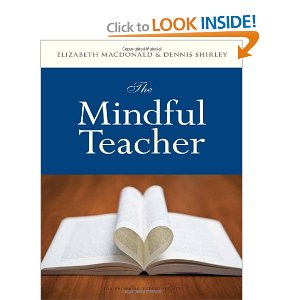
The Mindful Teacher by Elizabeth MacDonald and Dennis Shirley

Last year, I was in a challenging situation and sought a path to continue my teaching and learning journey. Elizabeth MacDonald and Dennis Shirley wrote a book called The Mindful Teacher. I read the book during September 2011.

A thesis was teachers feel alienated working in a system where few “possibilities remain for ethical, caring teachers to hone their craft and to inspire their students with the sheer joy and delight that is found in learning” (p. 2). The authors used teacher stories and personal reflections obtained through The Mindful Teacher Project which involved public school teachers in Boston. MacDonald and Shirley cautioned this was not “a recipe that can be followed, or  a ‘silver bullet’ … it is a form of teaching that is informed by contemplative practices and inquiry that enables teachers to interrupt their harried lifestyles, come to themselves through participation in collegial community of inquiry and practice, and attend to aspects of their classroom instruction and pupils’ learning that ordinarily overlooked in the press of events” (p. 4).

As I read the book, I realized how inattentive I had grown in classroom instruction and about personal growth. Collegial mindfulness has not appeared in a conventional sense, but I discovered alternative spaces i.e. daily meditation, spiritual retreats, World Café Events, and blogging which filled some of the void. I try to pay closer attention to “Who is the self that teaches” advocated by Parker Palmer. I completed a guided study into mindfulness in daily life. Each aspect added mindfulness previously absent in my life.

Amazon Books

Gains: I  have slowed down, reflect more often, and try respond and not react. It is a journey and that is why we call it practice. Each school day, I spend 20-30 minutes meditating. When I am flustered in the classroom, and it happens, I try close my eyes, take a deep breath, and clear my mind before I respond. I refer to those successful moments as the new Ivon. An important gain was teaching is a calling, a vocation. As I read, I was reminded of that.

Questions: What do we do when adults do not trust between one another and that appears irreparable? I assume the authors wrote the book due to a perceived need by the authors. I imagine there are environments lacking trust. What do we do then?

Recommendation: This is short, easy read filled with stories and ideas. From a veteran teacher perspective, it helped me tend to long overdue internal work. A new teacher could use ideas to shape their career. I would recommend it for all teachers and, when done, find a group and have open, joyful, non-judgmental conversations. What brought you to teaching and learning?

Seeing the Ordinary as Extraordinary

During a recent conversation with an acquaintance, we discussed the concept of seeing the ordinary as if it were extraordinary. She commented, “If we could do that, imagine the joyfulness in the world!” I try observing the world through this lens and some days I catch a glimpse of the extraordinary elements of my life. Let me offer examples of this joyousness and its synchronous nature.

I listen to a wonderful little radio station, CKUA. When I get in the car, it is on and I usually pay at least superficial attention to the songs. I love Blues, Soul, and Gospel music and on three particular mornings I was welcomed into my car by great music. On Thursday, Lead Belly sang Grey Goose; on Friday Nina Simone sang Feeling Good; and on Saturday, Commander Cody and the Lost Planet Airmen sang Oh, Mama, Mama. I confess I was not feeling upbeat Friday when Nina Simone came on, but I was aware of the generous message and found space to feel better. Each song appealed to me and seemed to sooth a restless and weary soul.

Saturday morning I met with three friends and, during the conversation, we talked about my blog. One person commented it seemed two different people wrote at times. I pointed out some postings are academic and fit with my doctoral journey. When I write about a need for Eloquent Questions in Education, my voice is, hopefully, more scholarly. When I share about a paralyzing fear of heights in Images to Provoke Thoughts, I try to personalize and humanize the self, Ivon, who writes, but my complexity is revealed. I explained Kathy proofreads and edits many postings. She does an amazing job of cleaning up conventions and keeping the message on track. I am challenged to acknowledge and express my gratefulness, as well as I should.

Frequently, I take for granted both the complexity of my self and who I am, and the important, sustaining relationships in my life, rendering them ordinary. Both are extraordinary and help me observe and understand the self when I contemplate, “Who is the self that teaches?” Parker Palmer offered this question and I try to extend it further to ask, “Who is the self that lives this life?” I think these are critical questions because, without self-awareness, what possibility of transformation exists? I follow Cooperative Catalyst and they posted Why Transformation May Hit a Snag: Observations from the Field. Two questions emerged from the article for me, both about self-awareness. First, what am I doing to transform my self? Second, what values guide this transformational process? Gandhi proposed, “Be the change you want to see in the world.” Being aware and present to my self and those who matter most in my life are essential steps. Some days are better than others and the ordinary becomes extraordinary.

Words to Inspire

I arrived home, tired, and feeling uninspired, unsure what I would write. Several ideas are running around, but they required more percolation time. I broke from routine and checked Facebook first A colleague from the Circle of Trust retreat in Seattle shared an inspiring, heart warming article: “A teacher, a student and a 39-year-long lesson in forgiveness.”

One line that resonated was “the beauty of an apology is that everyone wins because it reveals not only who we are, but who we hope we are.” An apology is transformational rather than transactional. It takes the form of acts and words offered with compassion, care, and integrity.

Please take a moment to read.

A Lovely Sentiment

I am back from Seattle and will post thoughts later about a wonderful experience. I got three hours sleep last night and was wired today at school. Despite that, I felt alive. It was an affirming experience and I hope revitalizes a warrior.

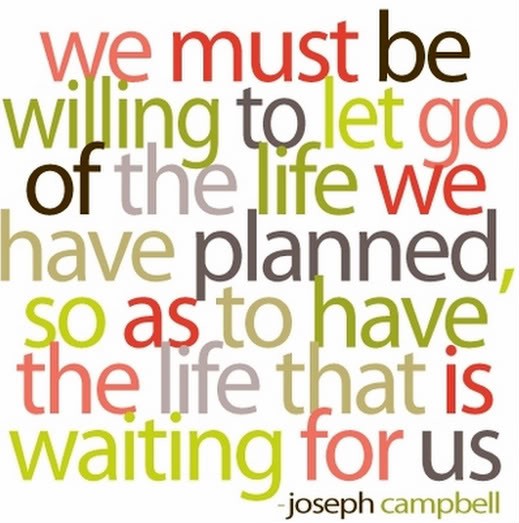
Synchronicity plays a major role in life and being aware helps me to recognize that which I used to miss. Today, on Facebook, a  friend posted this Joseph Campbell quote about the way life should be lived, fully in the moment without reservation.

A year ago,  I was in an increasingly  dark place. There was little positive in certain aspects of my life. A question emerged: “What is my lot in life?” I quickly realized I was trying to change things I had little or no control over instead of focusing on what I did control in life, living in the moment and being present. I undertook a journey that began with the question, “Who am I?” I completed a directed studies course on mindfulness focused around the question, “What is there about mindful practice that can help me live a fuller, richer life in each moment?” I read Thomas Merton, Parker Palmer, Thich Nhat Hanh, and others on the subject of mindfulness. I attended spiritual retreats and meditated. I posted an entry entitled Connectivity + Synchronicity = Love. Connecting with me the important first step. Yesterday, the synchronicity continued when this blog posting found is way into my life.

Read what Marie posted. I am still a work in progress, but the ways I have used to date are immensely helpful. Take care.

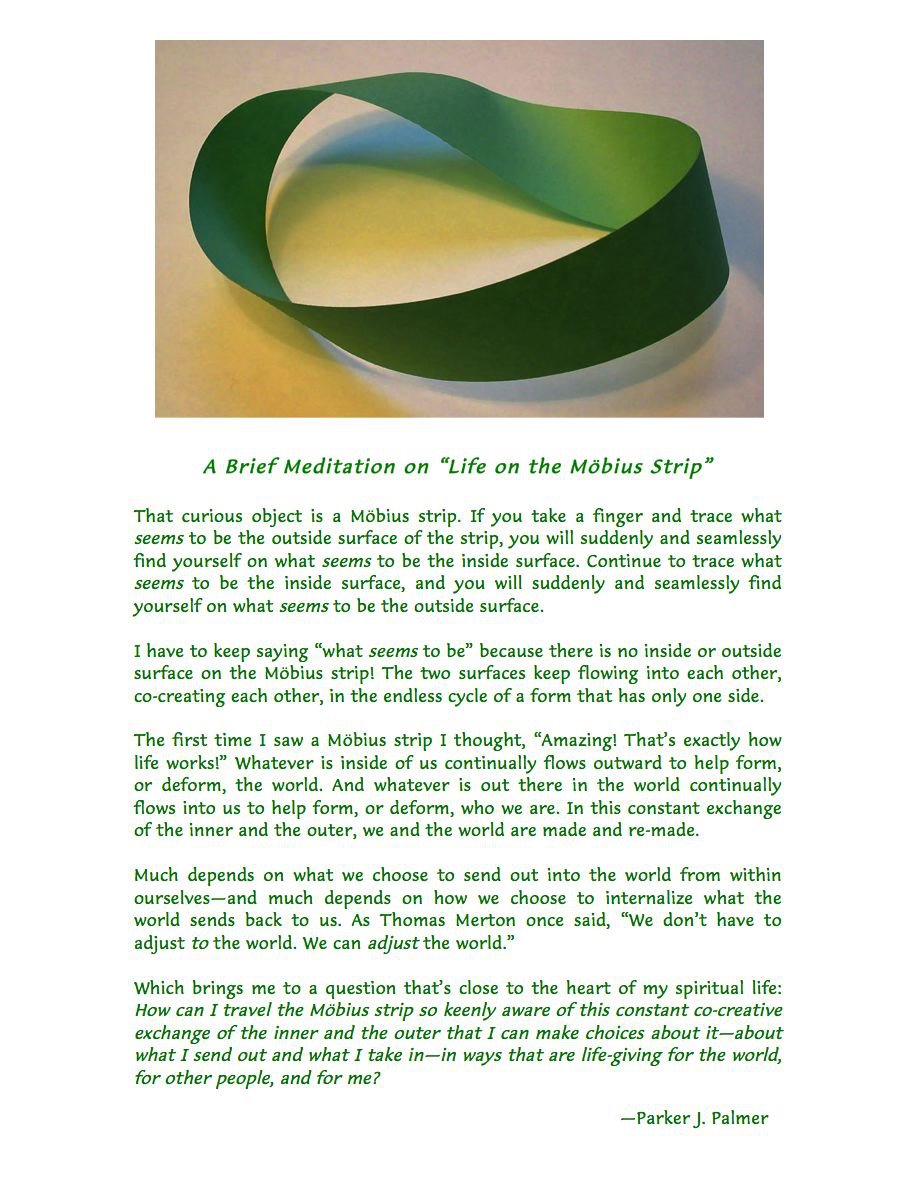
Mobius Strip Meditation By Parker Palmer

Parker Palmer is one of my favourite authors. He writes about spending time looking in and making one self whole. The mobius strip provides a metaphor for the rhythm and flow that occurs when we take time to stop, look in, and show each of us what is important and makes us whole. Please take time to read this wonderful passage.

Community and Servant-Leadership

Community has been a recurring theme throughout the World Café conversations and events, with many descriptors alluding to communal practices and relationships needed for learning to happen. Reciprocity, connection, supportive, affirmation, and other words expressing interactions suggest community. The summary posters of the March 17, 2012 World Café Event confirmed this recurring theme of community and the table posters, to being posted, also bear this out. The theme of community is important not just in learning, but in life itself. Without community, can life and learning be as meaningful?

Parker Palmer recently shared in a Facebook posting: “Community does not mean living face-to-face with others—it means never losing the awareness that we are connected with each other…”

The servant-leadership conference I attend in Portland reinforced that, although community continually evolves, as a value it can remain intact. Here are some examples.

Professor Shann Ferch, from Gonzaga, spoke about the “beloved community” that the late Martin Luther King so eloquently referred to. It is the necessity to see each other, including oppressors and those who have done harm to us, as human. Dr. Ferch also quoted Viktor Frankl: “We are made to turn outward, toward another human being to whom we can love and give ourselves. … Only when in service of another does a person truly know his or her humanity.”

We easily dismiss these references to community as the extreme and needed actions and words of those in different settings. After all, Dr. King led the Civil Rights movement in its halcyon days and paid the ultimate sacrifice. Dr. Frankl survived the atrocities of concentration camps during World War II. What do their experiences have to do with simply getting through the day?

Kirk Young, a colleague from Gonzaga, elaborated on what could be understood as community in the form of a value. The communities we choose to belong to share one common ingredient: intimacy. Ferdinand Tonnies, a German sociologist, used the word gemeinschaft and described this form of community as “a tighter and more cohesive social entity. [It is] exemplified in family and kinship” suggesting when humans gather in community, intimate experiences are shared. Members share the good, the bad, and grow together towards common purposes, thus are mission driven. Values and mission serve as glue for community.

Father John Dear, a Jesuit priest, proposed in The Rebel Jesus, a second, mostly unnoticed miracle occurred during the Sermon on the Mount: the forming of community. Community allowed people to see the human nature of each other as Jesus instructed those closest to him to organize the large group (some believe well over 5,000 people) into small, more intimate groupings of about 50 people. Father Dear suggested that in these small communities, people interacted differently and shared as they made connections with those now close to them. People were no longer strangers; because moments before they were simply part of a large and increasingly hungry throng. In contemporary parlance, they were statistics.

By witnessing the humanity in each other, we form community and share intimacy without fear. Our humanity is the one thing we share with others and through it, we find purpose to gather and create community around the universality of human values and the value of humans.

What Was not Said at the World Cafe Events

I intentionally let the World Cafe Events and results lay fallow to provide reflective space so new ideas could emerge. What surprised me was it was not what was said explicitly, but what went unsaid—no reference to the importance of subject matter in learning and teaching was made. I considered this and arrived at possible explanations.

First, perhaps the group saw the area of expert subject knowledge as unimportant. This is the most unlikely assumption. There were educators in the conversations and I imagine they think this is important. Teachers  train to deliver material in specific subject areas. I have a Physical Education major and a French minor. I chose those areas and, while I no longer actively teach either subject on a regular basis, I enjoy both and feel they contribute positively to my teaching. I cannot generalize my experiences or conclusions to the work of all teachers, but one still could see it as important to teachers, as professionals.

Second, it could be, in education, life-long learning is a given; by definition educators are life-long learners. This is also hard to generalize, but I can speak from personal experience. Currently, I teach Science, Social Studies, and English Language Arts in a multi-grade junior high classroom. I consciously chose to shift from earlier subject area training. To be personally successful and for student success, I actively and purposefully upgrade. There is evidence teachers  serve as models of life-long learning for students when they engage in life-long learning themselves. A question here is, “What does life-long learning mean in this context? Is it different from other professions and work settings?” Defining life-long learning is hard to do. so my conclusions are, at best, specific to me and my experience.

Third, and I think the most likely explanation is based on the adage, “Students care how much you know as a teacher, if they know how much you care about them as people.” The ethic of care in education might be more important than it is given credit for. The World Cafe group acknowledged that mastery was based on meaningful and purposeful learning that prepared and motivated students to learn. Those observations suggest subject matter is important but, at the same time, a real focus on qualities such as communication, compassion, reciprocity, community, affirmation, mutualism, etc. require greater attention. It is easy to dismiss these characteristics as soft, but educational luminaries, Nel Noddings, Deb Meier, and Parker Palmer, have pointed out these are challenging and critical aspects of teaching and learning. Mike Seymour devoted the book Educating for Humanity to building healthy, vibrant, and truly democratic communities in schools. These purported ‘soft’ qualities build positive environments with relational trust and commitment only found in true community (a link to an article by Anthony Bryk) and suggests we should know students, their parents, and our colleagues. Engaging in and building caring, compassionate, and supportive relationships is hard work, but worthwhile. Why do we avoid this effort?

My reflections led to a hypothesis that teachers are expert in chosen subject matter and, when given choice, do continuously work at life-long learning. This means deep, mufti-layered, nuanced learning as opposed to superficial simple attendance to the latest fad. To make real differences, adults should care enough about students individually and collectively to reach and grow beyond themselves. This carries a responsibility with it that educators need to learn about students, their needs, and their environments outside school walls. That is relational and commits teachers, by the nature of a variety of choices, to be learners and co-creators of knowledge with students, families, and community.