Tag Archives: poetry

To Look at Any Thing

It was a busy day. I was alone with the students. Usually, I there is a parent, but today the schedule was unfilled. We were still productive and covered challenging material.

The Grade 7 class is building scenarios and predicting what if learned experience is used in new situations. The Grade 8 class is exploring differences between authority and power. The Grade 9 class is taking and defending positions on the Canadian youth criminal system. Like all good things, learning takes time.

John Moffitt’s poem speaks about a way we learn the world. We should savour it, not consume it.

To look at any thing,
If you would know that thing,
You must look at it long:
To look at this green and say,
‘I have seen spring in these
Woods,’ will not do—you must
Be the thing you see:
You must be the dark snakes of
Stems and ferny plumes of leaves,
You must enter in
To the small silences between the leaves,
You must take your time
And touch the very peace
They issue from.
Dreams

It was a long day. I feel tired and I was not as close to 100% as I thought. Despite that, I had an interesting conversation and, on the way home, I wondered if many children’s dreams have exploded? Do children dream like I did when I was a child? Do some children while others are afraid or unable to dream? I turned those questions over and they reminded me of Langston Hughes’ wonderful poetry. What is my role in holding their dreams with them?

Hold fast to dreams
For if dreams die
Life is a broken-winged bird
That cannot fly.
Hold fast to dreams
For when dreams go
Life is a barren field
Frozen with snow.

The Lame Goat

I feel better; more tired and listless than sick today. I lack of creative juices today, opened one of my poetry anthologies, and came across this Rumi poem. It depends on my perspective whether I lead or follow. Perhaps, I can do both and even at the same time?

You’ve seen a herd of goats

going down to the water.

The lame and dreamy goat

brings up the rear.

They are worried faces about that one,

but now they’re laughing,

because look, as they return,

the goat is leading!

They are many different kind of knowing.

The lame goat’s kind is a branch

that traces back to the roots of presence.

Learn from the lame goat,

and lead the herd back home.

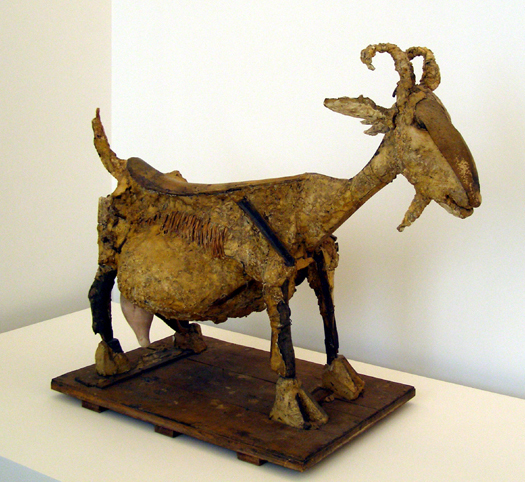
Goat sculpture from found objects, by Picasso.

For the Children

I began reading Meg Wheatley’s book So Far From Home. Similar to Parker Palmer, she uses poetry to bring her message to life. She quoted Gary Snyder at one point and I recognized it from a retreat I attended. Her point is we live in a world of relationships and not just science. When I look at the sadness of our world, the constant conflict in it, and the violence, I can only wonder if it is a result of loneliness and separation we experience? I will ponder that during my Sabbath.

The rising hills, the slopes,
of statistics
lie before us.
the steep climb
of everything, going up,
up, as we all
go down.

In the next century
or the one beyond that,
they say,
are valleys, pastures,
we can meet there in peace
if we make it.

To climb these coming crests
one word to you, to
you and your children:

stay together
learn the flowers
go light

Foolishness? No, It’s Not

I am a little rushed, but found some time to sit and work with the blog. I was unable to spend the time answering all the comments, but hope to find some time late after we do a bit more visiting. As well, I apologize for not attending to the awards that we so generously bestowed on me. I will attend to them when we get home after the New Year.

I think, as I enter 2013, there will be considerable change upcoming for me professionally. I look forward to some times of transition and building relationships like I have over the past few months with this blog. Mary Oliver always seems to find the words I seek as I look ahead.

Sometimes I spend all my day trying to count the leaves on a single tree. To do this I have to climb branch by branch and write down the numbers in a little book. So I suppose, from this point of view, it’s reasonable that my friends say: what foolishness! [He’s] got [his] heads in the clouds again.

But it’s not. Of course I have to give up, but by then I’m half crazy with the wonder of it–the abundance of the leaves, the quietness of the branches, the hopelessness of my effort. And I am in that delicious and important place, roaring with laughter, full of earth-praise.

Take care friends, ring in the New Year, and be safe my friends.

You Shall Above All Things

When I teach poetry, I always include ee cummings. I include him for several reasons. First, he was a pretty good poet. Second. junior high students worry too much about style and conventions. Third, he was a rebel and junior high students like rebels. Fourth, and I doubt it is last, he had something important to say like all good rebels.

I am not sure our schedule. We leave within the hour and will be on the road most of tomorrow. If I do not find my way back to the Internet, I wish you all a good New Year.

you shall above all things be glad and young.

For if you`re young, whatever life you wear

it will become you;and if you are glad

whatever`s living will yourself become.

Girlboys may nothing more than boygirls need;

i can entirely her only love

whose any mystery makes every man`s

flesh put space;and his mind take off time

that you should every think, may god forbid

and(in his mercy)your true lover spare:

for that way knowledge lies,the foetal grave

called progress,and negation`s dead undoom.

I’d rather learn from one bird how to sing

then teach ten thousand stars how not to dance.

Two Kinds of Intelligence

We enjoyed a restful Christmas. We head out tomorrow night for a trip to British Columbia where my 88-year old mother lives. Over the past few days, I thought about what I hold true and came across this Rumi poem. I will be working more on the literature review for my dissertation and I need to assure myself that I distinguish between two types of intelligences: one that grounds me and one that is simply the currency of the day.

There are two kinds of intelligence: one acquired,

as a child in school memorizes facts and concepts

from books and from what the teacher says,

collecting information from the traditional sciences

as well as from the new sciences.

With such intelligence you rise in the world.

You get ranked ahead or behind others

in regard to your competence in retaining

information. You stroll with this intelligence

in and out of fields of knowledge, getting always more

marks on your preserving tablets.

There is another kind of tablet, one

already completed and preserved inside you.

A spring overflowing its springbox, A freshness

in the center of the chest. This other intelligence

does not turn yellow or stagnate. It’s fluid,

and it doesn’t move from outside to inside

through the conduits of plumbing-learning.

This second knowledge is a fountainhead

from within you, moving out.

Spacious Sanctuary

I will break for Christmas tomorrow (Saturday) and return December 27, 2012. It is an extended Sabbath. I find a few days away from the digital world creates a quieter space. I began to think about this even though I will post one more time before the break. I looked in a bit today and realized there is a need to replenish the spiritual and creative elements.

I step away–

Ease into a low-tech space;

Sense stillness–

Eyes unsquare,

Fewer fidgets

A mindful practice

Just be.

I rest–

Embrace wakefulness

Emerge from frenetic hibernation,

I run yet stand still–

Deplete the spirit

Rediscover lightness,

A spacious sanctuary.

Poetry Beckons

As I drove to work this morning, I reflected on the comments shared on the post I Dwell in Possibility. The car is a tough place to write and I hurriedly got into the classroom and pulled my notebook out. I sat with the reflections during the day as they bubbled near the surface. Writing poetry is a space I needed and find comfort in as the school year unfolded. I find solace in the poetry and the unlikely moments it beckons.

in unlikely moments,

poetry beckons–

pulls me to her side–

she is a different lover–

no carnal, siren calls,

a modest, unobtrusive presence,

a compassionate companion whispers,

come hither friend–

sit, reflect–

here, realize refuge–

close your eyes

open your heart

observe,

pause,

discern an inaudible voice

ask, what moves the soul

animates a weary spirit,

urges the writer on,

words find paper.


I Dwell in Possibility

Emily Dickinson wrote this beautiful poem. With questions, I dwell in possibility. Poetry calls gently to me, leaves a space that I can peer into, and observe that which moves my soul. Without questions, there would be no answers and no certainty. That seems odd and paradoxical, but seems very real to me. Questions allow me real faith and a belief in those things I cannot touch. They are there and I know they are.

I dwell in Possibility–
A fairer House than Prose–
More numerous of Windows–
Superior–for Doors–

Of Chambers as the Cedars–
Impregnable of Eye–
And for an Everlasting Roof
The Gambrels of the Sky–

Of Visitors–the fairest–
For Occupation–This–
The spreading wide my narrow Hands
To gather Paradise–