Tag Archives: poetry

Waterton Lakes National Park Day 2

We are back from day 2 of our Waterton Lakes National Park adventures. Yesterday, I commented on International Peace Park that within reason animals are right there and pose for you.  We were unable to post our one bear sighting. Despite poor vision, bears hear very well our sighting was from the boat. As we moved closer, the bear heard us and headed for cover. We only took pictures of his rear end from a distance. Today we had two bear sightings.

This was our first sighting. This bear was about 100 metres away on a hillside as we left town. It is a fair-sized and is brown, but is likely a black bear and not a grizzly. What we could see of the snout and head does not look quite right and it is missing the hump on the back. Here is another view.
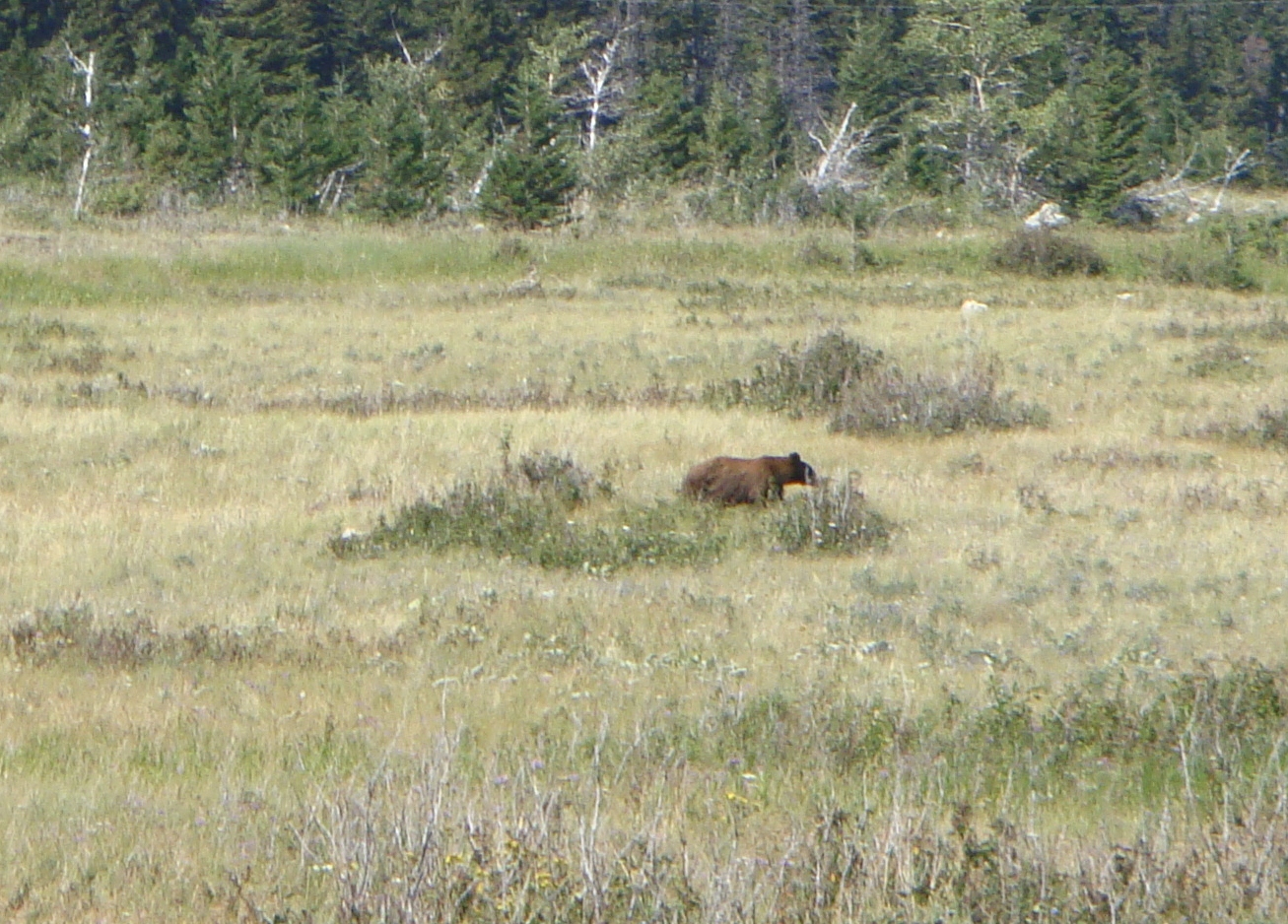
Grizzly bear are generally solitary and do not like humans around them where black bear are more likely to approach areas with humans around.
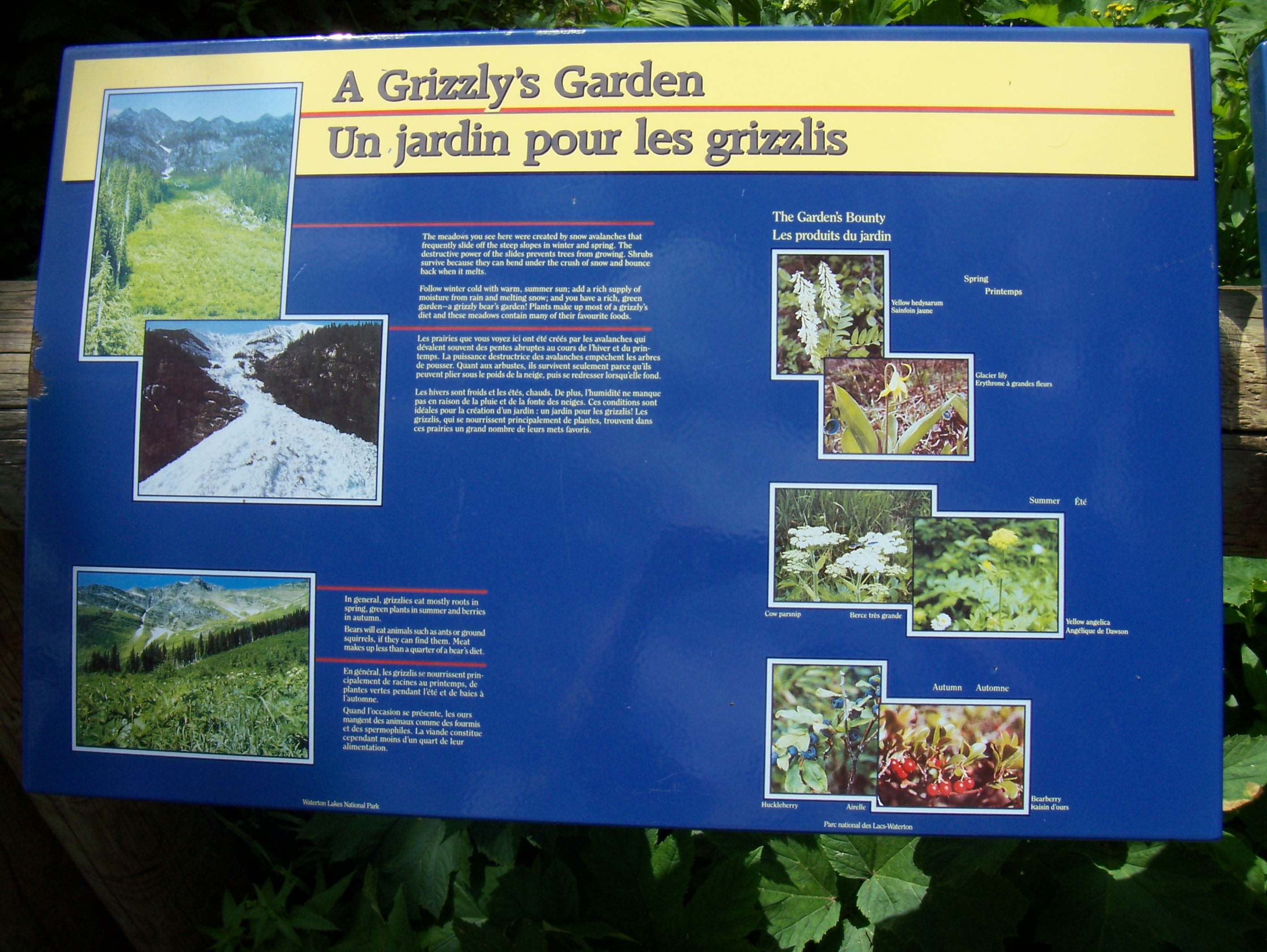
This sign is at the Cameron Lake trail and refers to the area beyond as a ‘grizzly’s garden’ and care is needed beyond this point.

Here is a haiku for grizzly bear we did not see, but we know is out there.

Grizzly’s home and garden

Tread gently and carefully

Grizzly habitat.

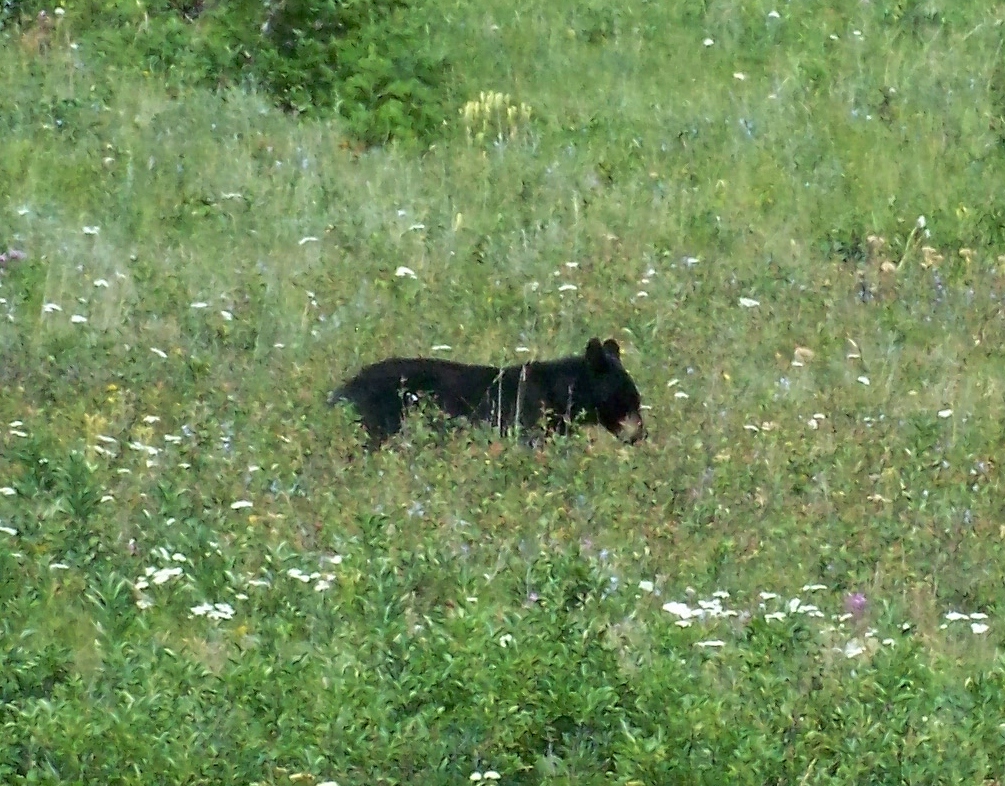
Our good fortune was not done. We spotted another black bear on another hillside on our way back from Red Rock Canyon. This one is younger and smaller and is definitely a black bear. I would guess it was born a year ago this past spring.

You can see the snout and the ‘piggy eyes’ of the bear. They are members of the same family as the pig. The ears stick up more and the grizzly would have ears that are ‘teddy bear like’ and stick out from the side of a very large head.
Not all animals we met were as intimidating.
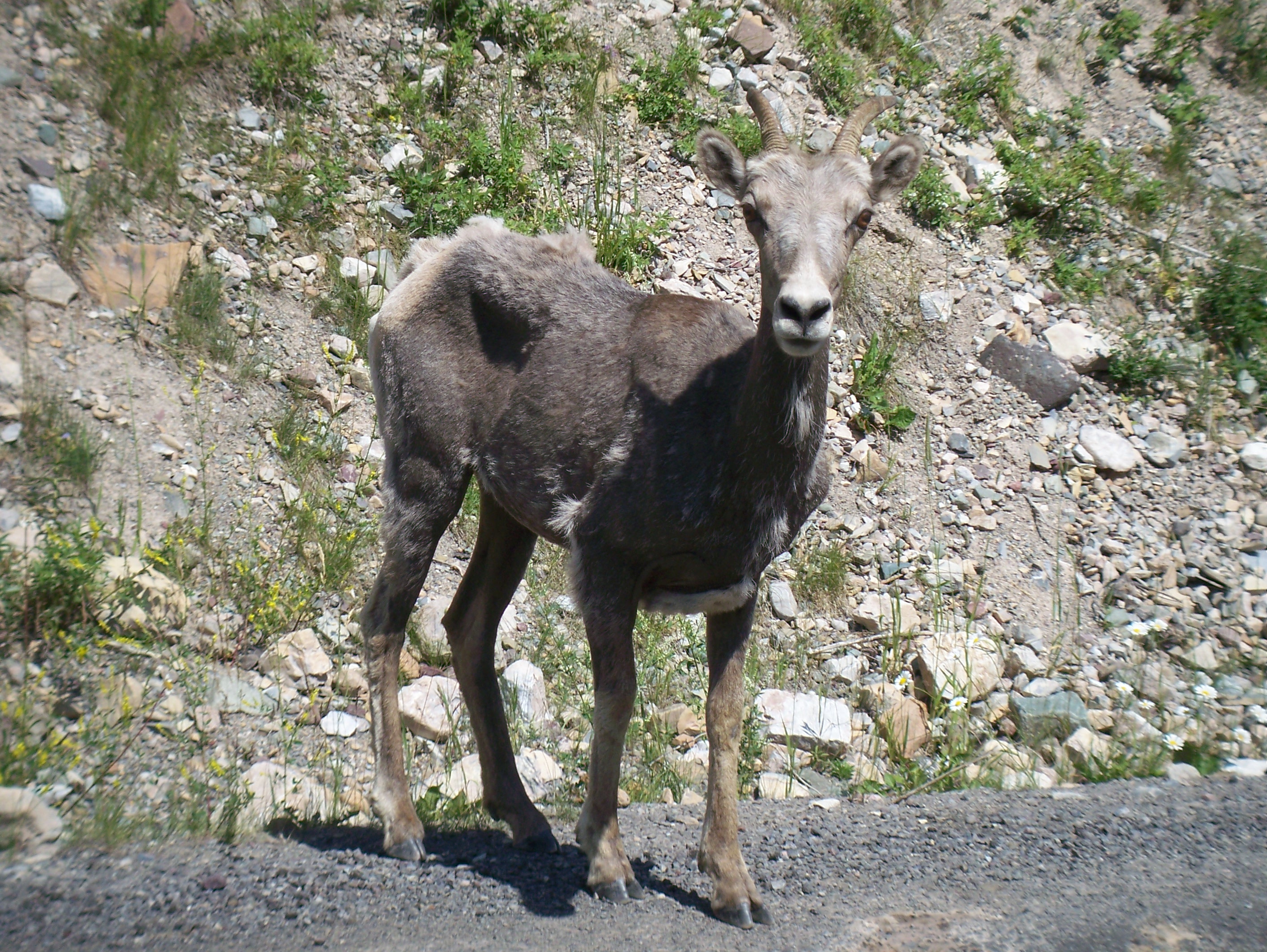
This sheep was about 2 metres from the car and just looked up to have its picture taken.

International Peace Park

Kathy and I wanted to travel down to Glacier National Park, Montana, but the logistics were challenging. We put this on the back burner this year and traveled to Waterton Lakes National Park in the southwest corner of Alberta. The two parks combine and form the first International Peace Park and are often called the Crown of the Continent, but there is no easy way to see both without a lot of traveling or so we thought. Luck intervened and we found our way down to Glacier National Park.

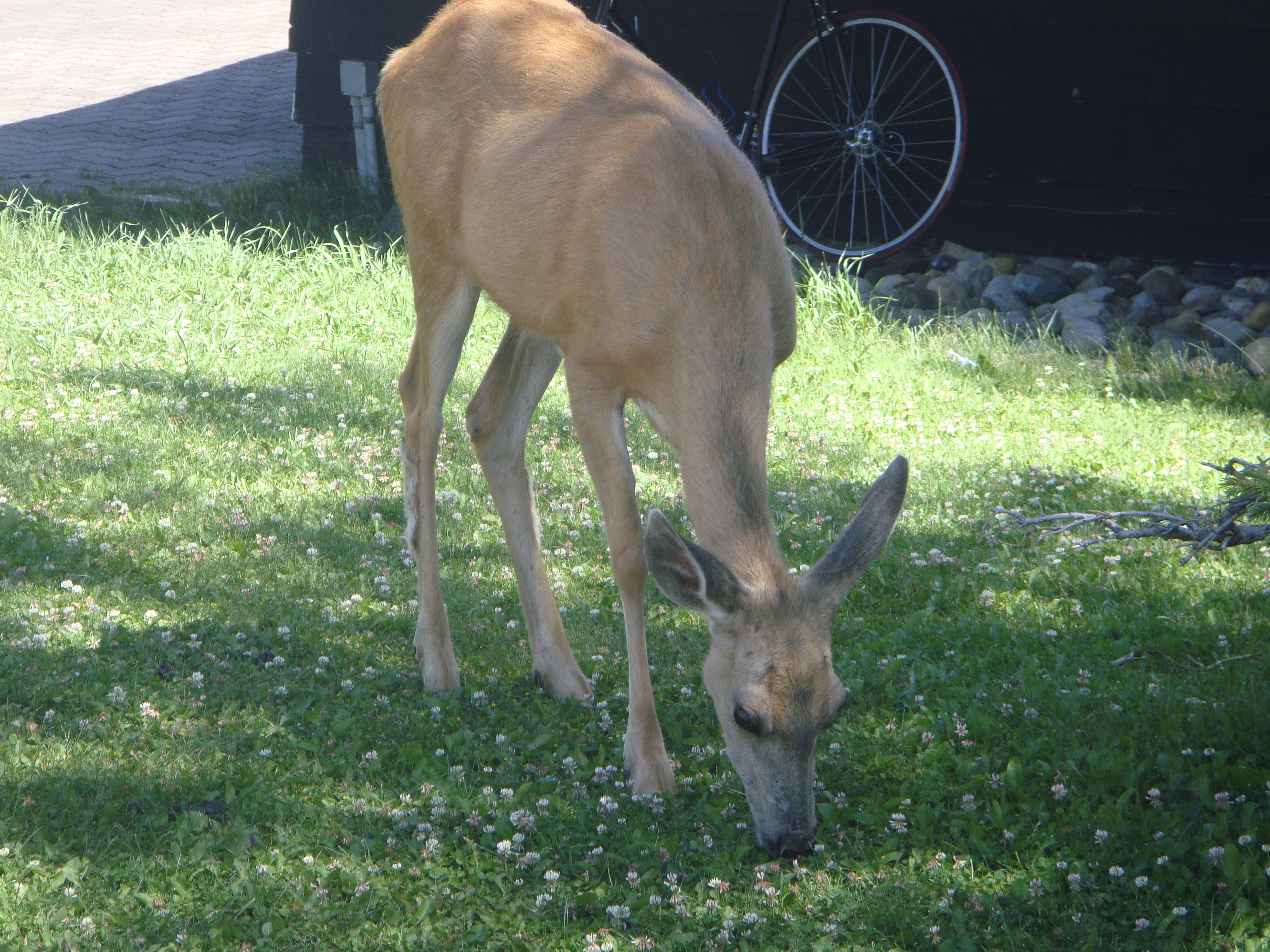
In national parks you can get up close and personal with the wildlife. They are still wild and skittish, but as long as you are careful they stay and. I took this picture just outside the ticket offices for the boat tours. She grazed, let several of us take pictures, and we were within a couple of metres (five or six feet) of her.

Oh my dear, it’s a deer.

We were able to travel to Glacier via an alternate mode of transportation: a boat. This is the US International, an 85-year-old boat, that makes four round trips on Waterton Lake to the south end. Part way through the trip, we crossed into the US and Kathy and I chose to stay for a couple of hours to do some hiking.

An icon of Waterton is the Prince of Wales Hotel. It was built in 1927 and overlooks the lake. It is open from mid-June until mid-September. We have missed it on other trips due to traveling in the off-season, but this year we are stopping for ‘high tea.’ This is a view from the boat.

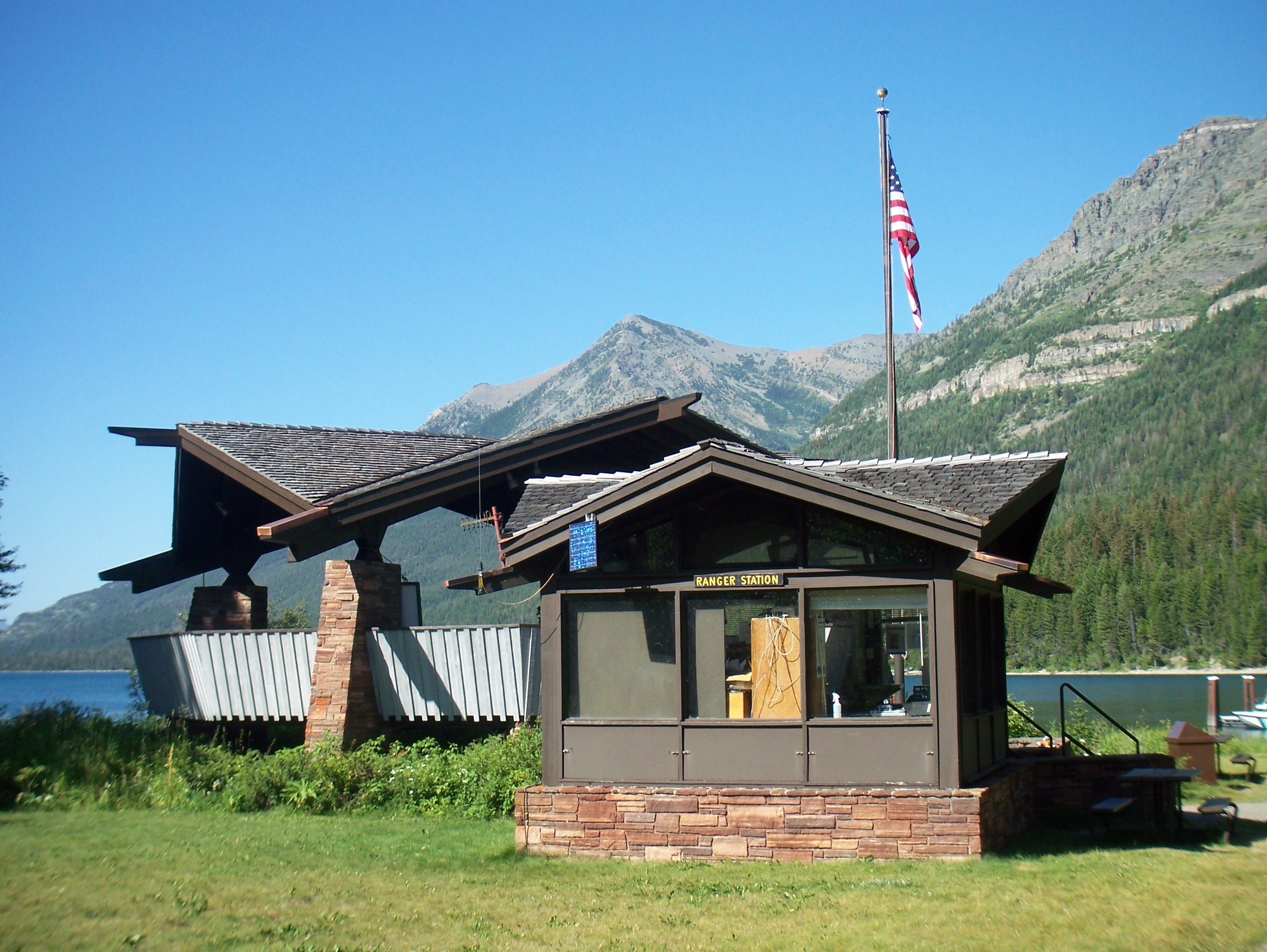
When Kathy and I got to the US port of entry at Goat’s Haunt, we stayed and hiked into a small alpine lake called Kootenai. It is about an 8 km walk (5 miles) and took about 2.5 hours. This is the ranger station and border crossing. We showed passports and answered routine questions.

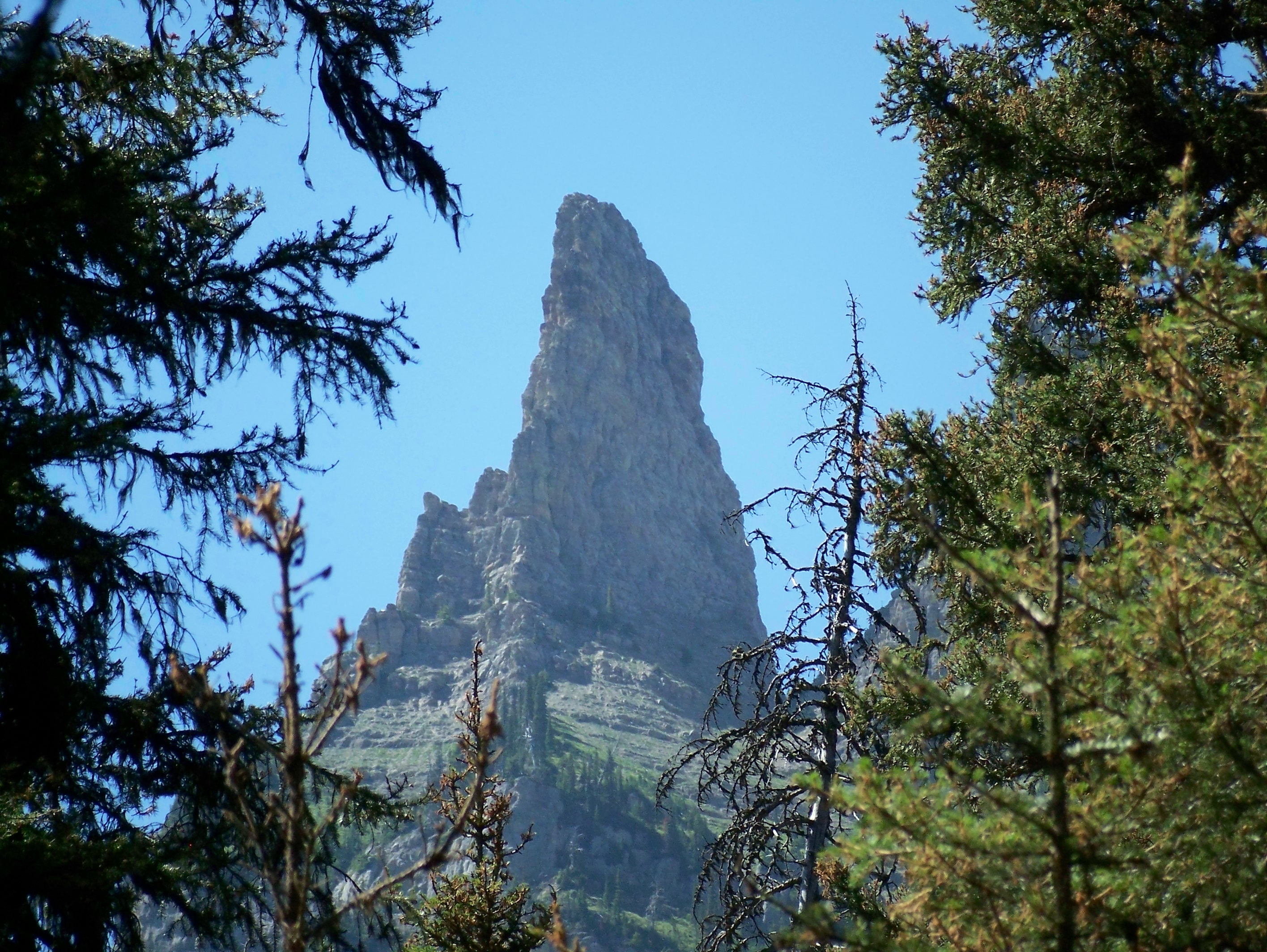
This is a view from the path along the way.

Nature’s cathedral

Light dances with shadows below

A benediction.

This was a small stream we passed over twice. The flow of water has worn the rock flat. Nature is rich with paradox.

Life’ rapid current

Smoothing and shining rough edges

Until next rough spot.

We are off for another day of adventure.

Heading Home – Haiku Haven

Kathy and I head home after a great month in Spokane and at Gonzaga. I enjoy my time here and find the “pause that refreshes.” Part of this is paying forward which happens and the flow of time within this relational space. I see paying forward as a circle. Yesterday, we said good-bye to a colleague on his way home. He reminded me I lent him one of my papers his first summer here and how much that meant to him at a time he was ready to pack it in. I told him my first experience here was similar and someone reached out to me. I find the same thing in virtual community. It is harder to carry on conversations and build relationships, but I find a qualities that are unmistakeably human: care, reciprocity, and trust. I am grateful for the daily support I receive in each form of relationship.

Hearts open in time

The reward is worth the wait

We listen deeply.

A place of comfort

The circle invites us in

Its safe reach shelters.

Community calls

Alchemy not formula

Companionship grows.

I found this quote at Circle Toward Wholeness  and it speaks to the circular nature of life and how gifts are constantly received and returned. The quote can also be found at Unitarian Universalist and Circle Fellowship in a more linear form.

Captains of Society

I mentioned when I posted Angry Young Poet there was a second poem I shared from my youth with my students. I softened this one a bit, as it had an angry voice. I know this version sounds pretty harsh, but it is gentler. A recent conversation reminded me how I marginalize voices of those already marginalized. A professor commented he was told by an affluent person that another less fortunate person was a non-entity and the worth of human was measured in material worth. I know this might be isolated, but it troubling and I was reminded of this poem.

Captains of Society

Shallow, superficial, arrogant

Single ambition

Greatness in the eyes of others

Only those with resources can apply

The rest

Forgotten

Pay a high price, but…

It’s their fault

They own their misery.

A cheque to charity

Assuages my conscience

What about the despair?

Don’t care

I claim I do

Donations in good faith, but

It’s a tax receipt

I can really claim, but…

Done on the backs of others

Get the staff to donate time

Not mine.

Increase taxes

Not mine!

No way!

It’s wrong!

Tax others!

What is work?

I create jobs

It’s a spectator sport

This work, which

I manage from afar.

Drive luxury wheels

Shout

Curse

What’s the hold up?

Who’s blocking my way?

The ‘75 Ford station wagon

Engine shot

Dead broke!

Is it their home?

 Throw a party

Drink

Eat

Be merry

No concern for homeless

A romantic notion this ‘hobo jungle’

Not my world

What’s wrong?

It’s not my fault

I gave at the office.

After all.

Throw money at problems

It might help

Don’t

Stop, see, care

If it really helps

Denying, refusing, unfeeling

I pay for a clear conscience

After all.

 The misery

In surround sound…

Is out of sight;

Out of mind

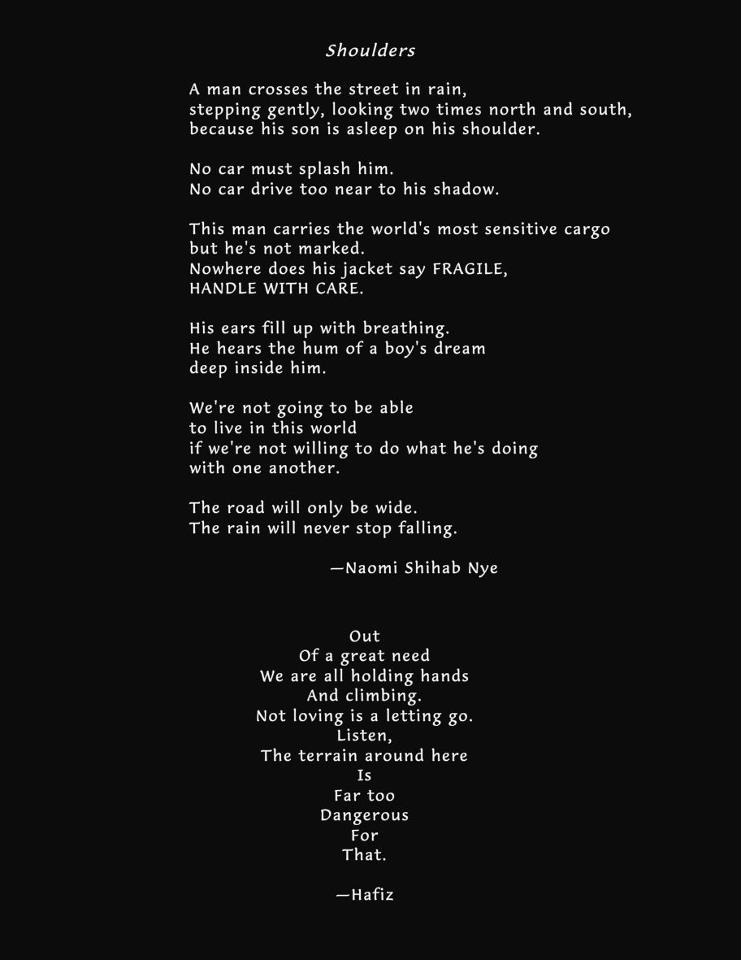
Shoulders by Naomi Shihab Nye and Out of Great Need by Hafiz

I finished reading Healing the Heart of Democracy by Parker Palmer. It is a wonderful book and, even though he wrote it from an American perspective, it has many universal messages. These poems focus on a message we are in life together-we share, reciprocate, appreciate.

I am reaching the point of settling into the dissertation process. My theme is technology, its implications in learning, mindful practices, and the role of leadership in the use of technology. Today, the responses I received from yesterday’s post, Inspiring Blog Award, was evidence that various social media offer opportunities to build digital community. Gonzaga has a journal club for its doctoral students. We find research articles, read them and summarize key points, and present our understanding as they relate to leadership. I presented one about Virtual Communities of Practice today. A key point is reciprocity or the giving and receiving of gifts. This is not a material gift, but one demonstrated through appreciation for the other when they post or say something online. I was able to share I saw the reciprocity and appreciation fully today. You are part of an emerging phenomenological study.

These poems are for you.

Tuned In and Fired Up

I mentioned this book in Culture of Peace and Angry Young Poet. It was worth a read. I start with a haiku which emerged from the book.


Who stretches the teacher?

Journey into their essence

Reveal the learner.

I read Tuned In and Fired Up by Sam Intrator for two reasons: as a teacher and as a graduate student preparing for the dissertation process. Sam contributes to the work of the Centre for Courage and Renewal which based on Parker Palmer’s writings and thinking.

The book is enjoyable, informative, and motivating. Teachers need to take time and pause, reflect upon, and recall the reasons they were called to teaching. There are alchemical moments of discovery we artfully use and define teacher, students, and subject. It is surreal and its magic can never be underestimated as the three blends into a single whole and respects individual integrity.

Part of the magic in this book is Mr. Quinn, the teacher. He took risks and students tuned in and fired up to his genuine presence. Parker Palmer, in The Courage to Teach, suggested “teaching is always done at the most dangerous intersection of personal and private life” (p. 18). Mr. Quinn’s teaching was learning and realized he could wrong. The magical aspect takes a teacher onto the boundary and, then, into uncharted waters. Good teachers take that risk and students sense it.

Towards the end Sam cited William Ayers: “Since teaching is always a search for better teaching, I am still in a fundamental sense becoming a teacher. I am stretching, searching, and reaching toward teaching” (p. 134). This is a virtuous cycle of learning-teaching-learning to infinity.

Sam leaves the reader with an incredible list of those things teachers can reflect upon and use according to their setting. Many are well-known: cultivate rapport with students, compete tenaciously for their attention, and spark their desire to create. Others were ones I felt were lesser known: embrace your role as a performer, tap into their senses, and acknowledge boring. That last one is challenging. At the adolescent level, treat them like they are becoming adults.

Questions: A concern expressed by Sam was a need for genuine collaboration. What practices do you use in your workplace or learning that foster collaboration between adults? If you teach, what ways do you include students?

Recommendation: I loved the book and let me leave you with just two ways. It was easy to read without losing meaning. Sam used simplexity and achieved his aims. Second, he left a thorough recipe without the quantities. I need to figure those out with students and subject.

Intrator, S. M. (2003). Tune in and fired up: How teaching can inspire real learning in the classroom. New Haven, CT: Yale University Press.

Palmer, P. J. (2007). The courage to teach: Exploring the inner landscape of a teacher’s life. San Francisco: Jossey-Bass.


Sabbaths by Wendell Berry

What do I gain from taking a break; disconnect to reconnect? I think this poem speaks volumes. Jay F. Smith contributed the idea for this poem along with a brief reflective essay in Leading from Within.

In his essay, Rev. Smith indicated the Sabbath mood is “a mood resulting from a deep sense of knowing that no matter what the immediate visible, tangible, measurable ‘results’ may be, [something bigger than me] God is at work in the world” (p. 114).

Whatever is foreseen in joy

Must be lived out from day to day.

Vision held open in the dark

By our ten thousand days of work.

Harvest will fill the barn; for that

The hand must ache, the face must sweat.

And yet no leaf or grain is filled

By work of ours; the field is tilled

And left to grace. That we may reap,

Great work is done while we’re sleeping.

When we work well, a Sabbath mood

Rests on our day, and finds it good.

Berry, W. (2007).  Sabbaths.  In S. M. Intrator and M. Scribner (Eds.), Leading from within: Poetry that sustains the courage to lead (pp. 115). San Francisco: Jossey-Bass.

Sabbath’s Circle

Have a great 23rd of July, 2012.

A virtuous circle

Begins at the end

Ends at the beginning.

A source of refuge

Moments of discovery within

No urgency

Besides just breathing.

Just be

With all nature’s cycles

Brings wholeness

Sabbath liberates.

I find life events are increasingly filled with synchronicity. When I posted the poem Auditory Illusion, I had listened to a thunderstorm chase itself in and out of the Spokane area. It thundered overhead, moved off, and returned several times circling in and out of the area for about an hour. After the post, I reflected on life’s circularity as it is and scribbled some thoughts down before going to bed last night.

I heard the rain differently than it was. It sounded like the storm was over, yet, when I got up, it was raining hard. The eaves of the building had tempered the sound. Today, in Wayne Muller’s Sabbath, he wrote about the etymological roots of the words absurd and obedient. Absurd is from the Latin surdus which means deaf and obedient from the Latin to listen. Yesterday, listening or mislistening to the storm and its intensity reminded me of the frequency I misunderstand parts of life and its relationships. Wayne Muller was friend of Henri Nouwen and said he was “a fiercely astute observer of our worried, overfilled lives [and that] … the noise of our lives made us deaf, unable to hear when we are called, or from which direction” (p. 84). I am commited to daily moments of silence and a weekly Sabbath to help me listen when called.

Wayne Muller concludes each short chapter with a brief reflection for Sabbath. The chapter Let it Be is also the title of my favourite Beatles’ songs. Today, the reflection was from Brother David Steindl-Rast an Austrian monk.

“Let the silence drop like a pebble right into the middle of the day and send its ripples out over its surface in ever-widening circles” (p. 86).

Muller, W. (1999). Sabbath: Restoring the sacred rhythm of rest. New York: Bantam Books.

The Auditory Ilusion

Drops of water

No rhythm

Fall from eaves.

Seemingly,

Out of tune

An orchestra warms ups

Occasionally, silence breaks out.

The aftermath

Thunder chased itself in and out

Lightning lit the mid-day sky.

Now, a steady rain

With a different view

More than sound

More than intermittent drops

From the protected, artificial eave.

When I laid down, an afternoon thunderstorm had just started to move into the area. I listened and it sounded quite different from what I saw when I got up. Now, I am up on the fifth floor, or the penthouse, so it might sound quite different at street level.

I wonder what other illusions we have based on position and perspective on life?

Haiku Haven

Last year, I found I was tired and often in pain and began to look for ways to deal with these issues. Cautiously, I examined the concept of meditation and a mindful practice. This morphed into more, as I began to read about the topics and I completed an individual and directed study as part of my doctoral process. I am provided with an opportunity to explore the self who teaches and lives this life during these quiet moments. I discovered a need for a mindful life, where I was fully present and meditation serves me well.

Each morning, I get up and begin my day with a quiet, mindful space:

Each morning’s practice

I fall awake into day

Embrace the calmness.

Most days, I walk to the local coffee shop where everybody knows my name and continue my practice. Even in the noise of the place, I mindfully read and drink my tea. Part of it is the walk.

With each of life’s steps

Earth receives me graciously

And we become one.

Each afternoon, I try lay down for an hour. I rarely sleep. My neck and shoulders ache and they are asking for a break. I focus on my breath and let thoughts flow by on my stream of consciousness.

Embodied mind speaks

Rest the mind and body

Take refuge, sabbath.

Take care and have a great 21st of July, 2012.