To be present and aware in the world is a rare gift. Here is a gift from William Stafford.

Enjoy.
To be present and aware in the world is a rare gift. Here is a gift from William Stafford.
Enjoy.
I occasionally forget what got me where I am today. I follow a blog called Slappshot and its author poses questions. Recently, he asked, “What’s your line of work and if you could choose another career…what would it be?”
I responded, “I would not want to change anything, but, if I could keep everything else in tact, I want to be a professional hockey player.” You see what I have is very good. Yes, I struggle with things each day, but around me there are people who care and this poem is for them. I am learning to focus on the positive in life instead of the negative.
Each morning
Awaken
Tentatively step forward
Discover voice
Discover meaning
That which nourishes, waters, and heals the soul
With those who stand with you
For you
By you
Share the journey
Break bread
Mutual, Reciprocal, Companionship
A refuge in each other
Speak mindfully, heartfully, graciously
Hear mindfully, heartfully, graciously
Your self and the other present.
I found these picture of a small lake in the Crowsnest Pass when I was looking at the pictures I posted at A Time to Listen. Nature is a spectacular and paradoxical part of creation and I hope this is revealed in the following.

Green, aqua, granite
Nature draws from her palette
Drawing me to her.

Water cascading
Suddenly appears out of rock
Disappears again.
Calmness and chaos
Nature speaks in paradox
Harmony emerges.
Kathy and I travel. We spend time during the summer touring Alberta, British Columbia, Saskatchewan, and adjoining American states. This summer we are revisiting Waterton Lakes National Park as part of my rehab. We travel through this area regularly and it brings back great memories.
On one trip, we stopped at a provincial park just above Lundbreck Falls. Recently, I went through pictures of the Crowsnest River downstream and it reminded of what I notice and don’t notice in life. Wendell Berry wrote a beautiful piece: The Impeded Stream is the One that Sings. I realized I heard the river before I saw it. I recalled the life around the river: cottonwood fluff flying, flowering wild rose, insects pollinating, and a musky smell perhaps of a bear recently by. The river is a living instrument sharing a song to others forming a web of life.
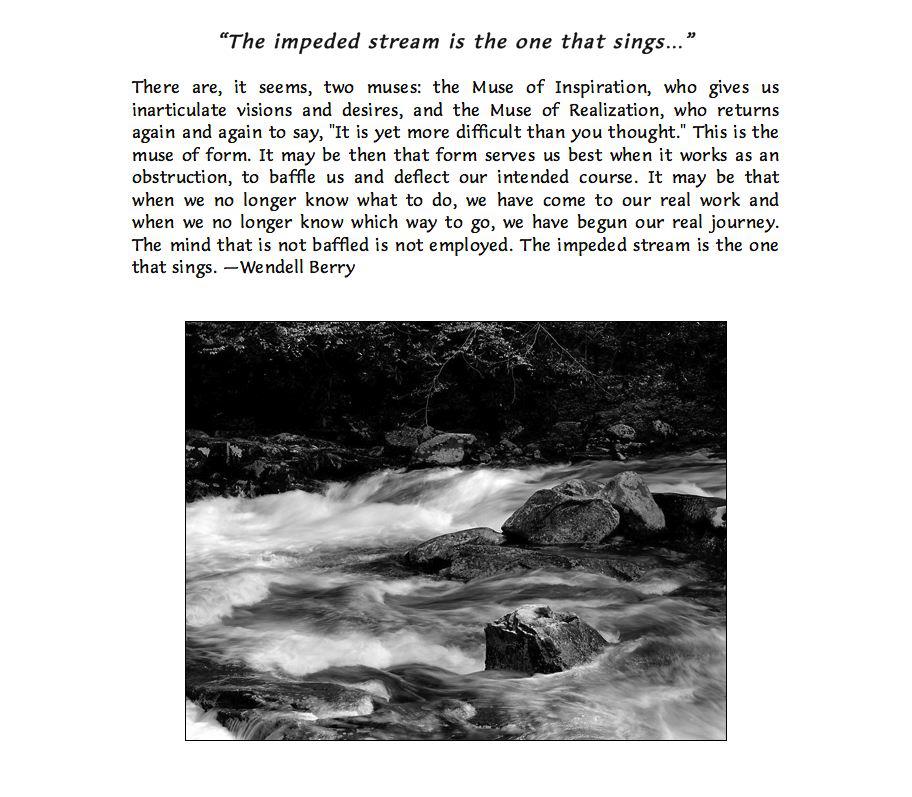
I read Wendell Berry’s words while reliving the picture and was inspired to write a Haiku.
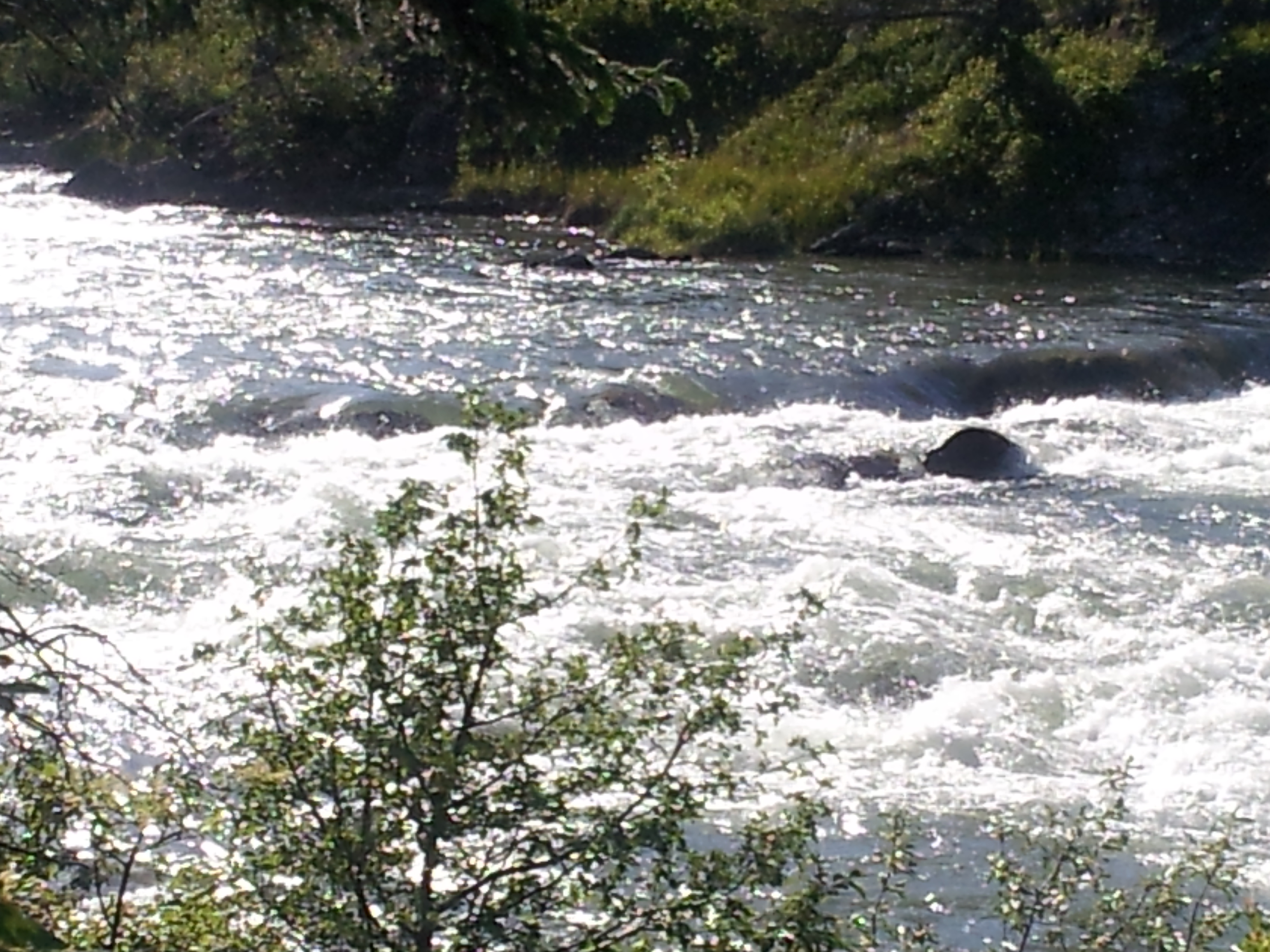
Observe life’s current
Pausing, listening, caring
Present with my self.
I read pedagogy of the oppressed by Paulo Freire during my undergraduate experience and return to it as a source of reflection and when I write. Similar to Parker Palmer, Paulo Freire left an indelible mark on my life’s practice. Education is an uplifting, liberating experience which shines light on each step Antonio Machado described: “Wanderer, your footsteps are the road, and nothing more; wanderer, there is no road, the road is made by walking.” Freire’ s contention was everyone can act as an agent in their learning thus freeing them and transforming the world they live in.
Freire used the Portuguese word conscientização which “refers to learning to perceive social, political, and economic contradictions and to take action against the oppressive elements of reality” (17). Humans become mindful of and present in the world and act to transform it. Freire used a banking metaphor and described traditional education where knowledge is deposited into students. Teachers and the system act oppressively in determining what is important to learn. Freire felt education uplifted people and their learning. “Liberation is a praxis: the action and reflection of men and women upon their world in order to transform it” (p. 60). Learning occurs when compliance and conformity are rejected in favour of dialogue based on love which allows each human to name their world and what is of value in it. The student is a teacher and student; the teacher both student and teacher.

Questions: What can we do to truly bring a new pedagogical structure into our schools and communities of learning? What function would school play in this pedagogical structure? What is dialogue based on love? What role do educators and communities play in liberation education?
Recommendation: I love the book. It is a challenging, but I return to it often and find something new each time. Today, I became aware of the following: “Concepts such as unity, organization, and struggle are immediately labeled as dangerous. … These concepts are dangerous—to the oppressors” (p. 122). What does this mean in supposedly modern, liberated, and affluent societies?
A second point was the similar language used by Freire and Martin Buber. There is a shared understanding of respectful dialogue using the words I and Thou to describe the uplifting, liberating, loving dialogic process.
Freire, P. (1993). pedagogy of the oppressed. (M. B. Ramos, Trans.). New York: Continuum.

I subscribe to a daily meditation written by Father Richard Rohr. a Franciscan priest.I talk and write about the concept of common sense, which I understand as local and global. Father Rohr cast it from a theological perspective, I think the explanation provides an insight gained without reading Gadamer’s Truth and Method. I believe there is a universal truth or common sense (Vico called this sensus communis), something that makes us all brothers and sisters bringing us together in community. I think Father Rohr offers an explanation though his meditation on Father’s Day helping us to live in community each day. Certainly, Rilke does.
“It is this sense that founds community” (Gadamer, 1989, p. 19).
Gadamer, H-G. (1989). Truth and method. (J. Weinsheimer & D. G. Marshall, Trans.). New York: Continuum.
Catch only what you’ve thrown yourself, all is
mere skill and little gain;
but when you’re suddenly the catcher of a ball
thrown by an eternal partner
with accurate and measured swing
towards you, to your center, in an arch
from the great bridgebuilding of God;
why catching then becomes a power–
not yours, a world’s.
–Rainier Maria Rilke
Each year, we learn about Haiku in our classroom. I was fortunate this year. We began the process during the fall when the Harvest Moon was in full glory. Driving to work in the morning, the Moon would be sitting above the horizon or in the evening it appeared as a rich, orange orb almost asking me to reach and touch it. I also drove through the Rockies just before the school year began and Mount Robson was in full majesty with a tiny wisp of cloud.
It had been several years since I heard a student say, “Poetry is stupid. My dad says it is a waste of time” or words to that effect. This year I heard it. I even had one parent tell me it was a waste of time. I calmly pointed out writing out poetry, in general, is the practice of choosing the right word and Haiku takes this one step further, at least I think it does. What I left unsaid, but is worthy of saying, poetry is always present, is part of being mindful, and being in the world.
Those mornings and evenings I observed the moon I found words pressing forward and asked to be shared. I wrote these on the whiteboard as an exercise of being mindful and present.
Majestically,
Touching endless sky above
Roots firmly grounded.

Greetings and adieu
Sun and Moon sharing the sky
Guides my morning drive.

Enjoy Saturday.
I began blogging in earnest in February, but it really began to take off in April. Today was a milestone with my 200th follower. With that, comes the reverse. I follow. There is a tremendous digital gathering and we are only just beginning to understand its impact.
200,
it isn’t 300,
the movie
or followers.
Thank you
for finding your way to this blog.
On a digital palette
I create
vent
share
reveal
learn
present
about the complex nuances of my life in this world.
My gratitude expressed two ways–
following others
who blaze trails
as pioneers
as companions.
Thank you
grateful
you share
your venture along
on this road less traveled
a humbling
transforming
uplifting space.
I am grateful, indebted.
Thank you
is the second way to express gratitude to 200 + 1 now.
Here is a sampler of blogs I follow. Please visit and add to their following. They inspire, teach, and share each day I prepare to write. I ma sure you will enjoy all or some of the following. Check out my blog roll for others.
Spokane Favs is a colleague of mine at Gonzaga University in Spokane WA.
Mikibong inspires with diverse and great photography
Marie Wetmore is a life coach par excellent
Elke Teaches is an Australian teacher to be and mother
Words/Love is a fantastic and creative writer
Zellie M Quinn is a writer and reflector of life
Edilio Ciclostile is a whimsical artist who wants you help him grow down
Enough of the Cat Talk is a teacher from New York who shares in many ways
Meanwhile Melody Muses is an exceptional writer of great poetry who honours nature and teaches.
Mike’s Look at Life is through poetry and photography of things we normally ignore but are there all the time
Brian Gaynor Photography provides inspiring pictures of and in nature
Rod Posse is a photographer of unusual but interesting things
RC Gale is a writer and creator of space for other writers.
That Dude Eddie is a writer of poetry and prose spreading love and peace.
Simon Marsh is an Anglican Priest in England who shares a passion for the writings of Parker Palmer and Thomas Merton
Elizabeth Rambles from a banana boat up the Clyde
Nonoy Manga is an artist and animator with a little writing thrown in on the side.
Seaman Mom is a mother from Romania who works on a cruise ship.
Colour the Day is an artist who finds beauty in many places and ways.
The Jog is by an Anglican minister in England.
Eleven 11 has gone quiet the last few days, but his is a fun blog to read.
I wanted something a little different for the beginning of the year. We had new students and sometimes new students find it difficult those first few days to introduce themselves and share something about themselves with others who are better established. We are an alternative school environment. Some students have been with us since Grade 1 and are now in junior high. Without realizing it, returnees form groups and new students are slightly intimidated by the tightness that has formed despite everyone’s best efforts. I tried a poetry activity and it worked very well.
1. I used a Kahlil Gibran quote from The Prophet:
“Say not, “I have found the truth,” but rather, “I have found a truth.”
Say not, “I have found the path of the soul.” Say rather, “I have met the soul walking upon my path.”
For the soul walks upon all paths.
The soul walks not upon a line, neither does it grow like a reed.
The soul unfolds itself like a lotus of countless petals.”
The quote served as a conversational anchor. I read it out loud a couple of times. Students re-read it, highlighted words or questions that emerged, discussed their reflective findings in pairs, and finally we shared with the group. What did this passage mean? What was the theme? We talked about self-knowledge and truths. I refer to Parker Palmer in my classroom so students had discussed the idea of holding one’s own truth while respecting the truths of others.
2. Students prepared a small poster. I asked them to include two poems, some pictures of activities they enjoyed, some quotes they thought helped describe who they were, and their name proudly displayed in the centre of the poster.
3. Initially, I wanted a free verse poem and a cinquain poem. The former was too abstract for some students so changed allowing some flexibility with another formula poem i.e cinquain, diamond, or acrostic. This helped considerably. Even though I teach in a multi-grade setting, with three junior high grades, this struggle with abstraction was not based on grade level only. There were some older children who struggle with the free verse and younger children who did not.
4. Each child put their poster about who they were on the bulletin board and it has remained there all year. An interesting note is, when corners of posters have come loose on the bulletin board, students take time to tack them back up carefully even if it is not their poster.
For those unfamiliar with the pattern poems I referenced above, here are some instructions and examples.
How to Write a Cinquain
There are two methods:
Line 1 – a one word title
Line 2 – a 2 word phrase that describes your title or you can just use two words
Line 3 – a 3 word phrase that describes an action about your title or just actions words
Line 4 – a 4 word phrase that describes a feeling about your topic or just feeling words
Line 5 – one word that refers back to your title
Line 1 – two syllables
Line 2 – four syllables
Line 3 – six syllables
Line 4 – eight syllables
Line 5 – two syllables
Example
Ivon
Mr. P
teach, learn, enjoy
It is my calling
Teacher
How to Write a Diamond Poem
Method
Line 1 – a one word noun
Line 2 – 2 adjectives that describe the noun
Line 3 – 3 verbs that the noun does
Line 4 – 4 things (nouns) that the top noun and the bottom noun has
Line 5 – 3 verbs that the bottom noun does
Line 6 – 2 adjectives that the describes the bottom noun
Line 7 – a one word noun that is opposite the top noun
Example
cat
furry, silky
sleeping, purring, meowing
tail,   fur,    tongue,   collar
barking, playing, licking
friendly, big
dog
How to Write Acrostic Poems?
Acrostic is an easy poetry formats to use with young writers.
It can be about any subject, written in different ways, but the simplest form is to put the letters that spell your subject down the side of your page. When you have done this then you go back to each letter and think of a word , phrase or sentence that starts with that letter and describes your subject, and give out your hidden message that’s contained in this format, that can run forwards, or backwards.
Example
I ngenious
V irtue
O mniscient (or so students think)
N octurnal


 Teacher as Transformer