Tag Archives: Progressive Education

A Blog Experiment

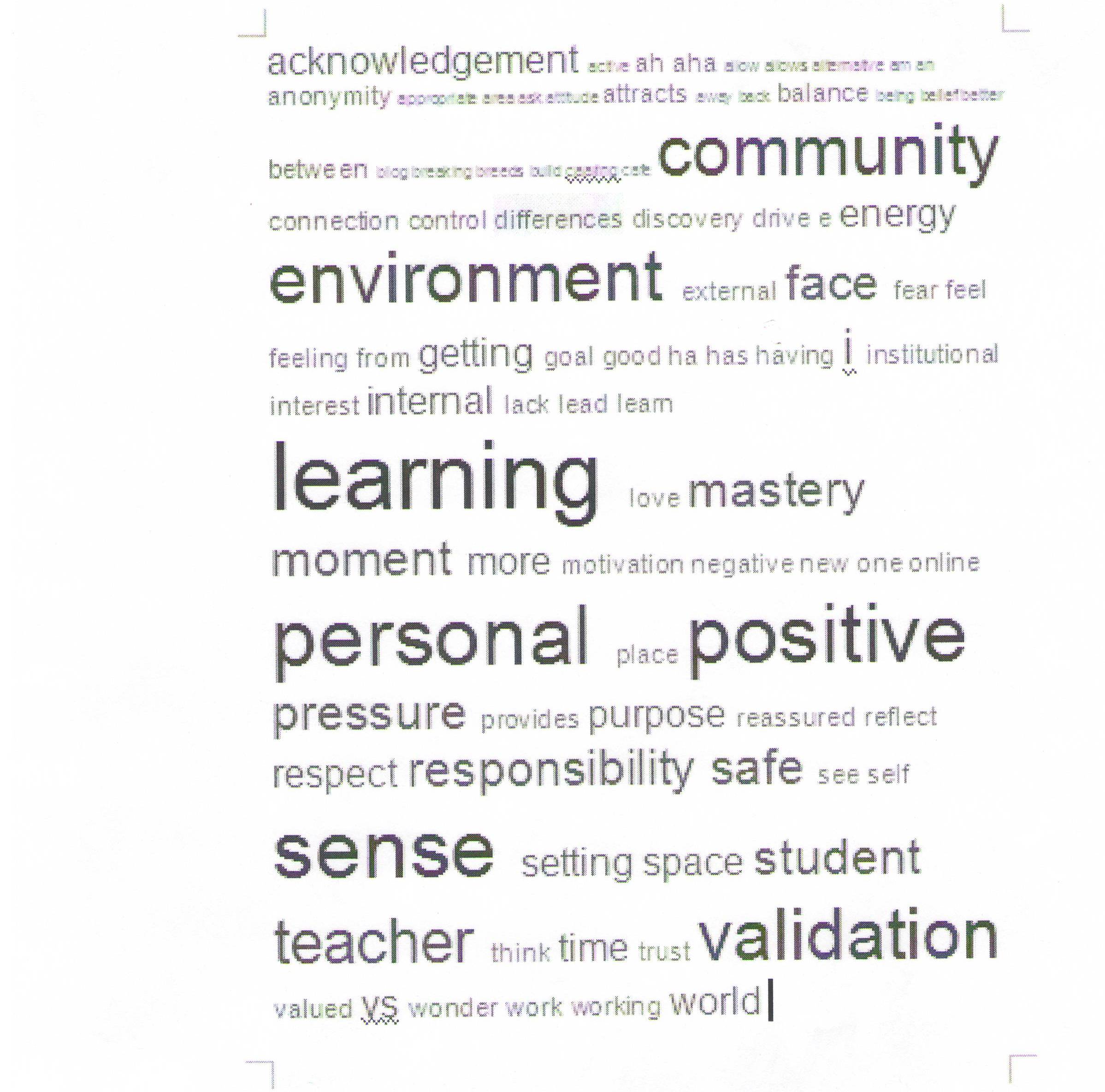
I am using software called NVivo. Essentially, I use it to organize and summarize qualitative data. One cool feature is the ability to create a word cloud. I am experimenting with that feature and using the image facility on my laptop. I summarized some World Cafe events we held in February and March. The results were simply outstanding. The only fly in the ointment was I had to scan the picture and lost the colour.

The overarching question we created our conversation around was: “What engages us in learning?

February 4, 2012

Think of a time that you feel was a high point in your learning. This would have been a time you felt most alive, effective, and engaged in the learning process. Describe how you felt. What made this possible?

February 18, 2012

“Without being humble, describe what you value most about yourself. How does this contribute to the experience of learning for you? What setting does this seem to flourish best in? What would attract you to that setting?”

March 3, 2012

What encourages us to continue learning and see learning as important in our lives?

Questions emerged. I thought the most interesting was an absence in the data. What about teacher expertise in subject area or technical knowledge? It could be these are unstated but assumed necessary. Or it could be that the relational aspect, the art of teaching, is so important to this group of people the technical and subject knowledge is secondary.  What do others think about this?

John Lennon’s Advice on Education

I wonder what education might look like if we followed this simple advice each day for every person who walked in the door’s of our schools?

Imagine a world where we could be happy, responsible, and not deny others their opportunities?

Thought and Haiku for Saturday

Last night, just before I went to bed, I was watching the news from one of the Spokane TV stations. Washington State completed an audit for public education. One of the conclusions was that simply moving 1%of funding from central offices and administration would add about 1000 classroom teachers states-wide. I am not suggesting this could be done across the board in every jurisdiction but it is food for thought. What if we moved 10% from school administration and central office administration? What would the benefits be? Right off the top of my head I thought of additional classroom teachers and effective professional learning could be undertaken.

Will this even be considered or are we merely protecting an antiquated and bloated status quo?

I am working on the World Cafe summaries from several months ago trying to find software to organize, analyze, and present the data in a meaningful way. The March 17, 2012 event yielded what was very close to a haiku. I massaged it a bit this morning and came up with the following:

schooling as a place

can just be interrupting

learning for children.

It sounds a bit like Mark Twain.

Chair Building

I use this lesson plan as an activity in the Grade 7 Science Structure and Forces unit. The students work in pairs.

  • Students draw a plan for the chair design.
  • Concepts to Include might include corrugation, lamination, and triangulation; design considerations such as arches, beams, trusses, and columns; and show an understanding of what fastening techniques for this design i.e. friction fit, mass, and glue, staples, rope, tape (within reason), or nails or screws (within reason).
  •  Consider properties i.e. stability, brittleness, ductility, hardness, plasticity, compression, and tensile strength.  Students need to consider deformation, structural stress, structural fatigue, and possible structural failure. What are internal forces (mass of materials) and external forces (load on the chair).
  • What role do aesthetics play i.e. symmetry and appearance? What is the chair used for?
  • Students use recycled material i.e. cans, plastic containers, and cardboard (boxes, tubing, and pieces).
  • Students construct and track changes. The original chair design might be altered depending on material availability, functionality, and durability.  They should test the chair as they build.
  • I limit class time to 2-3 classes. Most materials are found at home and students can receive help from family, friends, or neighbours.
  • I email parents and tell them they are consultants, who can offer expertise, guidance, and time unavailable in the classroom. Parents are good about insuring students do the lion’s share.

Students are innovative. One student included pop bottle (he told me it was for pop) holders in the arms of a deck chair. Another student gathered discarded pizza boxes after hot lunch and used those.

Assessment is a rubric. A criterion is I test the chair. Its ability to hold my 250 pounds, give or take, is part of the challenge. Only one chair collapsed under my mass. It lacked support.

This is a Grade 7 project, but I think other can modify it for other grade level needs. Students can work in pairs.

Cautionary note: I allow nails, screws, and tape as fasteners, but within reason. The first time I did this activity a student built a nail chair. He used so many nails it is doubtful they were recycled.

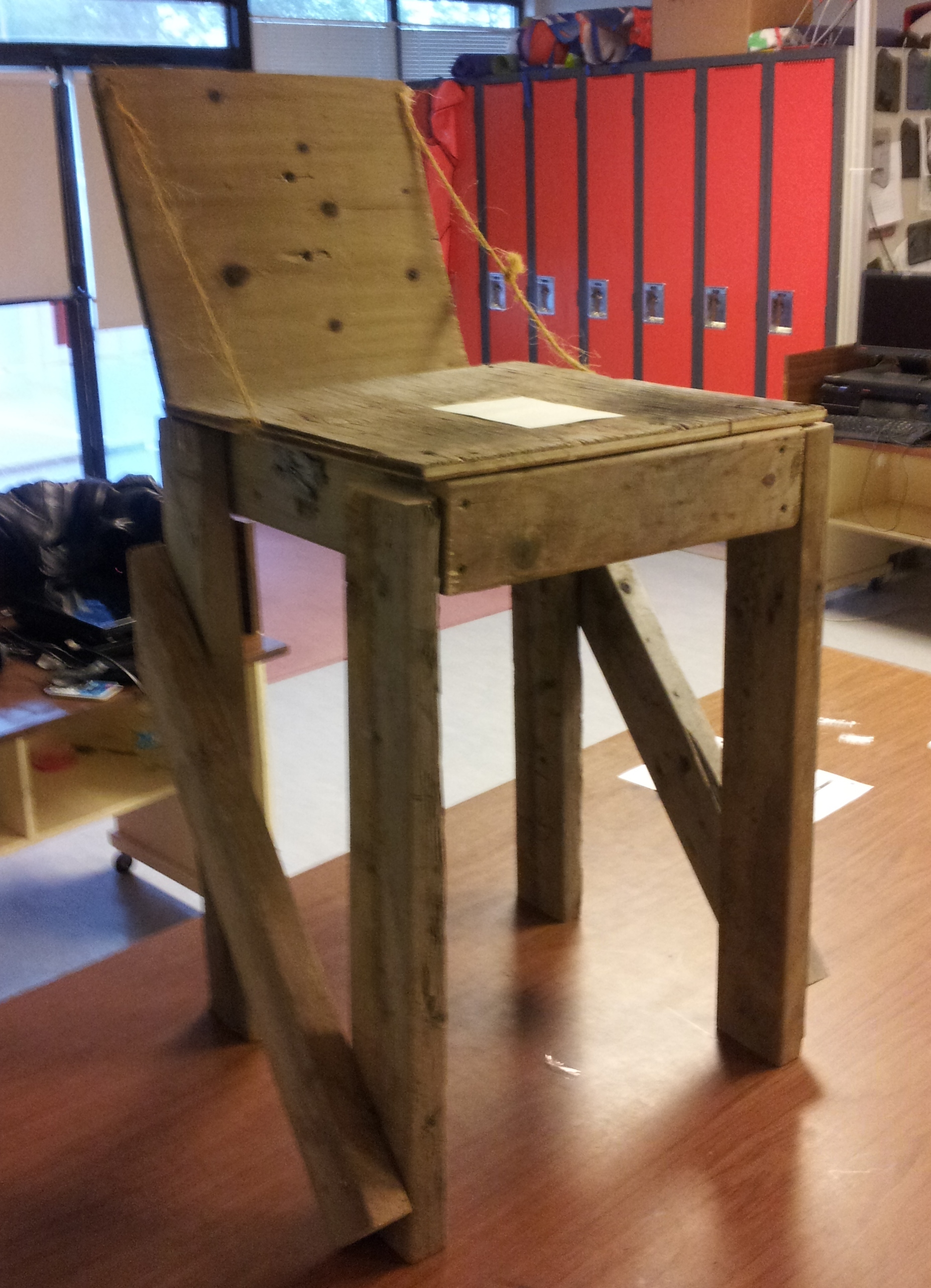
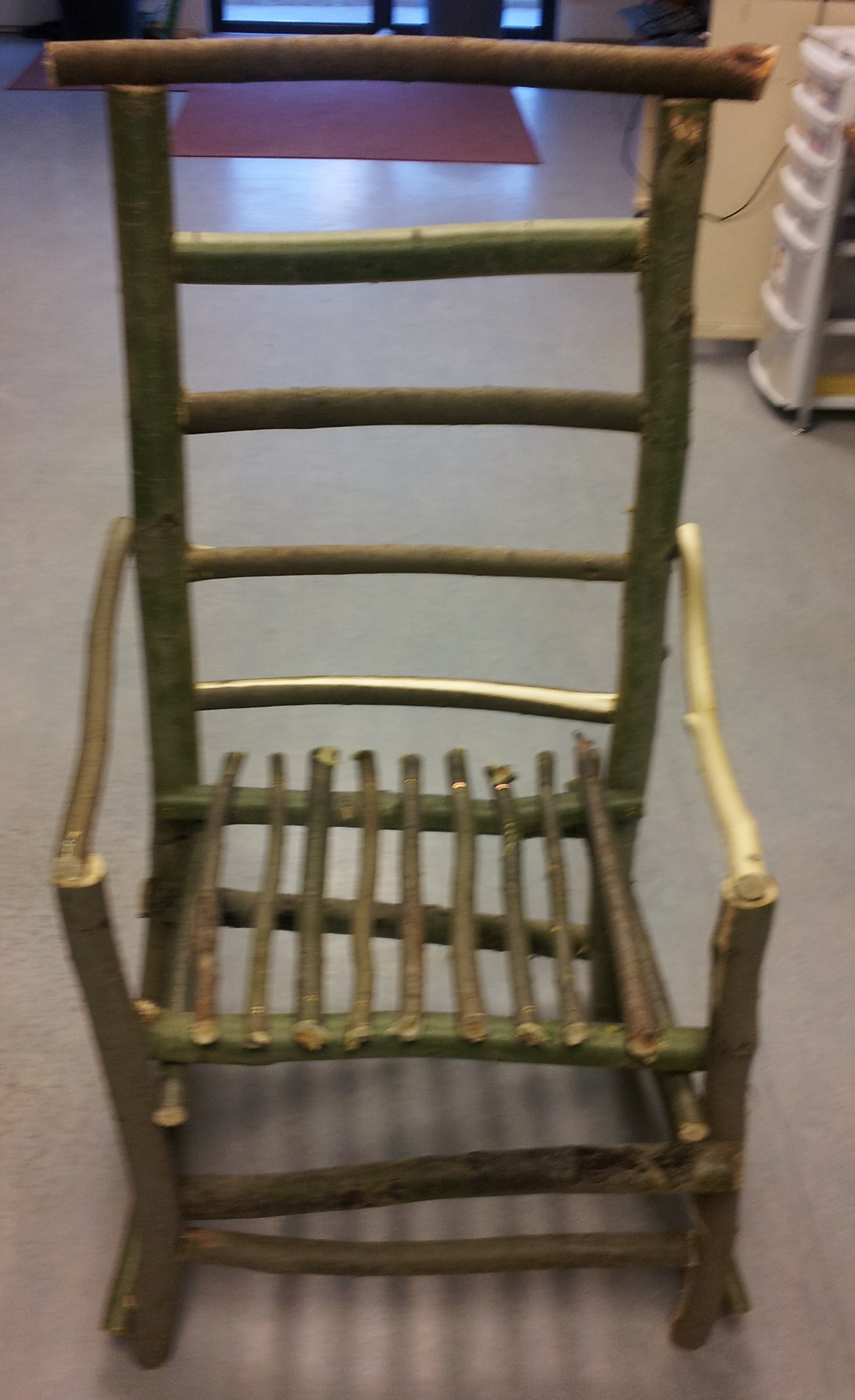
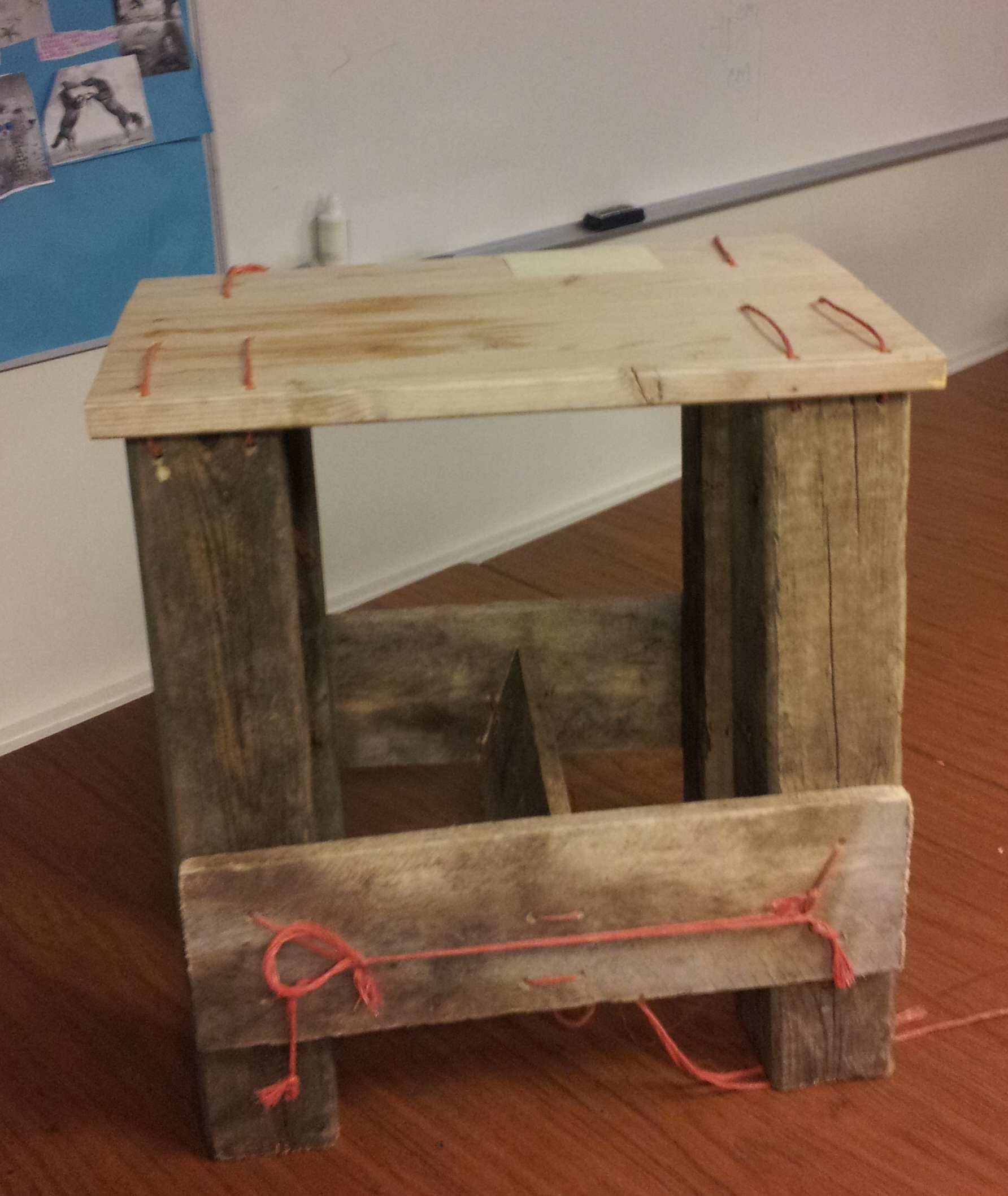
Here are some examples of this year’s chairs.

This chair is made from used pressure treated lumber and plywood. The back folds forward and the student used baling twine he got from the farm as the hinges.

This chair is constructed from willow. The willow qualified as recyclable as the students were going to have to dispose of the willows when they cleared underbrush anyway. The only thing missing is a cushion. These students could go into business selling yard furniture.

Although this stool did not have triangles for stability, the centre piece helped in that respect. When I sat on the stool, it was wobbly, but with my mass it became less so. The students used baling twine as the only fasteners. One of them has horses and these were available.

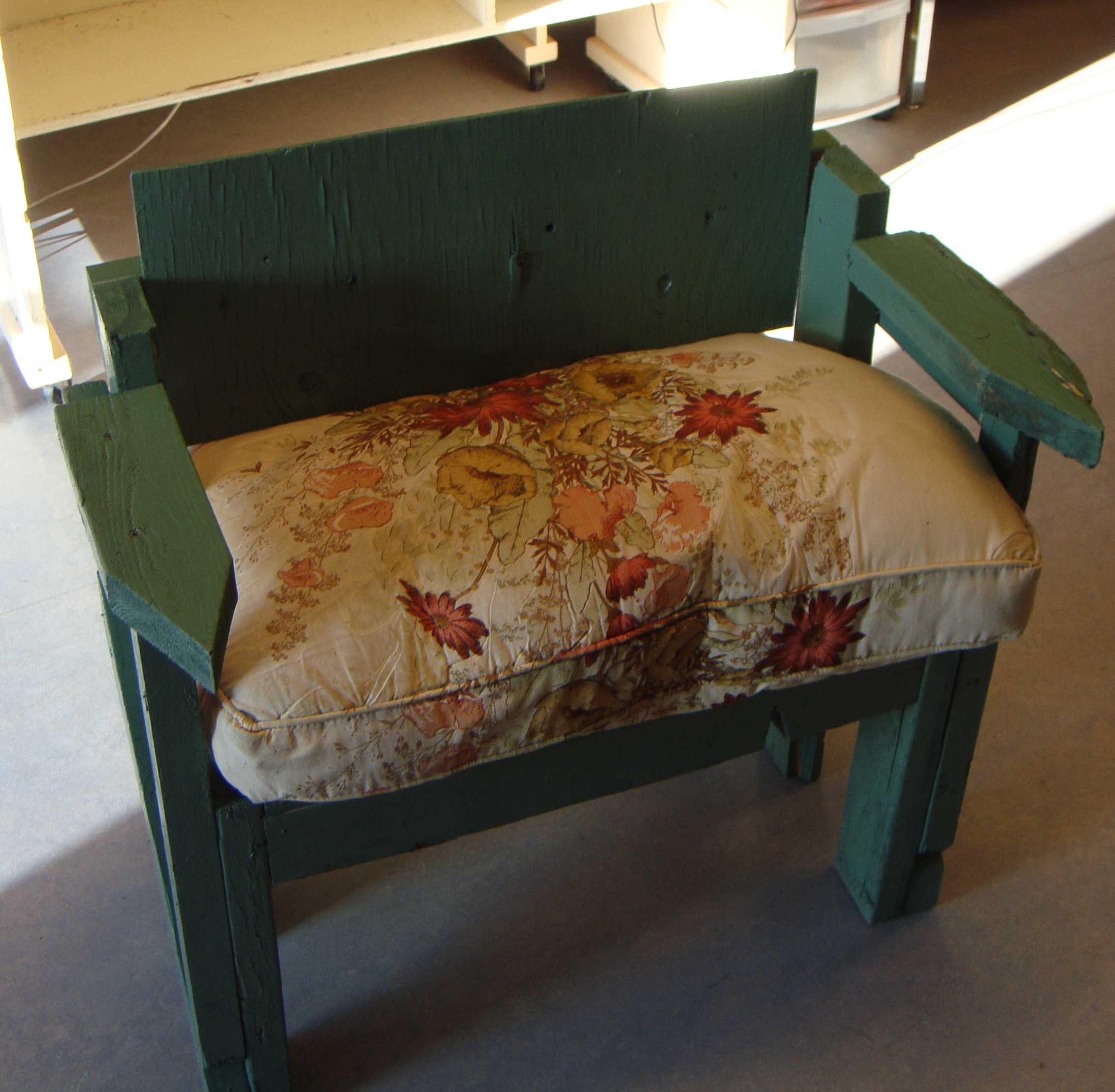
This chair is built from recycled wood and a discarded cushion. The students gathered the wood from the neighbourhood and a neighbour helped. He drilled tap holes for the screws.

Leadership Is a Conversation – Harvard Business Review

Leadership Is a Conversation – Harvard Business Review. Here is an excellent article form Harvard Business Review. Leading is about a conversation. Leaders need to recognize the importance of listening mindfully and attentively otherwise their role is one of management.

Are educators ready for this? Conversations are much harder work than using glib commentary.

Whales Forever

This is not about whales per se. Several years ago, my Grade 8 class struggled with the simple machines unit in Science. I proposed an alternative assessment route. Instead of writing a test, they could apply their learning and build a complex machine. They were all over it, but I had to come up with something and began a search of the Internet. I found an idea called Whales Forever and modified it to fit my needs. It has been a success ever since.

1. Whales become stranded on beaches around the world and Whales Forever is concerned with the survival rate of beached whales. This environmental organization rescues whales and returns them to open water quickly so they will not perish. Whales Forever announced a contest for Grade 8 students to create a prototype machine which would safely lift a stranded whale onto a hover craft so it could be transported back to open water as it receives medical treatment.

2. Students design and build a machine which with a minimum mechanical advantage (MA) of 4. The machine consists of at least two simple machines. Mechanical advantage is calculated output force divided by the input force.

3. The machine will lift the whale a height of 10 cm and lower it 5 cm onto the simulated hovercraft. The whale is simulated by a resealable plastic bag filled with marbles or sand. Students can hand position the ‘whale’ in a harness which is part of the system to begin the lifting process.

4. Students sketch exploratory labelled diagrams of their chosen design including measurements indicating critical components i.e. simple machines used, gears, and drive trains. They provide mechanical advantage calculations.

5. Students use available materials i.e. desks, stools, tables, retort stands. Last year, a student used a Meccano set and this year students used K’Nex. They are not allowed to use a motorized system. They use planes, levers, pulleys, screws, wheel and axles, and perhaps a wedge.

6. Students give a written reflection outlining the strengths and weaknesses of their design including written suggestions for improvement.

7. Students make a 4 minute presentation to the board of directors of Whales Forever.

I use a rubric and assess the design including diagrams, the effectiveness of the prototype, the reflection, and the presentation.

Here are some examples of this year’s products.

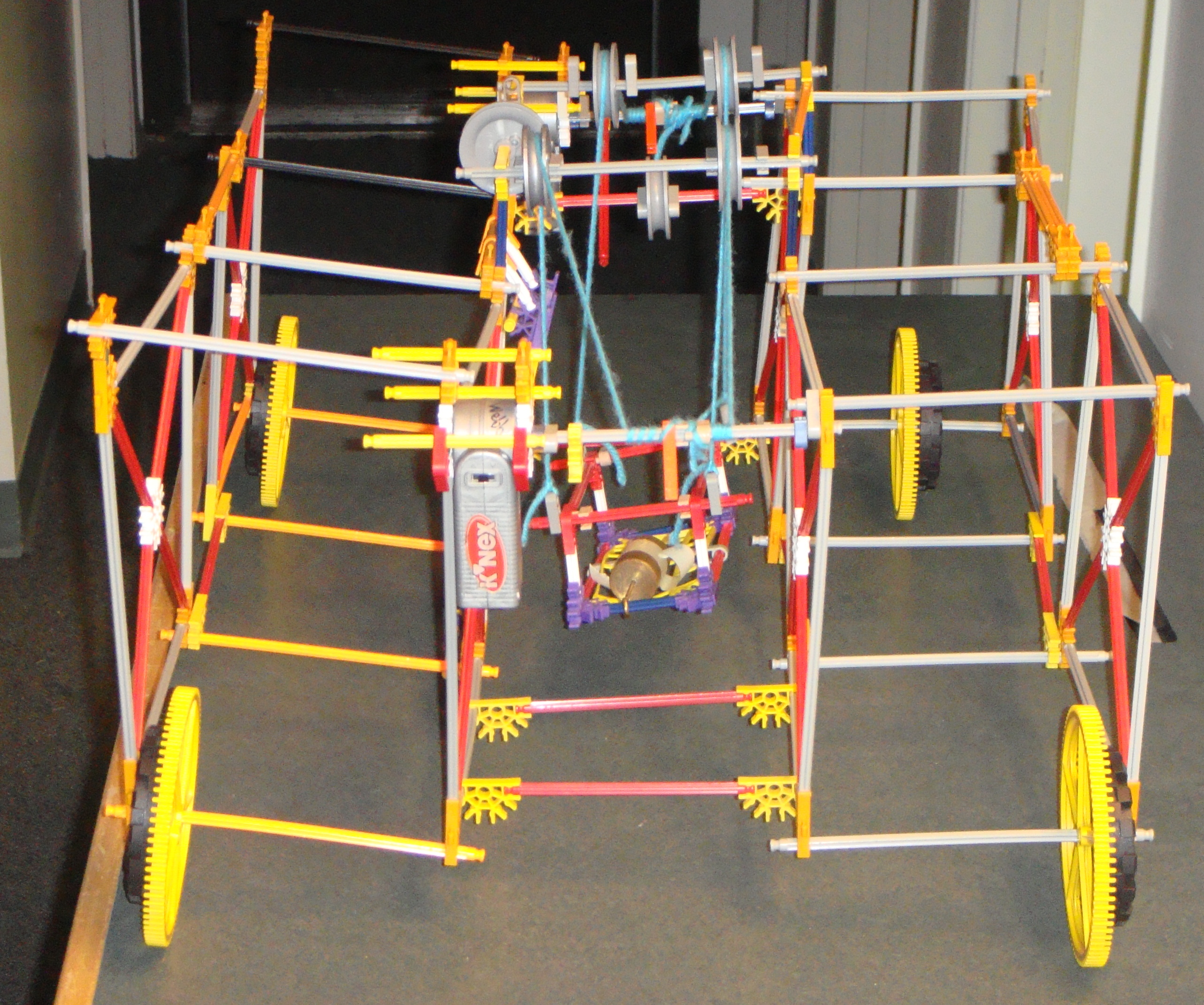
Whale Saver constructed from K’Nex. You can see the harness on this one. It had a mechanical advantage of about 15. The one challenge with the K’Nex is hooking up the scale. It took some maneuvering.

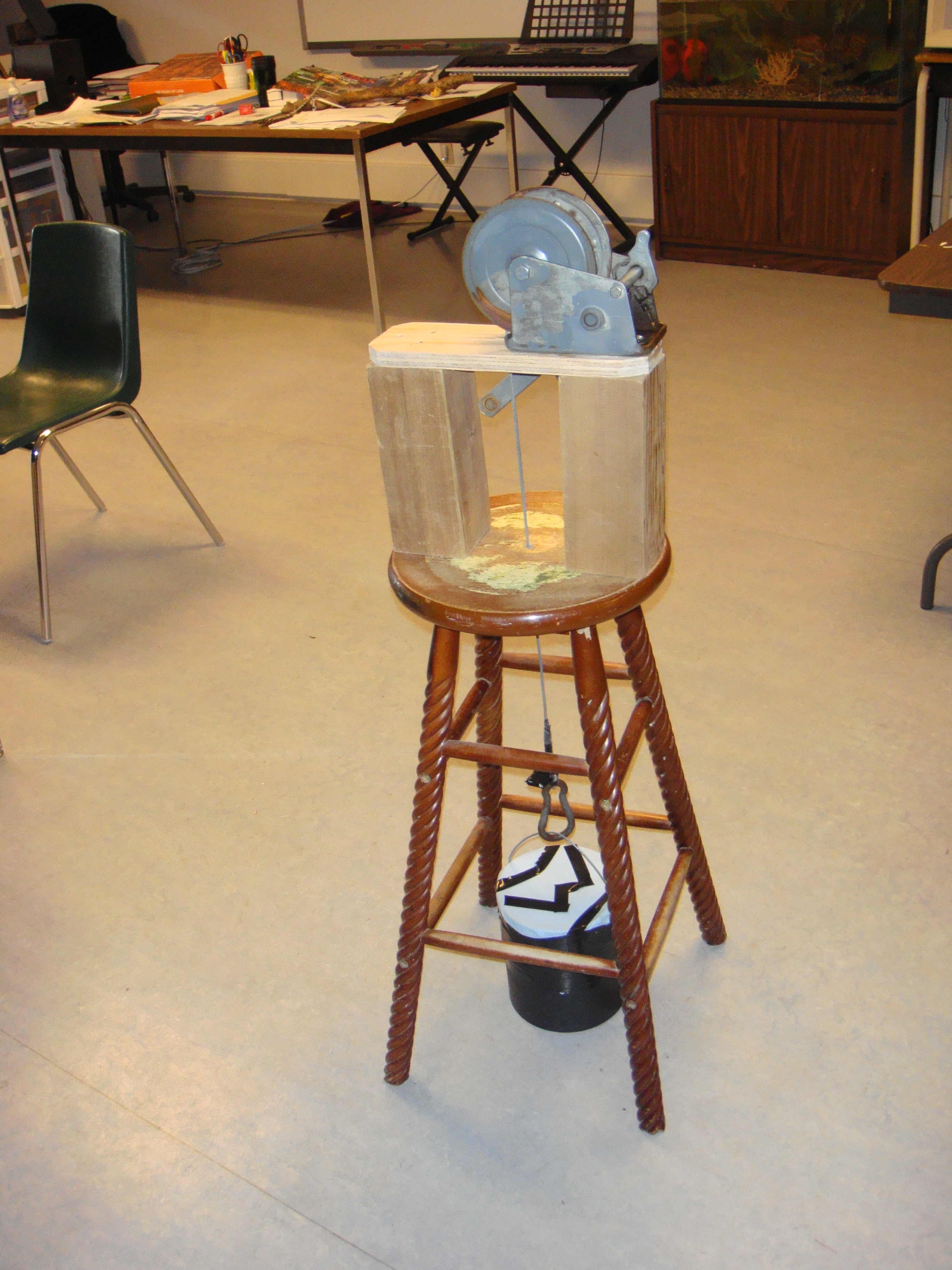
This one was homemade. It had a mechanical advantage of 20.

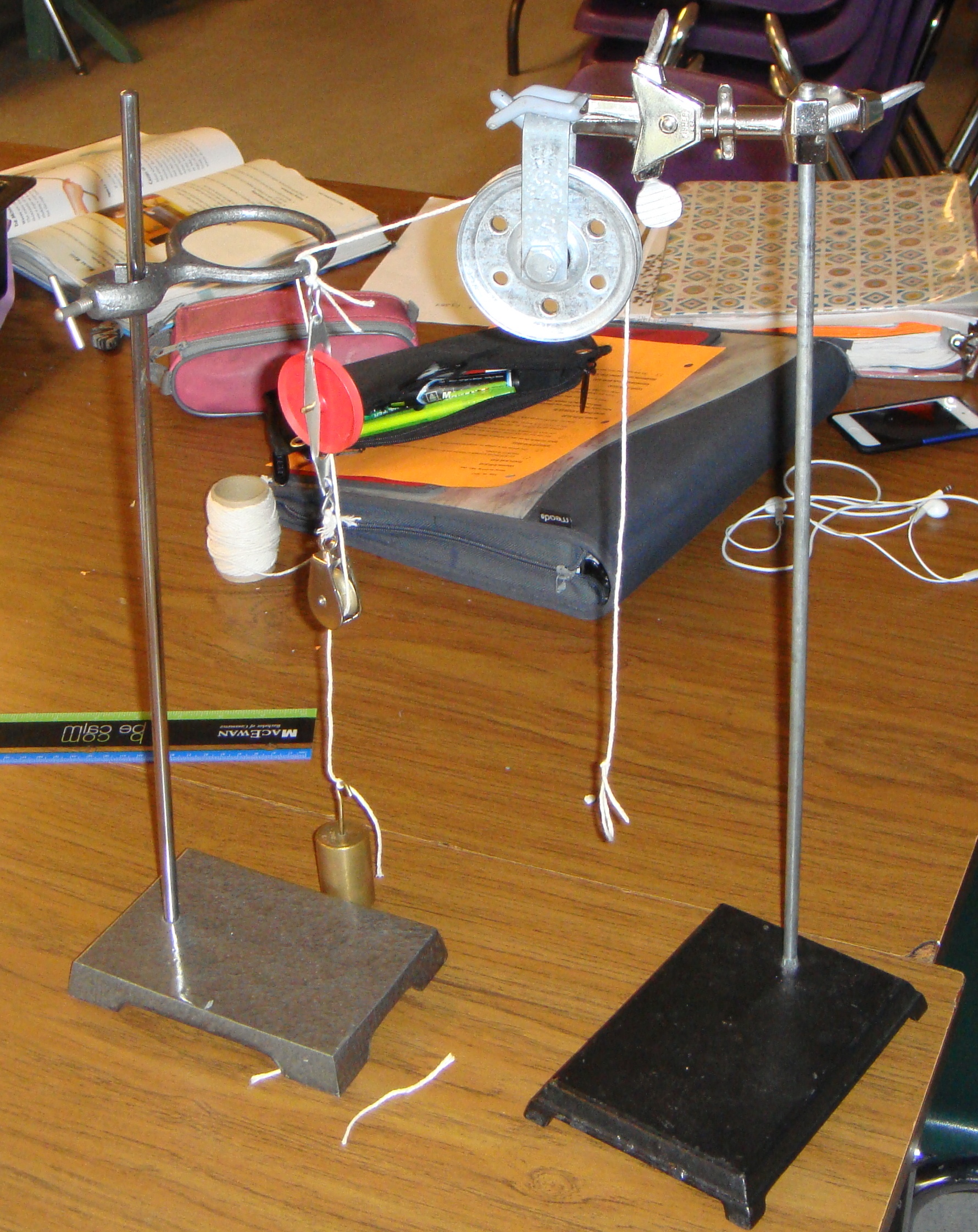
These students used materials from the classroom primarily. It had a mechanical advantage of about 8 or 9.

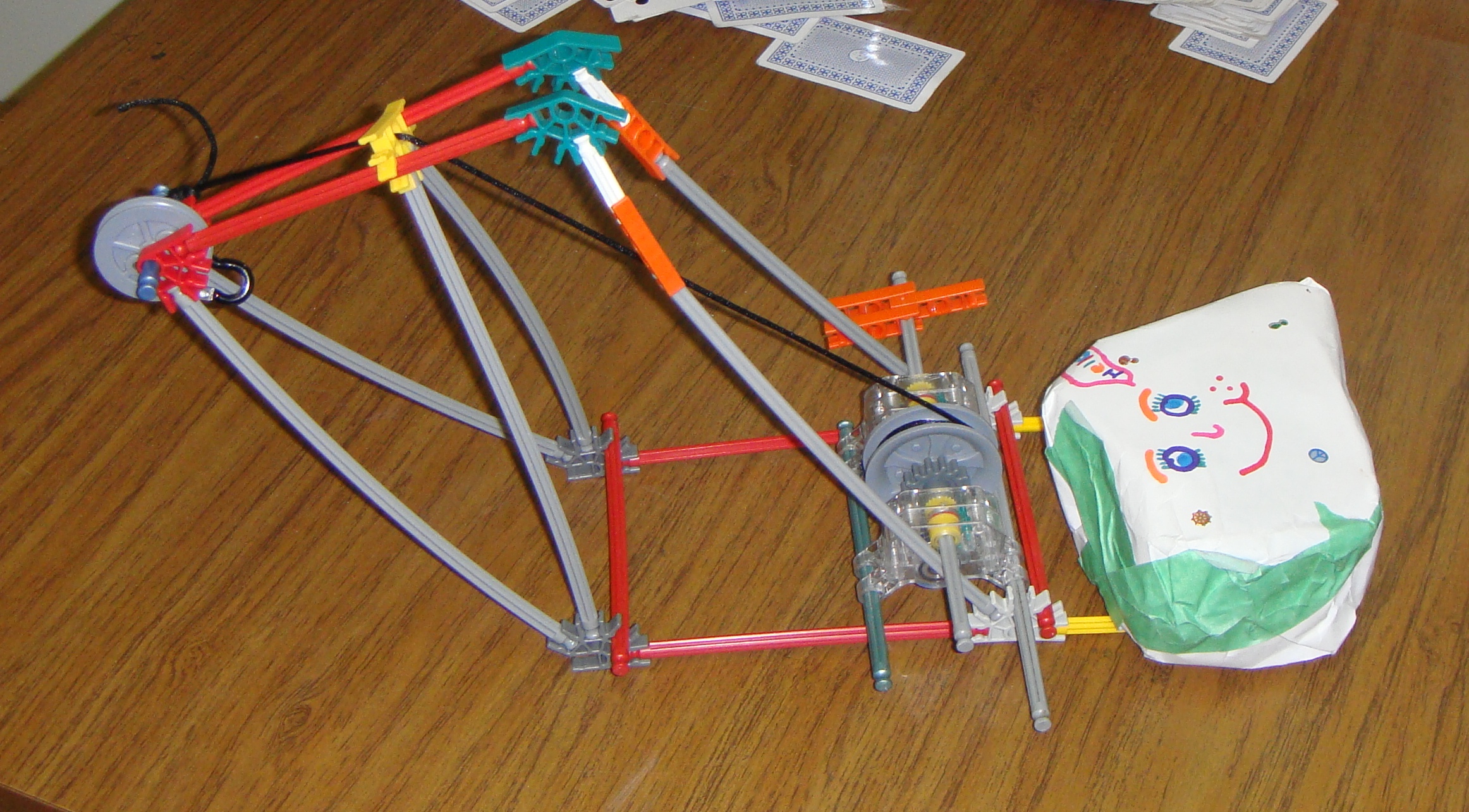
This was another K’Nex design. The thing on the right is a rock wrapped in paper with a face on it. The rock countered the weight of the whale as it was lifted. This machine had a mechanical advantage of about 10.

Blueberries | Jamie Vollmer

Blueberries | Jamie Vollmer.

This is worth reading. It fell into one of my email boxes this morning. In theory, I agree with the idea that we cannot, as teachers, return our students like Mr. Vollmer could return his blueberries. Fundamentally though, there is still a problem. In the province of Alberta. there are over 25% of students who will not finish high school. Those are the ones who leave our schools. What about those who do not leave and finish? There are still some amongst them who are on the margins and school has not served well. The 25% is an average.What about students who live in First Nation communities, in the inner city, or face any number of other life issues?

Education needs an overhaul. There is a genuine need for a different conversation and not sticking our heads in the sand. Please take a few minutes to read.

Diane Ravitch is a leading American educator. Although what happens south of the border is not important to us, this article poses a great question. Who is advantaged; those with resources or those without resources? Servant-leadership, which is lost in education, asks the leader to serve those around him or her and help them grow. That focus increases for the most disadvantaged. When will politicians, bureaucrats, and technocrats allow teachers in the classroom to become leaders who serve students and the community?

dianeravitch's avatarDiane Ravitch's blog

Mitt Romney launched his foray into education by visiting the Universal Bluford charter school in West Philadelphia, an impoverished, largely African-American neighborhood. He went to tout his plan for vouchers and charters as the new civil rights crusade of our era.

While there, thinking he was in friendly territory, he made some unfortunate remarks. First, he asserted that class size wasn’t important. That is no doubt the advice he had received from his advisors, who like to claim that having a “great teacher” is far more important than class size reduction. Then, he advised his listeners that one of the keys to education success is to be a child of a two-parent family. He got called out on both comments.

A music teacher rebuked him on the class size issue, saying: “I can’t think of any teacher in the whole time I’ve been teaching, over 10 years — 13 years —…

View original post 292 more words

There are excellent points in this article, but some areas of concern. The role of students, educators, and school provided insight into a different way of thinking about education. I disagree with the premise that administrators are a separate group, although they seem to be. Are administrators not educators themselves? I once met a retired educator who when I was introduced as a teacher and had something in common with her, she responded, “Oh, I was a principal” making it sound like I was inferior by remaining a classroom teacher. In recent years, I have witnessed this desire among many teachers to escape the classroom. We are teachers first.  If not educators, what is our role? What about children who needs help? What do we do to raise them up? I think this article is a starting point for a conversation.

Jabreel Chisley's avatarCooperative Catalyst

Education is something that is vital to the existence of a country where financial prosperity is something that is universally longed for. This is because that in order to reach financial prosperity one must reach a level of knowledgeable prosperity that unlocks the true innovator within them. However, if our countries goal is to allow for everyone to reach a level of financial prosperity then its time for us to sit down and come up with a dedicated pathway to delivering education with equality, equity, loyalty, and dignified passion in mind. If this is our goal then it is time for us to do away with the days where our educational system is balanced on the practice of every child left behind and every teacher for themselves. The time has come where we must push forward, with dignified loyalty, professional reservation, and universal respect for the student, the classroom, and…

View original post 933 more words

Words for the Wise – Partie Deux

Words for the wise was a product of an incident yesterday. I was left exasperated, exhausted, and feeling somewhat unintelligent. I calmed down and found the wisdom shared by Winnie the Pooh helpful in creating a new lesson plan for today’s poetry time, but, first, let me explain the back story from yesterday.

About two months ago, a student brought their scooter to school and was riding it up and down the sidewalk in front of the building we occupy. Our school is located in what was a commercial building our school division acquired. There is no space to scooter in the front of the building, because there is a sidewalk and a parking lot immediately in front of the building. Usually, both are busy so it is an unsafe pastime. Second, students must wear proper equipment i.e. approved helmet, knee pads, and elbow pads. The young man in question is proficient, or so I have been told, so he took the equipment rule as a problem. Frankly, I would to, if I was any good at riding my scooter.

Yesterday, another student brought their scooter to school. While I was occupied, two students, including the aforementioned young man noted, borrowed the scooter and rode it in the parking lot and on the sidewalk while others watched. I was angry; that is the polite way of putting it. I gave some students credit. They recalled explicit instructions about the conditions a scooter could be used i.e. equipment, supervision, and location. Others had forgotten, but it was more likely a situation they were not listening for any number of reasons. This morning I received an email from the young man’s parent saying he informed her he could ride the scooter out back. I am not sure where out back is, because there is no place to ride out back. He left out the equipment and supervision.

Listening, which I think is essential to being responsible for one’s actions and words, seems limited to what a person wants. We listen when we are motivated by words or sounds that are we want to hear. I think that might be human nature. We lack mindfulness and being in the present moment. As luck would have it, sitting on my desk was a William Stafford poem entitled Listening. We had a great conversation after reading it, reflection time, and sharing in pairs.

Listening

My father could hear a little animal step,

or a moth in the dark against the screen,

and every far sound called the listening out

into places where the rest of us had never been.

More spoke to him from the soft wild night

than came to our porch for us on the wind,

we would watch him look up and his face go keen

till the walls of the world flared, widened.

My father heard so much that we still stand

inviting the quiet by turning the face,

waiting for a time when something in the night

will touch us too from that other place.

Thank you William Stafford. Winnie, I was brave and strong enough to tell my students I was listening, but I cannot always do what they want. I simply do not have the power some days and am smart enough to recognize this.