Tag Archives: school

Accepting This

When Kathy and I decided I would teach one more year, I wanted to make it the best year possible. I tired last year, was in physical pain, and it was difficult to be there for students as I wanted. I examined my life as Socrates suggested. I realized I focused on things I had little or no control over which is unlike me. I knew I wanted this year to be different and I worked hard the first 1/2 of the year in that respect. I remind myself I can only do what I am capable of doing. I stopped planning and organizing that which is not plannable or organizable and take a breath now and then. I choose to accept my life as it unfolds and as I author it in this moment. I owe this to the students and their families who support them and me.

Mark Nepo reminded me today of this as I read this beautiful poem.

Yes, it is true. I confess,
I have thought great thoughts,
and sung great songs—all of it
rehearsal for the majesty
of being held.

The dream is awakened
when thinking I love you
and life begins
when saying I love you
and joy moves like blood
when embracing others with love.

My efforts now turn
from trying to outrun suffering
to accepting love wherever
I can find it.

Stripped of causes and plans
and things to strive for,
I have discovered everything
I could need or ask for
is right here—
in flawed abundance.

We cannot eliminate hunger,
but we can feed each other.
We cannot eliminate loneliness,
but we can hold each other.
We cannot eliminate pain,
but we can live a life
of compassion.

Ultimately,
we are small living things
awakened in the stream,
not gods who carve out rivers.

Like human fish,
we are asked to experience
meaning in the life that moves
through the gill of our heart.

There is nothing to do
and nowhere to go.
Accepting this,
we can do everything
and go anywhere.
To be of use

Yesterday, I spoke with a frustrated parent. Our little school thrived because parents contributed in meaningful ways to their children’s education. This parent said she was felt like an unpaid employee whose efforts were no longer valued. Now, she could have been just being nice, but she told me she felt welcomed and appreciated in my classroom.

When we ask people, of all ages, to do something they should feel welcomed and worthy of the effort they give. Marge Piercy wrote about this human need to do real work. We find purpose, worth, and identity in our calling. Voice and vocation come from the same etymological roots. We find voice in the work that chooses us. Real work calls us and makes us whole.

The people I love the best
jump into work head first
without dallying in the shallows
and swim off with sure strokes almost out of sight.
They seem to become natives of that element,
the black sleek heads of seals
bouncing like half submerged balls.

I love people who harness themselves, an ox to a heavy cart,
who pull like water buffalo, with massive patience,
who strain in the mud and the muck to move things forward,
who do what has to be done, again and again.

I want to be with people who submerge
in the task, who go into the fields to harvest
and work in a row and pass the bags along,
who stand in the line and haul in their places,
who are not parlor generals and field deserters
but move in a common rhythm
when the food must come in or the fire be put out.

The work of the world is common as mud.
Botched, it smears the hands, crumbles to dust.
But the thing worth doing well done
has a shape that satisfies, clean and evident.
Greek amphoras for wine or oil,
Hopi vases that held corn, are put in museums
but you know they were made to be used.
The pitcher cries for water to carry
and a person for work that is real.

First Reader

We experienced a good day today. We are writing fractured fairy tales which are parodies of the originals. Students turn the story around and rewrite it with a twist. One student explained that the boy who cried wolf was visually impaired and was the victim of pranks by the sheep. Another student told the story of the Billy Goats Gruff through the eyes of the troll. Would you like it if someone were clacking around on your roof? The handsome prince dumps the beautiful princess for the maid in Rapunzel so someone did live happily ever after. The kids have fun with this activity and we talk about perspective. What if I were the Big Bad Wolf? We learn to understand that life is revealed through many eyes and experiences.

Billy Collins wrote this poem which I think expresses the way we learn and shape our learning. Occasionally, we need to let go, just be in the moment, and experience learning. I think we did that today.

I can see them standing politely on the wide pages
that I was still learning to turn,
Jane in a blue jumper, Dick with his crayon-brown hair,
playing with a ball or exploring the cosmos
of the backyard, unaware they are the first characters,
the boy and girl who begin fiction.

Beyond the simple illustrations of their neighborhood,
the other protagonists were waiting in a huddle:
frightening Heathcliff, frightened Pip, Nick Adams
carrying a fishing rod, Emma Bovary riding into Rouen.

But I would read about the perfect boy and his sister
even before I would read about Adam and Eve, garden and gate,
and before I heard the name Gutenberg, the type
of their simple talk was moving into my focusing eyes.

It was always Saturday and he and she
were always pointing at something and shouting,
“Look!” pointing at the dog, the bicycle, or at their father
as he pushed a hand mower over the lawn,
waving at aproned mother framed in the kitchen doorway,
pointing toward the sky, pointing at each other.

They wanted us to look but we had looked already
and seen the shaded lawn, the wagon, the postman.
We had seen the dog, walked, watered and fed the animal,
and now it was time to discover the infinite, clicking
permutations of the alphabet’s small and capital letters.
Alphabetical ourselves in the rows of classroom desks,
we were forgetting how to look, learning how to read.

Poem Against the First Grade

When I read this poem, I do so with care. George Venn wrote it in the voice of a six-year-old, but I can easily imagine anyone so excited about learning that they trip over their words and speak so fast words just run together. The poem reminded me of the way small children or a learner of any age, stops in mid-sentence and makes pronouncements in ways that do not always fit the conversation, but seem so right.

What a marvel when I do not worry about the need to be expert or proficient. I can just be in that moment a small child excited by the newness of my life.

Alex, my son, with backberry jam
smeared ear to ear and laughing,
rides his unbroken joy with words
so fast we let him get away
on the jamjar without clean cheeks first.

He spills frasasass
tea with milk and honey;
a red-chafted schlicker
beats our cottonwood drum.
Thumping the pano keys
like a mudpie chef,
he goes wild with words
at the wittle wooden
arms inside, a hundred
Pinoschios to singsong.
If he can’t wide byebye
bike to the candy store,
where he is Master Rich
with one penny, words turn
to tears in his mouf. Once
in a while, he walks home
with pum-pum-pumpernickel bread
his nose twitching so fast
a wabbit would love him.

Now this language is not taught in first grade.
Alicia, his tister, knows this fact.
But he juggles it around all day
until she makes him spit it out like
a catseye marble or a tack. “Ax,” she says,
“that’s not right.” She’s been among giants
who wipe off the dialect of backberry jam,
then pour hot wax on each bright mistake.

I hope for a bad seal on Ax and tister,
encourage the mold of joyous error
that proper sad giants, armed to the ears
with pencils and rules, all forgot.

Children Will Listen

I tell people when I facilitate workshops we do not teach human qualities, we model them. Good sportsmanship, integrity, and kindness, to name a few of those qualities, are prime examples. We seem to live in a world of “do as I say, not as I do”. Children are observant and intelligent and see through this so easily. They know when things do not add up and are inconsistent. In a world that changes so rapidly, adults need to be vigilant, authentic, and careful about the modeling they do.

Stephen Sondheim wrote this song for the musical, Into the Woods. I enjoy songs with deep meaning in the lyrics and this one is a prime example

How do you say to your child in the night?
Nothing’s all black, but then nothing’s all white
How do you say it will all be all right
When you know that it might not be true?
What do you do?

Careful the things you say
Children will listen
Careful the things you do
Children will see and learn
Children may not obey, but children will listen
Children will look to you for which way to turn
To learn what to be
Careful before you say “Listen to me”
Children will listen

Careful the wish you make
Wishes are children
Careful the path they take
Wishes come true, not free
Careful the spell you cast
Not just on children
Sometimes the spell may last
Past what you can see
And turn against you
Careful the tale you tell
That is the spell
Children will listen

How can you say to a child who’s in flight
“Don’t slip away and i won’t hold so tight”
What can you say that no matter how slight Won’t be misunderstood
What do you leave to your child when you’re dead?
Only whatever you put in it’s head
Things that you’re mother and father had said
Which were left to them too
Careful what you say
Children will listen
Careful you do it too
Children will see
And learn, oh guide them that step away
Children will glisten
Tamper with what is true
And children will turn
If just to be free
Careful before you say
“Listen to me”

A Note

Well, I made it to the finish line this week and had a good day today. I ran out of steam after lunch, but afternoons have been kind this week. We are writing Fractured Fairy Tales and students get into this activity. I find opportunities to work 1-on-1 with students who need a little extra help. It is a great unit plan and can be modified for different ages.

Wislawa Szymborska wrote this poem. It fits with recent reflections about the extraordinary nature of ordinary life. My father-in-law, Bill, used to ask, “Who has more fun than people? More people do, of course!” I recalled his quirky, wise sayings as I read this poem. It is simple things, often overlooked, that give life its fullest meaning.

Life is the only way
to get covered in leaves,
catch your breath on sand,
rise on wings;

to be a dog,
or stroke its warm fur;

to tell pain
from everything it’s not;

to squeeze inside events,
dawdle in views,
to seek the least of all possible mistakes;

An extraordinary chance
to remember for a moment
a conversation held with the lamp switched off;

and if only once
to stumble on a stone,
end up soaked in one downpour or another,

mislay your keys in the grass;
and to follow a spark on the wind with your eyes;

and to keep on not knowing
something important.


To Look at Any Thing

It was a busy day. I was alone with the students. Usually, I there is a parent, but today the schedule was unfilled. We were still productive and covered challenging material.

The Grade 7 class is building scenarios and predicting what if learned experience is used in new situations. The Grade 8 class is exploring differences between authority and power. The Grade 9 class is taking and defending positions on the Canadian youth criminal system. Like all good things, learning takes time.

John Moffitt’s poem speaks about a way we learn the world. We should savour it, not consume it.

To look at any thing,
If you would know that thing,
You must look at it long:
To look at this green and say,
‘I have seen spring in these
Woods,’ will not do—you must
Be the thing you see:
You must be the dark snakes of
Stems and ferny plumes of leaves,
You must enter in
To the small silences between the leaves,
You must take your time
And touch the very peace
They issue from.

The Soul’s Choice

It was cool, rainy, and windy at times today. We are going to go through a couple of days of below seasonal and bounce back on the weekend. Today, a new parent was the parent-helper. She did a wonderful job and told me how much her child was enjoying our little corner of paradise. It warmed the heart on a dreary day.

The day broke

Cool and wet

Grey.

Able to dampen one’s spirit;

If allowed–

And let the dull prevail.

A glow emerged

Warmth radiates

Revealed in community.

In communal spirit

Discover my world

Leads me forward.

A Time of Rest

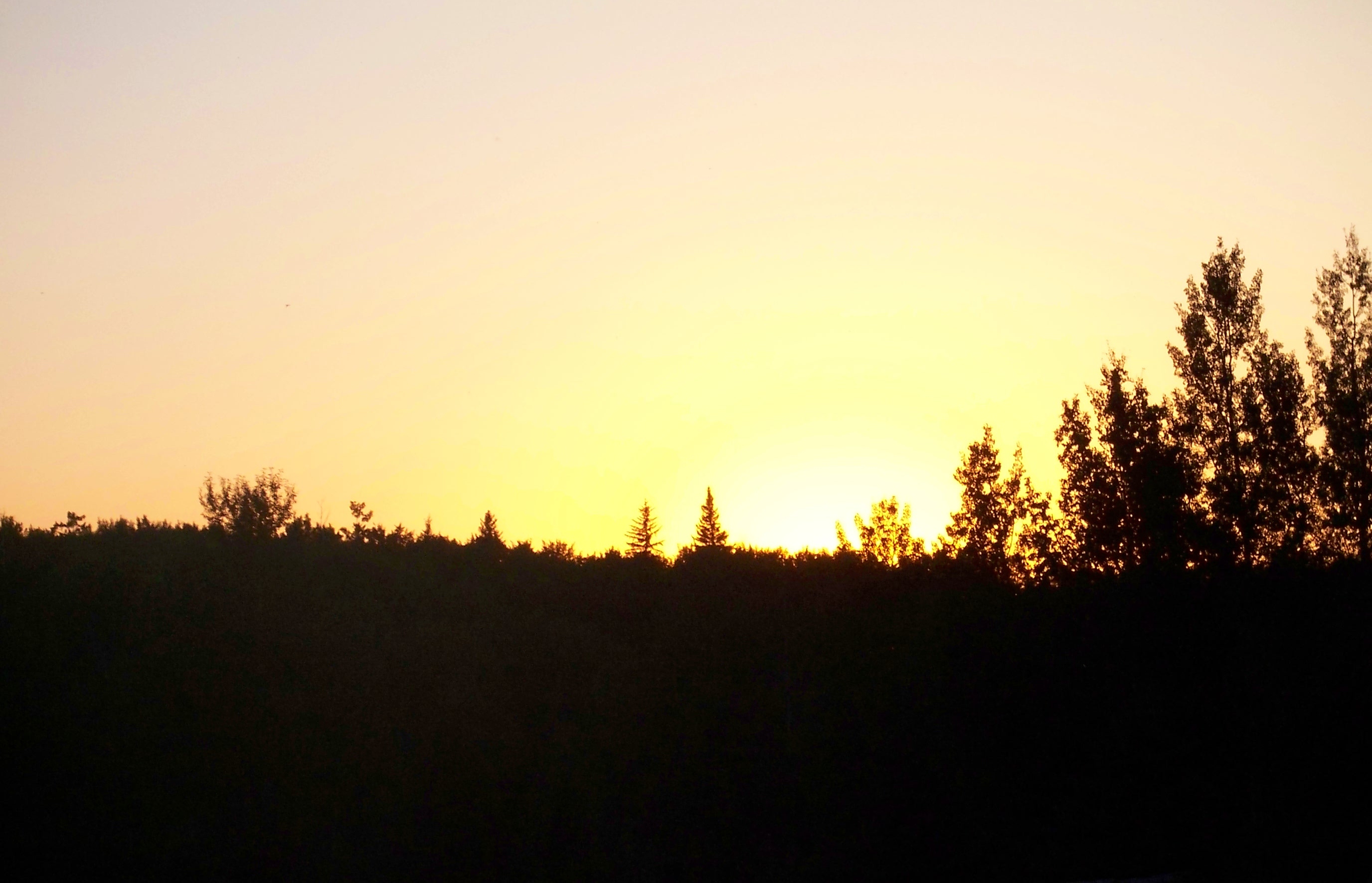
Kathy took this picture last weekend. They finished a day cleaning the farmhouse and it is livable. The sun, after a dreary day, appeared and the sky was awash with golden rays. I feel this way in the classroom. I love what I do. I am whole and find voice. I am a learner, a teacher, and the two are inseparable, but I remind my self to be mindful and give thanks.

Fleetingly framed

Trees against golden skyline

Nature paints day’s end.

Glorious moment

Sky awash with golden light

I am fulfilled.

Conversation Circles

In our classroom, we use a conversation circle. I use it as a time to clarify things from my perspective and allow students to speak about what they would like to do. At other times, we talk about upcoming events. Today in the conversation circle, each student introduced themselves to the group, which seems like a small thing, but sometimes goes unattended in classrooms.   I also asked the students about what they want for complementary courses. This is an outgrowth of the conversation circles we held last year. Students want a voice in their learning.

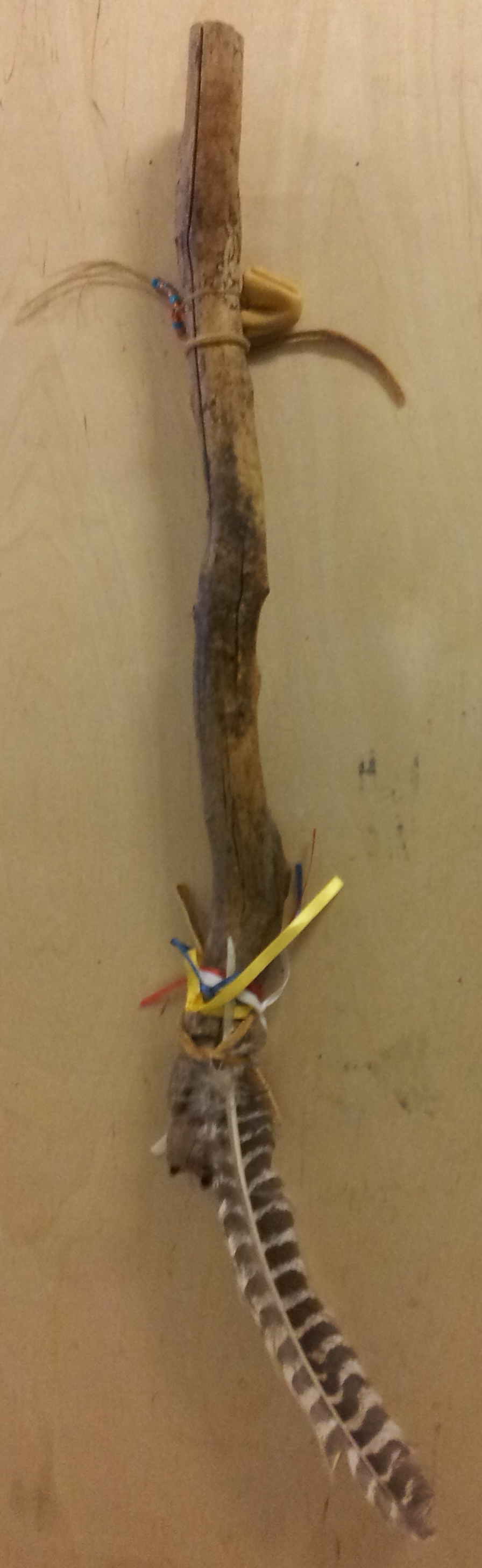
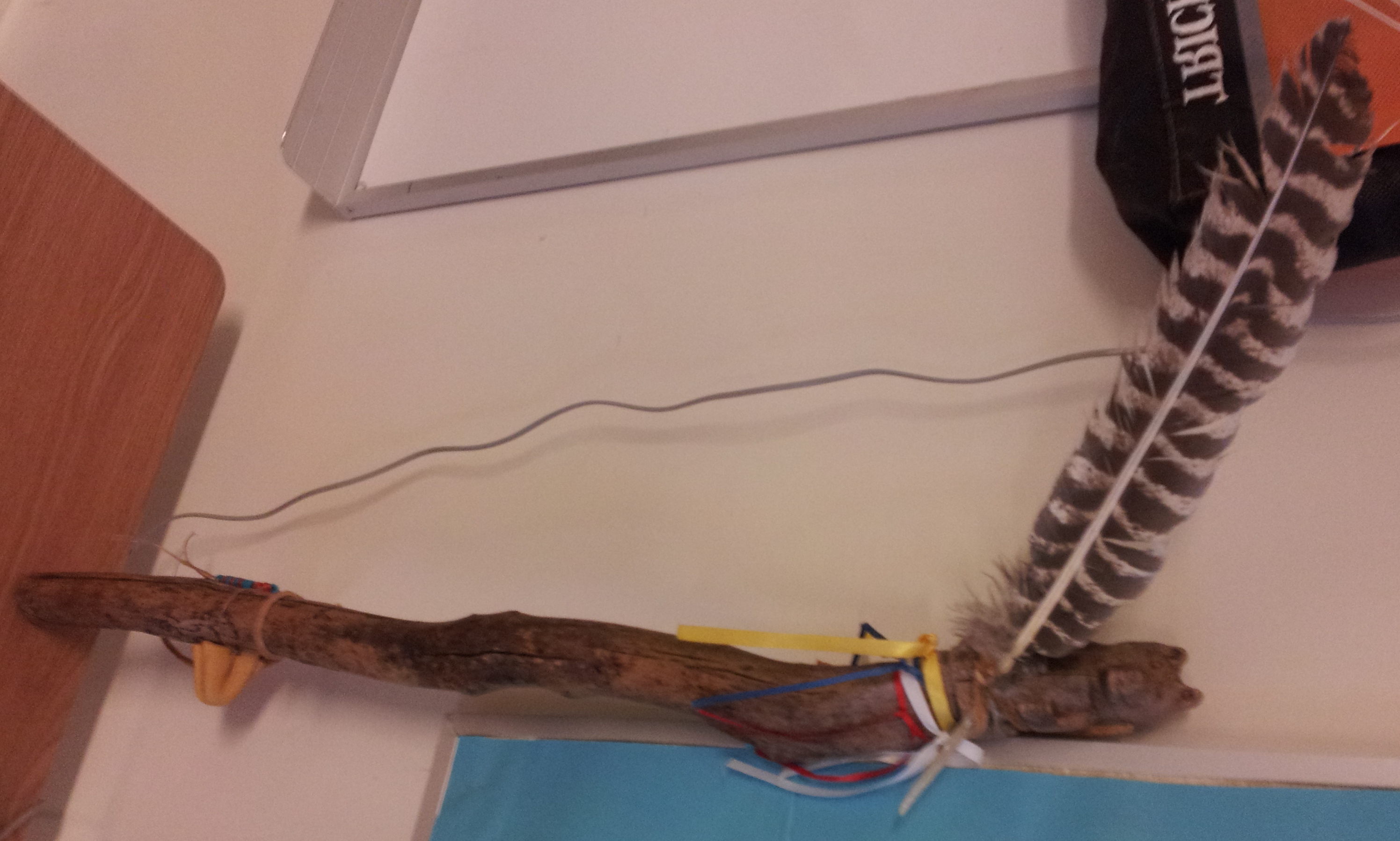
We use a ‘talking stick.’ The person with the ‘talking stick’ is the speaker and others listen. In an era of digital technologies, the stick reinforces a protocol of face-to-face conversation which we increasingly need in our world. The ‘talking stick’ was a gift from a parent last year. She is a member of a First Nation so it has some traditional meaning attached to its design.

The wood is driftwood which came from a local lake and reflects nature’s contributions to the circle. Someone carved a bear head into the top of the stick. In some traditions, the bear symbolizes courage, freedom, and power. The feather is from a hawk. Hawks are visionary and guide the person. The coloured ribbons represent the four directions in the circle. The parent attached a medicine bag. The medicine bag heals, guides and protects, and has materials or objects of value to its carrier.