Tag Archives: servant-leadership

9/11

“Where was I on September 11, 2001 as the planes hit the towers?” This is a question many of us of a certain age revisit each year to mark this date.

I was in my car driving to school when the news broke. It seemed surreal like H. G. Wells’ War of the Worlds must have. When I got to school, I found a TV, and we watched it in the classroom. I asked the students, the parent of the day, and educational assistant if they had friends or relatives in the US. About 3/4 of the group raised their hands. Our family has roots in the US with relatives and friends living there. Both my post-graduate degrees are from American schools and we spend a considerable amount of time in the US.

The play Come From Away is about people in Newfoundland opening homes and lives to over 7000 people who were on diverted flights.

On September 10, 2001, who would have thought it would happen the following day? Who could predict the consequences of the act of a handful of men that day and the lasting impact on lives? But, it did impact us in a 6 degrees of separation way. I did not know anyone in the planes or towers, but I know at least two others who knew someone on the flights. In today’s world,  interconnectedness is real and vivid.

Emblazoned in infamy,

Seared into minds–

Surreal and nightmarish.

Senseless and tragic,

Touching one–

Touching all.

Sharing grief,

Never fully healing–

Holding memories.

Loved ones gone,

Never forgotten–

Shedding tears.

In recent days, we have a Blues channel on to listen to music. Today, I heard this song by Bonnie Raitt and it touched me on this day. We missed seeing her several years ago as the tickets sold out before I got there.

The song raises a question for me: “How can learn we are more alike as humans than different?”

Speaking One’s Truth

I wrote this as I was making decisions about continuing to teach. There had been considerable upheaval as new administrators arrived and left, families left, and a friend and colleague retired. I found myself constantly in the midst of a storm with little or no control in how things might move forward. At a retreat in Oakland, I spent considerable time reflecting and journaling about the issue at hand, so this was not intended to be a poem and it took a year to write itself.

What I wrote was a summary of the past year and the struggle to ways to create in my teaching and be more present to my students. What I lacked was confidence in who I was and what I was enacting as a teacher, the performativity and improvisation essential to my teaching. I planned a lot in my teaching, but the depth of planning allowed me to improvise in ways that a lack of planning could not.

In The Book of Joy, The Dalai Lama and Desmond Tutu discuss how loss and fear lead to anger. What is important is during challenging times to try to be aware of what gives us meaning and hope in life. Although I would love to teach and be part of educating the next generation of teachers, I find it easier to accept that is not happening, focusing energies on writing and teaching in a new way. If the situation arose to teach and educate the next generation of teachers, I would consider it. What it is not doing is defining who I am and my life.

It’s emerging,

Happening–

Letting go;

Speaking with love–

Accepting the lost.

Sitting with questions,

Accepting uncertainty, incompleteness–

Taking stock;

Gazing inwards–

Feeling humbling hope.

Accepting extended hands,

Discarding baggage–

Walking forwards;

Living my truth;

Questing in each moment.

I took this picture in Arizona in March. It was the last of five I took. Each day, as I walked back, the cactus had bloomed one or two more flowers. The cactus and its flowers exist just to be a cactus and its flowers, beautifying the world. They remind me, even in harsh conditions, plants and animals flourish in their time.

As I was writing, Curtis Mayfield’s Move On Up played. It is appropriate. As we face challenges, we move on up and achieve, albeit an unpredictable, something.

Do Pigs Have Udders?

Part of educating for hope is “reading the world” in hopeful while living “in dynamic interrelationships” with others (Paulo Freire, Pedagogy of the Oppressed, p. 102). This means opening the world to eloquent questions without presupposed answers and without the threat of violence of any form. I used the quote in a recent book chapter I co-authored with a colleague from North Carolina. The book is to be published in late 2020 or early 2021. What does it mean to live in a world full of hope; a hope(ful) world.

My first day back from the retreat I posted about in Welcoming Differences and Gentle Rain I noticed the students were subdued. In the afternoon, I was alone, which was unusual. Without an adult and teaching three grades, it could be demanding. Other times, it provided interesting moments, and this turned into one of those moments.

I had contacted a substitute teacher I had used several years before and who was available again after completing a long term assignment for an ill teacher. As we talked about what was bothering me, the students told me they had not enjoyed the teacher. I was surprised, as he had seemed a good fit before. I asked for an example and they told me he had told them their conversation was inappropriate. This was unusual, as the students in this group were well-behaved and respectful. I asked them what the conversation was about and they told me, while completing some Science, one student asked “Do pigs have udders?” Apparently, this became a hotly debated topic and it was brought up again today.

I laughed. For me, it was funny and pointed to an irrevocable human truth: curiosity about the world we live in and eloquent questions leading to exploring the world and learning about it. We had serious fun as we talked about what udders were and their role in feeding offspring. I even phone Kathy, who was raised on a farm, and asked he. She was not sure, but thought it was a structural thing and pigs probably did not have it. We left it as an open question.

Simple question,

Emerging eloquently,

Not presupposing answers;

Fueling curiousity–

Energizing learning.

What does this mean?

Is it true?

Querying and questing;

Seeking to fill gaps;

Not with certitude;

New questions emerging.

With passing years,

Recalling that moment,

Smiling, chuckling;

Appreciating simple, provocative question–

Do pigs have udders?

As best as we can learn, they do and it was fun trying to figure it out. Adolescent children ask the darnedest things. Laughter is an antidote for difficult moments. Something I learned as a student teacher was a safe classroom allows children, youth, and probably adults to ask provocative questions with no preconceived answers. In the polarized world we live in, we have lost that assurance of safety and are reluctant to ask questions needing answers.

I will save you looking up the answer on the Internet. Pigs do not have udders. Udders are a reference to mammary glands on certain mammals and it has to do with their structure. I read a version of this poem for a group at a retreat in Wisconsin. As I finished, adults wanted to know the answer. I said I didn’t know and someone looked it up on the spot.

I don’t have a picture of a pig. Here is one of a bear I took in Waterton Lakes National Park. Bear and pigs are related, so it was as close as I could get.

Mindfulness

Yesterday was an interesting day for me. I am a diehard sports fan in general and hockey specifically. Even with Covid19, I find time to follow hockey on TV without disrupting my writing. What made it interesting was the “work stoppage” by many professional athletes in North America. More than a love for hockey and sports, I feel there is a need for more compassion and equity in this world.

As the National Hockey League was announcing the “work stoppage,” one of the Canadian sports networks interviewed Brian Burke who is a former hockey executive and current hockey commentator. He lives in Canada while holding dual Canadian-American citizenship. He talked about a need to understand this is an important moment in social justice in the US, and I submit Canada. I was excited hockey players and other professional athletes, regardless of colour, gender, ethnicity, religion, etc., took part in the “work stoppages.” (The video is at Burke Supports Players Regarding Boycott).

Burke spoke about how great change is not kicking the door down. It is more like a mud wall being eroded. I think it is watching a mountain change. You have to leave and come back to see if any real change; transformation happened. He mentioned the work of Martin Luther King Jr. and how little of substance has changed since 1968. There are still major impediments and barriers to equity for those who are treated as less than human, denied of rights those who are privileged take-for-granted.

What does mindfulness have to do with all this? We often use the word to simply talk about being aware of something. In a broad sense, it has moral and ethical implications we can overlook. We just say, “I was mindful of such and such.” To mind something or someone is to demonstrate care, tend for it or them and cultivate it or them in a loving way. This crosses boundaries and is steeped in mystical traditions of all stripes e.g. Buddhism, Sufism, Judeo-Christian, etc. It involves lovingkindness, compassion, flourishing, and stewardship. It is about becoming better in indefinable ways.

Several years ago, I wrote this poem after reading a meditation from Father Richard Rohr. Often, he writes about a radical unity that brings us together with our self, creation, neighbours, enemies, and something that is transcendent and beyond each of us.

Mindfulness,

Seeking to choose better–

Blending one’s passion;

Joining with lovingkindness,

Binding together.

Nurturing better angels,

Ripening, maturing–

Bearing healing fruit;

Joining a universal banquet;

Responding to life’s bounty.

Assuming responsibility,

Passion for one’s self–

(Com)passion For one another;

Minding the world;

Becoming one;

Becoming whole.

I began talking about hockey, so I will close with a video by David Francey who we have seen numerous times. You will note he has an English accent, but lives in Canada and grew to love hockey while in Quebec. The scene is how many youngsters were introduced to hockey in my generation. I began as a pre-schooler on an outdoor pond. As well, I listened to Hockey Night in Canada on Saturday nights and La Soiree Du Hockey on Radio Canada Sunday nights. The latter was in French, but, as a person whose first language is French, I was blessed to listen to both. I sat on a kitchen stool in the corner just under the window. When I am on the road, I listen to hockey games on my laptop, never streaming them. I close my eyes and imagine the game as it unfolds.

Welcoming Differences

I wrote this poem in SeaTac airport in Seattle waiting for my flight I had about 6 hours so there was considerable time to reflect. I make a point of scheduling reflection time into my routine and, when blocks of time emerge reflect, I take advantage of them. Reflecting on what happened and what we aspire to are essential to a well-lived life.

This poem emerged from a conversation about leadership allowing the uncomfortable to reveal itself in conversations. Jacques Derrida may have concluded being uncomfortable is admitting the strange into one’s life and the moment. There is a risk of danger and rejection, steeped in possible hospitality towards of one another and acceptance.

With patience and humility, I can welcome and listen in what Martin Buber referred to as an I-Thou encounter, not an I-it encounter where I diminish and objectify the Other a a thing. As noted in Gentle Rain, when we encounter someone, even briefly, we grow and add a little of each other to our selves. As humans, we are more alike than different. This is lost in the highly politicized rhetoric where purported leaders pit us against one another, dividing and highlighting differences for the sake of conquering.

Patience–

Conversing fully;

Making the world anew,

Healing through listening–

Welcoming uncomfortableness.

Information prevailing–

Supplanting heart’s courage;

Its wisdom,

Sensing the common–

Common sense.

Awakening, pausing, observing–

Emerging from hibernating;

Welcoming that which is different,

Iniviting–

Completing unfinished circles.

Piecing together peace–

Filling voids;

Voicing the silenced,

Heralding life–

Each voice rejoicing.

Making ones’ self whole–

Accompanied by others;

Joining hands and hearts,

Belonging to each other–

Fulfilling humanness.

I took this picture as we travelled through Glacier National Park. At the time, I just took it. Later, as I read about deep ecology, I learned geologists look at the strata in a mountain as chapters in the mountain’s story. For me, this is much like how we each have our unique stories brought together both in what makes us unique and what we hold in common.

One’s Story

I wrote this poem while I was at the retreat I mentioned in Companions. The retreat was long, tiring, and rewarding. Even though events of this nature can be stimulating, I also find I run up against blocks due to how tiring they can be. I mean tiring in a good way. We spend time in solitude, which is not something that is easy. When we were together, deep listening, another overlooked quality, was essential.

I wanted to share my experiecnce at the retreat here and questions that emerged. To write the poem, I let ideas percolate for a couple days. The word courage and heart are related. Courage comes from the French word coeur, meaning heart. The heart is the holding place for our truth and we often have to have the heart and courage to tell our story. Humans are the only beings capable of telling their story, flawed and essential to their being and becoming.

One’s courage;

Revealing one’s story,

So telling to tell,

Always emerging.

Narrating and sharing,

Telling one’s story;

Sharing to be heard,

Listening differently,

Listening deeply.

Words anew,

Illuminating, enlightening

Sharing sacred space;

Recognizing and loving.

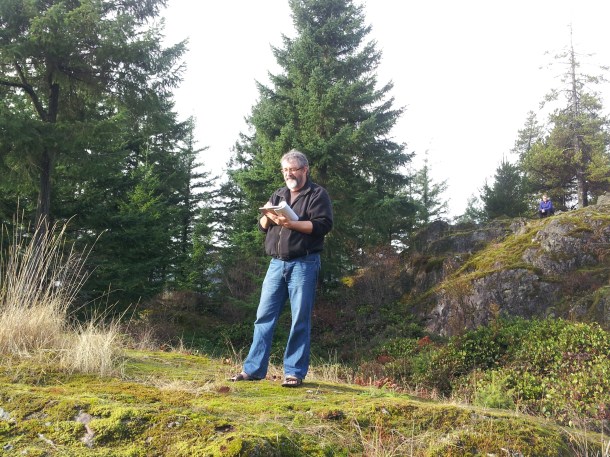
A colleague took this picture of me at the retreat. We spent a considerable amount of time on our own and in nature. It brings out the best in me.

Companions

I wrote this poem as I prepared to go to Bainbridge Island, WA. While there, I attended a leadership retreat offered by the Centre for Courage and Renewal based on the writing of Parker Palmer. As it was the second part of the process, I had a sense of how rewarding the process and journey were.

Like my time at Gonzaga, I found companions who I remain in touch with via social media and as I travel to various parts of Canada and the US. These companions complement the ones I have at home.

Companion and company come from an old French word (compagnie) meaning to break bread with others, usually on a journey. We accompany one another and share what we have, including conversation and care for one another.

Beloved community,

Inviting, one another,

Sharing more than a moment.

For alone,

Troubles weighing heavy us down

Each step, we struggle.

Gathering together,

Enlightening–

Feeding each other’s souls.

Backs straightening–

Shoulders squaring–

Holding heads higher.

Journeying, sharing, entrusting–

Becoming together,

Breaking bread.

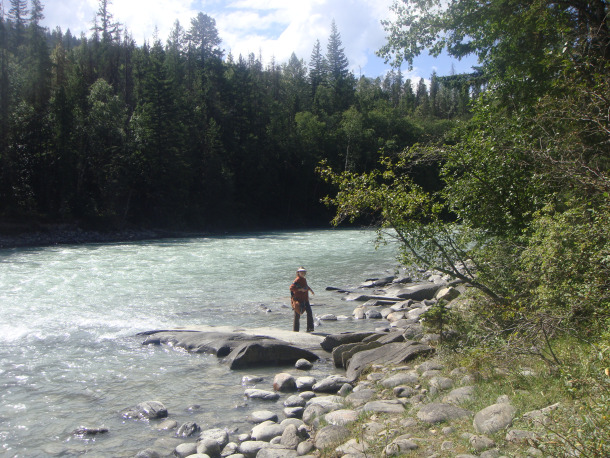
I took this picture several years ago of Kathy just above and around the corner from some serious waterfalls on the Fraser River.

Just Being

Sometimes as I write one poem, another emerges in the tangle of thoughts and words. This happened with the post Transforming. One poem gave way to another. Both poems remind me of the unnecessary chase in life. Life is not a race or hunting trip in which I seek the biggest prize. What I need is patience with life arriving fully in each moment, revealing itself in  extraordinary ways.

There are quotes that are on the tip of tongue at all times. Alfred North Whitehead wrote the present moment is holy ground. The  past and future meet in each present moment, making it whole. Some humans tend to see life as a competition and end up running in one spot. This contradicts being present and patient, echoing Matthew 6:28: consider the lilies of the field, how they grow; they toil not, neither do they spin. To flourish and experience good health, one has to reduce the stress of spinning in one spot.

Seeking,

Chasing,

Competing–

Failing.

Patience calling,

Just sitting,

Cooperating–

Life discovering.

Life revealing itself,

In its good time,

Arriviving–

Right on time.

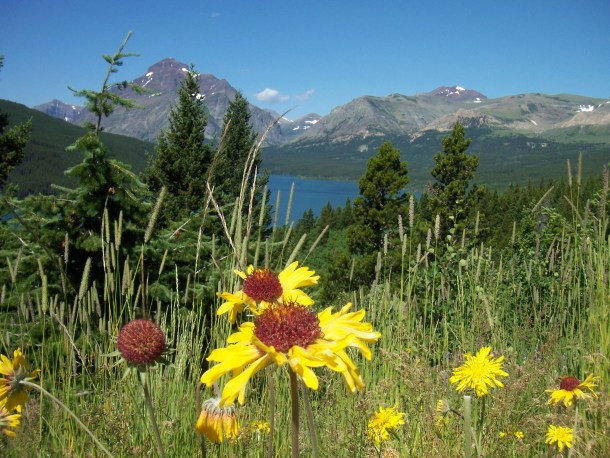
I know these are not lillies. Kathy took this picture hanging out the window of her car while driving on the Highway to the Sun in Glacier National Park. Elements of nature complement one another, forming the whole.

Soul Dancing

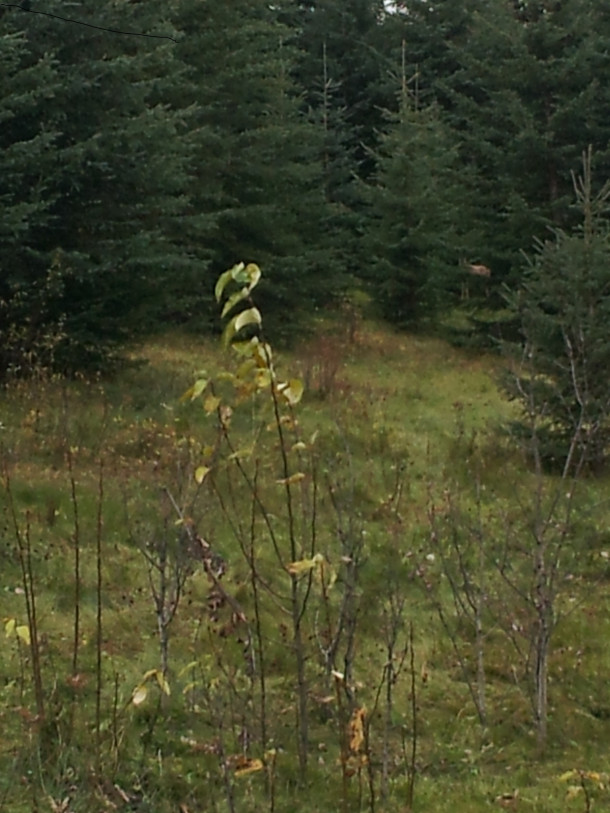
Several years ago, Kathy and I went to the farm to visit. Late in the afternoon, we went for a walk and saw the doe in the picture below. You have to look carefully to find her. She moved away from us, but still seemed to want to stay close to where we first saw her. As we walked, the deer reappeared several times and, despite attempts at being quiet and still, the deer kept her distance. My best guess was she had a spring fawn in the bush and was trying to distract us, moving us away from being a threat to the young vulnerable offspring.

In The Hiddent Wholeness, Parker Palmer compares the soul to a shy and vulnerable animal. Each humans’s spiritual nature is personal and private. I think we begin by tentatively exploring its meaning with our self first and, as we become comfortable, with those we are closest to, testing and adjusting what it means to us. In a secular world, we often conflate religion with spiritual. As Parker points out, we have many words for soul e.g. spirit, essence, inner self, etc. and those words can carry non-religious connotations for each of us. To engage the soul and animate our being, it is essential to spend time in contemplative and meditative ways.

I sit quietly, with occasional great stillness, and my spirit, like the deer, emerges from cover and protection. In the midst of strangers, intruders, and busyness, we need those moments to let the soul speak to each of us and be protected, understanding its vulnerability.

Look closely. The poplar and the spruce in the foreground frame her in the background.

Quietly,

In stillness–

Vigilant,

Keeping her distance–

Camouflaging,

Protecting the vulnerable–

Distracting intruders,

Returning to its child.

Sitting,

Patiently waiting–

Soul peeking out,

Tentatively emerging–

Awaiting safety,

Revealing in perfect stillness–

Infinitely,

Repeating the dance.

Life’s Calling

Originally, I called this life’s mission, but that seemed to neo-liberal and neo-conservative for my liking. I subscribe to life as a calling and vocation based on the writings of Thomas Merton and Parker Palmer. Vocation comes from the Latin meaning voice, so a calling and vocation gives each of us voice in living and has an essential spiritual aspect to it. What calls each of us animates and we respond in ethical and moral ways. I think we have lost much of this in our current world. Although John Dewey did not write from a spiritual context per se, he wrote about self-interest as words meaning the same thing. What interests me? Interest comes from the Latin esse, which also is the root of essence, which is related to spirit. What inspirits me?

I wrote the following poem after a professional development day. I found inconsistencies revealed in those days fascinating. They were uninspiring, exhausting, and counterproductive. They lack personal, responsible choice. Too often, adults are dependent on others to make their decisions, hence the concept of accountability overriding responsibility. It is hard to believe we think these adults can engage in educating children, youth, and adults in any meaninful ways. Our voices are repressed, suppressed, and oppressed.

At the end of that day, I wondered and reflected on the following questions: “Am I seeing this in a proper light? What can I do to further the process of learning as a role model for students and other adults?” Learning and teachng are relational processes between people and subject. Parker Palmer argues we put the subject of our learning in the middle of pedagogic conversations. In this way, we acknowledge each human present has a different perspective of the same subject.

For me, going to an event based on Parker Palmer’s work, a poetry workshop with David Whyte, an assessment workship, etc. were and are exciting. It animates. When I obtained my Master’s of Education and PhD, it was not to earn more money or move up some fictional career ladder. Education was and is essential. In the midst of a pandemic. I am exploring how we can return to the roots of educating for life, as opposed to schooling to produce a compliant and conforming workforce. I think the latter emerges from the former, rather than the other way around

Living fully,

Sharing fully,

(Ex)pressing one’s voice–

Singing one’s song.

Whetting wonder,

Planting seeds of awe,

Lighting fires–

(In)spiring to dance one’s dance.

Watering, feeding, nourishing,

Enriching, emboldening, becoming–

Embracing what brings life and joy–

(In)spiriting.