Tag Archives: social justice

As Relevant as Ever

I am headed to New Zealand to present at an International Peace Conference and have been thinking of resistance so needed today. Music, poetry, and art play a significant role in resisting violence, including that imposed by governments and other institutions that are supposed to protect.

One of the first albums I bought was The Freewheelin’ Bob Dylan. I was about 16-years old and I still have the album. It is iconic with songs like Blowin’ In the Wind (melody based on a spiritual called No More Auction Block), Masters of War, A Hard Rain’s a-Gonna Fall, Oxford Town about resistance to desegregation in the American South, and Talkin’ World War III Blues. Dylan covered Lead Belly’s version of I Shall Be Free.

Talkin’ World War III Blues is my favourite song on the album. Dylan was at his best in the spontaneity of the song and it fits with the talking blues genre. In I Shall Be Free, he sings about making love to Elizabeth Taylor. Even in the early 60’s a was a way to avoid the reality that hung over the world was to turn to popular culture as a distraction from the threats of nuclear war.

About the same time, I wrote a poem in school. I know Mr. P. writes poetry is hard to imagine for my students. The poem was about the tragedy of war and it stole lives in absolute ways whether through death or through the physical and psychic damage done to those who were forced into service in a war they did not understand. Many of those who died or were left deeply scarred with the trauma of war were from the African American population, which was about 12% of the American population at the time. Their deaths alone represented about 25% of the casualties, so statistically overrepresented. The personal narratives within their families and communities can not be quantified.

The poem I wrote as a teenager is below.

Win or Lose: What Difference Does it Make?

A game–

Darwin misunderstood,

No great thing to win.

War and it language!

Bells ringing hollow,

Men, women, children gone!

Woe! vanquished losers and winners;

Humans, vanquished in every sense–

Thriving on dividing.

Resenting conquerors,

Rebuilding ruins–

On countless graves.

Morally rudderless,

Blaming the fallen,

Beggaring humans.

Homes on streets,

Hollowing souls–

What war brings?

Innocence dying–

Prryhric victories,

What war brings?

Comrades fallen,

Enemies vanquished–

Proving nothing.

Will we learn?

I pray

For human survival.

What is that weird, tingling feeling? Could it possibly be … hope? — Live & Learn

But then the sun came out where I live this week, and I was alive again. Dunno if you’ve noticed this, but it’s been the longest year since records began, and the timing of lockdown restrictions easing this week coinciding with warm weather in parts of England – which the press was more than happy […]

What is that weird, tingling feeling? Could it possibly be … hope? — Live & Learn

I don’t recall when I began following David‘s blog, but it has been a number of years. He shares wonderful daily posts and this one is no exception. He shares a part of a newspaper article with us about how we might be feeling as the light seems to become increasingly larger at the end of COVID tunnel. Of course, it could be a train hurtling down on us, so we must not let our guards down.

Hope is a recurring theme in my writing, publishing, and the publishing I hope to do as I move forward. It is grounded in reality . COVID-19 sharpened my awareness of challenges others face and made me realize there are taken-for-granted challenges. For example, how we treat our elderly, BIPOC humans, sexual and gender minorities, etc. are real challenges. How do we help lift up others in times of need? How do we help infuse hope in the lives of others?

Hope is essential to our dreams. Despite this, what we each dream for is not guaranteed. There is a realistic side to hope that suggests to get to the other side or the end of the tunnel we each need to be resilient. Like passion, which includes suffering for what and who we love, hope has an element of potential failure and suffering. Passion moves to compassion when we share the suffering of others and accept their lives and experiences are different than those we experienced. Hope has a similar collective feel to it. We find hope in community, what we have in common with one another, which is our humanity, how we communicate the common and disparate features of our lives, and how we live in communion with each other.

Hope and its relationship with resilience remind me of the Zen proverb: Fall down seven times, get up eight. How do I compose myself as I get up each time? Is it with grace, compassion, and kindness or do I lash out at others? I find Emily Dickinson and Langston Hughes‘ poems meaningful in days like these, so I share them again.

“Hope” is the thing with feathers

“Hope” is the thing with feathers –
That perches in the soul –
And sings the tune without the words –
And never stops – at all –

And sweetest – in the Gale – is heard –
And sore must be the storm –
That could abash the little Bird
That kept so many warm –

I’ve heard it in the chillest land –
And on the strangest Sea –
Yet – never – in Extremity,
It asked a crumb – of me.

Mother to Son

Well, son, I’ll tell you:
Life for me ain’t been no crystal stair.
It’s had tacks in it,
And splinters,
And boards torn up,
And places with no carpet on the floor—
Bare.
But all the time
I’se been a-climbin’ on,
And reachin’ landin’s,
And turnin’ corners,
And sometimes goin’ in the dark
Where there ain’t been no light.
So boy, don’t you turn back.
Don’t you set down on the steps
’Cause you finds it’s kinder hard.
Don’t you fall now—
For I’se still goin’, honey,
I’se still climbin’,
And life for me ain’t been no crystal stair.

Have a wonderful weekend.

Merry Christmas

It has been a couple of weeks since I posted and offer this poem.

Today, I read a short piece written by Parker Palmer that reminds me the miracle of Christmas is in the incarnation of God in human form. His essay reminds me of how, as a child growing up in Northern Alberta, Christmas provided a sense of wonder I could not explain and try not to as a rational adult.

Parker also posted on Facebook an event he experienced last year in Nogales Mexico at a house for asylum seekers. Asylum seekers is another way of saying they were seeking refuge. He points out Jesus was likely a person of colour. I take it one step further and point out he was a Jew and born into that faith. His birth was an ecunemical event, not a Christian one.

Carpenter guiding the way,

Expectant mother riding,

Backs straight; heads held high–

Donkey serving as regal carriage.

Seeking refuge from the night–

Giving birth in a stable,

Swathed and cradled in a manger,

Beasts welcoming the child.

Showering gifts upon us–

Returning each year,

Lighting the way–

Only asking, “Can you open your hearts?”

Source of strength,

Our turn to humbly receive gifts,

Restocking spirits,

Rejuvenating souls.

Kathy and I enjoyed Canadian Indigenous singer and actor Tom Jackson. Most years, he tours at this time of year and helps food banks. In the midst of Covid, we each have to find ways to share with those in need.

He does a lovely rendition of Huron Carole, which I share below. Again, this points to an ecunemical nature of Christmas, Christ’s Mass, echoing Parker’s remembrance of “the story, the music, the candlelight, the scent of pine, the silent night, the warm presence of family and friends.” For me, it was also the food and opening a present on Christmas Eve. The food included traditional French-Canadian tourtière (meat pie), which Kathy and I continue to share with our children and grandchildren.

A Prayer for our Times

Val shared a wonderful poem by Danna Faulds and I could not resist sharing it. Although the title suggests a prayer for our times might be specific to these times, this poem has a timeless quality to it.

What COVID-19 revealed was the challenges we face in our times. The inequities and injustices have existed for some time. The depth of those inequities and injustices were what were and are revealed.

I liken the market system as a multi-level sales scheme with most of us running around trying to make ends meet and many people simply left behind. A handful of people benefit and many simply continue to run on the spot with little chance of gaining ground.

What the neo-liberal and neo-conservative policy makers. politicians, and corporate chieftains count on is we are remain driven by self-interests, as opposed to what others may need. Who has benefited most from these times?

I could not find this poem on a video, but Danna Faulds’ poetry contains qualities of common weal, pluralism, reconciliation, love for one another, and healing to make us whole in complex times. I chose this poem as it speaks to the human condition we all live through and our need for one another.

Unpretentious Intimacy

I wrote this while sitting, feeling tired, waiting for a connector flight home in Vancouver International Airport. Despite being tired, I was grateful and able to reflect.

At the time, I was experiencing dis-ease. What got me through was people who reached out to me, sensing my unhappiness.

At the retreat I attended, forming relationships with people I had not met before was essential. In the midst of this, I was able to be vulnerable and drop a shield of invincibility. In the space provided. we were able express a sense of caring for each other and bring one another into the fold.

This type of experience raises questions, often without easy answers. What makes each of us who we are? It is scary, but rewarding. It is in the slow cooking of a crock pot in which intimacy can be born. In the slow brewing, we explore identity and masks of personae we wear, gazing into relational mirrors. But, it often sneaks up on us without us being aware the mirror is there.

In wondrous spaces–

Dropping one’s guard,

Sharing secrets;

Hoping to fulfill hopes.

Informing new forms–

Shedding carnival mirror images,

Revealing being vulnerable;

Experiencing a new love.

Allowing intimacy to bloom–

Glimpsing who I am,

As if for the first time–

Revealing one’s self in an other’s presence.

I listen to the blues a lot. The blues have a quality of life about them that reminds me there is more than me in the world. Willie Dixon said “the blues is the roots and other musics is the fruits.” This resonates with me.

Shemikia Copeland is a superb singer/songwriter who reminds me of the plight of others and how much hope they have in the face of systemic injustices. This song is from her most recent album.

The Panther

I learned new words today. I read an article by Judith Butler who used the word carceral, meaning “relating to prison.” It fits with systemic prejudices e.g., racism, where particular groups of people are imprisoned at a greater rate than their percentage of a society or country.

But, it includes how people are limited to a geographic space, so they do not come in contact with the elites. It extends injustice and oppression those groups and individuals experience. Paulo Freire argued this cuts across racial, gender, and linguistic lines and includes class distinction. People are trapped and imprisoned within a life that offers little hope for them and their children.

I am unsure Rainer Maria Rilke intended to make a political statement in The Panther, but it serves as an analogy to understand how another might experiences life in the midst of oppression. In not witness ing another’s disenfranchisement e.g., economic, political, educational, etc., I grow to think their plight is not real. But, bars, literal and figurative, become reality. As Rilke states “a great will stands stunned and numbed.”

The opposite of my indifference is love and serving, reaching out to give a hand to those who need help to cut the bars away that oppression has built around them. It is less about doing for them and more about valuing their lived-experiences in meaningful ways. Freire said to read the word, humans first read their world, bringing their understanding of living to formal education.

From seeing the bars, his seeing is so exhausted

that it no longer holds anything anymore.

To him the world is bars, a hundred thousand

bars, and behind the bars, nothing.

The lithe swinging of that rhythmical easy stride

which circles down to the tiniest hub

is like a dance of energy around a point

in which a great will stands stunned and numb.

Only at times the curtains of the pupil rise

without a second … then a shape enters,

slips through the tightened silence of the shoulders,

reaches the heart, and dies.

I love the blues. A sad thing about the genre is many women who were pioneers were not recorded as often as men. It is a treat to hear someone like Sister Rosetta Tharpe sing.

Being Alive

I originally wrote this on Bowen Island, attending an Art of Hosting retreat. It reminded me of the counter cultural nature of Parker Palmer’s writing and events focused on his work. It is about communicating and seeing others as fully human.

In today’s divided world, this seems countercultural. An essential element to hosting and dialogue is listening to others in respectful ways. It does not mean we agree with them. What it means is we are open and listen to hear how they experience living their life, guided by one’s conscience and sense of values that ground us. Values give each of us strength, anchoring us and letting us understand what is proper and improper.

When we invite people into conversation, listen deeply, and ask questions which shake our certainty about the world we turn inward and focus on what grounds us to respond to them and help heal a hurting world.

Perching pensively–

Holding pen tentatively;

Senses coming,

In the midst of nature’s beauty.

Awakening–

Becoming aware;

Listening deeply;

In the midst of sounds flowing.

Breeze caressing gently–

Sunlight bathing softly;

Basking in these moments,

Resting in peace.

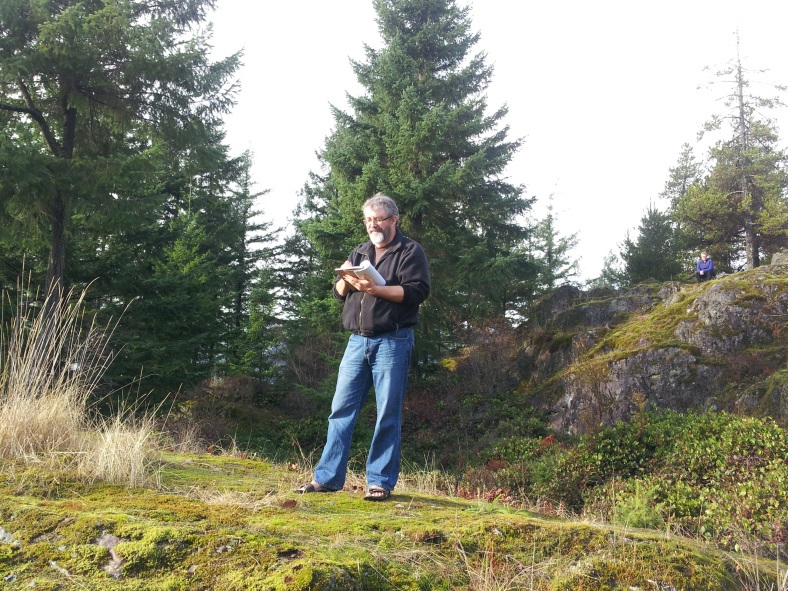
A colleague took this picture of me on top of Cates Hill on Bowen Island as I wrote and they were gracious enough to share it with me. It is spectacular with water and land in the panoramic view.

Gettin’ My Mojo Back

I looked at this poem a month ago and decided not to post it. As I listened to music today, a song came on called Getting My Mojo Back and felt it was time to post it.

I wrote this during a retreat on Bainsbridge Island based on the work of Parker Palmer. It was at a time I was wrestling with staying in teaching due to the politics. I felt I was not giving it my all and lacked confidence in my teaching.

During the retreat, I reflected and had candid conversations with others and concluded it was time to control what I could control. Interestingly, it was in the conversations with others that I had to choose to be all in really came to the forefront. I went back to my classroom, spent another 5 years teaching, and giving it my all.

I think, when we lose confidence, we do not realize it. It sneaks up on us, rather than being a cataclysmic shift. Recovering confidence is similar. It is done in small steps and realizing we are not alone in the moment.

I had to realize anger was born out of fear and loss. Once I acknowledged this, I was at ease with letting go and moving forward.

It just happens–

Letting go;

Speaking without anger–

Embracing one’s sadness;

For what is lost.

Staring into an abyss–

Sitting with unformed questions;

Terrifying darkness–

Sensing incompleteness,

Feeling uncertainty.

Taking stock–

Looking inwards;

Accepting extended hands–

Discarding baggage

Moving towards a place of light.

Mojo gaining momentum–

Emerging at its pace;

Creating healing space–

Living one’s own truth;

Living in each moment’s question.

I attended a John Lee Hooker concert in 1972 or 1973. I grew up listening to jazz, gospel, folk, and blues with traditional country, early rock and roll. I took it for granted that I attended a John Lee concert until an American, who shared a love for the blues, told me he never did. African-American performers toured in Canada on a regular basis at a time they did not have that same ease of movement in their own country.

When I used Langston Hughes’ poetry in my teaching, I remembered he wrote from a different understanding of what America was. This was an outgrowth of an awareness of my privilege as a white Canadian male.

Listening

I began to write this poem after a long and tiring week. Sometimes, when I step back from the visceral nature of my emotions, postive and negative, I find a kernel to prompt writing, thinking, and acting.

Too often, I find myself talking when I should be listening. This includes listening to me, and, more importantly, listening to those whose stories are silenced in unjust ways. I think those two forms of listening go hand-in-hand. Not listening to others is often a product of being so busy with the noise of my own life. When I listen from the heart, I hear words anew.

Rich stories silenced–

Seeking just spaces,

Sharing and healing;

To speak freely.

Listening deeply–

Sadly, stories unheard,

Of being oppressed;

Shunted to the margins.

Listening with heart–

Leaning into stories,

With grace and humility,

Hearing for the first time.

Am I ready to act?

Listening, hearing–

But, without doing;

(In)justice remains.

I listen to the blues, gospel, and jazz most of my life. When it comes to the blues, gospel, and jazz music I am aware of the privilege I experience and do not take it for granted.  As a Canadian, I attended concerts, because African-American performers came to Canada. They had access to venues I could attend here that they did not have in their own country.

Today, I heard Mavis Staples (on her latest album) singing and it resonated. For real and just change to emerge, I must be willing to listen and change the things I can.  When I listen to the blues and gospel music, particularlyperformed by African-American women, there is an undercurrent for meaningful and just change in the world.

Ongoing Quest

I wrote this during my last year teaching. It had been a particularly challenging day in the classroom and beyond. The students were full of energy and it was not always healthy. I grew frustrated and visibly annoyed part way through the afternoon. Part of it was a lack of a healthy relationship with the administration, which seeped into my teaching at times. It was challenging to set those frustrations aside, particularly with little support and how it impacted my teaching.

Having said thi, I chose to teach anothere year and wanted to teach those particular students. On myway home, I realized I need to establish a different, encouraging tone. In a sense, my ability to influence is my ability to recognize my reality and walk into the fire, the crucible, so to speak.In his teaching, Thich Nhat Hanh reminds me even weeds of a tough day serve a purpose. They fertilize and increase the yield of a crop: children’s learning and this could be lost on on me. For the remainder of the school year, some 7-8 months, I used this as my touchstone.

Sometimes, I allow myself to assume what is out there makes me who I am. If I let it, I succumb to those forces. On the other hand and stepping back from the brink, I reclaim my view and my callings in life. I do not let others and circumstances dictate who I am. I can choose how to respond. This is no mean feat as, in the heat of  the battle, it is hard to not be reactionary. The best I can do is be the best I can be in a moment, reflect later, and grow anew with fertilizer provided by tough moments.

transforming–

ongoing quest,

seeking vision,

unearthing a better, truer self–

digging deep,

resting in my heart.

transforming–

polishing the gems of self,

righting speech! righting action!

influencing others properly–

reclaiming my voice,

bringing forth my best.

Much to my mother’s chagrin, I got The Freewheelin’ Bob Dylan when I was in high school. I still have it and still spin the vinyl after all these years. Although it is now almost 60 years old, A Hard Rain’s A-Gonna Fall still rings true for me today. Dylan wrote this in the midst of the Cold War with nuclear threats all around. Today, we are in the midst of multiple crises: health, wealth distribution, inequities, etc. The question I should ask in difficult times, small and large, is how can I be the difference I want to see in the world to paraphrase Mahatma Gandhi? Even if it is difficult, it is noble, virtuous, and hopeful, in the face of great obstacles, to speak truth to power, (re)calling I can only make the difference I can make.