Tag Archives: spirituality

A Time to Listen – Visually and Poetry

Kathy and I travel. We spend time during the summer touring Alberta, British Columbia, Saskatchewan, and adjoining American states. This summer we are revisiting Waterton Lakes National Park as part of my rehab. We travel through this area regularly and it brings back great memories.

On one trip, we stopped at a provincial park just above Lundbreck Falls. Recently, I went through pictures of the Crowsnest River downstream and it reminded of what I notice and don’t notice in life. Wendell Berry wrote a beautiful piece: The Impeded Stream is the One that Sings. I realized I  heard the river before I saw it. I recalled the life around the river: cottonwood fluff flying, flowering wild rose, insects pollinating, and a musky smell perhaps of a bear recently by. The river is a living instrument sharing a song to others forming a web of life.
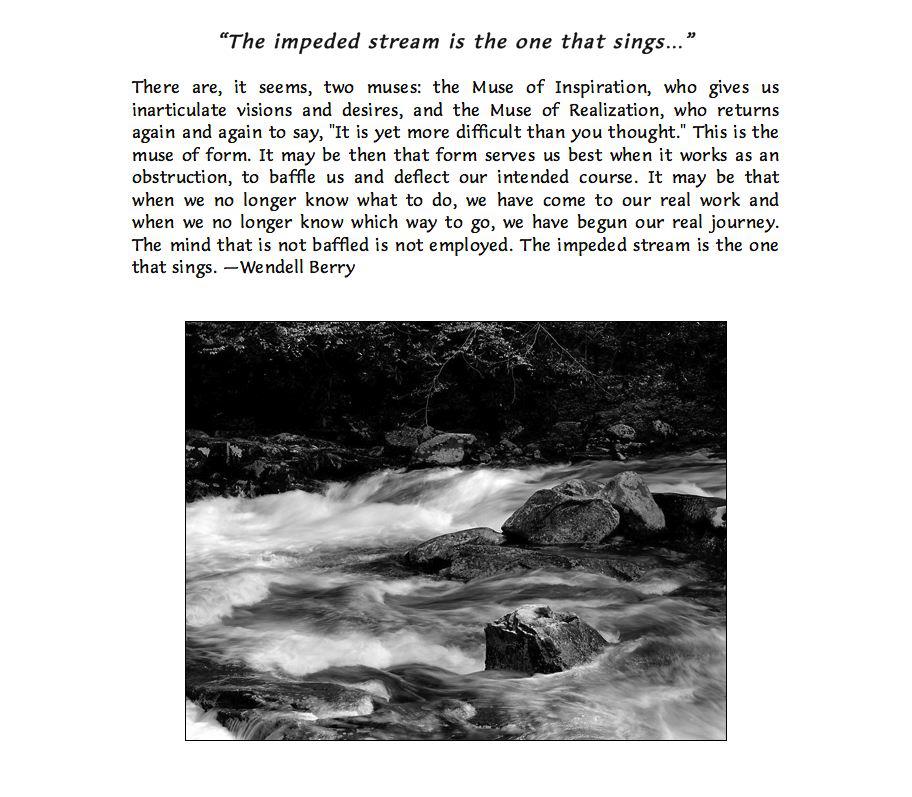
I read Wendell Berry’s words while reliving the picture and was inspired to write a Haiku.

Observe life’s current

Pausing, listening, caring

Present with my self.
Autobiography in Five Short Chapters by Portia Nelson

A medical practitioner I visit once a week to try resolve some issues with chronic, physical pain was the source of this wonderful, insightful poem. Whether physical, emotional, spiritual, or intellectual, I fall into habits and absolve my self of responsibility f or my actions.
Autobiography in Five Short Chapters
Chapter 1
I walk down the street.
There is a deep hole in the sidewalk.
I fall in.
I am lost … I am helpless.
It isn’t my fault.
It takes forever to find a way out.
Chapter 2
I walk down the same street.
There is a deep hole in the sidewalk.
I pretend I don’t see it.
I fall in again.
I can’t believe I am in the same place.
But it isn’t my fault.
It still takes a long time to get out.
Chapter 3
I walk down the same street.
There is a deep hole in the sidewalk.
I see it is there.
I still fall in … it’s a habit.
My eyes are open.
I know where I am.
It is my fault.
I get out immediately.
Chapter 4
I walk down the same street.
There is a deep hole in the sidewalk.
I walk around it.
Chapter 5
I walk down another street.
 
~ Portia Nelson ~

The Violence of Modern Life

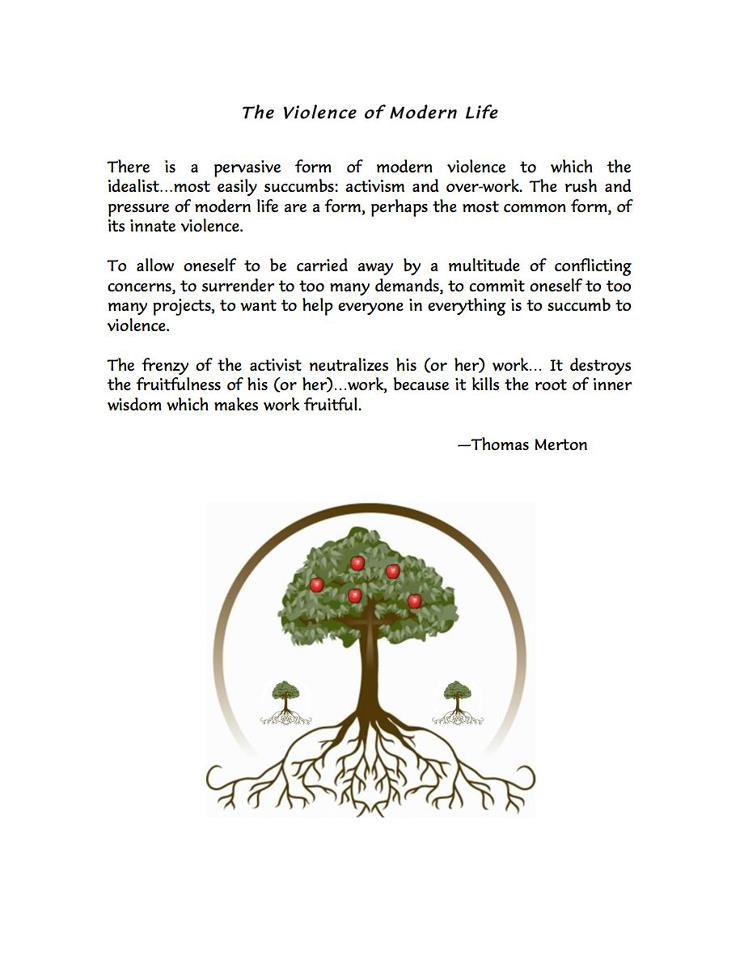
Thomas Merton is one of my favourite authors and spiritual thinkers. He offered a radical definition of violence. This sounds like the opposite of multi-tasking, single-tasking. I hope I can do better as I move forward and take time to listen to the inner teacher and its wisdom.

Parker Palmer shared this with those of us who follow him on Facebook.

ivonprefontaine's avatar

Father Day’s

I subscribe to a daily meditation written by Father Richard Rohr. a Franciscan priest.I talk and write about the concept of common sense, which I understand as local and global. Father Rohr cast it from a theological perspective, I think the explanation provides an insight gained without reading Gadamer’s Truth and Method. I believe there is a universal truth or common sense (Vico called this sensus communis), something that makes us all brothers and sisters bringing us together in community. I think Father Rohr offers an explanation though his meditation on Father’s Day helping us to live in community each day. Certainly, Rilke does.

“It is this sense that founds community” (Gadamer, 1989, p. 19).

Gadamer, H-G. (1989). Truth and method. (J. Weinsheimer & D. G. Marshall, Trans.).  New York: Continuum.

Catch only what you’ve thrown yourself, all is

mere skill and little gain;

but when you’re suddenly the catcher of a ball

thrown by an eternal partner

with accurate and measured swing

towards you, to your center, in an arch

from the great bridgebuilding of God;

why catching then becomes a power–

not yours, a world’s.

–Rainier Maria Rilke

A Vision By Wendell Berry

Nothing worth its salt comes easy. I enjoy Wendell Berry and his reminders that the world is a better place if we live in it fully in the moment and mindful of this very moment and place.

If we will have the wisdom to survive,

to stand like slow-growing trees

on a ruined place, renewing, enriching it,

if we make our seasons welcome here,

asking not too much of earth or heaven,

then a long time after we are dead

the lives our lives prepare will live

here, their houses strongly placed

upon the valley sides, fields and gardens

rich in the windows. The river will run

clear, as we will never know it,

and over it, birdsong like a canopy.

On the levels of the hills will be

green meadows, stock bells in noon shade.

On the steeps where greed and ignorance

            cut down

the old forest, an old forest will stand,

its rich leaf-fall drifting its roots.

The veins of forgotten springs will have

            opened..

Families will be singing in their fields.

In the voices they will hear a music

risen out of the ground. They will take

nothing from the ground they will not

            return,

whatever the grief at parting. Memory,

native to this valley, will spread over it

like a grove, and memory will grow

into a legend, legend into song, song

into sacrament. The abundance of this

            place,

the songs of its people and its birds,

will be health and wisdom and indwelling

light. This is no paradisal dream.

Its hardship is its possibilities.

                                    ─Wendell Berry


When we discussed this poem, students understood that success is not always an easy journey. Some important aspects are the hard work and disappointments along the way. The word and phrase that caught their attention was “This is no paradisal dream. Its hardship is its possibilities.

Truths

I woke this morning

to several truths;

honouring

respecting

diversity

in wholeness

in parts

healing

wisdom

meaning

makes us stronger

me stronger

without weakening.

Community

thrives

each person

and truths

named

nurtured

watered

fed

valued

appreciated

strengthened

in healthy diversity.

with healthy diversity.

Poetry Arises

To begin the day in a quieter, peaceful, and wiser place, I meditate each morning. .Elizabeth Myhr commented about creativity in her writing. She “does not jump into creativity. Creativity bumps into her on its way through the world.” As I sat, I realized I was writing poetry in my mind. Words, phrases, and images were floating in a stream. I recognized I felt calmer and quieter in those moments.

Francesca Zelnick offered advice in a recent post. She suggested, when ideas emerge or bump up against me as I move through life, write them down. I did and edited later. Here is the product.

Sit quietly,

5:30

AM.

Can’t sleep

wait

listen

pay attention

be patient

meditate

contemplate

focus on breath.

Gently return

to a quiet space

solitude

like a river

single words

phrases form

metaphors arise

images appear

in the current.

Discover a gentle smile

on the corners of lips

face softens.

Fresh day

creates space

for voice

words observed

soul speaks

asks to be heard.

Tranquil,

bump into creative moment

Poetry written.

Enjoy!

Observational Poems : Touching the World : Deep Underground Poetry Community

Observational Poems : Touching the World : Deep Underground Poetry Community.

I was just surfing and came across this poem. Mindfulness is a universal concept and is not the sole domain of Buddhists or mystics. I find it ironic that the wave of scientific theory which pushed mindfulness out of the western practice was called the Enlightenment. Who or What did it enlighten? Mindfulness and scientific thought are complementary practices which make each other whole.

Transformation in Daily Life

When Kathy and I were married we chose the Prayer of St. Francis as one of our readings in the ceremony that day. It remains an integral part, albeit sometimes overlooked, part of my daily life. St. Francis spoke in a transformational voice and as a change agent of his time. His message remains as important today as it when it was first presented.

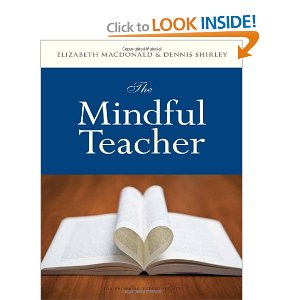
The Mindful Teacher by Elizabeth MacDonald and Dennis Shirley

Last year, I was in a challenging situation and sought a path to continue my teaching and learning journey. Elizabeth MacDonald and Dennis Shirley wrote a book called The Mindful Teacher. I read the book during September 2011.

A thesis was teachers feel alienated working in a system where few “possibilities remain for ethical, caring teachers to hone their craft and to inspire their students with the sheer joy and delight that is found in learning” (p. 2). The authors used teacher stories and personal reflections obtained through The Mindful Teacher Project which involved public school teachers in Boston. MacDonald and Shirley cautioned this was not “a recipe that can be followed, or  a ‘silver bullet’ … it is a form of teaching that is informed by contemplative practices and inquiry that enables teachers to interrupt their harried lifestyles, come to themselves through participation in collegial community of inquiry and practice, and attend to aspects of their classroom instruction and pupils’ learning that ordinarily overlooked in the press of events” (p. 4).

As I read the book, I realized how inattentive I had grown in classroom instruction and about personal growth. Collegial mindfulness has not appeared in a conventional sense, but I discovered alternative spaces i.e. daily meditation, spiritual retreats, World Café Events, and blogging which filled some of the void. I try to pay closer attention to “Who is the self that teaches” advocated by Parker Palmer. I completed a guided study into mindfulness in daily life. Each aspect added mindfulness previously absent in my life.

Amazon Books

Gains: I  have slowed down, reflect more often, and try respond and not react. It is a journey and that is why we call it practice. Each school day, I spend 20-30 minutes meditating. When I am flustered in the classroom, and it happens, I try close my eyes, take a deep breath, and clear my mind before I respond. I refer to those successful moments as the new Ivon. An important gain was teaching is a calling, a vocation. As I read, I was reminded of that.

Questions: What do we do when adults do not trust between one another and that appears irreparable? I assume the authors wrote the book due to a perceived need by the authors. I imagine there are environments lacking trust. What do we do then?

Recommendation: This is short, easy read filled with stories and ideas. From a veteran teacher perspective, it helped me tend to long overdue internal work. A new teacher could use ideas to shape their career. I would recommend it for all teachers and, when done, find a group and have open, joyful, non-judgmental conversations. What brought you to teaching and learning?