I wonder what education might look like if we followed this simple advice each day for every person who walked in the door’s of our schools?

Imagine a world where we could be happy, responsible, and not deny others their opportunities?
I wonder what education might look like if we followed this simple advice each day for every person who walked in the door’s of our schools?
Imagine a world where we could be happy, responsible, and not deny others their opportunities?
Last night, just before I went to bed, I was watching the news from one of the Spokane TV stations. Washington State completed an audit for public education. One of the conclusions was that simply moving 1%of funding from central offices and administration would add about 1000 classroom teachers states-wide. I am not suggesting this could be done across the board in every jurisdiction but it is food for thought. What if we moved 10% from school administration and central office administration? What would the benefits be? Right off the top of my head I thought of additional classroom teachers and effective professional learning could be undertaken.
Will this even be considered or are we merely protecting an antiquated and bloated status quo?
I am working on the World Cafe summaries from several months ago trying to find software to organize, analyze, and present the data in a meaningful way. The March 17, 2012 event yielded what was very close to a haiku. I massaged it a bit this morning and came up with the following:
schooling as a place
can just be interrupting
learning for children.
It sounds a bit like Mark Twain.
Nothing worth its salt comes easy. I enjoy Wendell Berry and his reminders that the world is a better place if we live in it fully in the moment and mindful of this very moment and place.
If we will have the wisdom to survive,
to stand like slow-growing trees
on a ruined place, renewing, enriching it,
if we make our seasons welcome here,
asking not too much of earth or heaven,
then a long time after we are dead
the lives our lives prepare will live
here, their houses strongly placed
upon the valley sides, fields and gardens
rich in the windows. The river will run
clear, as we will never know it,
and over it, birdsong like a canopy.
On the levels of the hills will be
green meadows, stock bells in noon shade.
On the steeps where greed and ignorance
cut down
the old forest, an old forest will stand,
its rich leaf-fall drifting its roots.
The veins of forgotten springs will have
opened..
Families will be singing in their fields.
In the voices they will hear a music
risen out of the ground. They will take
nothing from the ground they will not
return,
whatever the grief at parting. Memory,
native to this valley, will spread over it
like a grove, and memory will grow
into a legend, legend into song, song
into sacrament. The abundance of this
place,
the songs of its people and its birds,
will be health and wisdom and indwelling
light. This is no paradisal dream.
Its hardship is its possibilities.
─Wendell Berry
When we discussed this poem, students understood that success is not always an easy journey. Some important aspects are the hard work and disappointments along the way. The word and phrase that caught their attention was “This is no paradisal dream. Its hardship is its possibilities.
I use this lesson plan as an activity in the Grade 7 Science Structure and Forces unit. The students work in pairs.
Students are innovative. One student included pop bottle (he told me it was for pop) holders in the arms of a deck chair. Another student gathered discarded pizza boxes after hot lunch and used those.
Assessment is a rubric. A criterion is I test the chair. Its ability to hold my 250 pounds, give or take, is part of the challenge. Only one chair collapsed under my mass. It lacked support.
This is a Grade 7 project, but I think other can modify it for other grade level needs. Students can work in pairs.
Cautionary note: I allow nails, screws, and tape as fasteners, but within reason. The first time I did this activity a student built a nail chair. He used so many nails it is doubtful they were recycled.
Here are some examples of this year’s chairs.
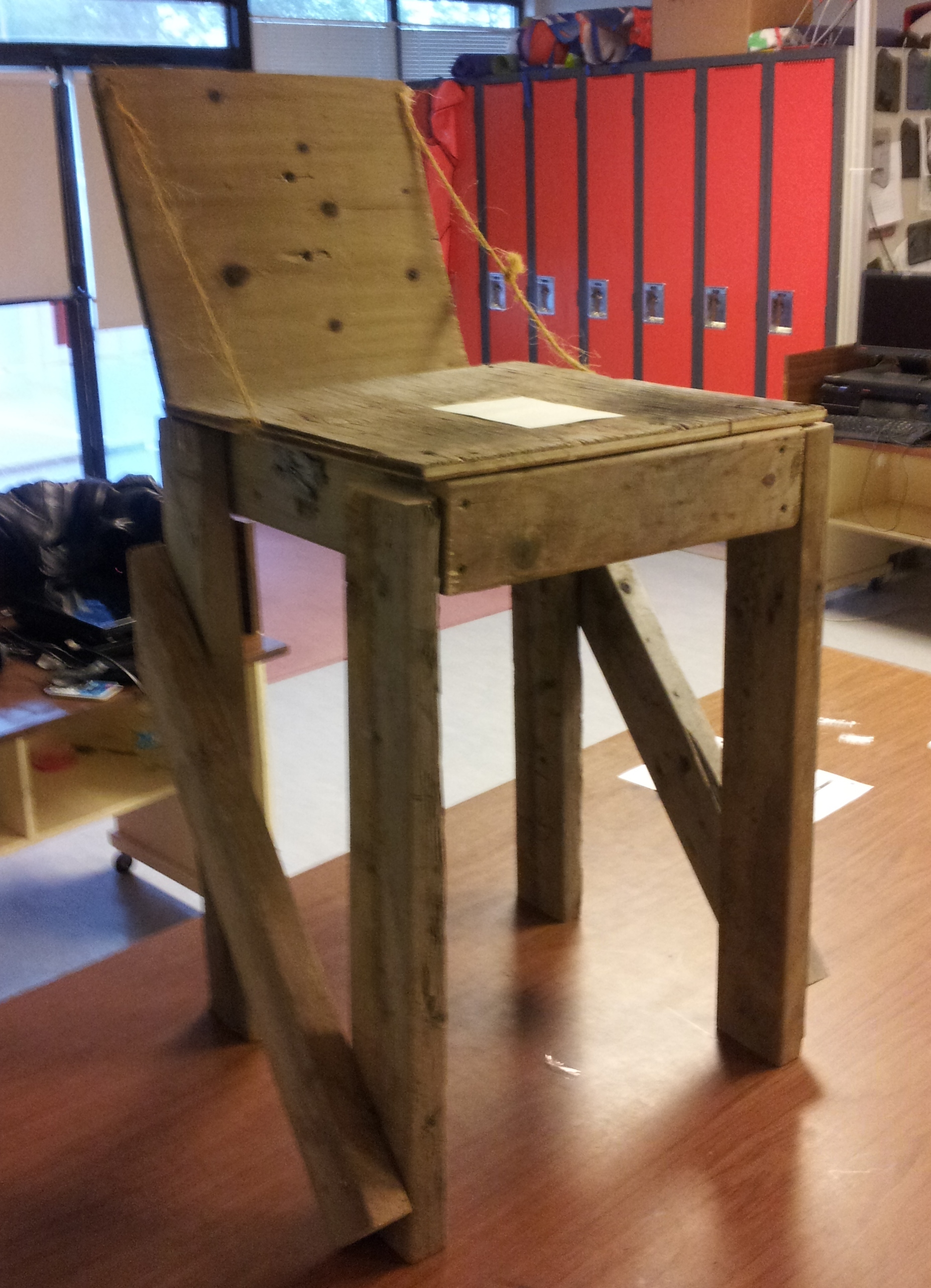
This chair is made from used pressure treated lumber and plywood. The back folds forward and the student used baling twine he got from the farm as the hinges.
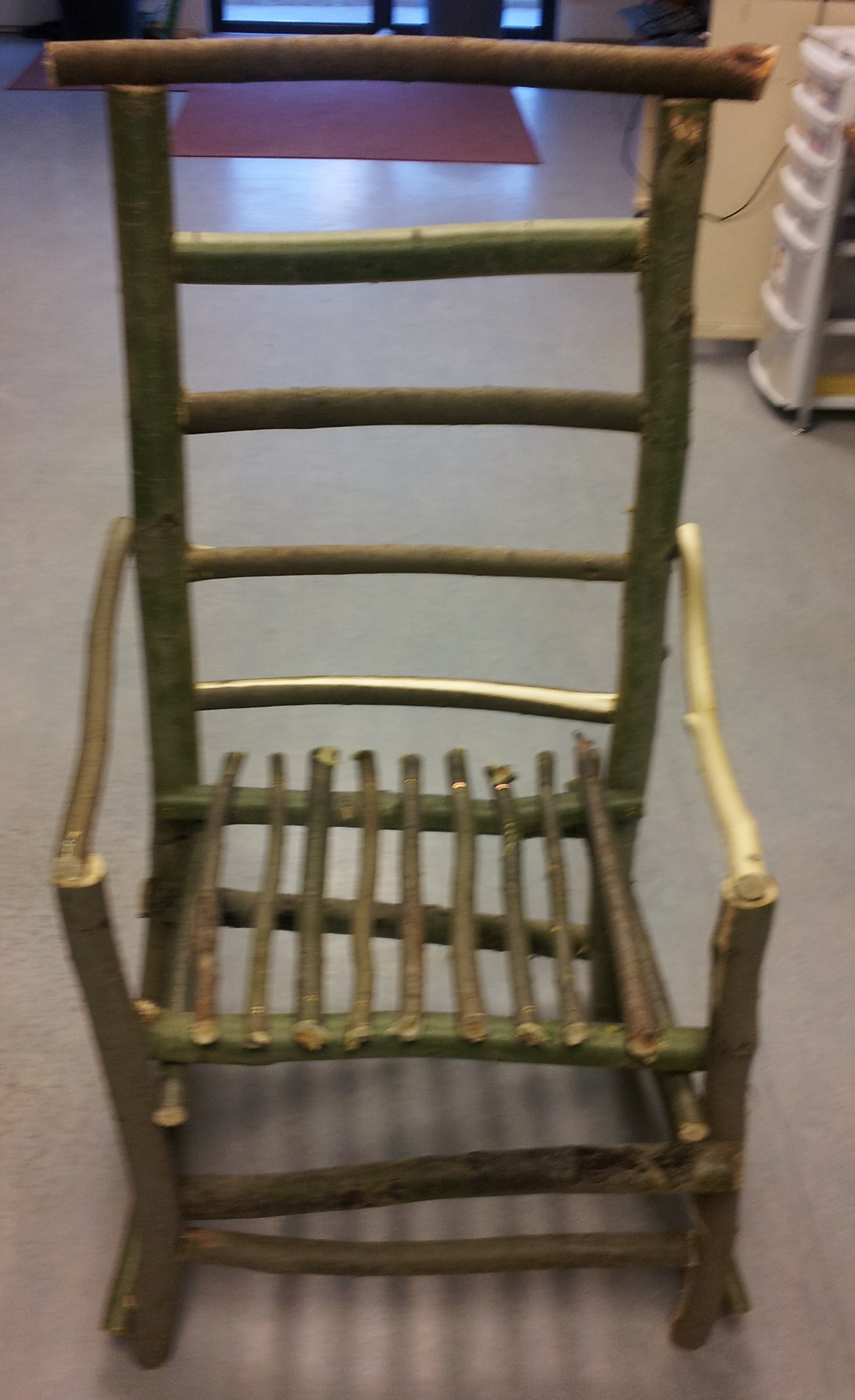
This chair is constructed from willow. The willow qualified as recyclable as the students were going to have to dispose of the willows when they cleared underbrush anyway. The only thing missing is a cushion. These students could go into business selling yard furniture.
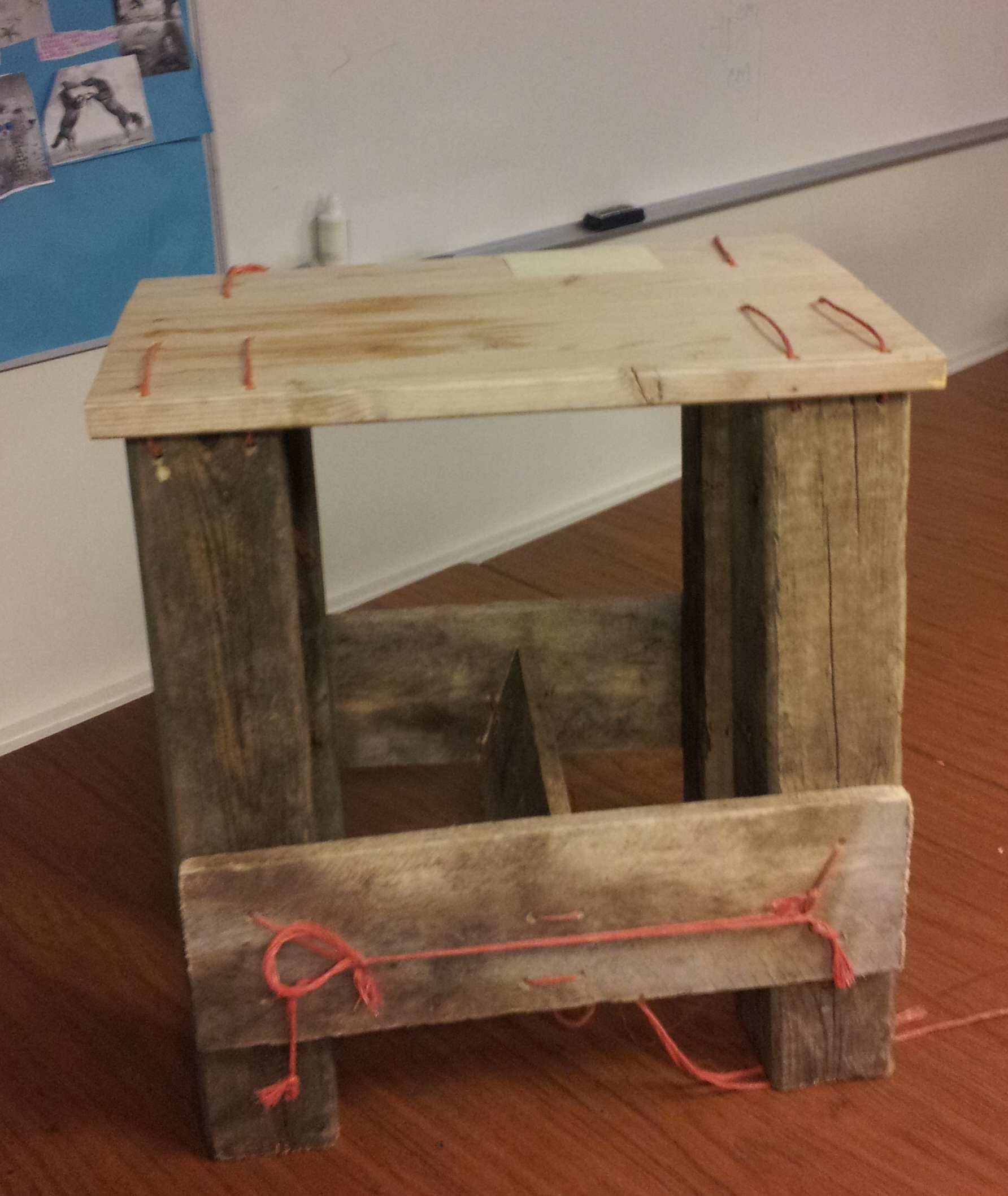
Although this stool did not have triangles for stability, the centre piece helped in that respect. When I sat on the stool, it was wobbly, but with my mass it became less so. The students used baling twine as the only fasteners. One of them has horses and these were available.
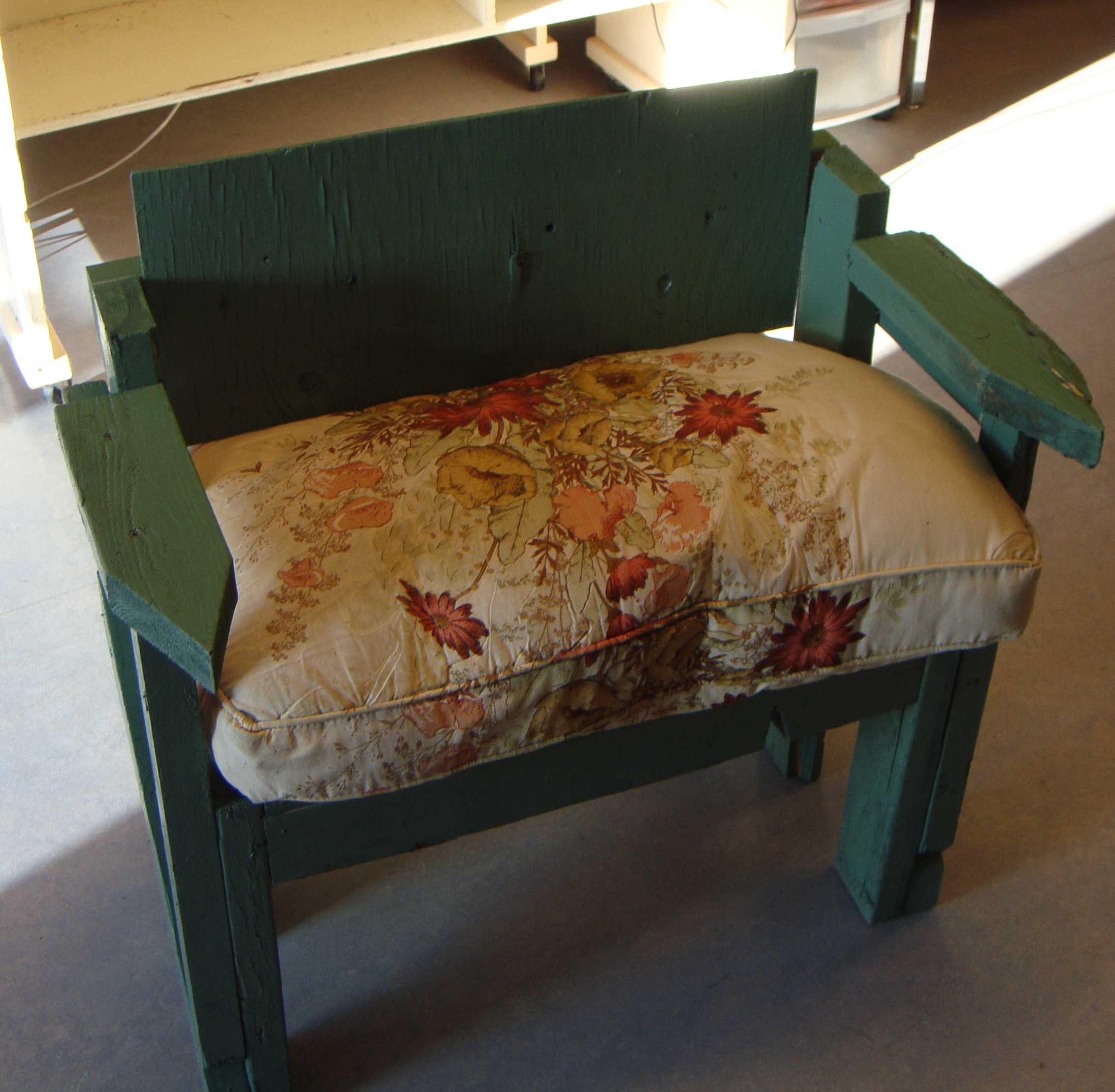
This chair is built from recycled wood and a discarded cushion. The students gathered the wood from the neighbourhood and a neighbour helped. He drilled tap holes for the screws.
In a world full of busyness and artificial flavouring for the day, this is a solid message of what brings peace to each of our lives. Slow down, you move to0 fast. Sounds like a song I heard somewhere.
This is worth reading. It fell into one of my email boxes this morning. In theory, I agree with the idea that we cannot, as teachers, return our students like Mr. Vollmer could return his blueberries. Fundamentally though, there is still a problem. In the province of Alberta. there are over 25% of students who will not finish high school. Those are the ones who leave our schools. What about those who do not leave and finish? There are still some amongst them who are on the margins and school has not served well. The 25% is an average.What about students who live in First Nation communities, in the inner city, or face any number of other life issues?
Education needs an overhaul. There is a genuine need for a different conversation and not sticking our heads in the sand. Please take a few minutes to read.
They are really my socks. They do not fit inside of any shoes or boots I own, so, technically, they might not qualify as socks, but as slippers. On cold winter mornings, I wear them around the house. What makes them interesting? I am glad you asked.
These were Christmas gifts. Kathy’s grandmother made them for us. We always knew after the first person opened their gift from Grandma what we were each receiving that year. That part never changed. What made each year’s gift deserving of an ode, was the time and generosity sewn, crafted, or knitted into the gifts. We also wanted to know what package our gift came in that year.
Grandma was a thrifty, frugal woman, not cheap. She lived and raised children in cabins almost her entire adult life. Their isolated homestead was on the McLeod River south and west of Edson, Alberta. She worked a trap line into her 80’s with the help of children and grandchildren. She worked hard and had little in terms of material wealth, but she gave gifts made by hand and given from the heart. Part of her thrift was the packaging of each gift. I think, after several years, it became part of a game, too. She packed gifts in macaroni, spaghetti, and cereal boxes. Even the adults thrived on this part of the gift-giving. What was our gift packed in that year?
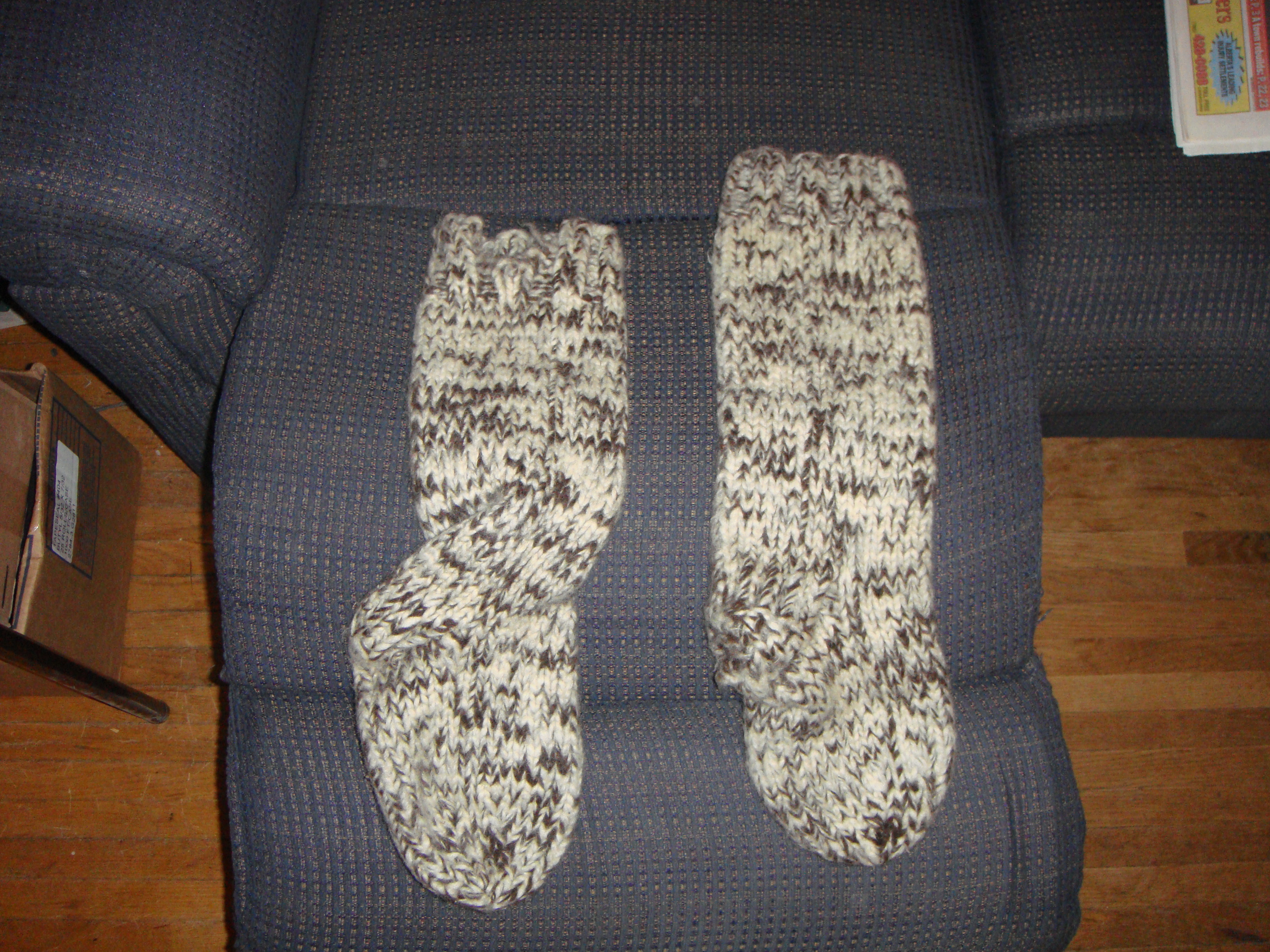
When I share Pablo Neruda’s Ode to My Socks with students, I tell this story. Children and adolescents need the figurative message made concrete. This poem is about moving life’s supposedly ordinary events to the extraordinary. Students often recount a gift given or received from the heart after my story. It moves the context of daily life forward from the ordinary, and makes it rich. Beauty is twice beauty, after all.
Mara Mori brought me
a pair of socks
which she knitted herself
with her sheepherder’s hands,
two socks as soft as rabbits.
I slipped my feet into them
as if they were two cases
knitted with threads of twilight and goatskin,
Violent socks,
my feet were two fish made of wool,
two long sharks
sea blue, shot through
by one golden thread,
two immense blackbirds,
two cannons,
my feet were honored in this way
by these heavenly socks.
They were so handsome for the first time
my feet seemed to me unacceptable
like two decrepit firemen,
firemen unworthy of that woven fire,
of those glowing socks.
Nevertheless, I resisted the sharp temptation
to save them somewhere as schoolboys
keep fireflies,
as learned men collect
sacred texts,
I resisted the mad impulse to put them
in a golden cage and each day give them
birdseed and pieces of pink melon.
Like explorers in the jungle
who hand over the very rare green deer
to the spit and eat it with remorse,
I stretched out my feet and pulled on
the magnificent socks and then my shoes.
The moral of my ode is this:
beauty is twice beauty
and what is good is doubly good
when it is a matter of two socks
made of wool in winter.
Pablo Neruda

It has been a terrific blogging journey and traffic increased, but this is a two-way stream. I follow a number of blogs and each contributed to my growth during the past 2-3 months. Marie Wetmore at http://mariewetmore.com/ nominated my site for a versatile blogger award.
I am posting a list of favourite blogs. Who are the authors and creators of my favourite blogs? What makes them versatile? Please take a moment to visit some of these sites. Thank you.
Thanks Marie Wetmore! It is an honour. I am grateful and humbled!
7 interesting things about me:
My Nominees
I acknowledge people who were role models and encouraged me in blogging as Teacher as Transformer. I am grateful for daily contributions and offerings. I shifted from an ego-driven Teacher as Transformer and began internal work. I thank each of you.
WHAT ARE YOUR FAVORITE BLOGS? COMMENT BELOW!
Diane Ravitch is a leading American educator. Although what happens south of the border is not important to us, this article poses a great question. Who is advantaged; those with resources or those without resources? Servant-leadership, which is lost in education, asks the leader to serve those around him or her and help them grow. That focus increases for the most disadvantaged. When will politicians, bureaucrats, and technocrats allow teachers in the classroom to become leaders who serve students and the community?
Mitt Romney launched his foray into education by visiting the Universal Bluford charter school in West Philadelphia, an impoverished, largely African-American neighborhood. He went to tout his plan for vouchers and charters as the new civil rights crusade of our era.
While there, thinking he was in friendly territory, he made some unfortunate remarks. First, he asserted that class size wasn’t important. That is no doubt the advice he had received from his advisors, who like to claim that having a “great teacher” is far more important than class size reduction. Then, he advised his listeners that one of the keys to education success is to be a child of a two-parent family. He got called out on both comments.
A music teacher rebuked him on the class size issue, saying: “I can’t think of any teacher in the whole time I’ve been teaching, over 10 years — 13 years —…
View original post 292 more words
There are excellent points in this article, but some areas of concern. The role of students, educators, and school provided insight into a different way of thinking about education. I disagree with the premise that administrators are a separate group, although they seem to be. Are administrators not educators themselves? I once met a retired educator who when I was introduced as a teacher and had something in common with her, she responded, “Oh, I was a principal” making it sound like I was inferior by remaining a classroom teacher. In recent years, I have witnessed this desire among many teachers to escape the classroom. We are teachers first. If not educators, what is our role? What about children who needs help? What do we do to raise them up? I think this article is a starting point for a conversation.
Education is something that is vital to the existence of a country where financial prosperity is something that is universally longed for. This is because that in order to reach financial prosperity one must reach a level of knowledgeable prosperity that unlocks the true innovator within them. However, if our countries goal is to allow for everyone to reach a level of financial prosperity then its time for us to sit down and come up with a dedicated pathway to delivering education with equality, equity, loyalty, and dignified passion in mind. If this is our goal then it is time for us to do away with the days where our educational system is balanced on the practice of every child left behind and every teacher for themselves. The time has come where we must push forward, with dignified loyalty, professional reservation, and universal respect for the student, the classroom, and…
View original post 933 more words


 Teacher as Transformer