Tag Archives: teacher as transformer

What Does it Mean to Be in Control?

I arrived in Seattle today and it is raining. I am attending a Circle of Trust retreat based on the writing and work of Parker Palmer. We share stories and look at the lives we live. Today, I shared a story about my fear of flying and its underlying source. This ends up being a humourous story in the end and revealed something I am only beginning to understand.

Recently, Kathy and I flew from Edmonton to Portland. After arriving in Vancouver late, we rushed across airport and just made the Portland connection. The doors were closed before we had our seat belts fastened. I settled in, we climbed to altitude, the captain came on the intercom and announced words fearful fliers do not want to hear, “Folks there is inclement weather en route and there will be turbulence.” We did hit turbulence. It was not the worst I have experienced, but it was bad enough to create apprehension for me. Kathy calmly explained, “It is similar to a school bus on a gravel road.” I was not impressed and continued to suffer. As the turbulence died down, I reflectively asked a question: “What is causing me to feel this way?” Just as I was beginning to explore this intriguing question, we hit another patch of turbulence. Already engaged in an answer seeking mode, I realized I was moving my feet like I was working the pedals in a car. My fear of flying is largely based on a lack of control. When the flight moved past the turbulence, I mentioned this to Kathy who suggested one of us needed to get a pilot’s license to resolve the problem. We were able to laugh. The good news is today I had a relatively good and relaxed flight to Seattle. Being aware of a potential cause, is important and asking that first question was important.

This is not the first time I used this strategy. Driving to a meeting in November, I did the same thing when I grew anxious about the meeting.  I asked myself what made me feel the way I did and realized a lack of feeling in control of the meeting and its agenda was at the heart of my anxiety. I was able to relax and remain poised during the meeting. The lack of control existed in my mind as an imagined narrative I held to be true. I had not mentally rehearsed or visualized how I would handle what I assumed would be a confrontational situation. This was my normal way of dealing with these situations. The result that day was a quieter, more relaxed mind and body; better prepared actually by not preparing the old-fashioned way. Retreats, like the one I am attending this weekend offer opportunities to explore the internal landscape in a different way than normally done in the busyness of my daily life. From a leadership perspective, if a person is always going off the deep end emotionally, how can that be effective leadership? The time to reflect and spend time attending to one’s inner landscape is an essential, but overlooked aspect of true leadership.
 

Qualities of a Learning Community

What did the World Cafe events reveal? The concept of community, in some form, was the most repeated quality of what engaged people in their learning. There were many descriptors for a community of learning. One that stood out was the community of learning being safe. Safe learners feel comfortable stepping out of their comfort zone and stretching to learn. This could be called the “Goldilocks Paradigm.” Learning is not too hard causing arresting stress; not too easy allowing boredom to prevail; just right, adding to the edges of knowledge the student possesses.

One discussion led to an interesting revelation about the use of technology and what it contributes to a safe learning experience. As a strategy, it might be better suited for older students, but has potential across a range of ages and abilities from upper elementary and beyond. Video and audio files allow for use of pause and rewind, reinforcement of key concepts, time for mindful reflection and response, and opportunities for anonymous questions. The group was clear this should not replace the face-to-face interactions vital to learning, but could provide opportunities for interactions to develop in addition to the teacher-student relationship, such as valuable peer-to-peer connections. In an increasingly digital world, students and teachers can support each others learning outside the existing temporal and spatial restrictions associated with school as a building to attend on school days. School becomes more than a space and the online capacity expands the potential rather than diminishing it. Physical attendance coupled with other points of contact i.e. blogs, online forums, and video formats provide exciting potential for what a safe learning community can mean.

The conversation about community, learning, and the role of multiple points of contact in the learning community resonated with my own learning experiences. I use a variety of digital formats in my learning at Gonzaga i.e. electronic blackboard, wikis, and blogs. They reveal the reality that learning is not place- or time-focused. It is ongoing with multiple points of contact essential to the shifting landscape of what school is and can become. The Khan Academy is a useful Math resource for some students and Selman Khan, its designer, has employed self-directed learning features by Selman Khan in the design of this site. He makes use of the advantages discussed in our group-connections, time for reflection, and anonymity, and makes learning safe..

Paradox of Community

Several themes emerged in the World Cafe conversations about learning and an important one was community. The group used various connotations for community and qualities to describe community, but this theme resonated throughout the mindful and reflective conversations.

The concept of team often served as a corollary for community. Teams strive towards common goals in sports, business, or education. A component of successful teams is ‘shared vision.’ Rather than leadership being vested in a person or a small group of people in a hierarchical structure, successful teams have the anchor of a vision and share the values that support the vision. A critical first question in a learning environment would be “What vision and values energize learning?” The common goal and energy bring to life the acronym: Together Everyone Achieves More [TEAM]!

Humans share. It reveals who we are and what is important to us individually and allowing us to connect to the collective. We are affirmed as others listen. The World Cafe group suggested sharing was central to learning by revealing what is important and what is learned. The sharing may reveal gaps in learning or reveal more than one way to solve a problem and learn. Sharing in a safe environment, or community, focuses learning past the expert knowledge of one person, the teacher, and shifts it to the broader collective. Risks are more readily undertaken because there is support, and everyone can both teach and learn. We live in an increasingly complex world where the paradox of teacher and learner calls strongly for sharing.

The idea of connectivity arose several times. A complexity of today’s world is a burgeoning need to connect with others in both new and traditional ways. We face paradox as we seek community. Community is no longer defined solely by where we live, as in a digital world, connections are made across the globe and communities shaped in radical ways. This encourages different and emerging views of community: where we live, where we work, and, how we connect.

Community suggests  paradox. The World Cafe group felt being face-to-face with others was essential at times, but suggested face-to-face might include digital platforms such as video conferencing or Skype. A benefit of on-line instruction is the ability to pause a video or audio file, reflect on material, take notes, and return to earlier points in the file. We cannot pause teachers in real-time to repeat exactly what was said, but we can in the digital world. Wise, prudent, and mindful use of technology serves learning if safely implemented. How do we use technology in traditional classrooms? What role can it or should it play in moving learning beyond the walls of the traditional and sometimes outmoded classroom?

Healthy, vibrant, and safe communities give time and space for solitude. A common criticism of school and classroom scheduling is the lack of reflection time for teachers and students. Busyness is the order of the day in schools and classrooms. Time is necessary for learners to process the reams of available information to connect it to subject matter and make it meaningful. We observed this in the four World Cafe sessions; there were times when the room was quiet, as people processed and reflected on the questions or comments. Community brings us together and, at the same time, paradoxically allows personal space and time.

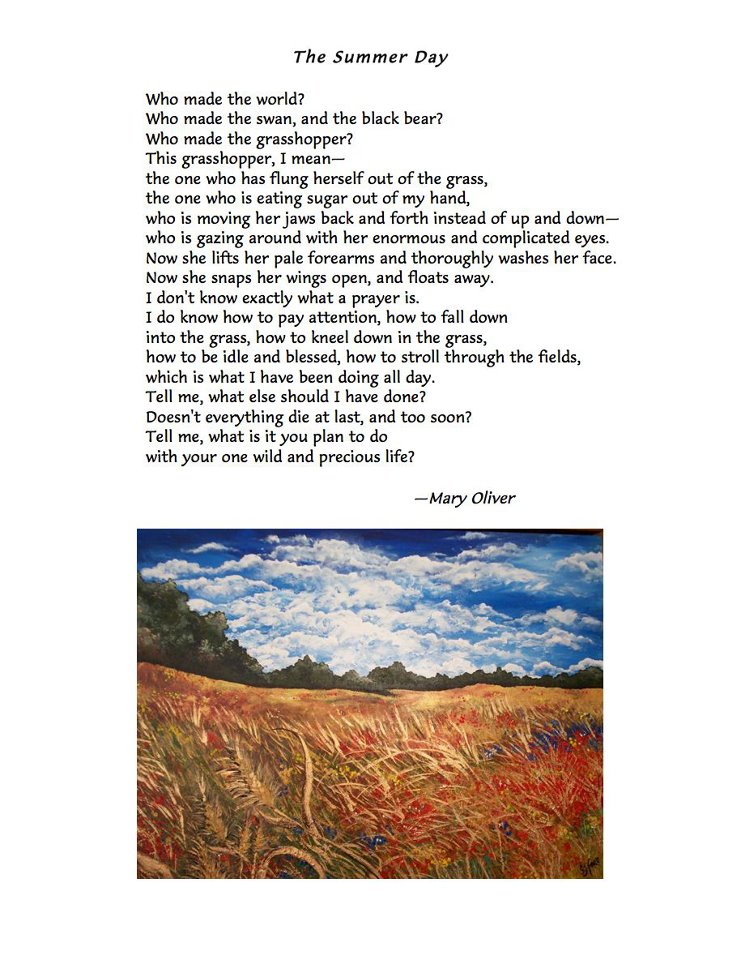
A Summer Day by Mary Oliver

One of my favourite poets is Mary Oliver. Here is one of her poems called A Summer Day. After a weekend of not great weather, it was a timely poem to receive, read, and reflect upon. Mary Oliver, through her poetry, poses such great questions and asks us to take time to enjoy our life. It is the only life we have. Live it well.

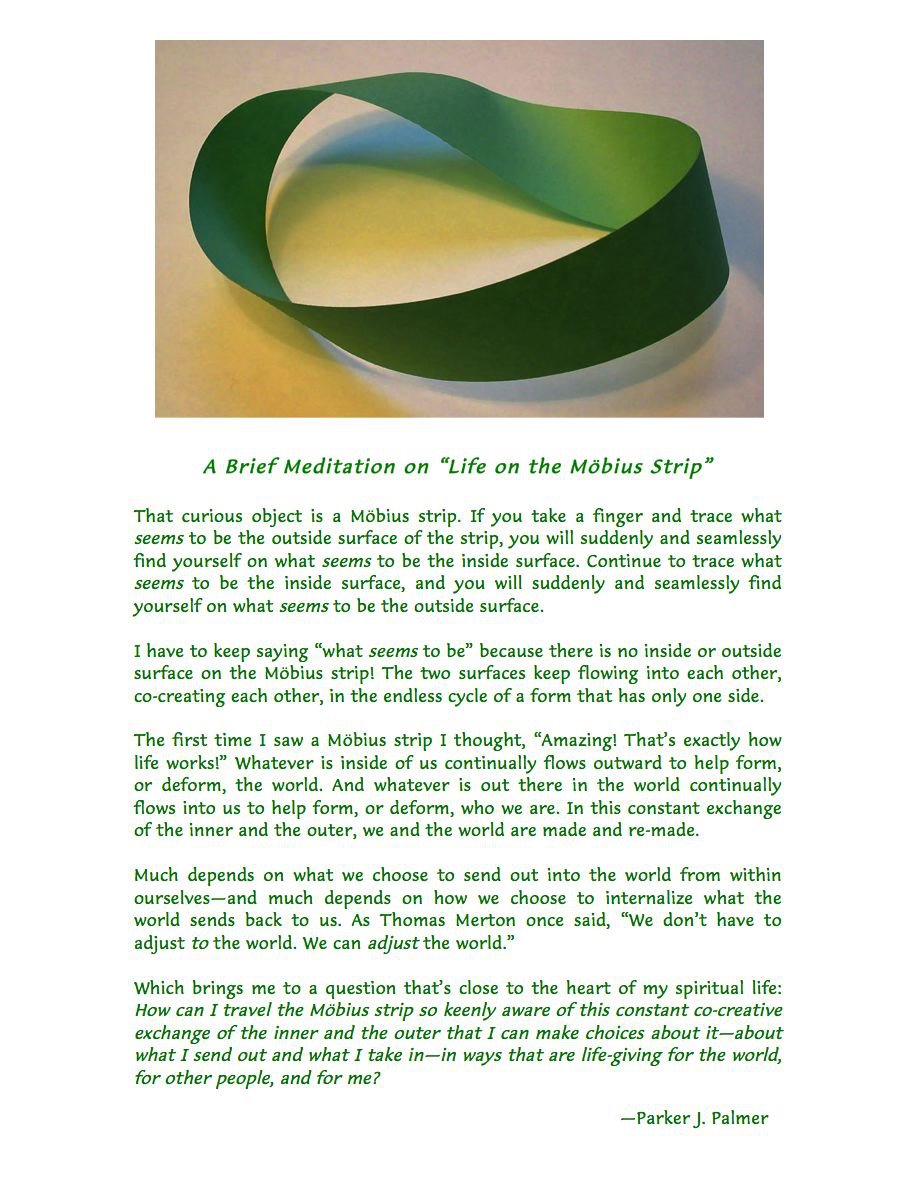
Mobius Strip Meditation By Parker Palmer

Parker Palmer is one of my favourite authors. He writes about spending time looking in and making one self whole. The mobius strip provides a metaphor for the rhythm and flow that occurs when we take time to stop, look in, and show each of us what is important and makes us whole. Please take time to read this wonderful passage.

Community and Servant-Leadership

Community has been a recurring theme throughout the World Café conversations and events, with many descriptors alluding to communal practices and relationships needed for learning to happen. Reciprocity, connection, supportive, affirmation, and other words expressing interactions suggest community. The summary posters of the March 17, 2012 World Café Event confirmed this recurring theme of community and the table posters, to being posted, also bear this out. The theme of community is important not just in learning, but in life itself. Without community, can life and learning be as meaningful?

Parker Palmer recently shared in a Facebook posting: “Community does not mean living face-to-face with others—it means never losing the awareness that we are connected with each other…”

The servant-leadership conference I attend in Portland reinforced that, although community continually evolves, as a value it can remain intact. Here are some examples.

Professor Shann Ferch, from Gonzaga, spoke about the “beloved community” that the late Martin Luther King so eloquently referred to. It is the necessity to see each other, including oppressors and those who have done harm to us, as human. Dr. Ferch also quoted Viktor Frankl: “We are made to turn outward, toward another human being to whom we can love and give ourselves. … Only when in service of another does a person truly know his or her humanity.”

We easily dismiss these references to community as the extreme and needed actions and words of those in different settings. After all, Dr. King led the Civil Rights movement in its halcyon days and paid the ultimate sacrifice. Dr. Frankl survived the atrocities of concentration camps during World War II. What do their experiences have to do with simply getting through the day?

Kirk Young, a colleague from Gonzaga, elaborated on what could be understood as community in the form of a value. The communities we choose to belong to share one common ingredient: intimacy. Ferdinand Tonnies, a German sociologist, used the word gemeinschaft and described this form of community as “a tighter and more cohesive social entity. [It is] exemplified in family and kinship” suggesting when humans gather in community, intimate experiences are shared. Members share the good, the bad, and grow together towards common purposes, thus are mission driven. Values and mission serve as glue for community.

Father John Dear, a Jesuit priest, proposed in The Rebel Jesus, a second, mostly unnoticed miracle occurred during the Sermon on the Mount: the forming of community. Community allowed people to see the human nature of each other as Jesus instructed those closest to him to organize the large group (some believe well over 5,000 people) into small, more intimate groupings of about 50 people. Father Dear suggested that in these small communities, people interacted differently and shared as they made connections with those now close to them. People were no longer strangers; because moments before they were simply part of a large and increasingly hungry throng. In contemporary parlance, they were statistics.

By witnessing the humanity in each other, we form community and share intimacy without fear. Our humanity is the one thing we share with others and through it, we find purpose to gather and create community around the universality of human values and the value of humans.

What Has Blogging Done for Me?

I went back and checked my first blog posting of February 2011. Blogging began as a tentative venture and, at times, I felt apprehensive, unsure of my writing and topics. Over time, there is a different feeling in my writing, perhaps simply finding my voice in this medium. The Internet provides a new forum for publishing. We can publish and then edit.

The reversal of publishing and editing roles was a challenge. I want a high quality product when I post for others to read. In those early months, some people advised me that just being out there and taking the risk to be less than perfect was enough. That goes against the grain for me. Recently, I explored and read other blogs with regularity which pushed me to look at other people’s postings and ask questions. Were other bloggers posting with little concern for grammar, spelling, and clarity of message? The answer is an unequivocal, “No!” I toured, read, and saw others’ passion and was impressed with the professionalism with which they approached blogs featuring everything from text to  mostly visual to all points in between.

I  felt I had something to offer and the blogosphere served a purpose. I enjoy both learning and traveling. It is affirming and energizing to read others’ entries, communicate on them, and receive responses. Pictorial essays people provided took me back to my childhood in Northern Alberta, reading encyclopedias for fun. Even a die-hard hockey fanatic would not venture out when it was -50 degrees below zero with a wind chill. In a pre-TV and computer era, books served as a window to the world. Blogs with pictures of faraway places i.e. Fort Lauderdale, Miami, and Yosemite take me back to the living room in Rycroft reading an encyclopedia and exploring the world.

I am enjoying blogging and I think, most of the time, I am finding it a space that fits my communication. On those occasions, when I slip into dull, pedantic, or obtuse writing, point me back to this cartoon.

I do tend to stray and can become this writer.

This is an interesting posting and it struck a personal chord on two levels. Several months ago, someone asked me what I was going to do when I finished my doctorate. These types of questions are the domain of those who think humans have any control and certainty in planning the future. I was also completing an independent study course on mindfulness and it confirmed the absolute need to dwell on what we know is certain: living in the present moment. Being present, in each moment, is its own reward and is as thrilling as it gets. Well said Kayla.

Kayla Cruz's avatarGen Y Girl

Of all the annoying questions I’m asked on a daily basis, I think my favorite has to be this one…

“Where do you want to be in five years?”

My response?

“Wherever Ryan Gossling is.”

JK…that’s where I want to be NOW. Not in five years 😀

No but seriously, this question really upsets me.

You see, I’ve always been an obsessive compulsive planner. Three years ago, I would have been able to answer that question down to the kind of toilet paper I’d be using in five years. At 18 I thought I knew exacly what I wanted to do with my life. I thought I knew exacly what kind of job I wanted and I thought I had met the guy I would marry. We were going to have really pretty babies.

Seemed like a pretty good plan to me. Only, it wasn’t.

Throughout college I found that my interests changed…that there were so…

View original post 374 more words