Tag Archives: writing

Poetry Arises

To begin the day in a quieter, peaceful, and wiser place, I meditate each morning. .Elizabeth Myhr commented about creativity in her writing. She “does not jump into creativity. Creativity bumps into her on its way through the world.” As I sat, I realized I was writing poetry in my mind. Words, phrases, and images were floating in a stream. I recognized I felt calmer and quieter in those moments.

Francesca Zelnick offered advice in a recent post. She suggested, when ideas emerge or bump up against me as I move through life, write them down. I did and edited later. Here is the product.

Sit quietly,

5:30

AM.

Can’t sleep

wait

listen

pay attention

be patient

meditate

contemplate

focus on breath.

Gently return

to a quiet space

solitude

like a river

single words

phrases form

metaphors arise

images appear

in the current.

Discover a gentle smile

on the corners of lips

face softens.

Fresh day

creates space

for voice

words observed

soul speaks

asks to be heard.

Tranquil,

bump into creative moment

Poetry written.

Enjoy!

Blogs I Follow

It has been a terrific blogging journey and traffic increased, but this is a two-way stream. I follow a number of blogs and each contributed to my growth during the past 2-3 months. Marie Wetmore at http://mariewetmore.com/ nominated my site for a versatile blogger award.

I am posting a list of favourite blogs. Who are the authors and creators of my favourite blogs? What makes them versatile? Please take a moment to visit some of these sites. Thank you.

Thanks Marie Wetmore! It is an honour. I am grateful and humbled!

7 interesting things about me:

  1. I love Kathy. We have spent almost 40 years together and we still learn something about each other.
  2. My second love is connected to my first love. We have three terrific sons who are successful and give in many ways. I am proud of Marc, Yves, and Luc.
  3. I love sports in general, but hockey (ice hockey) is my passion. This love affair began on a small pond in a backyard over 50 years ago and morphed into a long career playing and coaching.
  4. I love teaching. I look forward to my students, their contributions to each other, and the joy young people do bring into our lives. I spent 15 years in private industry, but I always wanted to be a teacher. It is another reason I love my family. They supported me in this adventure.
  5. I love learning. It goes hand in hand with teaching.
  6. I love to travel. Growing up in a pretty isolated area of Northern Alberta made it challenging. I bring my travels home with me and thoroughly enjoy the blogs where people share about their lives and corners of the universe.
  7. I love writing. That is a reason I keep going back to school. It provided an outlet and so has my blog. I even tapped back into old roots and wrote poetry to post.
  8. I am going to cheat. I love music. My tastes are pretty eclectic from Blues to Gospel to non-traditional country to folk to world music and beyond. Kathy and I do a lot of concerts big and small. We attend a small folk club with an amazing line up every year.

My Nominees

I acknowledge people who were role models and encouraged me in blogging as Teacher as Transformer. I am grateful for daily contributions and offerings. I shifted from an ego-driven Teacher as Transformer and began internal work. I thank each of you.

Awaken Your Child

Elke Teaches

Enough of the Cat Talk

Gen Y Girl

Going Dutch

Grow Mercy

Meanwhile Melody Muses

Mike’s Look at Life

The Pal Guy

R C Gale

Rod Posse

Simon Marsh

Spokane Favs

Words/Love

Zellie M. Quinn

WHAT ARE YOUR FAVORITE BLOGS?  COMMENT BELOW!

Daily Poetry Lesson Idea

I set aside 30 minutes each day for poetry. A typical lesson plan for junior high or middle school might be as follows:

  • Read the poem and have the students follow along as they listen to it for the first time.
  • Read or ask students to read the poem a second time. Students listen for words, phrases, or elements which catch their ear.
  • Students quietly take a few minutes to highlight or underline key words, phrases, or literary elements.
  • Students quietly share the key words, phrases, or literary elements with one or two classmates. Did they enjoy the poem? Why or why not? I ask them for specific responses. It sucks or was interesting needs support.
  • We come together and share. What stood out? What literary elements did the poet use and what did they add to the poem?
  • What were the literal and figurative messages of the poem?

Students are invited to share their favourite poems.  One student shared Do Not Go Gentle into that Good Night by Dylan Thomas and another Mr. Nobody by Walter de la Mare. I used the latter poem for a conversation about responsibility.

Students sometimes are reluctant to write poetry. I use Pablo Neruda’s Ode to My Socks as an example of a poem about a mundane object, a pair of socks, and how this poem transforms the socks with rich and vibrant language, similes, and metaphors into something quite extraordinary. A person needs to read or be read this poem to appreciate what makes socks worthy of an ode by a Nobel Prize winner and how everyday objects become subjects for poetry.

When we read The Road not Taken by Robert Frost, the students worked in triads and created collages about the themes they found in this classic poem. The end products were well thought out.

Killing Weasels – A Legend

My mother tells a story about her mother, my Mémère, which is French for Grandmother. The family lived in a cabin and had a homestead on the Lesser Slave Lake when my mother was growing up. The cabin had a dirt floor which needed sweeping regularly. People tell me a dirt floor is swept so things spilled on it are not packed down into the dirt and to reduce vermin.

Mémère was sweeping when, quick as a flash, a weasel ran across the floor. She, Mémère  that is, moved her bottom hand adeptly up the broom handle much like a baseball player would to hold a bat and, without missing a beat, took a mighty swing that would have made even Casey proud. My mother recalls how the weasel was accommodating and hopped just a bit  so he was above the floor. The broom head connected, the weasel flew across the room, and struck the wall solidly. It fell unmoving to the floor and Mémère returned to her sweeping as if nothing had happened. She quietly instructed my mother to remove the weasel and throw him into the yard for the dogs or cats.

My mother says it was an everyday event and was treated as such. It was just another day on the little homestead on the Lesser Slave Lake.

Junior High Creative Writing Activity: A Fractured Fairy Tale

Children hear and read fairy tales at a young age. When they reach late elementary and junior high school age, they can explore and discover inconsistencies in fairy tales i.e. Goldilocks breaks into the Bears’ house and vandalizes it. Here is a creative writing activity in the form of a parody.

This is the most popular creative writing activity in our junior high class. This plan has worked well for me as a junior high teacher, but I think could be used with upper elementary students. I think it can be modified and meet the needs of younger and older students.
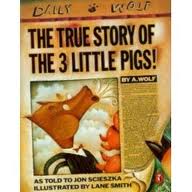
We use Jon Sczieska’s The True Story of the Three Little Pigs by A. Wolf as a model of a parody.

The unit plan includes:

Process

Reading the story to the class and brainstorm differences between the original and this version? Most students are familiar with the original story of The Three Little Pigs, but have it on hand if someone is unfamiliar with the story.

What fairy tales are students familiar with? Brainstorm and create a list. What parodies of fairy tales are they familiar with? Have they seen Shrek? What makes Shrek different from other fairy tales? Students may recognize Shrek as a parody of the genre and has features and structure of a fairy tale while it spoofs the genre in various ways.

What twists can be used to rewrite a fairy tale i.e roles of antagonist and protagonists or plot events? Some examples students have shared include what if the third little pig refused his siblings refuge to teach them a lesson where would they stay?  Could the pigs organize a pig posse to run the wolf out-of-town?  Would they have become ‘ham jam’?  What about the story from the wolf’s perspective?  What if the wolf were a vegan?

What other fairy tales are students familiar with?  Brainstorm and make a list. This helps students choose a fairy tale to rewrite. Choose a familiar fairy tale and brainstorm ways to ‘fracture.’ We have used Cinderella. The list can offer starters for students and could also be used in the parody of another fairy tales. What if…

  • Cinderella has beautiful step sisters?
  • The prince cannot dance?
  • Cinderella is a homebody who likes to cook, sew, and clean and is not interested in attending the ball?
  • The magic wand is defective and does not get the spell right?
  • Cinderella does not want to get married?
  • Cinderella wants a car and not a carriage?
  • Etc…

Brainstorm elements fairy tales share and create a graphic organizer to hand out. Some features have included:

  • Once upon a time…
  • Good vs. evil
  • Beautiful heroine and handsome prince
  • Magic/supernatural
  • Personification
  • …live happily ever after
  • Etc…

Students can ‘fracture’ a fairy tale and change stories in unexpected, clever, and humourous ways by altering characters, modifying language, using a modern context, etc. The fairy tales still remain true to their original forms despite changes.

Here are sites to find fairy tales or refresh memories about the fairy tales students choose: Story Nory, Grimm’s Fairy Tales, and Ivy Joy. Some sites include other genres i.e. fables. Stick to fairy tales as they are well-suited for this project.

Students include an outline or web and a rough draft. Peers or teachers can proofread the story so students can edit.

Final Product

A picture book format is popular. The authors of the picture book can read to their stories to younger students.

Words of caution

  • This is not a yearlong project
  • Students  need to choose something of a manageable length.
  •  Usually the audience is younger. Students should use appropriate language and images, keep the book short i.e 20 pages, and use large font.

Assessment

I use this activity to assess creative writing, sharing orally, and finding appropriate images for the story and the audience. As well, there are brainstorming, proofreading, and editing.

Questions

What engaging writing activities do other teachers use in their classrooms? What changes can be used for older and younger students? What other assessment purposes can you think of for this type of activity?

What Has Blogging Done for Me?

I went back and checked my first blog posting of February 2011. Blogging began as a tentative venture and, at times, I felt apprehensive, unsure of my writing and topics. Over time, there is a different feeling in my writing, perhaps simply finding my voice in this medium. The Internet provides a new forum for publishing. We can publish and then edit.

The reversal of publishing and editing roles was a challenge. I want a high quality product when I post for others to read. In those early months, some people advised me that just being out there and taking the risk to be less than perfect was enough. That goes against the grain for me. Recently, I explored and read other blogs with regularity which pushed me to look at other people’s postings and ask questions. Were other bloggers posting with little concern for grammar, spelling, and clarity of message? The answer is an unequivocal, “No!” I toured, read, and saw others’ passion and was impressed with the professionalism with which they approached blogs featuring everything from text to  mostly visual to all points in between.

I  felt I had something to offer and the blogosphere served a purpose. I enjoy both learning and traveling. It is affirming and energizing to read others’ entries, communicate on them, and receive responses. Pictorial essays people provided took me back to my childhood in Northern Alberta, reading encyclopedias for fun. Even a die-hard hockey fanatic would not venture out when it was -50 degrees below zero with a wind chill. In a pre-TV and computer era, books served as a window to the world. Blogs with pictures of faraway places i.e. Fort Lauderdale, Miami, and Yosemite take me back to the living room in Rycroft reading an encyclopedia and exploring the world.

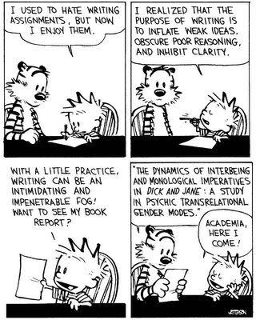
I am enjoying blogging and I think, most of the time, I am finding it a space that fits my communication. On those occasions, when I slip into dull, pedantic, or obtuse writing, point me back to this cartoon.

I do tend to stray and can become this writer.