Monthly Archives: May 2012

Why School by Mike Rose

Why School: Reclaiming Education for All of Us by Mike Rose was a follow-up read to his earlier book Lives on the Boundaries. The latter book explored, in an autobiographical way, Mike Rose’s ascent from growing up in a working class neighbourhood with little support for education at home. He found support from educators along the way and became an educator himself. Professor Rose used a similar biographical method in the current book and explored the purpose of education, different views of intelligence, learning, and knowledge, and the humbling, yet hopeful work, that results from learning.

The general thesis examined a need for a new conversation about the role of public education, one “not dominated by a language of test scores and competitiveness” (p. 4). Professor Rose presented a case for a good education being designed to help us make sense of the world. He argued that parents historically “sent their kids to school for many reasons: intellectual, social, civic, ethical, and aesthetic. Historically, these justifications for schooling have held more importance. Not today” (p. 4). If these reasons no longer hold a time-honoured place in educating our children, then it begs, “What is the purpose of school?”

Questions: What purpose does school serve in a democratic society? I find the object of school reform is not to change school or its purpose, but to simply layer one more fad on an already overloaded system which is ill-equipped to handle it. The result is we are failing many, serving few, and leaving a huge hole in the middle. What should school reformation or transformation look like? I believe this requires a conversation about purpose of school and its structure. Is the present hierarchical, industrial-age model a suitable mechanism to deliver education in the early 21st Century?

Recommendation: I enjoyed the book. It is short and easy to read. Professor Rose provides a view which is different from the mainstream educational reformer and challenges the reader with questions and not answers. I would recommend it to anyone searching for a different view of educational reform.

Transformation in Daily Life

When Kathy and I were married we chose the Prayer of St. Francis as one of our readings in the ceremony that day. It remains an integral part, albeit sometimes overlooked, part of my daily life. St. Francis spoke in a transformational voice and as a change agent of his time. His message remains as important today as it when it was first presented.

True Transformation

This posting is not an original. Yesterday, I read a chapter in Jesus the Radical by Father John Dear SJ. I thought the list of ways easing human suffering, in some ways updated, was worth repeating.

“If we take time for daily prayer and sit quietly listening, our hearts will be disarmed of our inner violence” (p. 107).

The disarming of inner violence can happen and be heard in

  • in the silence of the ashes of Hiroshima and Nagasaki as we call and act for an end for nuclear proliferation;
  • in the voices of the Hibakushka, the atomic bomb survivors who call for total nuclear disarmament and the abolition of war;
  • in the laughter, longings, and cries of the world’s children, who look to us for peace;
  • in the poor and the marginalized, who suffer the fallout of our six-hundred-billion dollar budget for war. This is now understated. What good could be done with a mere fraction of that money?;
  • in the cry of liberation from the wrongly and unjustly imprisoned, the tortured, the homeless, the hungry, the ill, and the dying;
  • in the dead of Rwanda, Bosnia, Palestine, Iraq, Sudan, Central America, South America, Libya, Syria, China, and our own city streets, who cry out, “Stop the killing, stop the bombings, stop the violence;”
  • in all those who are different from us, who call us beyond the blindness of racism to the vision of a reconciled humanity, the beloved community;
  • in the faithful women of the world, who remain wide awake, announcing a paradigmatic shift, the fall of patriarchy and its hierarchy;
  • in the solitude of creation, from the mountaintops to the oceans; in the gentle rain and the silent breeze that call us to praise a God of peace, a God of Life;
  • in our own hearts, in our breath, in our prayer so we can go down the mountain to our cross or suffering in a spirit of love.

Adapted from Dear, J.  (2000). Jesus the rebel: Bearer of God’s peace and justice. Lanham, MD: Sheed & Ward.

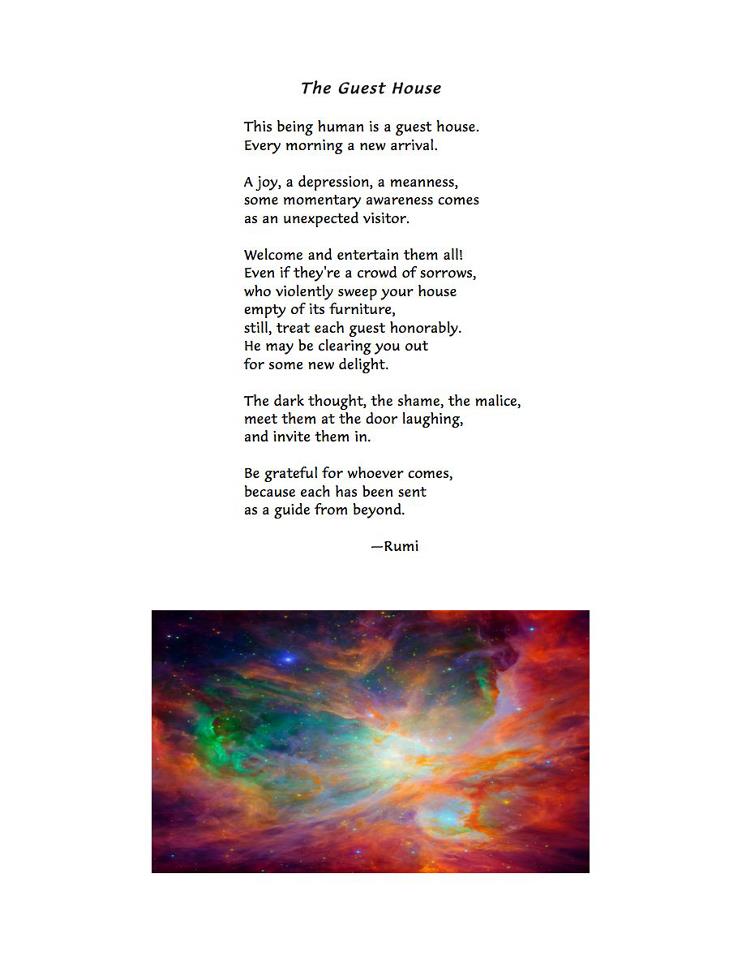
The House Guest by Rumi

I was going through my various accounts and Parker Palmer posted this on Facebook. After a challenging week, I read it and realized this was what my week had been like, very up and down. What do I say to those emotions which temporarily move in and shake my confidence? Or what do I say to those emotions which mislead me with their false promise of all things gold and glittery?

Thank you to Parker Palmer for this sharing.

Responsibility

I wrote about requiring a new culture in education which can lead to a new structure. I created a link to an article in that post and part of the article was an interview with Pasi Sahlberg.

Sahlberg stated, “There’s no word for accountability in Finnish. … Accountability is something that is left when responsibility has been subtracted.”

I understand responsibility as internalized and roles or tasks are conscientiously attended to and accountability is external and forced into place leading to feelings oppressed or alienated. Responsibility is personal or professional competency gained through maturity in a role. Accountability is personal or professional incompetency and immaturity which can  potentially be a result of change or newness in a role. Responsibility emerges in an organization when there is trust and a belief people can grow into and learn their roles. People become responsible because they are supported and cared for while they learn. A collaborative, compassionate culture emerges and subsequently a new structure for relationships to exist emerges.

The past few weeks have been a challenging time for me as I struggled with decisions. I wrote elsewhere that I too often get lost in idea that when I come to the end I see it as a something terminated. Instead, it is a moment to look back, celebrate the successes that often emerged without a plan, and to embrace the uncertainty of the future without a plan. I love to be in charge and am trying to set aside that. Zellie spoke to that part in me.

Yellowstone 2005

We love to travel and these are from our trip to Yellowstone National Park in 2005.

I was able to get within 15-20 feet of this bull elk. There were several trees between him and I plus I believed I was faster than at least one other person down there with me.

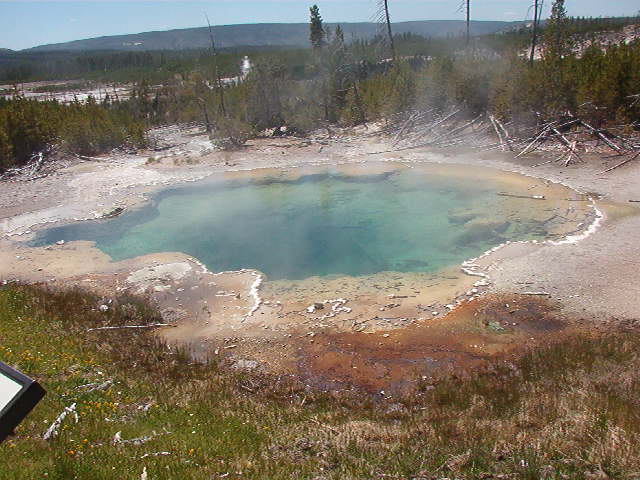
This is Emerald Spring. The emerald colour is a product of the reflected blue colour from the pool and the yellow sulfur. Although it does not seem very deep, this spring is 27 feet deep.

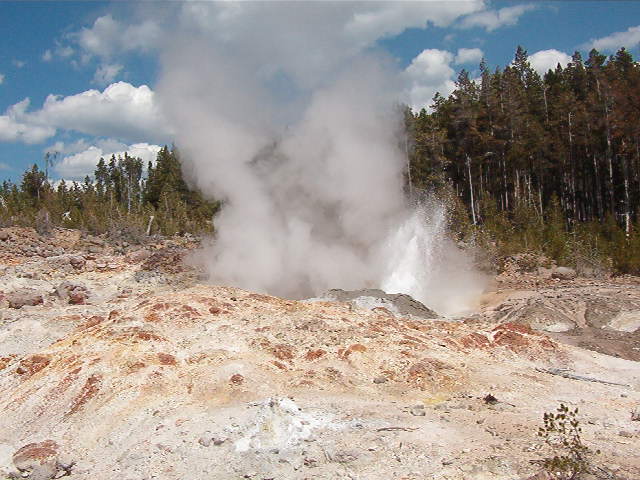
This is Steamboat Geyser. When it erupts, it is capable of producing a column of 300-400 feet in height which is 2-3 times higher than that of Old Faithful. The difference and a reason Old Faithful is better known is it is predictable in its eruptions because Steamboat Geyser is not and its major eruptions occur four days to 50 years apart.

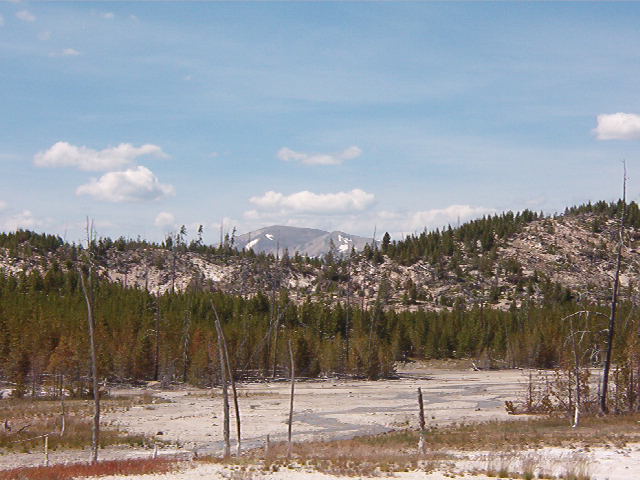
This is the Pearl Geyser area. I love mountains and it was that aspect of this picture which drew me. We lived in McBride, a small town in British Columbia, for two years and were surrounded by the mountains. We drive through McBride several times a year.

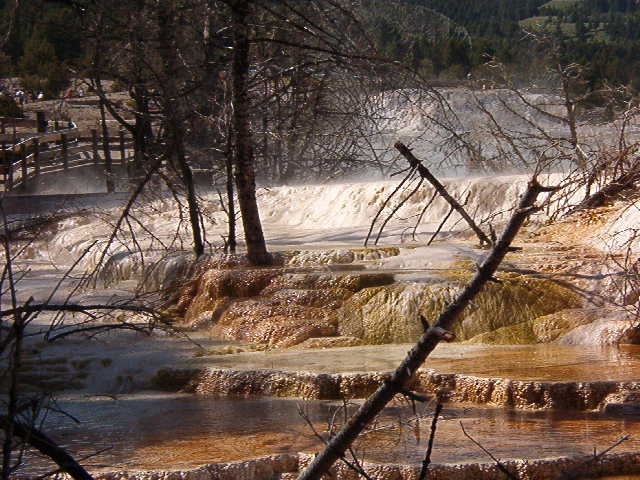
This is in the Cistern Spring area. Living algae and bacteria create the ‘living colours.’

Twig Geyser erupted for us.

This is a view across Yellowstone Lake to the mountains.

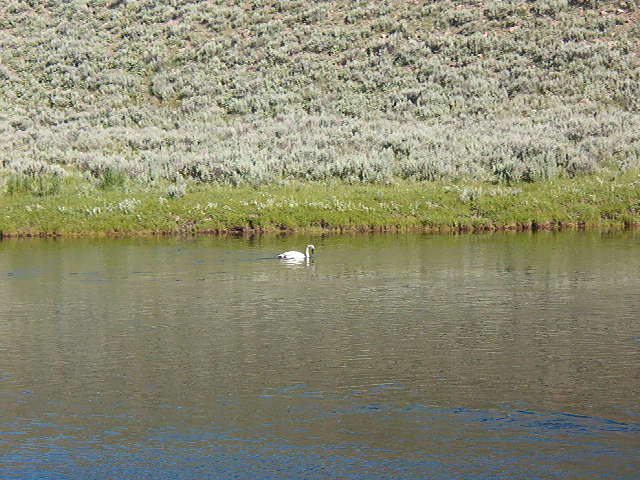
We do not get many swans in the Edmonton area. I enjoyed the single one on the river. There were other pictures, but this one had a stillness I found appealing.

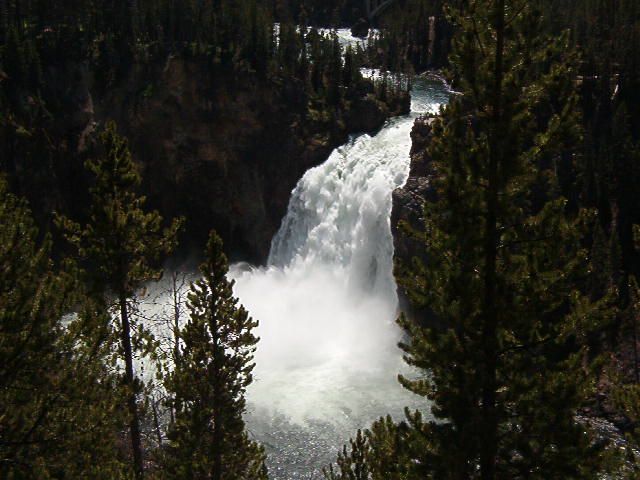
Kathy took this picture. My morbid fear of heights forced me to hang out in the parking lot. She walked in to the overlook and this was the result.

Yes, I am pretty sure Kathy took this one, as well.

I started with the elk and will finish with a bison. He was seriously considering what I was doing. I took this one from about 10 feet away with the front of the van between him and me. He grunted at me a couple of times, but kept moving when I grunted back.

Paradox in Educational Transformation – 2

I believe the second paradox proposed by Parker Palmer works in concert with the first paradox. “The space should be hospitable and ‘charged'” while being bounded and open. People “feel free to speak, but their speaking is always guided towards the topic … the open space is liberating [as it is] inviting, as well as safe and open” (p. 77). The negotiated contract is a covenant built through trusting and honest relationships where participants find their voices. “The space must also be charged. … No special effects are required to create this charge – it comes with the territory. We only need fence the space, fill it with topics of significance and refuse to let anyone evade or trivialize them” (p. 78).

I believe lessons learned from Finland’s educational experience, therefore the topics of significance here, was recognizing public education is a fundamental human right for each child and providing equal and unfettered opportunity for each child. Through open and safe conversation, implementation strategies uniquely suited to each community is revealed. People respectfully share their views in a safe, bounded, expansive, and invigorating space where they feel welcomed and honoured. The space honours each person’s truth as each person, in turn, respects the truths of others.

What can we do to create this space?

Reference

Palmer, P.  (2007). The Courage to teach: Exploring the inner landscape of a teacher’s life. San Francisco: Jossey-Bass.

Do Not Go Gentle Into That Good Night – Dylan Thomas

I sat quietly this morning after another poor night’s sleep. Initially, my ‘monkey mind’ chattered and cast blame to roil the waters and it difficult to find calm. Slowly, my mind became quieter and ideas flowed more easily. First, I asked, “What is causing these uneasy feelings?” I turn to that question more often in times of discomfort and dis-ease and I am often surprised by the answers.

I posted last night about my growing belief a different culture and conversation is needed for educational transformation. We need ‘safe containers’ for conversation about real and lasting change to occur. The change will not duplicate another educational model or be ordered from on high. We serve community needs and needs of children. I am fortunate. I learned and taught in just such a setting alongside colleagues, parents, children, and community members and real change happened through wonderful conversation. The words learned and taught signify a feeling that I rarely felt what we did was work. Life is transient and this place no longer exists except as a cherished memory.

I read a posting through a group I follow on LinkedIn about saying good-bye. The author quoted Dr. Seuss and I know the social commentary this subversive children’s author provided. The message was when the end comes we need to celebrate the accomplishments that led to that ending.  Mark Anielski, an economist, suggested teachers should conduct satisfaction surveys as students graduate, even between grades. When something or someone changes, and this is life, we should celebrate it as a new chapter in life. I can choose the positive over the negative and make a difference in the world I choose as Gen Y Girl suggested. After all, I am not a tree.

Yesterday, a Grade 7 student brought the Dylan Thomas poem in the title to school and asked if I would share it with the class. I asked what it meant to this Grade 7 student, but got no clear answer. I wondered what metaphor of life it offered me? Dylan Thomas wrote it for his dying father, but that is not my case. I sat quietly and the lines “Do not go gentle into that good night” and “Rage, rage against the dying of the light” did offer a life metaphor. When something good changes, my response is critical. Is it one of blame or fault? Was I silenced, or did I choose silence? Did I excommunicate my self. A sad lament of death I see as a request to live my life fully. I lose what I allow to be taken. Is it possible to raise one’s voice in silent protest? I think so, but it is not a silence of retreat, despair, and oppression.

I sat and waited for my inner teacher to share my truth while honouring the truth of others. I leave you with the poem. Choose your metaphor. I choose one of celebration otherwise I live a death, instead of life, due to my choices.

Do not go gentle into that good night,
Old age should burn and rage at close of day;
Rage, rage against the dying of the light.

Though wise men at their end know dark is right,
Because their words had forked no lightning they
Do not go gentle into that good night.

Good men, the last wave by, crying how bright
Their frail deeds might have danced in a green bay,
Rage, rage against the dying of the light.

Wild men who caught and sang the sun in flight,
And learn, too late, they grieved it on its way,
Do not go gentle into that good night.

Grave men, near death, who see with blinding sight
Blind eyes could blaze like meteors and be gay,
Rage, rage against the dying of the light.

And you, my father, there on the sad height,
Curse, bless me now with your fierce tears, I pray.
Do not go gentle into that good night.
Rage, rage against the dying of the light.

Transform Educational Culture and Restructure

Andy Hargreaves introduced me to the Finnish education system, its successes, and what it offers to those educators who believe we need to transform education in our schools and classrooms. It is easy to believe what is done in one setting is a model we can overlay in our schools. There is merit in examining their educational system and applying ideas that might work and make an impact. Pasi Sahlberg, a leading Finnish educator, suggested we, and I include Canada, need to see what equal opportunity in education looks like in What the US can’t learn from Finland.

“Finland can show [us] what equal opportunity looks like, [we] cannot achieve equity without first implementing fundamental changes in [our] school system.” He included equal funding of schools, holistic and equal attention for each child and education as a fundamental human right. Teaching is a valued profession in Finland, local schools write their curriculum, and teachers are given autonomy and trusted to carry out classroom responsibilities.  Although he never openly states it, the implication is that without reimagining education, teacher roles, holistic care of children as the central purpose of education, and the role the entire community plays educating children, real, sustainable change is unattainable. I think it is as important to realize that shifting towards a model of equal opportunity still will not mean our system, whether in Alberta or elsewhere, can or should look identical to Finland’s. What are the needs of our children? This is a central question to the needed conversations.

I think articles, such as What Americans [Canadians] Keep Ignoring About Finland’s School System and From Finland, an Intriguing School-Reform Model, provide more grist for the necessary conversations about transformation in education. With caution, we can use strategies which proved successful in Finland. Linda Darling-Hammond said in the second noted article. “Thirty years ago, Finland’s education system was a mess. It was quite mediocre, very inequitable. It had a lot of features our system has: very top-down testing, extensive tracking, highly variable teachers, and they managed to reboot the whole system.”

Whether as a preemptive strike or to resuscitate a failing system, there is a call to engage communities, reduce competition in schools, recruit and support the best, and trust the people we place with children in classrooms.  We can learn a lot from the Finnish education system.