Monthly Archives: June 2012

Five Steps to Destroy Public Education

Five Steps to Destroy Public Education.

Diane Ravitch is a real educational reformer in the US. I think parts of her message in this post is universal. I particularly like her comments about underfunding our schools and overcrowded classrooms.

It is just not the underfunding that starves the schools; it is the poor management and decision-making by the bureaucrats, technocrats, and oligarchs. What is the latest fad?

Overcrowding our classrooms silences the teachers. Do I even have time to lift my head and uplift students under those conditions?

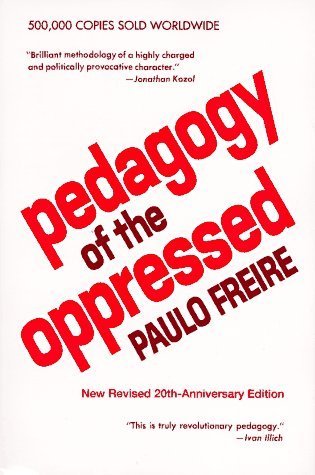
pedagogy of the oppressed by Paulo Freire

I read pedagogy of the oppressed by Paulo Freire during my undergraduate experience and return to it as a source of reflection and when I write. Similar to Parker Palmer, Paulo Freire left an indelible mark on my life’s practice. Education is an uplifting, liberating experience which shines light on each step Antonio Machado described: “Wanderer, your footsteps are the road, and nothing more; wanderer, there is no road, the road is made by walking.” Freire’ s contention was everyone can act as an agent in their learning thus freeing them and transforming the world they live in.

Freire used the Portuguese word conscientização which “refers to learning to perceive social, political, and economic contradictions and to take action against the oppressive elements of reality” (17).   Humans become mindful of and present in the world and act to transform it. Freire used a banking metaphor and described traditional education where  knowledge is deposited into students. Teachers and the system act oppressively in determining what is important to learn. Freire felt education uplifted people and their learning. “Liberation is a praxis: the action and reflection of men and women upon their world in order to transform it” (p. 60).  Learning occurs when  compliance and conformity are rejected in favour of dialogue based on love which allows each human to name their world and what is of value in it. The student is a teacher and student; the teacher both student and teacher.
Questions: What can we do to truly bring a new pedagogical structure into our schools and communities of learning? What function would school play in this pedagogical structure? What is dialogue based on love?  What role do educators and communities play in liberation education?

Recommendation: I love the book. It is a challenging, but I return to it often and find something new each time. Today, I became aware of the following: “Concepts such as unity, organization, and struggle are immediately labeled as dangerous. … These concepts are dangerous—to the oppressors” (p. 122). What does this mean in supposedly modern, liberated, and affluent societies?

A second point was the similar language used by Freire and Martin Buber. There is a shared understanding of respectful dialogue using the words I and Thou to describe the uplifting, liberating, loving dialogic process.

Freire, P. (1993). pedagogy of the oppressed. (M. B. Ramos, Trans.).  New York: Continuum.

Advice From Ivon

There was an image here and some of you responded. I appreciated your comments and left them in place. Apparently, I infringed on a copyright of a group that sells the postcard I posted. I leave you with this.

What advice can I give?

Stand firmly rooted to the Earth.

Reach and touch the sky.

Take risks.

Trust those closest to you.

Love those closest to you.

Find your voice.

Speak right.

Act right.

Apologize sincerely when it is right do so.

And wonder in awe when it is time do so.

About the rights of nature and humans.

Take care.

I humbly apologize for using an image posted in various other places. I meant no harm … Here is what I am legally obliged to present for making a human error:

The Advice from a Tree image and words previously posted were an infringement of the copyrights of Ilan Shamir and Your True Nature and has been shared around the Internet. I am reposting the correct version of this and encourage you to visit the Advice from Nature website at http://www.yourtruenature.com for Advice from a Tree and over 100 other advice bookmarks, posters, journals, tshirts and other eco products.                                                                                    copyright 1993-2012 YTN

Again, enjoy.

I thought I would only blog briefly this morning, but too much has come across my screen. I love the Mark Twain quote provided below the video. Both moms and dads do learn a lot more after their children are adults. Kathy and I do not get many chances for the boys, Marc, Yves, and Luc, and physically share with us due to distances, but on Friday we went for supper. It was a belated Mother’s Day and an early Father’s Day. Thank you Marie for the great reblog.

When I was a boy of fourteen, my father was so ignorant I could hardly stand to have the old man around. But when I got to be twenty-one, I was astonished at how much the old man had learned in seven years.  – Mark Twain

Nick presents a perspective from around the world, Australia. This is not a story with a single question, let alone a single answer or two camps. It is a narrative needing multiple questions, new conversations, and new ways of engaging those in the classrooms in the conversations.

nickfalkner's avatarNick Falkner

You may have read about the Edmonton, Canada, teacher who expected to be sacked for handing out zeros. It’s been linked to sites as diverse as Metafilter, where a long and interesting debate ensued, and Cracked, where it was labelled one of the ongoing ‘pussifications’ of schools. (Seriously? I know you’re a humour site but was there some other way you could have put that? Very disappointed.)

Basically, the Edmonton Public School Board decided that, rather than just give a zero for a missed assignment, this would be used as a cue for follow-up work and additional classes at school or home. Their argument – you can’t mark work that hasn’t been submitted, let’s use this as a trigger to try and get submission, in case the source is external or behavioural. This, of course, puts the onus on the school to track the students, get the additional work…

View original post 843 more words

I meant to reblog this several days ago. It is topical with the suspension of a high school teacher in Edmonton for giving zeros. Marks are a currency and abstract, therefore when given do serious damage to children. Alberta has 1/4 of its students leave school. What role did marks play in there exodus? What about the students who stay? Who makes the decisions? It is certainly not the classroom teacher. It is bureaucrats, technocrats, and politicians who form committees. The last time God used a committee was to design the camel. That was a long time ago. If I am a professional, treat me like one. When you ask my opinion, I do not offer as an expert. I offer it as a classroom teacher who sees the impact of poor policies on students every day.

elketeaches's avatarelketeaches

Major debate regarding giving zeroes to students in Canada right now.  Joe Bower gives great reasons NOT to do this here….

View original post

ivonprefontaine's avatar

Father Day’s

I subscribe to a daily meditation written by Father Richard Rohr. a Franciscan priest.I talk and write about the concept of common sense, which I understand as local and global. Father Rohr cast it from a theological perspective, I think the explanation provides an insight gained without reading Gadamer’s Truth and Method. I believe there is a universal truth or common sense (Vico called this sensus communis), something that makes us all brothers and sisters bringing us together in community. I think Father Rohr offers an explanation though his meditation on Father’s Day helping us to live in community each day. Certainly, Rilke does.

“It is this sense that founds community” (Gadamer, 1989, p. 19).

Gadamer, H-G. (1989). Truth and method. (J. Weinsheimer & D. G. Marshall, Trans.).  New York: Continuum.

Catch only what you’ve thrown yourself, all is

mere skill and little gain;

but when you’re suddenly the catcher of a ball

thrown by an eternal partner

with accurate and measured swing

towards you, to your center, in an arch

from the great bridgebuilding of God;

why catching then becomes a power–

not yours, a world’s.

–Rainier Maria Rilke

Haiku Haven

Each year, we learn about Haiku in our classroom. I was fortunate this year. We began the process during the fall when the Harvest Moon was in full glory. Driving to work in the morning, the Moon would be sitting above the horizon or in the evening it appeared as a rich, orange orb almost asking me to reach and touch it. I also drove through the Rockies just before the school year began and Mount Robson was in full majesty with a tiny wisp of cloud.

It had been several years since I heard a student say, “Poetry is stupid. My dad says it is a waste of time” or words to that effect. This year I heard it. I even had one parent tell me it was a waste of time. I calmly pointed out writing out poetry, in general, is the practice of choosing the right word and Haiku takes this one step further, at least I think it does. What I left unsaid, but is worthy of saying, poetry is always present, is part of being mindful, and being in the world.

Those mornings and evenings I observed the moon I found words pressing forward and asked to be shared. I wrote these on the whiteboard as an exercise of being mindful and present.

Majestically,

Touching endless sky above

Roots firmly grounded.

Greetings and adieu

Sun and Moon sharing the sky

Guides my morning drive.

Enjoy Saturday.

Santiago by David Whyte

The road seen, then not seen, the hillside
hiding then revealing the way you should take,
the road dropping away from you as if leaving you
to walk on thin air, then catching you, holding you up,
when you thought you would fall,
all the way forward always in the end
the way that you followed, the way that carried you
into your future, that brought you to this place […]
David Whyte
from “Pilgrim”

Friday Morning’s Thought

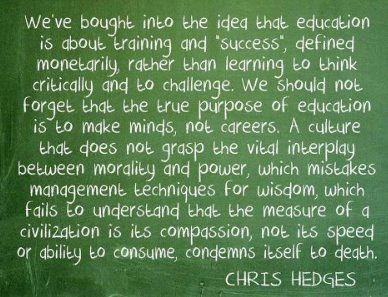
I received this from someone yesterday and thought I would share it. Public education is in need of a make over. What does that mean? That is a hard question to answer without a new conversation and a pause to fully understand what our children need. Here is a starter. Chris Hedges is a Pulitzer Prize winning author and a source of this quote is George Takei the actor who played Sulu in Star Trek. I am not a Trekkie, but I like this quote. The points that stand out are the purpose of education, the interplay between power and morality, and the need for wisdom. I follow several on-line forums about leadership. Even there, the leadership experts frequently confuse knowledge, information, and wisdom often using those words loosely and interchangeably. Wisdom emerges from values named and held within community–sensus communis or common sense. What passes from generation to generation is its common sense, what it holds and names as values in a society. This takes a compassionate conversation which is rare.

Take care and enjoy those you come in contact with today.