Monthly Archives: August 2020

Soul Dancing

Several years ago, Kathy and I went to the farm to visit. Late in the afternoon, we went for a walk and saw the doe in the picture below. You have to look carefully to find her. She moved away from us, but still seemed to want to stay close to where we first saw her. As we walked, the deer reappeared several times and, despite attempts at being quiet and still, the deer kept her distance. My best guess was she had a spring fawn in the bush and was trying to distract us, moving us away from being a threat to the young vulnerable offspring.

In The Hiddent Wholeness, Parker Palmer compares the soul to a shy and vulnerable animal. Each humans’s spiritual nature is personal and private. I think we begin by tentatively exploring its meaning with our self first and, as we become comfortable, with those we are closest to, testing and adjusting what it means to us. In a secular world, we often conflate religion with spiritual. As Parker points out, we have many words for soul e.g. spirit, essence, inner self, etc. and those words can carry non-religious connotations for each of us. To engage the soul and animate our being, it is essential to spend time in contemplative and meditative ways.

I sit quietly, with occasional great stillness, and my spirit, like the deer, emerges from cover and protection. In the midst of strangers, intruders, and busyness, we need those moments to let the soul speak to each of us and be protected, understanding its vulnerability.
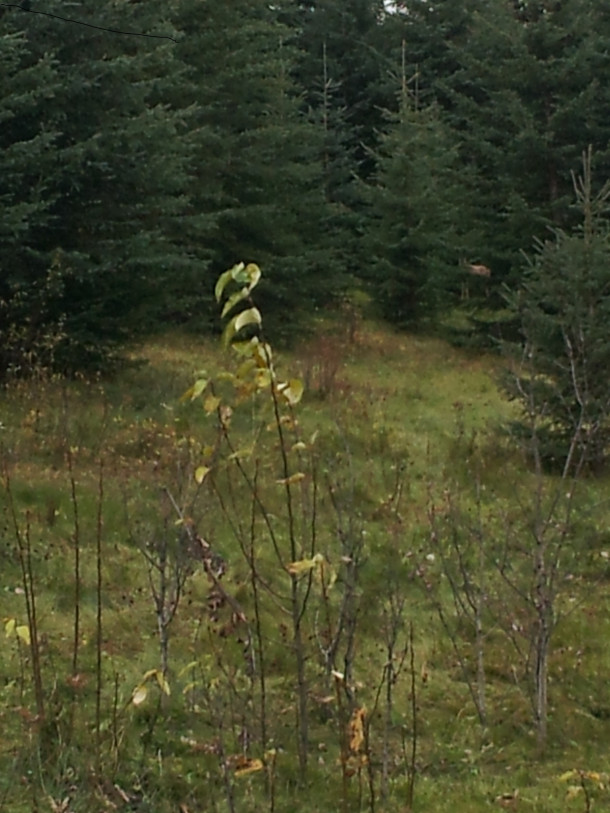
Look closely. The poplar and the spruce in the foreground frame her in the background.

Quietly,

In stillness–

Vigilant,

Keeping her distance–

Camouflaging,

Protecting the vulnerable–

Distracting intruders,

Returning to its child.

Sitting,

Patiently waiting–

Soul peeking out,

Tentatively emerging–

Awaiting safety,

Revealing in perfect stillness–

Infinitely,

Repeating the dance.
Life’s Calling

Originally, I called this life’s mission, but that seemed to neo-liberal and neo-conservative for my liking. I subscribe to life as a calling and vocation based on the writings of Thomas Merton and Parker Palmer. Vocation comes from the Latin meaning voice, so a calling and vocation gives each of us voice in living and has an essential spiritual aspect to it. What calls each of us animates and we respond in ethical and moral ways. I think we have lost much of this in our current world. Although John Dewey did not write from a spiritual context per se, he wrote about self-interest as words meaning the same thing. What interests me? Interest comes from the Latin esse, which also is the root of essence, which is related to spirit. What inspirits me?

I wrote the following poem after a professional development day. I found inconsistencies revealed in those days fascinating. They were uninspiring, exhausting, and counterproductive. They lack personal, responsible choice. Too often, adults are dependent on others to make their decisions, hence the concept of accountability overriding responsibility. It is hard to believe we think these adults can engage in educating children, youth, and adults in any meaninful ways. Our voices are repressed, suppressed, and oppressed.

At the end of that day, I wondered and reflected on the following questions: “Am I seeing this in a proper light? What can I do to further the process of learning as a role model for students and other adults?” Learning and teachng are relational processes between people and subject. Parker Palmer argues we put the subject of our learning in the middle of pedagogic conversations. In this way, we acknowledge each human present has a different perspective of the same subject.

For me, going to an event based on Parker Palmer’s work, a poetry workshop with David Whyte, an assessment workship, etc. were and are exciting. It animates. When I obtained my Master’s of Education and PhD, it was not to earn more money or move up some fictional career ladder. Education was and is essential. In the midst of a pandemic. I am exploring how we can return to the roots of educating for life, as opposed to schooling to produce a compliant and conforming workforce. I think the latter emerges from the former, rather than the other way around

Living fully,

Sharing fully,

(Ex)pressing one’s voice–

Singing one’s song.

Whetting wonder,

Planting seeds of awe,

Lighting fires–

(In)spiring to dance one’s dance.

Watering, feeding, nourishing,

Enriching, emboldening, becoming–

Embracing what brings life and joy–

(In)spiriting.

Civil Conversation Circles

In a world with a shortage of civil discourse, we have reduced talking to talking at people. There is a binary process where we say yes or no, turn on or off, incude or exclude people. This leads to thinking in limited ways about choices we face. In fact, I think we end up dependent on those we perceive to be in charge to make decisions on our behalf. This is happening in education as we try to figure out how to get students back in class. As I listen to politicians, educationalists, teachers, parents, etc., what impresses me is we have limited our choices to re-opening schools completly, often without adequate resources and human capacity. or some form of remote learning, as if these are the only two choices. Other choices e.g. home school seem to be excluded, understood as marginal.

Quite a few years, I introduced daily conversation circles. We used them to clarify from my perspective, Also, students shared what they wanted. At the beginning of the school year, each student introduced themselves. It seems small, but this often goes unattended in groups, regardless of where they exist. In my experience, each student, humans in general, want a voice in their learning and work; a voice often cancelled.

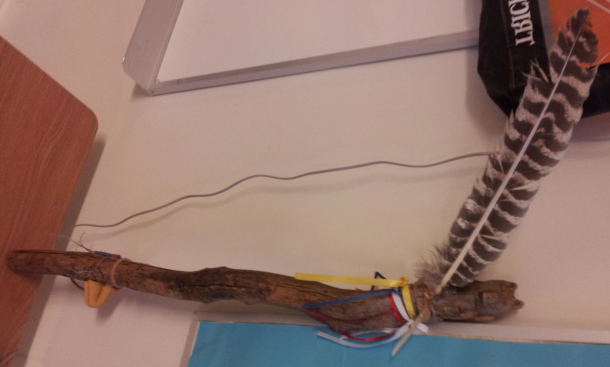
In our conversation circles, we used a ‘talking stick.’ The person with the ‘talking stick’ is the speaker and others listen. The ‘talking stick’ was a gift from a parent who was a member of a First Nation. It had some traditional meaning attached to its design. In an era of digital technologies, the talking stick reinforces a civilty of face-to-face conversation which we increasingly need in our world.

In our small school, parents played an integral role, including and not limited to meaningful teaching in the classroom, teaching complementary courses, teaching at home, etc. I shared about our small school in a post called Soul’s Choice, so won’t add more here. My experience and research suggests, after Kindergarten, parents and teachers are somehow on a different team. But, as one teacher proposed, “We share something; the love of a child.” In bringing children back together, we need to hear from two essential voices, often excluded from the conversation about teaching, parents and teachers.

The following is a poem that rattled around for a few days. It might be a bit rought around the edges, but I thought it needed to see the light of day.

Reducing to binary,

Simplifying choice–

0 or 1,

Silencing others.

Inserting ‘and’ in conversations,

Accepting ambiguity–

Listening with one’s heart,

(In)forming community.

Embracing each child,

Loving without conditions–

Parent and teacher raison d’être,

Centring our calling.

Educating,

Sharing purpose–

Making whole,

Caring and healing together.

The picture is the talking stick, which I still have. The following is a short description of the symbolism of the talking stick. The wood is driftwood which came from a local lake and reflects nature’s contributions to conversation circles. Someone carved a bear head into the top of the stick. In some traditions, the bear symbolizes courage, freedom, and power. The feather is from a hawk. Hawks are visionary and guide the person. The coloured ribbons represent the four directions in the circle. The parent attached a medicine bag. The medicine bag heals, guides and protects, and has materials or objects of value to its carrier.