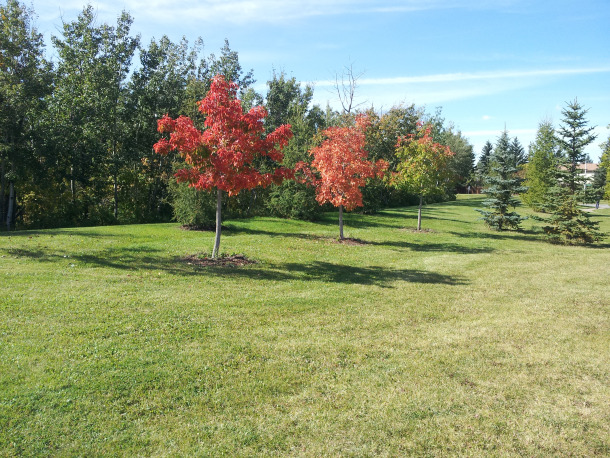
I wrote this poem and took this picture while attending a mindfulness retreat several years ago. The picture was taken in the early fall on a beautiful day as the sun warmed, the breeze cooled, and colours changed. When I sit in meditation or practice yoga, mindfulness reminds me I am one part of a much larger scheme. There is a lot acting on me that goes unnoticed and taken-for-granted. It is in mindfulness I remember to be humble and grateful for the small part I do play in the world.
On June 29, I posted a similar poem and theme. I am not sure what led me to post two that shared the same title. It is likely, early in the school year, it feels chaotic. Early in a school year, there are moments of repreive in this feeling and, as the year gains momentum, they become more common. As one co-participant in my dissertation put it: “I learn to stand in the middle of the storm.”
The other inflluence was I took several courses in my PhD about leading in complex and chaotic times. Servant-leadership, mindful leadership, and transformational leadership are forms of leadership particularly effective in times. We focus on questions about what needs to be changed, how do we engage each person in change, and how does each person become a leader in their own right? These forms share common features: grounded in the present, ethically guided, there is foresight without being set in certainty, etc. Mixed in this was courses on the Tao of Leadership, Systems Leadership, Leadership and Justice, Dialogic Leadership, etc. When I re-entered the classroom each September, what I learned in my PhD founds its way in with me. How could I better serve each student? How could we transform and share our experiences into something nourishing each other’s lives? How could I make a difference for each student? How could they grow and become better leaders than me?
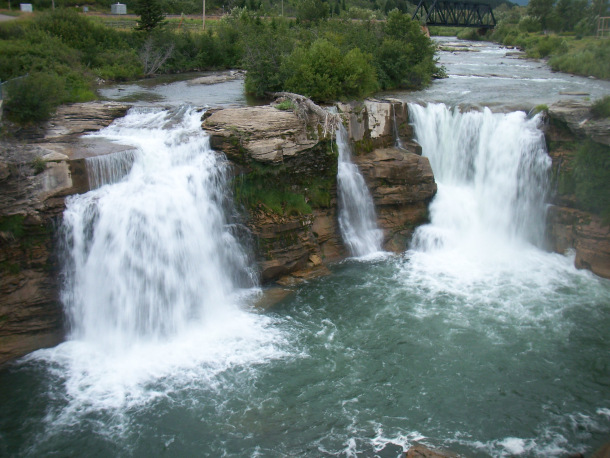
I took the pictures at Lundreck Falls as a reminder of how quickly nature can bring a sense of calm back even in the midst of what is initially chaotic. Within a short distance from the falls, the water pools and calms, at least on the surface. What goes on underneath the surface can remain chaotic and complex much like life, needing non-judgemental, humility, foresight, patience, and wisdom to navigate the unforseeable and unpredictable.
Needless to say, I wrote a poem about the challenges of remaining calm in the midst of the storm sometimes raging around me.
I wrote this on a day when I had a new parent as the parent-helper in the classroom. She did a wonderful job and told me how much her child enjoyed our little corner of paradise. It was a dreary day and her comments warmed my heart.
Not every parent walked into the classroom ready to jump right in to being active and in a teaching role. I always kept an eye and ear turned towards those tables and times when I knew concepts were more challenging. Parents accepted my jumping in and, quite often, I just sat and listened. Parents brought skills and perspectives I lacked. I had a doctor down on his hands and knees teaching the Grade 8’s where the spleen was on the life-size body systems they were drawing. Or, an artist parent who taught the students how to do a particular art form. One grandmother brought her rock collection in each year for the Grade 3 Science unit. The junior high students always found a way to go and check it; some because it was new to them and others because they recalled the joy of it in Grade 3. The educational assistant led in our Food Science class, along with parents and students.
We are each called to do something in our lives. It is our vocation and provides us with a voice to share with the world.
Day breaks,
Cool and wet–
Greying one’s life.
If allowed,
Dampens one’s spirit;
Letting the dullening prevail.
Yet, glow emerge,
Warmth radiates,
Shared within community.
A communal spirit,
Exploring, discovering
Edges of others’ worlds.
I took this picture of Frank Slide in Alberta’s southwest corner. The slide that took place lasted about 100 seconds and about 110 million tonnes of Turtle Mountain covered part of the community of Frank. When I took this picture, it was a dreary day and I was not having any luck getting what I considered great shots. When I wrote the poem, I remembered the picture and it fit.
Towards the end of my teaching, I found it challenging to stay positive. Administrators, who spent little time talking and listening to what we did, often imposed their arbitrary decisions oblivious to possible consequences. Having said this, and with time to reflect, I did little to bridge differences. I went back to my classroom, shut my door, and taught. In teaching, the extraordinary emerged.
I bracket extra to draw attention to the ordinary. Thich Nhat Hanh writes about how (extra)ordinary emerges, not as a miracle, out of the overlooked and ordinary we experience. I appreciate this more today than I did those last years of teaching. Barry Lopez says the opposite of love is not hate. It is indifference, an uncaring attitude towards other humans and objects in our presence. It begs questions: “What calls me? What am I mindful of in my life that needs my fullest attention? Who and what am I a steward of?” Today, this understanding (in)forms me when I encounter challenging moments. For example, struggling to find my way into a higher ed classroom I see this as an opportunity to write and read.
Sometimes. I tend to create negative narratives rather than let each moment live itself fully and be aware of as much as I can be of it. This is hard, but grows easier as I set aside dis-ease. Parker Palmer reminds me, when I do something that is not calling me and I am not responding to the call in a full throated way, I do violence to my life and that of others. He speaks about how we conflate lonliness with solitude. The former is problematic and the latter a paradoxical need alongside a need to live in community and share with others. It is in moments of solitude the (extra)ordinary can emerge from the ordinary
Unlike loneliness,
Alone is (in)different,
Solitude appreciates,
Providing solace.
Gift of silence;
Growing whole–
Energizing spirit–
Ordinary in (extra)ordinary;
(Re)memembering one’s life.
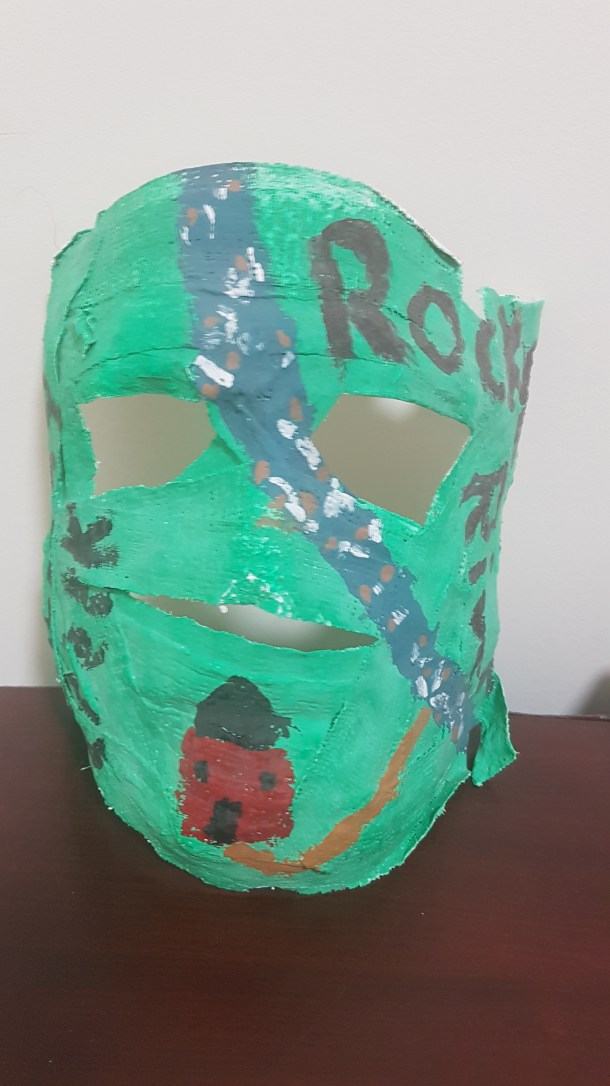
I taught Art the last year. I am no artist. We made, designed, and painted papier mache masks. For some students and me, this signaled the end of our time together. For others, they did not want to do the project, until I said I was going to participate. On our last day, a student said “It is not what you taught we will remember. It is how you taught us we will remember and the lessons of what it means to be a person.” To (re)member is to put things back together, sometimes in partial ways. Between the mask and those words, I put meaning back together about teaching and living life to the fullest.
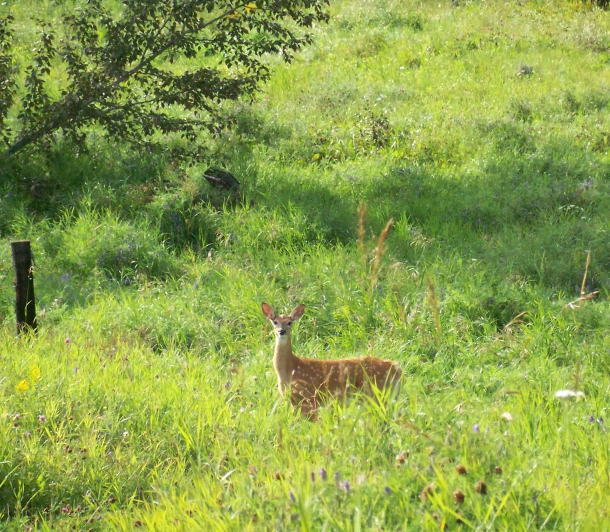
Several years ago, Kathy took this picture at the farm. She walked in from the road and the fields between the house and the road were overgrown. Regardless of whether a place is still physically inhabited or not, it is inhabited with memories, overflowing with meaning. In this sense, visitors abound.
We sat at the kitchen table, watching as various wildlife found safe haven in the midst of human dwelling. Both the wildlife and humans, shared and belonged to the space. As Kathy walked in that day, this beautiful doe looked up and posed to have her picture taken.
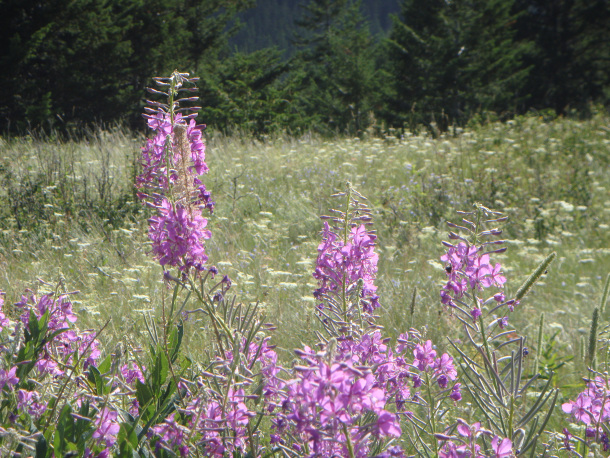
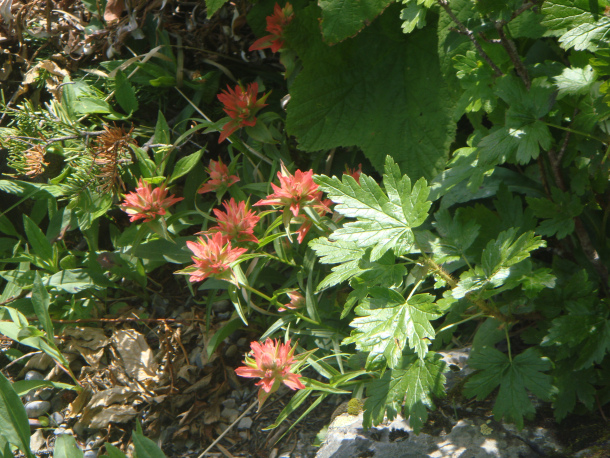
I wrote this poetry and took these pictures on a trip to British Columbia with Kathy via Jasper National Park and Mount Robson Provincial Park. It was for my mother’s 88th birthday and, at that point in her life, each birthday was an important event. She was the last of her generation in our family, on both sides.
I took pictures of two flowers common to temperate areas in North America: Fireweed and Paintbrush. Fireweed is hardy and is often found in areas which were disturbed by fire or oil spills generally spreading out in open areas left behind. It is part of the first step in ecological succession.
Appearing amidst destruction,
Flourishing,
Restoring,
Inviting to embrace.
Filling alpine meadows,
Colouring once damaged landscapes,
Lighting paths,
Giving hope.
The Indian Paintbrush or Prairie-Fire is widespread and was used by Indigenous peoples for food, hair conditioner, and to treat rheumatism. This is an example of the coastal variety.
Painting the world alive,
Gently,
Sensously.
Off Nature’s palette,
Dancing vibrantly,
Living colours.
During these times with the COVID-19 health crisis, which revealed the deep social, economic, and political fissures in our world and the social activism emerging after the murder of George Floyd, Canada has to take time to look at its own history and treatment of marginalized peoples. This begins, but does not end, with how we treated and continue to treat First Nations’ people. This is a song by a local singer-songwriter, Connie Kaldor, who sings poignantly about the murdered and missing indigenous women across Canada. The report, completed in June 2019, had over 90 recommendations, which have not been acted on. In Canada, protests against systemic racism highlight this lack of action.
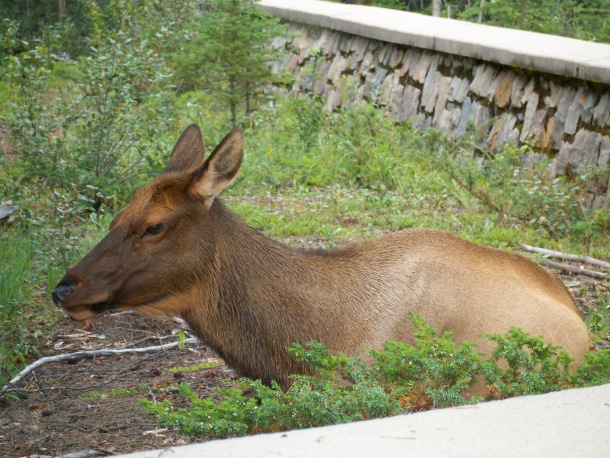
It was a perfect day. We wandered in Jasper National Park, enjoyed scenery, surprises and I was with my favourite person. We found the best at the end of the day. I posted a picture of a bull elk on Yellowstone 2005 . I took that picture from 15-20 metres. Kathy took this picture of a cow elk chewing her cud. She seemed aware of our presence. We were quiet and, as others joined us in a secluded area, she posed. The wall was about 1 metre thick wall and a similar height.
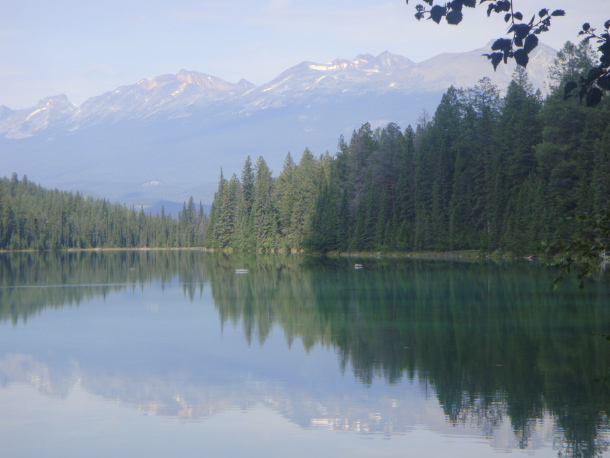
Earlier in the day, we hiked for a couple of hours in the Valley of Five Lakes, exploring some of the small lakes in the valley. We were able to get close to three of the lakes and took pictures. The other two did not have paths into them and were quite deep in the bush. Here are the three lakes we got close to. Each has its own personality, so to speak.
At one of the lakes, I forget which one we came across another visitor who posed for a picture.
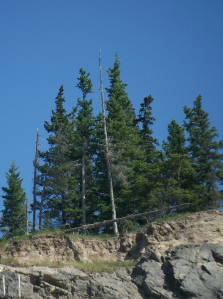
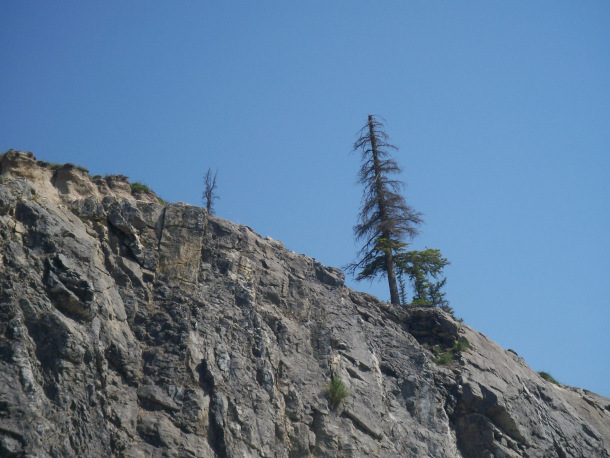
This tree stood all by itself on the crest surrounded by the pretty ones. What attracted me was it stood out from the crowd and thrived. I alluded to this in On the Edge. They were in the same area as we drove up to the Columbia Ice Fields in Jasper National Park. These trees do not just survive. They thrive in demanding conditions, sometimes for 100’s of years. There is little soil, water, and nourishment on the embankments, so they appear stunted. It thrives on the margins of its ecosystem. Perhaps, we find beauty in places we do not anticipate. We have to be ready for this or it will slip by.
In today’s environment, with calls for greater equity and social justice, it is not enough to ask people to survive with less than living wages, inadequate housing, little or no healthcare, etc. as if that is a major accomplishment. We must allow them to thrive as humans.
I took one class in special education in my B Ed. and another in my M Ed. I learned we have more in common than makes us different. Paulo Freire wrote of unity in diversity; John Dewey about communicating what we have in common to form community, and Parker Palmer about the paradox of living in community and with solitude. If we are more alike than different, we have a lot to communicate. It takes listening deeply, reflecting critically on one’s views (biases) of the world, and ethically transforming (moving beyond) the world, particularly that which is immediate to each of us. It is not enough to reform, but it may be a start to the process. It is becoming more and better, individually and collectively, in ways we cannot anticipate and can not be fully finished. There will always be good work to do, not matter how far we come.
On the margins;
Thriving–
Separate from the crowd.
Elements taking a toll;
World weighing heavy;
Thin, mottled.
Standing proud;
Reaching high–
Believing in something better.
Valuing who you are;
Individual, non-conformist–
Separate from the crowd.
Lonely, not alone;
Spacious, gracious solitude–
Revealing your own beauty.
Today, as I cruised Facebook, I found Parker Palmer posted Mary Oliver‘s poem The Summer Day. I love the closing lines: “Tell me, what is it you plan to do with your one wild and precious life?” It is a wild and precious life.
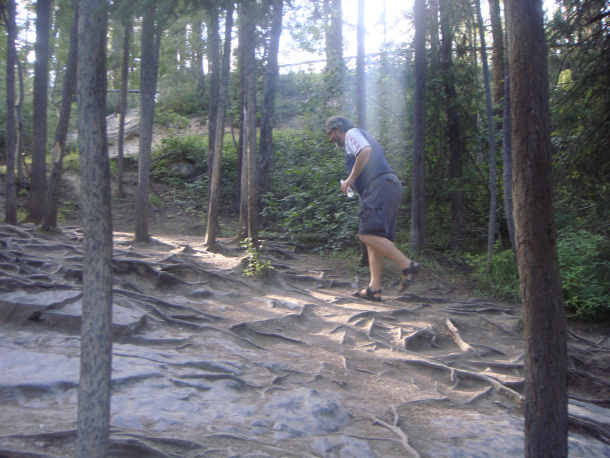
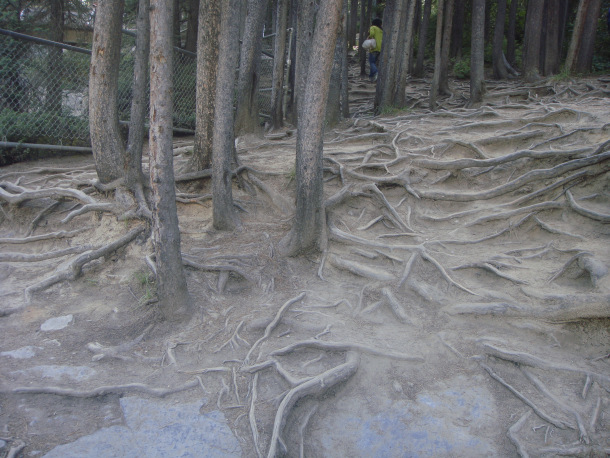
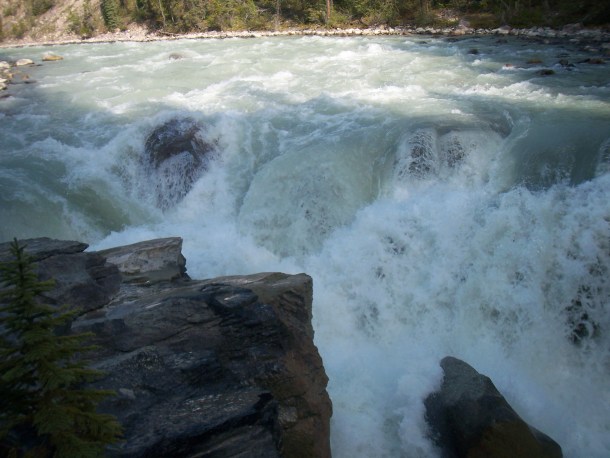
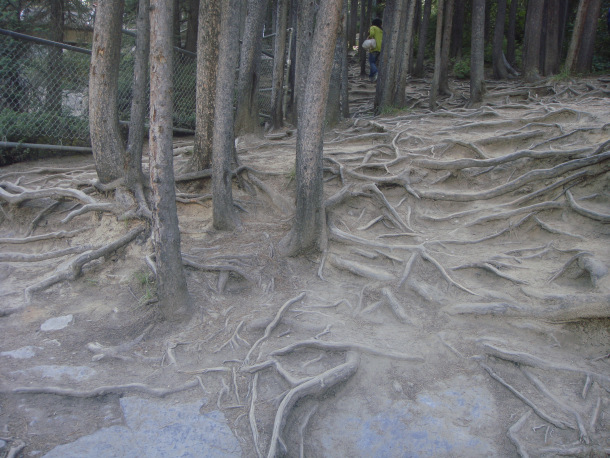
Kathy took these pictures at Sunwapta Falls in Jasper National Park. The Sunwapta River flows from Athabasca Glacier and the falls plunge over a hanging valley left by receding glaciers about 8000 years ago. The path down to the overview above the falls is unique with the tree roots playing an integral role in the stairway. The “staircase” is a product of human and nature wearing the surface. With the help of the stairway, I got closer to the edge than I usually do.
I wrote the following poem to accompany the pictures of the and borrowed the title from a more famous group, Led Zeppelin. I took time to read about the meaning behind the lyrics. It appears to be a statement about money not buying one’s way into heaven, whatever one might think that is.
Gnarled and gnarly,
Wending its way upwards,
Nature’s stairway
Revealing beauty.
Gaining confidence,
Moving safely,
Finding my way,
Fuller, richer.
Nature awaiting,
Golden rays find space–
Guiding steps,
Shining on each step,
On a ‘highway to heaven.’
For those who want to compare my poetry to that of Jimmy Page and Robert Plant, here is a version of the video.
When I wrote this poem, it was at a time I was unhappy going back into the classroom and teaching. I loved the students and looked forward to being with them. So much had changed in the little school I taught in with change imposed upon us, rather than negotiated with us. In my writing, I am beginning to look at what is essential to the spirit for each of us to flourish. What gives each of us hope? it will be different. What is certain is we each want to have a voice in what we are doing.
When I wrote the poem, I wrote from a negative place. Now, as I look at the image, the tree on the dge of the cliff fourished in its environment, which is rock with little soil. The tree is actually quite old. Our tour guide said about 300 years old. Despite its lack of size, it flourishes and that is what I failed to see in the last two years I taught. It begs the question: “what might I have done differently.” I was not very patient at times. Cornel West tells young people looking for change to be patient. Real, transformative, democratic, and sustainable change takes time and patience.
In being with each student and present to them, I found something other than gave me the impetus to teach for two more years and find ways to cope with the imposed change. One of the challenges I faced was what we did was so different than what other classrooms looked and felt like it was difficult to convince other educators what we did had merit. Teachers teach one grade at a time in isolation with children separated from families, like a workplace. We had a parent in the classroom each day to assist, many of the families knew each other, and I had a multi-grade classroom with 3 or 4 grades together. Children and youth attend school each day and homework is something we assign, because often there is not time to complete everything at school. Students attended our school 40-50% of the time on a set schedule, depending on grade level. I negotiated with parents the extra things to be done at home. Often, they were large culminating projects at the end of a unit. I taught and students learned what was necessary in class and had little homework. I did not teach all subjects in school. Parents taught Math, Health, and some Phys Ed at home. I went on home visits to support their teaching and make sure we were on track. I had no desks in my classroom. We sat at tables usually based on grade level, but, during complementary courses e.g. Art, Food Sciences, Programming, etc., students sat in mixed grade groups.
In short, we were on the margins, the edge of what was perceived as “normal’ school. Today, in the midst of a pandemic that sent children home to learn online, the relationships and support we had in our small community would have helped many families and teachers cope with the sudden and unpredictable change.
With each step,
Closer–
Be bold.
Balance precariously,
Hover over abyss
Be brave.
Instability and stability dancing–
To soundless music;
Be graceful.
Quieting one’s self;
Listening to soul’s–
Be poetic.
Between lines and stanzas–
Wisdom emerges–
Be patient.
On the edge,
Sisters and brothers–
What calls you with passion?
I try to walk in the neighbourhood each day. When I do, I listen to music. Yesterday, I heard a song by Bela Fleck and Abigail Washburn, which fit with this poem and how I felt when I wrote it. In talking to one’s younger self, they use words like bold, love, bold, and fear. I use passion, which suggests suffering as a necessary piece to flourishing.






 ivonprefontaine
 Teacher as Transformer