Category Archives: Community

Ode to Teachers

I wanted to blog and post pictures of some great cloud formations around Edmonton last night, but I received an email and there was an idea I could not resist. We each had teachers, and I use the word in its broadest definition, who made an impact on our lives. Ruth is someone I taught with for 12 years.  I use the word taught guardedly and refuse to use the work word to describe our relationship. We learned together. Learning is different and is relational. In her email, she described a visit with a parent of a former student and shared this phrase, ‘child whisperer.’

Each of us, had or have people in our lives in many forms who fit the phrase. They remind us of what the root word of educate is–educare. Even the Latin word speaks of care, which I think is vital to the relational nature of learning.

I can think of many who filled the role. Sister Phillips was my first grade teacher. She was a member of the Catholic order the Sisters of Service and it was special in her class. Later, in high school, I had Ms. Lyford, a short, stocky Australian woman who loved Shakespeare. She once said, “Ivon, if you only tried you would be an A student.” She did it loving and in a caring way, I think. I was good with a B and explained that to her.

Outside school it was my grandmother and mother. I still learn from them although the former is long past away and my mother lives 8 hours away. I learned from my father-in-law and mother-in-law and, needless to say, I learn from the daughter I married. I learn from our boys and my students in many ways. This list is incomplete, but the point is : Great teachers are great not because they tell you do something, but because they lead you to want to do it and ignite your imagination and spirit for learning in a magical way .”

Blend compassion and passion

Bring out the best in each child

Walk with them

Open your heart

Greet them

With your story

Receive their stories gently

Reveal vulnerability

Be a guide they need

In each moment

Learn, share, create

Listen and hear

And speak in a voice

Only a child whisperer can.

Take a moment, tell us about a teacher or teachers who made a difference for you, who whispered at the right moment and spoke the right words lighting a fire in your spirit.


Larry Cuban is a leading writer and researcher in school reform or I think a better way to phrase it is a lack of true reform. He points out several key points in this excellent article. His first paragraph about teachers working together daily is not prophetic as you will see in the article. It has been part of the educational reform lexicon for a several years, perhaps decades is a better word. Why do the ‘reforms’ with all their pat answers and revolving, recycled fads secret this away in the closet? I think they are afraid.


First, top down measures are not the order of the day. Second, schooling and learning (my added word) at all ages are complex systems and forged out of relationship not transactional activities. This nature does not invite top-down. It encourages community and collaboration. The leading thinkers he refers to part way through the article are a short but impressive list. I would add others who contribute in many ways i.e. Deb Meier, James Comer, and Nel Noddings come to mind. Finally, real communities actually are dysfunctional. It is what we do in those moments that leads us to collaboration. Joining hands around the camp fire is nice, but only superficially functional. Agree to disagree is sometimes the path.


I read another blog today and my conclusion is slow is sometimes the way forward.


We in Canada who think we are doing something better are wrong. We all need the same wake up calls, a new conversation, and a reimagining of schooling and learning. Note I did not say school. That is the brick and mortar that in some cases is passé.

larrycuban's avatarLarry Cuban on School Reform and Classroom Practice

Want to give a “no excuses” reformer a stroke? Suggest that teachers working together on a daily basis have a better shot at improving teaching and learning than the highly marketed structural changes of standards-based testing and accountability, Common Core standards, more charter schools, and evaluating educator performance through student scores.

Too many reform-driven policymakers high on the rhetoric of these current reforms ignore how much improvement in teaching and learning can occur when  teachers work collectively in their classrooms and schools to improve their content knowledge and teaching skills aimed at common district goals.

For many years, teachers, administrators, researchers, and a sprinkling of policymakers have concentrated on both traditional and innovative professional development and learning communities to build teachers’ capacities in knowledge of subject and teaching skills to improve instruction in schools and districts. Such school-based efforts converge on the teacher simply because within the complex system of…

View original post 1,209 more words

The 4th of July – An Outsider’s Perspective

Kathy and I spend part of our summers in Spokane and other places south of the US-Canada border. The first time we experienced the Fourth of July, the celebration, camaraderie, and heart-felt patriotism readily evident amazed me.Whatever differences Americans have with each other, are set aside for this day and more. The 4th begins several days before and lasts several days after the 4th. I use the code. One doesn’t say the phrase; saying the 4th is enough. Have a Good 4th means something more than just have a good day.

One summer, in Portland, celebrations continued for several days after the 4th with fireworks displays in the river valley. Another year, we met a family in Yellowstone who had just left Mount Rushmore where about 250, 000 people gathered for the 4th. In Canada, that requires every member of some provinces or territory gather and, sometimes, more invitations need to be sent out to reach that number.

I glanced through Parker Palmer’s latest book, Healing the Heart of Democracy, and found a passage from Leonard Cohen’s song, Democracy. I have listened to this song many times, but re-seeing the words made rethink their meaning, with a beginner’s mind. I often wondered if Cohen portrayed American democracy in a negative light, but seeing the words again I saw something different. It is a hopeful message acknowledging the messiness and awkwardness of democracy at work and that America is a place where the democratic experiment is still happening. America is a place where family exists in the broadest sense and the heart is full and open to democracy.

Imagine if you could make the 4th an every day event, engage everyone, and export the message of hopefulness, patriotism, and democracy well and fully lived, based on the model of the 4th? What a world we would live in!

It’s coming to America first,

the cradle of the best and the worst.

It’s here they got the range

and the machinery for change

and it’s here they got the spiritual thirst.

It’s here the family’s broken

and it’s here the lonely say

that the heart has got to open

in a fundamental way:

Democracy is coming to the U.S.A

This is a picture of some early fireworks we took on the 3rd, 2012.

Have a great 4th

Love After Love by Derek Walcott

Here are a couple of poems. The first is by Derek Walcott and speaks to the relational nature of being with our self. The second is a haiku I wrote yesterday about the need to live in relationship starting with one’s self and extending out to beloved others.
The time will come
when, with elation
you will greet yourself arriving
at your own door, in your own mirror
and each will smile at the other’s welcome,

and say, sit here. Eat.
You will love again the stranger who was your self.
Give wine. Give bread. Give back your heart
to itself, to the stranger who has loved you

all your life, whom you ignored
for another, who knows you by heart.
Take down the love letters from the bookshelf,

the photographs, the desperate notes,
peel your own image from the mirror.
Sit. Feast on your life.

Sitting in circles
Revealing our inner most thoughts
A covenant grows

Naming Values

I posted several times about the need to name values. I think this is important at the personal and collective levels. The word value shares the same root as the French word valoir which connects to such words as valour and valiant. Values give us strength and courage so we can act in a meaningful, purposeful, and courageous manner.Values anchor us our lives. We are not simply adrift on the sea losing sight of the horizon.

I think naming values, as nouns, brings them to life differently than saying something like, “I value” which monetizes the value as if it were currency. Naming a value allows me to hold the value. Although I do not think values are fluid in the sense they change definitions, certain values are important at times and others at other times in life. In this regard, it is important to not only name the values, but to return to them from time to time and tend to them like a gardener would to their flower bed.

Some values I will name and explain connect to others either in creating a balance or without the other they would not be fully understood.

Compassion – Buddhists refer to this as loving/kindness and it begins with one’s self. Compassion and its close cousin patience allows me to make mistakes or to be distracted and gently return my self to the moment. It balances the passion I have for certain things in my life. Without compassion the flame burns hot and is quickly extinguished.

Respect is the honouring of one’s truths and respecting the truth of others. Truth comes from the word troth and happens in relationship. Mindful listening and speaking are essential to respect. It is more than nodding one’s head and turning away.

Community is living with another, sharing what is common and important – the named values – and lifting each other up in difficult times. Mindful listening and speaking play a critical role. The functional community, one with purpose, is able to recognize its moments of dysfunction and communicate effectively. Within community, there is an honouring and respecting of the diversity and autonomy of each other.

Responsibility allows one to respond mindfully. I am responsible for my words and actions. Living in community calls on its members to be responsible or the community cannot survive. I think autonomy and responsibility are companions. Autonomy is the freedom to choose, but not at the expense of others. I set aside self-interest as I mindfully attend to the truths of others.

Wisdom is that which is shared and passed on from generation to generation. It allows the community to act prudently while expanding. Wisdom in this way is a common sense held by the community and learned by each ensuing generation. Carefully and attentively, we choose those things which apply and add as necessary.

Open-mindedness is in part the honouring of truths. Curiosity and the concept of beginner’s mind play a critical role. I step away from my expert’s role with predetermined solutions and replace it with the beginner’s mind of mindful listening, mindful speaking, and right action. The possibilities are generously fueled by curiosity with a sometimes playful face.

Justice is the fairness and equity we find in the most functional of communities. Things are not always equal, but understanding the multiple truths within a community, respecting those truths, and working with a beginner’s mind allows justice to emerge. This is not relativism gone wild, but born out of wisdom, being responsible for words and actions, and being compassionate brings justice to the forefront.

This list is not exhaustive. For the moment, these are the values I choose and name as the most important.

Human Being Instead of Human Doing

Many days I wonder about what other are doing, what causes them to do it, and what I can do to control their behaviours. I used the word do a lot in that first sentence. When I wonder that way, I become angry, frustrated, and hurt. I become a human doing instead of a human being. Being present and living each moment mindfully is part of this being.

Some words and an image to help us be today. Happy summer solstice.

The art of life isn’t controlling what happens, which is impossible; it’s using what happens.

~Gloria Steinem

pedagogy of the oppressed by Paulo Freire

I read pedagogy of the oppressed by Paulo Freire during my undergraduate experience and return to it as a source of reflection and when I write. Similar to Parker Palmer, Paulo Freire left an indelible mark on my life’s practice. Education is an uplifting, liberating experience which shines light on each step Antonio Machado described: “Wanderer, your footsteps are the road, and nothing more; wanderer, there is no road, the road is made by walking.” Freire’ s contention was everyone can act as an agent in their learning thus freeing them and transforming the world they live in.

Freire used the Portuguese word conscientização which “refers to learning to perceive social, political, and economic contradictions and to take action against the oppressive elements of reality” (17).   Humans become mindful of and present in the world and act to transform it. Freire used a banking metaphor and described traditional education where  knowledge is deposited into students. Teachers and the system act oppressively in determining what is important to learn. Freire felt education uplifted people and their learning. “Liberation is a praxis: the action and reflection of men and women upon their world in order to transform it” (p. 60).  Learning occurs when  compliance and conformity are rejected in favour of dialogue based on love which allows each human to name their world and what is of value in it. The student is a teacher and student; the teacher both student and teacher.

Questions: What can we do to truly bring a new pedagogical structure into our schools and communities of learning? What function would school play in this pedagogical structure? What is dialogue based on love?  What role do educators and communities play in liberation education?

Recommendation: I love the book. It is a challenging, but I return to it often and find something new each time. Today, I became aware of the following: “Concepts such as unity, organization, and struggle are immediately labeled as dangerous. … These concepts are dangerous—to the oppressors” (p. 122). What does this mean in supposedly modern, liberated, and affluent societies?

A second point was the similar language used by Freire and Martin Buber. There is a shared understanding of respectful dialogue using the words I and Thou to describe the uplifting, liberating, loving dialogic process.

Freire, P. (1993). pedagogy of the oppressed. (M. B. Ramos, Trans.).  New York: Continuum.

ivonprefontaine's avatar

Father Day’s

I subscribe to a daily meditation written by Father Richard Rohr. a Franciscan priest.I talk and write about the concept of common sense, which I understand as local and global. Father Rohr cast it from a theological perspective, I think the explanation provides an insight gained without reading Gadamer’s Truth and Method. I believe there is a universal truth or common sense (Vico called this sensus communis), something that makes us all brothers and sisters bringing us together in community. I think Father Rohr offers an explanation though his meditation on Father’s Day helping us to live in community each day. Certainly, Rilke does.

“It is this sense that founds community” (Gadamer, 1989, p. 19).

Gadamer, H-G. (1989). Truth and method. (J. Weinsheimer & D. G. Marshall, Trans.).  New York: Continuum.

Catch only what you’ve thrown yourself, all is

mere skill and little gain;

but when you’re suddenly the catcher of a ball

thrown by an eternal partner

with accurate and measured swing

towards you, to your center, in an arch

from the great bridgebuilding of God;

why catching then becomes a power–

not yours, a world’s.

–Rainier Maria Rilke

Friday Morning’s Thought

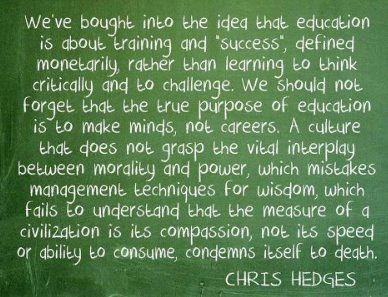
I received this from someone yesterday and thought I would share it. Public education is in need of a make over. What does that mean? That is a hard question to answer without a new conversation and a pause to fully understand what our children need. Here is a starter. Chris Hedges is a Pulitzer Prize winning author and a source of this quote is George Takei the actor who played Sulu in Star Trek. I am not a Trekkie, but I like this quote. The points that stand out are the purpose of education, the interplay between power and morality, and the need for wisdom. I follow several on-line forums about leadership. Even there, the leadership experts frequently confuse knowledge, information, and wisdom often using those words loosely and interchangeably. Wisdom emerges from values named and held within community–sensus communis or common sense. What passes from generation to generation is its common sense, what it holds and names as values in a society. This takes a compassionate conversation which is rare.

Take care and enjoy those you come in contact with today.

Fragmentation

Fragmentation.

This is an interesting, albeit American-based view of the charter system and the overall fragmentation issue of public education. I am not an advocate of reform. That tends to tinker at the edges. I advocate transformation. This requires new conversations at the grassroots. What does public education mean to you, your family, and the community you live in?