Category Archives: Leadership

We dance for…

Photo post by @jamesscarberry.

Source: We dance for…

Albert Einstein is one of my favorite sources for quotes. What do we dance for today? Dancing is a creative movement that signals powerful human emotions are at play in a particular event.

Natalie shared a quote that reminds us humans dance in sad moments, as well. On a day, when a few attacked, killed, and injured their fellow humans, our dance should dance away the fears and tears and create dreams filled with hope. It is important to remember hateful words and actions against others is wrong.

Dancing is an integral part of human life. Even Friedrich Nietzsche,who was not considered a happy person and religious person, reminded us that “we should consider every day lost on which we have not danced at least once.” In fact, he argued he “would only believe in a god who could dance.”

I believe that a God we all believe in is one who joins the human community in dance in moments such as today. Thich Nhat Hanh suggested “the pain of one part of humankind is the pain of the whole of humankind.”


lunes – Good morning everyone!!!

Are you ready for the start of another week?    My wonderful friend Mollie ( co-minister at the Baptist church in a community near here), has been  happily posting in a shared file we have .. IR…

Source: lunes – Good morning everyone!!!

This is a great link. I love the unique take on See No Evil, Hear No Evil, and Speak No Evil. When we speak words of kindness and act in kind ways towards others, we accomplish so much more. It takes time, but it is worth the wait.

As a teacher, I love to hear from students. They surprise me sometimes, as I do not remember them. However, they take the time to come over in an airport, a crowded grocery store, and a parking lot in a distant town. It reminds me that it takes time for those words and actions to resonate across time.

When we speak and act kindly, those words and acts resonate beyond the immediate moment and place we co-inhabit. It is a reminder of the impression we leave on the world when we take care.

The Invitation

I am not familiar with Oriah Mountain Dreamer’s poetry, but, when I found this poem, it reached out and called me.

What questions do I ask myself, that I cannot answer. There is an eloquence in those questions that leads me to new questions, without knowing the answers. When I sense the world in one way or another, I am unable to sense it in any other way.

What if I live the wildness of life and I allow myself some abandon, not carelessness? I can dance with that wildness and not care about what others may think, hopefully making the world a better place.

When we open our hearts to the other, their standing in life is about who they are as a person rather than what identifies them: their job, their age, where they live, etc. When we open our hears to the other, it is an invitation to be human and humane with them.

It doesn’t interest me what you do for a living.

I want to know what you ache for and if you dare to dream of meeting your heart’s longing.

It doesn’t interest me how old you are.

I want to know if you will risk looking like a fool for love, for your dream, for the adventure of being alive.

It doesn’t interest me what planets are squaring your moon.

I want to know if you have touched the centre of your own sorrow, if you have been opened by life’s betrayals or have become shriveled and closed from fear of further pain.

I want to know if you can sit with pain, mine or your own, without moving to hide it, or fade it, or fix it.

I want to know if you can be with joy, mine or your own; if you can dance with wildness and let the ecstasy fill you to the tips of your fingers and toes without cautioning us to be careful, be realistic, remember the limitations of being human.

It doesn’t interest me if the story you are telling me is true.

I want to know if you can disappoint another to be true to yourself. If you can bear the accusation of betrayal and not betray your own soul.

I want to know if you can see beauty even when it is not pretty every day.

And if you can source your own life from its presence.

I want to know if you can live with failure, yours and mine, and still stand at the edge of the lake and shout to the silver of the full moon,

“Yes!”

It doesn’t interest me to know where you live or how much money you have.

I want to know if you can get up after the night of grief and despair, weary and bruised to the bone and do what needs to be done to feed the children.

It doesn’t interest me who you know or how you came to be here.

I want to know if you will stand in the centre of the fire with me and not shrink back.

It doesn’t interest me where or what or with whom you have studied.

I want to know what sustains you from the inside when all else falls away.

I want to know if you can be alone with yourself and if you truly like the company you keep in the empty moments.


Patience: Darkness and light, conscious and unconscious

Night after night, darkness enters the face of the lily which, lightly, closes its five walls around itself, and its purse of honey, and its fragrance, and is content to stand there in the garden, …

Source: Patience: Darkness and light, conscious and unconscious

The link includes a lovely picture of lily accompanied by a Mary Oliver poem, The Lily. The poem reminds me of the passage from Luke describing the lilies and wild flower, just being and growing.

Nature is what it is. There is a mindfulness in its creation and how it dresses. The lilies wait in their splendor for us to notice them and realize how they are always present. Nature and lilies teach us. To paraphrase Confucius, they open the door and we enter when we are ready.

The Open Door

Danna Faulds wrote this lovely poem in the form of prose and tells a story with poetic language. When the door opens, something calls and we intuitively follow that call as we be/become. Something pulls us and allows us to be alive when we are fully aware, without “adverbs, descriptors, or qualities”. We hear the call in moments when we are present to the universe’s vastness and the spirit that calls us, animates us, and provides us with voice.

What calls to each of us is unique, but somehow shared through our humanity, our humanness, and humaneness. Rooted in antiquity, the call speaks to us in the present tense and we are unable to make full sense of it. Due to its vastness, there is always mystery in that which calls each of us.

“A door opens. Maybe I’ve been standing here shuffling my weight from foot to foot for decades, or maybe I only knocked once. In truth, it doesn’t matter. A door opens and I walk through without a backward glance. This is it, then, one moment of truth in a lifetime of truth; a choice made, a path taken, the gravitational pull of Spirit too compelling to ignore any longer. I am received by something far too vast to see. It has roots in antiquity but speaks clearly in the present tense. “Be,” the vastness says. “Be without adverbs, descriptors, or qualities. Be so alive that awareness bares itself uncloaked and unadorned. Then go forth to give what you alone can give, awake to love and suffering, unburdened by the weight of expectations. Go forth to see and be seen, blossoming, always blossoming into your magnificence.”

PS I could not find a link for Danna Faulds, but her poetry is too lovely not to share.

Capturing Life’s Precious Moments

Yesterday at work I was given the privilege to escort an elderly gentleman from one of our treatment rooms to the waiting room where his sweet wife was waiting patiently for him.  The couple’…

Source: Capturing Life’s Precious Moments

Whatever our job, it should inspire us in extraordinary ways. Tina‘s post makes that point so well.

Thich Nhat Hanh reminds us that we find the extraordinary in the ordinary. When we pause, enjoy the moment, and our mindful, we share what is important to us with others. We make the world a better place.

When I taught, I loved being in the classroom with students and sharing with them in many ways. What I found important was that, when I enjoyed what I was doing, they enjoyed it, as well. One student told his mother that he could not understand why he enjoyed Social Studies that year as he had not before. She answered, “When the teacher is enthusiastic and lets you sense that, that is what happens.”


Oceans

Juan Ramon Jimenez posed questions in this short and provocative poem. Sometimes when we are up against something that seems immovable, perhaps it is in that moment we turn to mindfulness and questions that guide us.

When we ask eloquent questions, we find ourselves guided by questions rather than fixed answers and destinations.

What does it mean to be in this moment when we do not seem to be moving? It might be that we are moving and it is our lack of awareness that makes us feel we are not. Quite often, we have predetermined outcomes and, as long as we are moving or think we are moving in that direction, we think something happens.

Stopping and meditating in a moment helps us realize that we are moving, just not in the directions we planned in moving. In those moments, we ask, “What does this mean?” and wait silently for answers to show themselves.

I have a feeling that my boat
has struck, down there in the depths,
against a great thing.
And nothing
happens! Nothing… Silence… Waves…

—Nothing happens? Or has everything happened,
and are we standing now, quietly, in the new life?

Roofless School

a dictionary of true mirages bird songs instead of geometry plus a clock with no hands many very magic felt pens words like primrose or rainbow painted on a huge whiteboard come into the roofless S…

Source: Roofless School

John Dewey suggested education is not preparation for life, but life itself. The poem, Roofless School, extends that metaphor to poetry.

Poets sit under the sky and experience the world in the most complete ways, but their poetry is subject to diverse interpretations. When I go back and read a poem, I find new meanings.

Each time we experience the world, we experience something new. Regardless of how familiar it seems to be, an experience can only be experienced once, in the moment I experience it. We re-experience the experience retrospectively and find new meanings in a new, reflective experience.

When I taught, I tried to begin each day fresh. It was not erasing the past, but I realized how the past informed my relationships with students, curriculum, and digital technology in the present moment. In those moments, being mindful and sensitive was paramount.

Walker

Antonio Machado reminds us that the path we follow is both made anew when we walk it and that once we step we can no longer go back.

We can look back and see where we came from, but that is a distorted image and, the further we move away from that point in time, the more distorted the memories we recall. We can reflect upon those moments and steps in a caring way that takes place only after the step.

It is in mindful walking that we make the path. There is an awareness and senstivity that only happens in the very moment we exist in, the present. Our presence is important in that moment as we step and live at that point on our path of life.

The mindfulness of our steps is important when we realize we lead others in their steps. They cannot walk the identitical path to our path, but the way we compose ourselves is a model for how they might live.

Walker, your footsteps

are the road, and nothing more.

Walker, there is no road,

the road is made by walking.

Walking you make the road,

and turning to look behind

you see the path you never

again will step upon.

Walker, there is no road,

only foam trails on the sea.

nature is never finished. – robert smithson

out walking with the kinders we happened upon a white swan happy and in between seasons. the same as us.

Source: nature is never finished. – robert smithson

When I saw the title of Beth‘s post and read her poem, I thought what a profound moment. Nature has many stories to tell us and many ways of telling them that leave a mystery in each story. We are always between the moments and seasons that desribe the beauty of nature and who we are becoming.

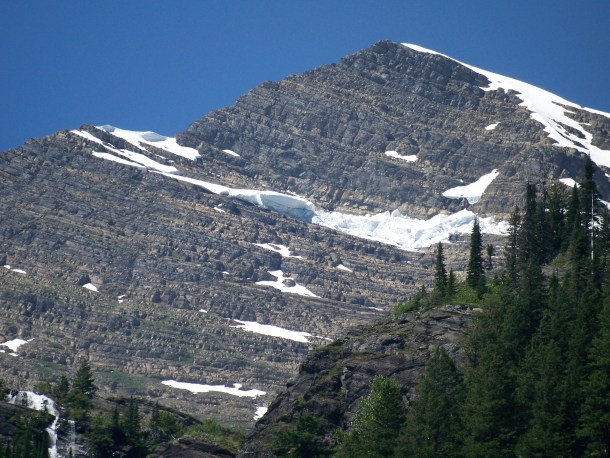
Several years ago, I took a picture of a mountain face. I did not have any idea why I took. It just spoke to me, like the swan in Beth’s poem. I used the picture in a presentation about eco-ethics, after I read an article about geologists who use the striations of a mountain to allow it to tell them its story, knowing it can never be completely told.

When I look at that picture, the mountain tells an even less complete story. The mystery in the story is what draws me back to the picture and maybe is what drew me, without knowing that, when I took the picture.

Mountain's Layers