Category Archives: Poetry

Sand Castles

Children live in each moment. Their inexperience allows them to be in a world that seems novel. They build sand castles in those moments. As adults we think we lose that ability to build our sand castles.

Being mindful and present to the world and others is a way of building sand castles, perhaps in some metaphoric way. How can I think about this person and that thing differently? How do I bring less suffering and pain to the world in understanding “differences make a difference?” Unlike children, adults often understand differences as threats.

It reminds me of Tolstoy‘s quote: “if you want to be happy, be.”

A child, playing in sand,

Building sand castles,

Absorbed in that moment.

The world is immediate,

Demanding one be present,

To embedded in this very moment.

As a child,

We know nothing different,

Our castles are real and momentous.

To outgrow our castles,

That is a tragedy,

To lose being mind(ful).

Let me return to that world,

To build castles in the sand,

As only a child can.
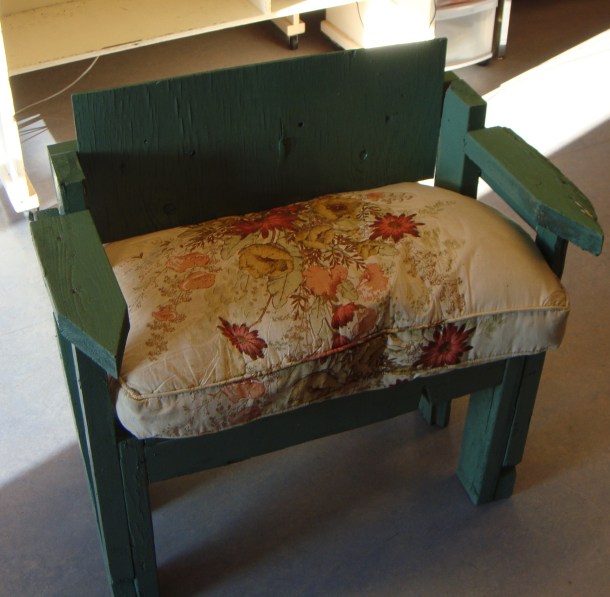
When I taught, the Grade 7 students built chairs for Science class. A criterion was they had to use recycled materials. They always built terrific chairs with little help from adults.

Anarchy

I felt a touch of sadness the last few days of school. I think it goes back to my first year teaching. The students told me they wanted school to continue into the summer. My last year teaching students sent me off with the message it was not the content that was meaningful, but the life lessons they learned.

Etymologically, anarchy comes from repeatedly new beginnings. Thought of that way, each new beginning is an opportunity to dance.

Rumi said “We rarely hear the inward music, but we’re all dancing to it nevertheless,
directed by the one who teaches us, the pure joy of the sun, our music master.” New beginnings are a dance that we do not always hear the music to.

As an end draws near,

Beginnings emerge,

In the anarchy of living.

One is drawn,

Not by the familiar,

By mystery.

In silent moments,

Stillness calls,

Reaching deep into one’s soul.

In silent moments,

The unseen radiates,

Touching one’s spirit.

Mystery lurks,

Pointing the way,

Deep wonder draws one forward.

The Real Work

I was laid up for the last few days. I have allergies and this time of the year is always a challenge. I think I picked up a bug to give me a double-whammy. I slept a good part of Friday and Saturday and, on Sunday, was upright for most of the day.

I am not sure if I will post later. While sitting upright and not doing much else on Sunday, this Wendell Berry poem kept poking at me.

Living is paradoxical. Parker Palmer described how this creates tension in living. Just as we think everything is as it should be, something pokes at us and unsettles us, calling on us to begin our real work and commencing the real journey. Being mindful and attentive remind us to be still and look below the surface of what is happening.

It may be that when we no longer know what to do
we have come our real work,

and that when we no longer know which way to go
we have come to our real journey.

The mind that is not baffled is not employed.

The impeded stream is the one that sings.

This is Athabasca Falls. The river upstream is quite wide and as it comes around the corner suddenly narrows. In Wendell Berry’s poem, it is impeded and creates a great force that carves out solid granite.

Silence of Poetry

Current shares the same etymological roots as curriculum: currere.

How we make meaning of living is like the spaces between words in a poem. It is in silence that meaning emerges. It flows between the words and stanzas.

We need silence in our lives to find meaning. It is standing on the edge of a mountain lake without others. There is a peace there.

“We are all visitors to this time, this place. We are just passing through. Our purpose here is to observe, to learn, to grow, to love… and then we return home.” Aboriginal Proverb

Living is a text,

Traveling through time and space,

Leaving others to ponder meaning;

A meaning that is never whole.

Engulfed in silence,

Emerging from a peace(ful) moment,

One’s inner voice speaks;

As if an other speaks.

Wrapped in meditative moments

When silence is a poem,

Bringing the text to life;

Sending it on its way again.


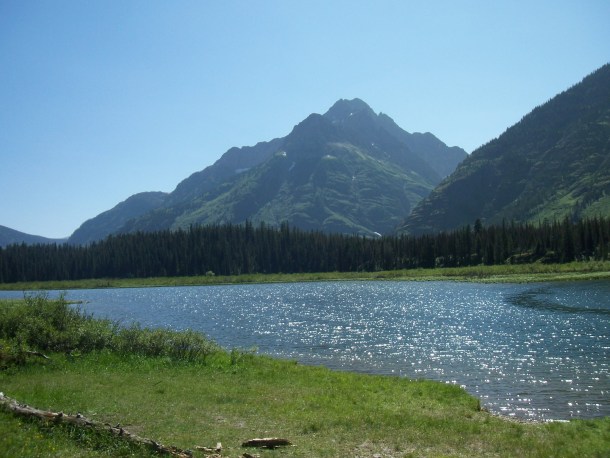
This is a small lake we walked to in Glacier National Park.

Eloquence of Ambiguity

Language matters. Yesterday, I read a post on an educational blog. Essentially, the person argued that “data driven education” was stupid and education was “child driven.” I accept children make choices about what they learn. As a teacher, I used data, including their choices, to inform how I taught.

What I understood demeaned anyone who spoke differently than this person. It is in pluralism and diversity the essence of eloquent ambiguity that we appreciate the world and receive gifts.

Most people accept a world that is grey and their language appreciates the eloquence of ambiguity. Language has a way of fixing things as if they were more permanent. It is the capacity of humans to interpret and re-interpret that brings forth the elegance of the world.

Appreciate the world as it is

It does not arrive pre-packaged.

Embrace uncertainty and ambiguity

Let its eloquence emerge.

Open your heart

Receive unimaginable beauty.

There are no pat answers

Only an internal compass that guides you.

This is a path in Waterton Lakes National Park. A person only sees a short distance ahead when walking a path. What comes next is uncertain.

Driftwood

I am back. The retreat was enjoyable and tiring. Although it was called a retreat, it was different in the sense that it involved research, writing, and lots of conversation. I find retreats invigorating. They are not sit, listen, and try taking notes as a speaker blasts through their presentation.

Retreats have a conversational part. Parker Palmer counsels people at his retreats not to take notes. Instead, we spend time writing and conversing how we feel about various prompts. That was a purpose of this retreat. It is the Currere Exchange.

Currere is the etymological root of curriculum, meaning to run the course of one’s life. It is a subjective way of interpreting a planned curriculum in a school. Whether teachers understand it or not, they are doing this continuously. As one of my co-researchers told me we make decisions about what to teach and leave things out we really like.

In a sense, currere is polishing a planned curriculum. It is a multi-faceted and complicated conversation between a person (re)membering their lived-experiences, aspire to a particular way of teaching in the future, and synthesize those two moments into the present. Each moment acts as a curriculum to inform the other, complicating one’s teaching in a dialogic way. Others enter the classroom and add to the complicated nature of the conversation, each adding their curriculum to the dialogue. It is like a piece of driftwood, being polished by the forces it comes in contact with.

My story being polished,

I (re)member and imagine;

Washed up on a new shore,

Who I am reflected anew.

I am a character in my story,

I pause a moment,

Noting lustre and matte,

Interpreting new meanings.

Soaking in the contours of living,

Experiencing new awakenings,

Running the course of my life,

Each new moment polishing me afresh.

Kathy took this picture in Waterton Lakes National Park.


Walk Your Path

We each walk our own path. Others can walk beside us, hold our hand, and be there. What they cannot do is live our lives.

I thought about traveling today, as I prepare for my trip tomorrow. It brought several quotes to mind about the paths we travel and what that means.

“Don’t walk behind me; I may not lead. Don’t walk in front of me; I may not follow. Walk beside me and be my friend.” Camus

“It’s your road, and yours alone. Others may walk it with you, but no one can walk it for you.” Rumi 

“Pursue some path, however narrow and crooked, in which you can walk with love and reverence.” Thoreau

The reflecting led me to look through some notes and this poem emerged.

Walk it so may be glorious.

Your courage is your truth

Let it shine a light on the path.

Discover beauty in what you give

Let it be the path you seek.

Walk at your pace

Be present in the world.

Walk with your story

Follow the questions of your quest.

Find a space to catch a glimpse of yourself

It is a space to dance, sing, and live.

Be vulnerable in that space

It is makes you who you are.

This is a path at Sunwapta Falls in Jasper National Park. We walked down to the see the falls and Kathy took the picture as I walked back up. The roots and people walking wove a pattern and story into the path.

Introduction to Poetry

Billy Collins asks to play with poetry and its words as we read it. Let the poem speak to us and we do not have to beat it with a hose to find out what it really means. I find that each time I return to a poem I find something that eluded me the other times. Maybe it was the mouse trying to find its way out or the waterskiier waving at the poet’s name.

Hermeneutic phenomenology is much like that, as well. When I interviewed each person for my dissertation the first time, they hesitated in telling their stories. The second time, they each began recounting their stories from the first interview.

Paul Ricoeur said hermeneutics is digging below the surface of our stories to find what the text of our lives tells us. I recount the story in poetic, fictive language and understand each time I (re)member the story differently.

“Differences make a difference,” as I am mindful to different aspects of the story and me as a character in that story. I cannot beat the meaning out with a hose.

I ask them to take a poem

and hold it up to the light

like a color slide

or press an ear against its hive.

I say drop a mouse into a poem

and watch him probe his way out,

or walk inside the poem’s room

and feel the walls for a light switch.

I want them to waterski

across the surface of a poem

waving at the author’s name on the shore.

But all they want to do

is tie the poem to a chair with rope

and torture a confession out of it.

They begin beating it with a hose

to find out what it really means.


Think Different

This poem, writen by Rob Siltanen, was part of an early Apple advertising campaign. He was a creative director for the company.

It stands out for me, because it echoed a phrase that emerged from my dissertation: “Differences make a difference.” It is in difference we discover what makes us each exceptional. Without the differences, we blend into an indistinguishable mass mere copies of one another. Worse yet, we might only copy the worst of the people we see succeeding.

The poem reminds of the Michelangelo quote: “Every block of stone has a statue inside it and it is the task of the sculptor to discover it.”

To be a teacher, is to inspire and allow each student to discover who they are. It is to be mindful and sensitive to what makes each of them different. It is to both serve and lead at the same time. It is to be different one’s self, as a teacher. How else could a teacher inspire?

The misfits.

The rebels.

The troublemakers.

The round pegs in the square holes.

The ones who see things differently.

They’re not fond of rules.

And they have no respect for the status quo.

You can praise them, disagree with them, quote them,

glorify or vilify them.

About the only thing you can’t do is ignore them.

Because they change things.

They invent. They imagine. They heal.

They explore. They create. They inspire.

They push the human race forward.

Maybe they have to be crazy.

How else can you stare at an empty canvas and see a work of art?

Or sit in silence and hear a song that’s never been written?

Or gaze at a red planet and see a laboratory on wheels?

And while some may see them as the crazy ones,

While we see genius.

Because the people who are crazy enough to think

they can change the world, are the ones who do.”


On Wiesel’s Night

Several years before I retired from teaching, a family approached me and asked me to tutor their child. Usually, I don’t tutor. Too often, it is about prepping for a test and is too rote for me.

After talking with the family and student, I agreed. The student was behind in some courses and wanted to be ready to transition from home schooling to attending high school full-time.

I helped her mostly in Math and Language Arts. I approach Language Arts through a cross subject method. I choose a novel and prepare a novel study. The students demonstrate comprehension, writing, grammatical, and other skills, instead of drill and kill method.

We discussed several possible choices for a novel study and decided on Elie Wiesel‘s Night, which is an autobiographical narrative of his time as a teenager in Nazi concentration camps with his family. I warned the student it was a tough read, but she insisted on the book. I asked her to read only assigned chapters and keep a journal.

The next week, she asked a question and confessed she read the whole book in one sitting. She asked if was OK to cry when doing a novel study. I said it was. We adapted and went through the book in a different way.

What I learned from that experience, is as hard as we try, as parents and teachers, there are things we cannot prepare children for in advance. This poem by Thomas E. Thornton, who was a teacher, echoed those sentiments. The poem is hard to read, but he wanted to impress upon students an appreciation for the horrors and violence of war.

I cannot teach this book.  Instead,

I drop copies on their desks,

like bombs on sleeping towns,

and let them read.  So do I, again.

The stench rises from the page

and chokes my throat.

The ghosts of burning babies

haunt my eyes.

And that bouncing baton,

that pointer of Death,

stabs me in the heart

as it sends his mother

to the blackening sky.

Nothing is destroyed

the laws of science say,

only changed.

The millions transformed into

precious smoke ride the wind

to fill our lungs and hearts

with their cries.

No, I cannot teach this book.

I simply want the words

to burn their comfortable souls

and leave them scarred for life.