Category Archives: Poetry

Love After Love

Derek Walcott wrote this poem that describes how, when mindful, we experience the fullness and richness of life. Perhaps it is only, when we older, that we have wisdom to sit, take it all in, and just be good with what life is.

Who is the person, the self, that looks back from the mirror? Or, greets me at the door? The answers are only questions in a new form, as the answers cannot be fully formed.

When we engage in conversation with ourself, we must be present to the person we speak and listen to. When we ask eloquent questions that cannot be answered, we allow those questions to remain unanswered and guide the conversation.

The time will come

When, with elation,

You will greet yourself arriving

At your own door, in your own mirror,

And each will smile at the other’s welcome,

And say, sit here, Eat.

You will love again the stranger who was your self.

Give wine. Give bread. Give back your heart

To itself, to the stranger who has loved you

All your life, whom you ignored

For another, who knows you by heart.

Take down the love letters from the bookshelf,

The photographs, the desperate notes,

Peel your image from the mirror.

Sit. Feast on your life.
 

Patience: Darkness and light, conscious and unconscious

Night after night, darkness enters the face of the lily which, lightly, closes its five walls around itself, and its purse of honey, and its fragrance, and is content to stand there in the garden, …

Source: Patience: Darkness and light, conscious and unconscious

The link includes a lovely picture of lily accompanied by a Mary Oliver poem, The Lily. The poem reminds me of the passage from Luke describing the lilies and wild flower, just being and growing.

Nature is what it is. There is a mindfulness in its creation and how it dresses. The lilies wait in their splendor for us to notice them and realize how they are always present. Nature and lilies teach us. To paraphrase Confucius, they open the door and we enter when we are ready.

Lingering in Happiness

Mary Oliver writes mystical and magical poetry. The words, the silences, and the images invoke and evoke something deep within my spirit. The etymologies of invoke and evoke, along with vocation, is “to call” in a ministering sense.

For me, teaching was/is a calling. I am still becoming a teacher. I reflect on what I experienced and arrive at new understandings about what those experience means. Emmanuel Levinas described an event as something that transcends time and place.

In that sense, becoming a teacher is an event as it continues to happen in many ways. Not only am I making sense of what that means and who I am, others do, as well. Even who I am becoming is an intersubjective event that shared with others.

Similar to the rain drops that slowly fall and nourish the oak, becoming some one is something that takes time. The drops and memories may disappear, but not vanish. They leave traces in the tree that grows and the person who is always becoming.

After rain after many days without rain,
it stays cool, private and cleansed, under the trees,
and the dampness there, married now to gravity,
falls branch to branch, leaf to leaf, down to the ground
where it will disappear – but not, of course, vanish
except to our eyes. The roots of the oaks will have their share,
and the white threads of the grasses, and the cushion of moss;
a few drops, round as pearls, will enter the mole’s tunnel;
and soon so many small stones, buried for a thousand years,
will feel themselves being touched.

The Open Door

Danna Faulds wrote this lovely poem in the form of prose and tells a story with poetic language. When the door opens, something calls and we intuitively follow that call as we be/become. Something pulls us and allows us to be alive when we are fully aware, without “adverbs, descriptors, or qualities”. We hear the call in moments when we are present to the universe’s vastness and the spirit that calls us, animates us, and provides us with voice.

What calls to each of us is unique, but somehow shared through our humanity, our humanness, and humaneness. Rooted in antiquity, the call speaks to us in the present tense and we are unable to make full sense of it. Due to its vastness, there is always mystery in that which calls each of us.

“A door opens. Maybe I’ve been standing here shuffling my weight from foot to foot for decades, or maybe I only knocked once. In truth, it doesn’t matter. A door opens and I walk through without a backward glance. This is it, then, one moment of truth in a lifetime of truth; a choice made, a path taken, the gravitational pull of Spirit too compelling to ignore any longer. I am received by something far too vast to see. It has roots in antiquity but speaks clearly in the present tense. “Be,” the vastness says. “Be without adverbs, descriptors, or qualities. Be so alive that awareness bares itself uncloaked and unadorned. Then go forth to give what you alone can give, awake to love and suffering, unburdened by the weight of expectations. Go forth to see and be seen, blossoming, always blossoming into your magnificence.”

PS I could not find a link for Danna Faulds, but her poetry is too lovely not to share.

Oceans

Juan Ramon Jimenez posed questions in this short and provocative poem. Sometimes when we are up against something that seems immovable, perhaps it is in that moment we turn to mindfulness and questions that guide us.

When we ask eloquent questions, we find ourselves guided by questions rather than fixed answers and destinations.

What does it mean to be in this moment when we do not seem to be moving? It might be that we are moving and it is our lack of awareness that makes us feel we are not. Quite often, we have predetermined outcomes and, as long as we are moving or think we are moving in that direction, we think something happens.

Stopping and meditating in a moment helps us realize that we are moving, just not in the directions we planned in moving. In those moments, we ask, “What does this mean?” and wait silently for answers to show themselves.

I have a feeling that my boat
has struck, down there in the depths,
against a great thing.
And nothing
happens! Nothing… Silence… Waves…

—Nothing happens? Or has everything happened,
and are we standing now, quietly, in the new life?

Prayer

Enjoy the day as If it was the last one for The dawn is so far. Be patient and take care A prayer flies to Heaven. The LORD is my shepherd; I shall not want.

Source: Prayer

Prayer is about listening. When we just speak, we cannot listen as closely and attentively as we need. Esther used the words patient and care in her beautiful poem. When I am patient, I listen more closely and take care to hear what is said and what is unsaid. The spaces between words, lines, and stanzas call to me, but in the busyness and noisiness of the world I can lose my way.

When I have faith and accept that my prayers will be answered in inexplicable ways, ways that I cannot understand, I find my way by being patient. I trust what is intuitive and I cannot possibly know fully. I walk the path carefully, but not alone. When I walk with others, it is an ethical journey where I take responsiblity for my actions and hold my hand out to the others I journey with.

Roofless School

a dictionary of true mirages bird songs instead of geometry plus a clock with no hands many very magic felt pens words like primrose or rainbow painted on a huge whiteboard come into the roofless S…

Source: Roofless School

John Dewey suggested education is not preparation for life, but life itself. The poem, Roofless School, extends that metaphor to poetry.

Poets sit under the sky and experience the world in the most complete ways, but their poetry is subject to diverse interpretations. When I go back and read a poem, I find new meanings.

Each time we experience the world, we experience something new. Regardless of how familiar it seems to be, an experience can only be experienced once, in the moment I experience it. We re-experience the experience retrospectively and find new meanings in a new, reflective experience.

When I taught, I tried to begin each day fresh. It was not erasing the past, but I realized how the past informed my relationships with students, curriculum, and digital technology in the present moment. In those moments, being mindful and sensitive was paramount.

Mountains Speak

Source: Mountains Speak

Let the mountains speak and share their story. As leaders, we must let the world and people speak to us and be sensitive and attentive listeners as it shares its stories.

I enjoy traveling through mountains. It is hard work, because heights terrify me. Kathy and I tell others that she drove on the Going to the Sun Road, because the driver has to have their eyes open. There are places that the drop off of a narrow road is thousands of feet.

The beauty of mountains is hard to fully describe in words. It is an experience, soaking in the moment. We lived in a small town, McBride, BC, for 2 years. It is in a mountain valley.

Mountains speak to me. The wind is different. The weather socks in for days and weeks. Animals appear at the door and appear unthreatened by human presence. One Sunday morning in McBride, I waited for Kathy on the front steps and about 20 feet away was a young cow moose, eating, and keeping a close eye on me. She moved when we decided it was time to get in the car. We were not separate from nature, but part of it in those moments.

When we are sensitive and mindful of the environment, so much of it speaks to us. This includes nature, the workplace, our families, and in our communities.

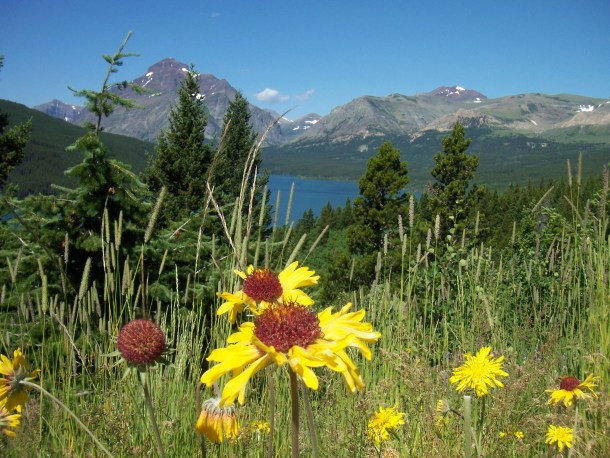
Daffodils, Lake, and Mountain in Glacier

I did not take that picture. Kathy did as she drove through Glacier National Park, MT.

Walker

Antonio Machado reminds us that the path we follow is both made anew when we walk it and that once we step we can no longer go back.

We can look back and see where we came from, but that is a distorted image and, the further we move away from that point in time, the more distorted the memories we recall. We can reflect upon those moments and steps in a caring way that takes place only after the step.

It is in mindful walking that we make the path. There is an awareness and senstivity that only happens in the very moment we exist in, the present. Our presence is important in that moment as we step and live at that point on our path of life.

The mindfulness of our steps is important when we realize we lead others in their steps. They cannot walk the identitical path to our path, but the way we compose ourselves is a model for how they might live.

Walker, your footsteps

are the road, and nothing more.

Walker, there is no road,

the road is made by walking.

Walking you make the road,

and turning to look behind

you see the path you never

again will step upon.

Walker, there is no road,

only foam trails on the sea.

Spring

Source: Spring

Mary Oliver is one of my favourite poets. There is something deeply spiritual about her poetry that finds its way into my heart.

I was not familiar with this poem. Poetry allows us to imagine that we have wings. With those wings. we tap our experiences more fully as we fly with others who join us. When we share the journey with others, it becomes much richer. It is not only our journey.