The Oak and the Rose, Poem by Shel Silverstein

I enjoy Shel Silverstein and found his poetry after I listened to the songs he wrote for the likes of Johnny Cash and Dr. Hook. He had a wit that made me wonder and still does. I wonder what it means to be big? What does it mean to be small?

silverbirchpress's avatarSilver Birch Press

Image

THE OAK AND THE ROSE 

by Shel Silverstein

An oak tree and a rosebush grew, 
Young and green together, 
Talking the talk of growing things —
Wind and water and weather. 
And while the rosebush sweetly bloomed 
The oak tree grew so high 
That now it spoke of newer things —
Eagles, mountain peaks and sky. 
“I guess you think you’re pretty great,”
The rose was heard to cry, 
Screaming as loud as it possibly could 
To the treetop in the sky. 
“And now you have no time for flower talk, 
Now that you’ve grown so tall.” 
“It’s not so much that I’ve grown,”  said the tree, 
“It’s just that you’ve stayed so small.”

Painting: “Two Gibbons in an Oak Tree” by Yi Yuanji (1000-1064)

View original post

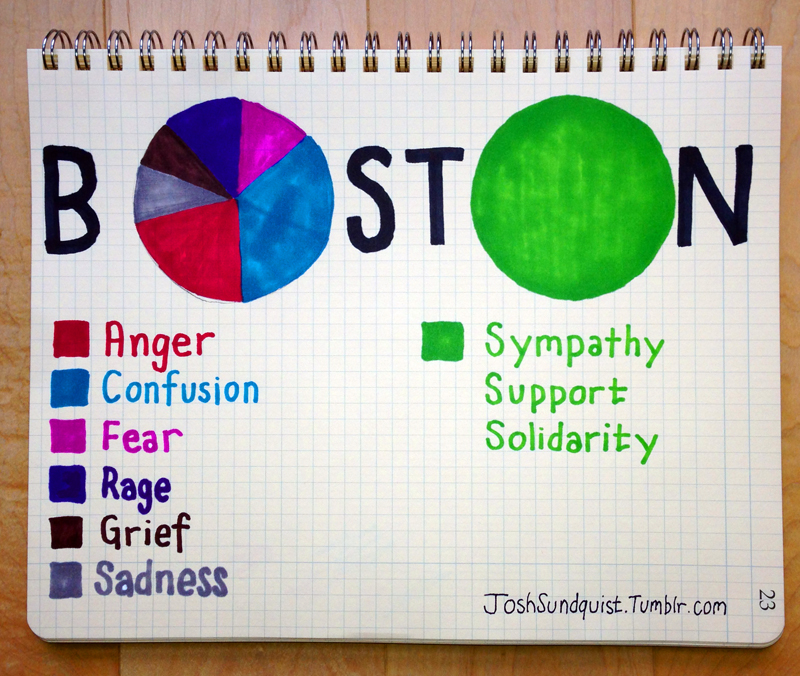
Boston

This does not require any words. Our thoughts and prayers go to people who were just running a race or standing enjoying the race.

Live & Learn's avatarLive & Learn

boston

Let’s just say that I don’t see all these colors.  I see Red, Dark Blue and plenty of Green.


Source: Ilovecharts

View original post

Reciprocity

We made home safe and sound. It was tiring, but we visited and shared with family, old friends, and made new friends. I looked through my volumes of poetry books today and came across this one which, for some reason, spoke to me today. I think it was the title. We share our gifts with each other in ways that can help us through each day. We need to be open and heartfelt in giving and receiving.

Nature offers us gifts and when we open our senses and heart we receive them. We saw the first real hints of spring on the drive home, despite the snowfall in places. Yes, it did snow on April 14th. In similar ways we live in relationship with humans, we live in relationship with the world, the universe and their gifts. We learn from the constancy, the peace, and the fortitude of nature. We only need be compassionate and patient.

John Drinkwater wrote this wonderful poem about this constancy, this peace, and this strength that is always around us and with us in the form of the universe, our family, our friends, and a Creator.

I do not think that skies and meadows are

Moral, or that the fixture of a star

Comes of a quiet spirit, or that trees

Have wisdom in their windless silences.

Yet these are things invested in my mood

With constancy, and peace, and fortitude;

That in my troubled season I can cry

Upon the wide composure of the sky,

And envy fields, and wish that I might be

As little daunted as a star or tree.

Spring Floats on Warm Breeze – A Tanka

We made it home. It was a long weekend and long drives. We saw faint glimpses of spring along the way with occasional pussy willows and greening of trees. Nature is awakening and I thought this beautiful poem was a testament to this awakening.

Dom DiFrancesco's avatarDom DiFrancesco

Spring floats on warm breeze

Golden rays bronze winters pale

Reincarnation

Rebirth of blossoming soul

Natures call awakening

~

~~ Dominic R. DiFrancesco ~~

View original post

The experience of being alive

This is a great quote from Joseph Campbell. To be fully alive, I need to experience my life and be alive. Thank you Bill for a great quote and picture.

drbillwooten's avatarDr Bill Wooten

“I don’t believe people are looking for the meaning of life as much as they are looking for the experience of being alive.” Joseph Campbell

317789_199120890164250_145519288857744_459133_965020414_n

View original post

Love After Love

We arrived safe and sound. There was not much traffic and the roads were clear through the mountains. It is a bit tiring with a lot of visiting of family and friends. We are a large family spread out geographically so we do not see each other often. It is different to see each other face-to-face, have conversations, share meals, and reminisce. There is much laughter.

I find it is in these gatherings that I look in. I greet my self through the presence of siblings, parents, nieces, nephews, and a varied assortment of relatives. Who do we resemble inwardly and outwardly? It is not always obvious until we see others who helped form of our lives. It is like meeting yourself on the journey of life. It is in this companionship, with others and eventually our self, we rediscover our self.

Derek Walcott wrote this beautiful poem around that theme, meeting yourself on life’s journey.

The time will come

when, with elation,

you will greet yourself arriving

at your own door, in your mirror,

and each will smile at the other’s welcome,

and say, sit here. Eat.

You will love again the stranger who was your self.

Give wine. Give bread. Give back your heart

to itself, to the stranger who has loved you

all your life, whom you ignored

for another, who knows you by heart.

Take down the love letters from the bookshelf,

the photographs, the desperate notes,

peel your own image from the mirror.

Sit. Feast on your life.

“Of course there is no formula for success, except perhaps an unconditional acceptance of life, and what it brings.” ― Arthur Rubinstein

What do I do when I do not succeed? Do I learn? Do I just give up? Looking at failure as a detour is a healthy way to look at the world. After all, this too shall pass.

pahari.s's avatarDISCOVERING MYSELF

View original post

Early Morning Meditations from Thomas Merton

Thomas Merton was ean interesting person. I love to read his work and think about what he had to say. Despite the fact he died in 1969, I find his thinking more timely today than it was when he wrote. The concept he discussed about the violence we do to ourselves in life through busyness and being now gets coverage, but it might have seemed out of place in his time. He was visionary and before his times. At the same time, he lived such a simple and traditional life. He lived the fullest paradox of life.

indytony's avatarA Way With Words

Thomas Merton

I was up early this morning – too early.  I was awakened by one of my “vocation dreams” where I imagine doing something new and different in my life and then wake myself up analyzing if it is possible.

Today, there was no going back to sleep, so I decided to look for a decent documentary on Netflix.  It took some searching, but I found one called Merton: A Film Biography.

Thomas Merton was many things in his life.  A little French boy of artistic parents, orphaned by age 15.  A bright, yet carousing student at Cambridge, then Columbia.  A Roman Catholic convert, received into the Cistercian order at the Abbey of Gethsemani, Kentucky.  A hard-working Trappist monk devoted to the contemplative life of prayer.  A poet and philosopher who sought to bring healing to a desperately wounded society.  A hermit who found in Buddhist writings and friendships companionship…

View original post 405 more words

Undivided Attention

We set out tomorrow for a short trip tomorrow through the mountains and, hopefully, no snow. There will be snow. I hope it is not snowing.

A colleague recently introduced me to the poetry of Taylor Mali. He is better known for the poem What Teachers Make. That was a poem I had heard several times before, but could not have attributed it to a poet. Mali has great wit, clarity, and creates powerful imagery through his words. He was a teacher for several years and I think he would have been fantastic in the classroom building relationships with young people. I wrote about Sam Intrator several months ago and I think Taylor Mali is the kind of teacher he was describing in his book, Tuned In and Fired Up.

This poem by Taylor Mali spoke as the day unfolded. I need to be present for my students to learn. I need to give them my undivided attention so they can give their undivided attention to the subject at hand, perhaps that piano hanging eight stories up across the street. What could we learn that day?

A grand piano wrapped in quilted pads by movers,
tied up with canvas straps—like classical music’s
birthday gift to the criminally insane—
is gently nudged without its legs
out an eighth‐floor window on 62nd street.

It dangles in April air from the neck of the movers’ crane,
Chopin-­‐shiny black lacquer squares
and dirty white crisscross patterns hanging like the second‐to­‐last
note of a concerto played on the edge of the seat,
the edge of tears, the edge of eight stories up going over—
it’s a piano being pushed out of a window
and lowered down onto a flatbed truck!—and
I’m trying to teach math in the building across the street.

Who can teach when there are such lessons to be learned?
All the greatest common factors are delivered by
long‐necked cranes and flatbed trucks
or come through everything, even air.
Like snow.

See, snow falls for the first time every year, and every year
my students rush to the window
as if snow were more interesting than math,
which, of course, it is.

So please.

Let me teach like a Steinway,
spinning slowly in April air,
so almost-­‐falling, so hinderingly
dangling from the neck of the movers’ crane.
So on the edge of losing everything.

Let me teach like the first snow, falling.

Peace & love for all!

This is just a beautiful sentiment for the day ahead.