This is for those who follow my blog and are on Facebook with me. I know some of you are horse people. Francesca is a wonderful writer, storyteller, and a horse person. Enjoy.

Francesca Zelnick's avatarWords/Love

When I was younger, I used to ride horses. Every Saturday, my mother would drive us out to the stables and wait while I took lessons. My parents were always waiting for me while I learned new things. They did it silently, and honorably, and without proper thanks. This is what people do for those they love.

The first time I ever got to ride outside, away from the confined ring of the stables with its little jumps and man-made obstacles, I rode a horse named Tarzan. He was properly named. He was tame, but still a beast. He was sweet, but wild. When he whinnied, the whole barn shook.

We went out as a group into the fields. We walked. We trotted. It was a beautiful day. But then something happened that I couldn’t see or hear. Tarzan got spooked. He took off, running.

I tried to slow him…

View original post 346 more words

I posted several weeks ago about what I learned during my first months of teaching from my students. I have learned more from children than in any university class. Teaching and learning are not theoretical functions and they are not just stumbling around in the dark. They are both relational, messy, and complex processes. This is a wonderful share by a teacher from Australia. She posted this great TED talk. Take a listen.

elketeaches's avatarelketeaches

Adora Svitak: What adults can learn from kids

This video came out a couple of years ago; it was powerful then and still is now.

“…in order to make anything a reality, you have to dream about it first…”

View original post

A Vision By Wendell Berry

Nothing worth its salt comes easy. I enjoy Wendell Berry and his reminders that the world is a better place if we live in it fully in the moment and mindful of this very moment and place.

If we will have the wisdom to survive,

to stand like slow-growing trees

on a ruined place, renewing, enriching it,

if we make our seasons welcome here,

asking not too much of earth or heaven,

then a long time after we are dead

the lives our lives prepare will live

here, their houses strongly placed

upon the valley sides, fields and gardens

rich in the windows. The river will run

clear, as we will never know it,

and over it, birdsong like a canopy.

On the levels of the hills will be

green meadows, stock bells in noon shade.

On the steeps where greed and ignorance

            cut down

the old forest, an old forest will stand,

its rich leaf-fall drifting its roots.

The veins of forgotten springs will have

            opened..

Families will be singing in their fields.

In the voices they will hear a music

risen out of the ground. They will take

nothing from the ground they will not

            return,

whatever the grief at parting. Memory,

native to this valley, will spread over it

like a grove, and memory will grow

into a legend, legend into song, song

into sacrament. The abundance of this

            place,

the songs of its people and its birds,

will be health and wisdom and indwelling

light. This is no paradisal dream.

Its hardship is its possibilities.

                                    ─Wendell Berry


When we discussed this poem, students understood that success is not always an easy journey. Some important aspects are the hard work and disappointments along the way. The word and phrase that caught their attention was “This is no paradisal dream. Its hardship is its possibilities.

Truths

I woke this morning

to several truths;

honouring

respecting

diversity

in wholeness

in parts

healing

wisdom

meaning

makes us stronger

me stronger

without weakening.

Community

thrives

each person

and truths

named

nurtured

watered

fed

valued

appreciated

strengthened

in healthy diversity.

with healthy diversity.

Chair Building

I use this lesson plan as an activity in the Grade 7 Science Structure and Forces unit. The students work in pairs.

  • Students draw a plan for the chair design.
  • Concepts to Include might include corrugation, lamination, and triangulation; design considerations such as arches, beams, trusses, and columns; and show an understanding of what fastening techniques for this design i.e. friction fit, mass, and glue, staples, rope, tape (within reason), or nails or screws (within reason).
  •  Consider properties i.e. stability, brittleness, ductility, hardness, plasticity, compression, and tensile strength.  Students need to consider deformation, structural stress, structural fatigue, and possible structural failure. What are internal forces (mass of materials) and external forces (load on the chair).
  • What role do aesthetics play i.e. symmetry and appearance? What is the chair used for?
  • Students use recycled material i.e. cans, plastic containers, and cardboard (boxes, tubing, and pieces).
  • Students construct and track changes. The original chair design might be altered depending on material availability, functionality, and durability.  They should test the chair as they build.
  • I limit class time to 2-3 classes. Most materials are found at home and students can receive help from family, friends, or neighbours.
  • I email parents and tell them they are consultants, who can offer expertise, guidance, and time unavailable in the classroom. Parents are good about insuring students do the lion’s share.

Students are innovative. One student included pop bottle (he told me it was for pop) holders in the arms of a deck chair. Another student gathered discarded pizza boxes after hot lunch and used those.

Assessment is a rubric. A criterion is I test the chair. Its ability to hold my 250 pounds, give or take, is part of the challenge. Only one chair collapsed under my mass. It lacked support.

This is a Grade 7 project, but I think other can modify it for other grade level needs. Students can work in pairs.

Cautionary note: I allow nails, screws, and tape as fasteners, but within reason. The first time I did this activity a student built a nail chair. He used so many nails it is doubtful they were recycled.

Here are some examples of this year’s chairs.

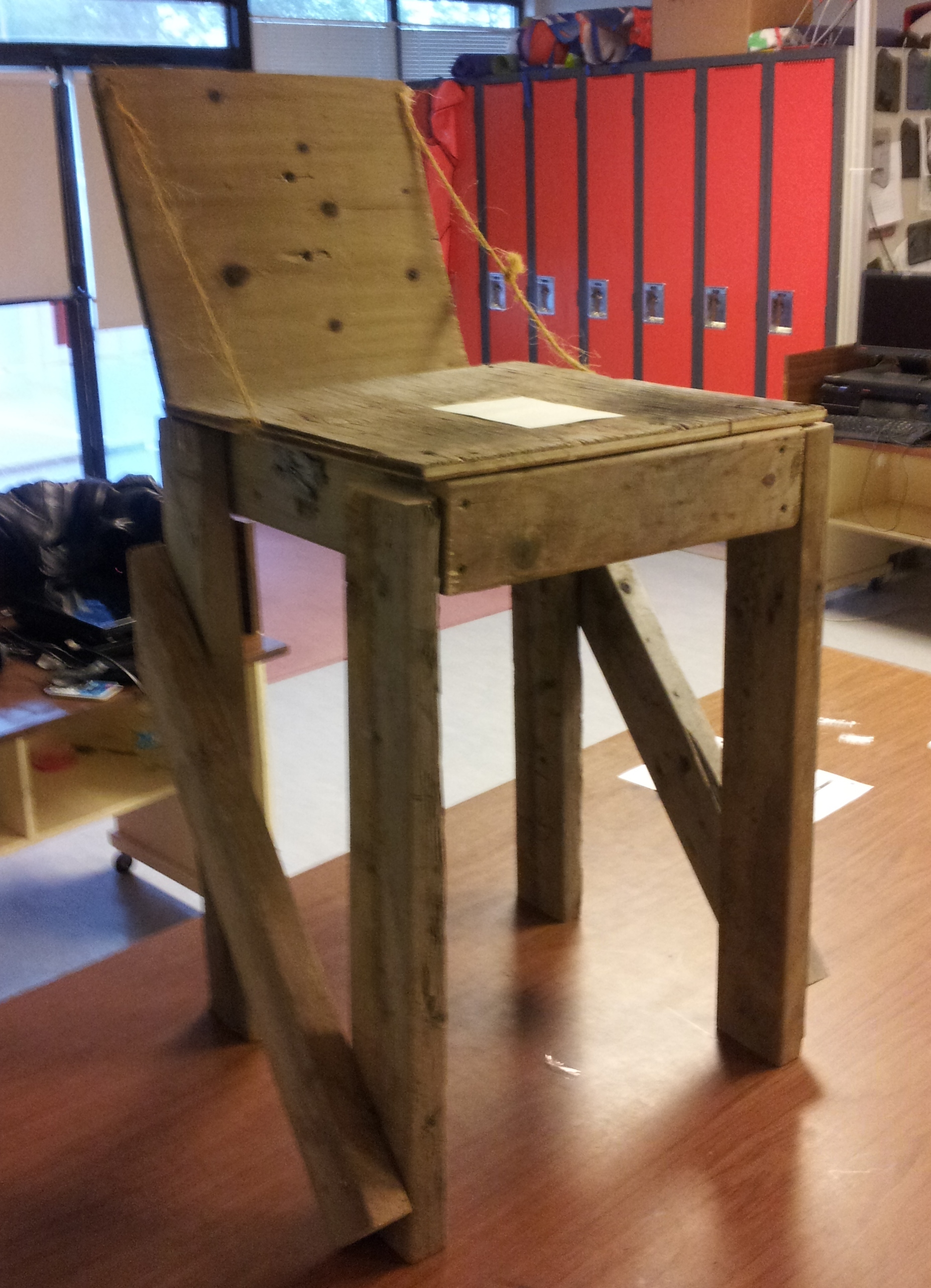
This chair is made from used pressure treated lumber and plywood. The back folds forward and the student used baling twine he got from the farm as the hinges.

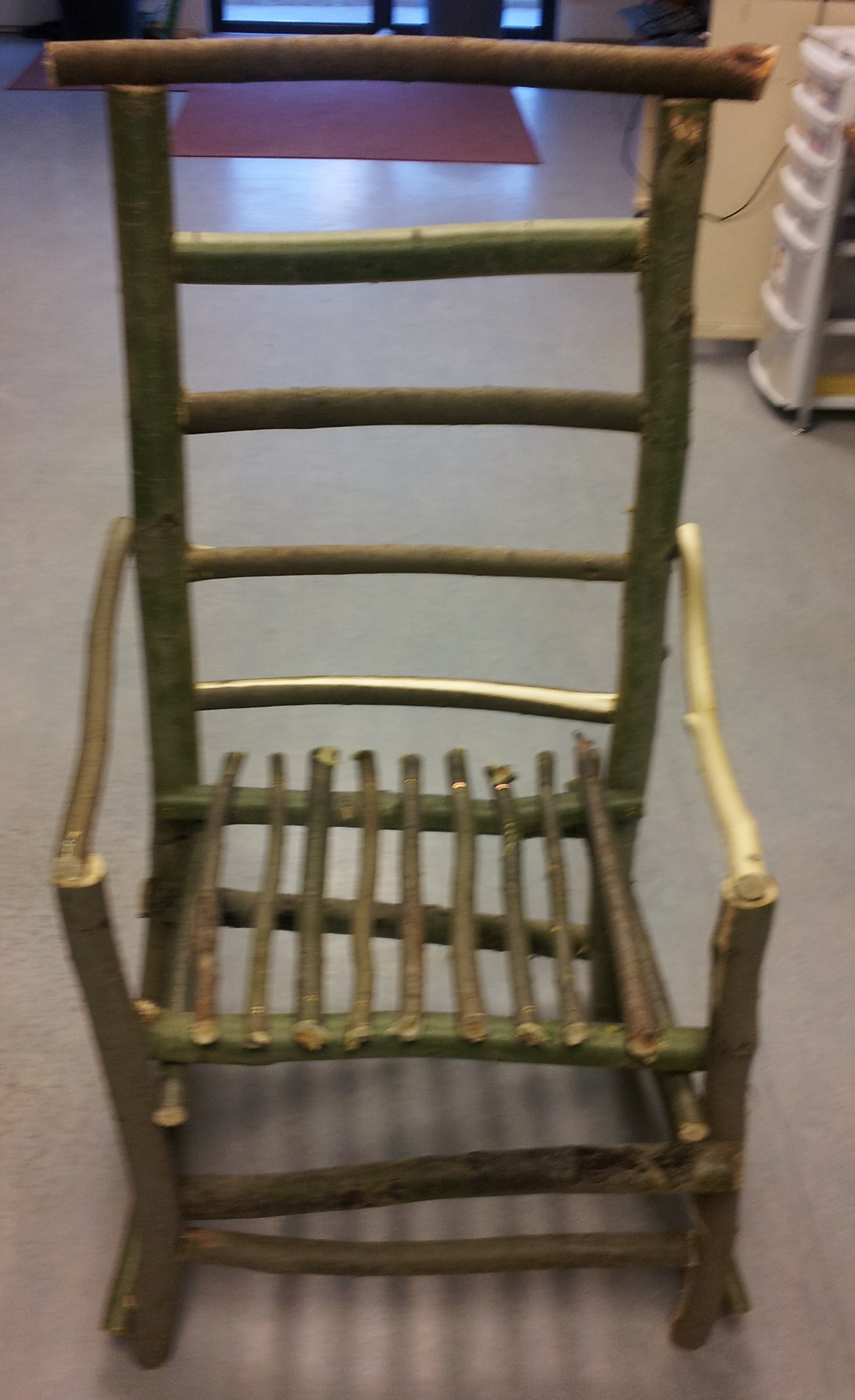
This chair is constructed from willow. The willow qualified as recyclable as the students were going to have to dispose of the willows when they cleared underbrush anyway. The only thing missing is a cushion. These students could go into business selling yard furniture.

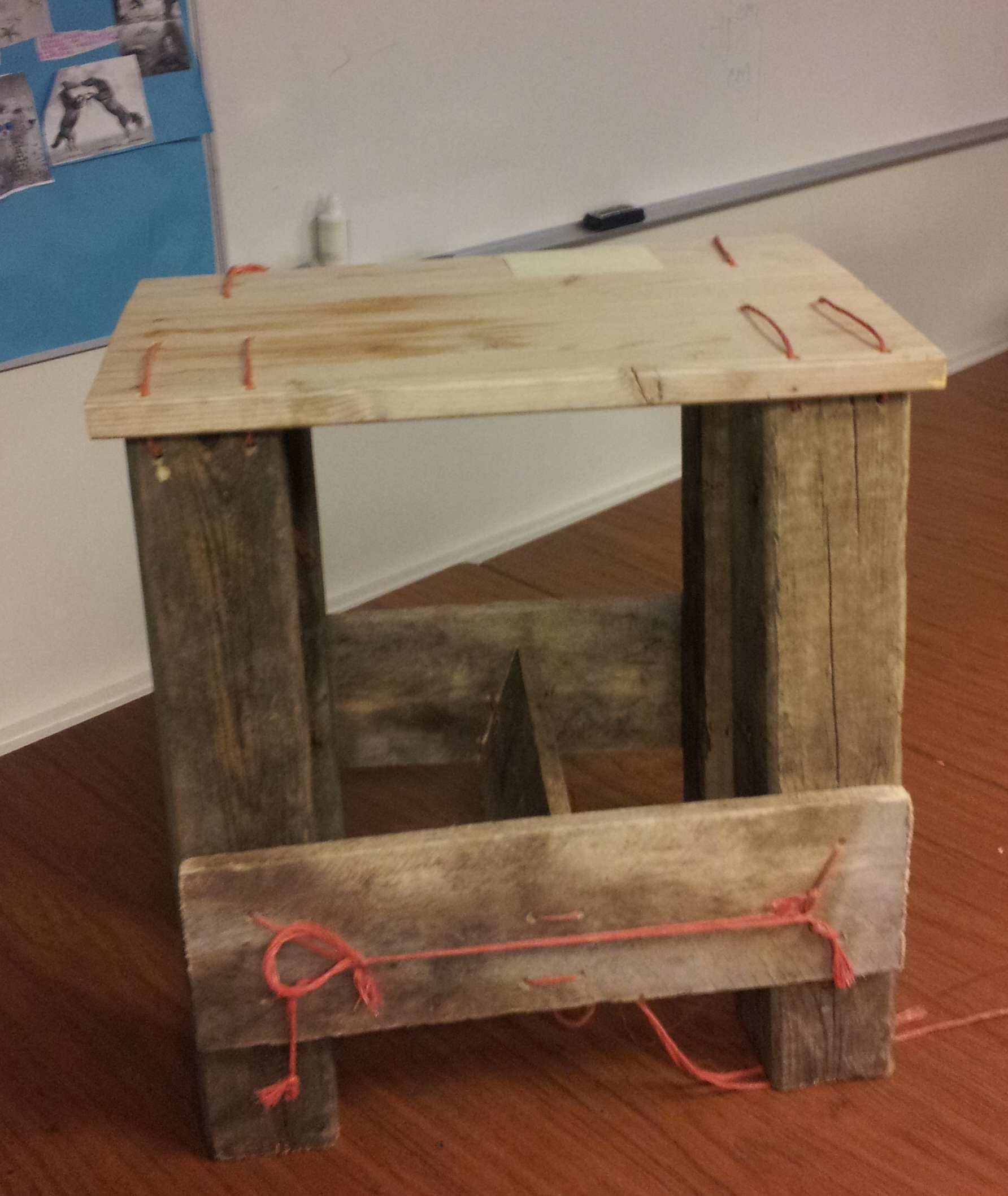
Although this stool did not have triangles for stability, the centre piece helped in that respect. When I sat on the stool, it was wobbly, but with my mass it became less so. The students used baling twine as the only fasteners. One of them has horses and these were available.

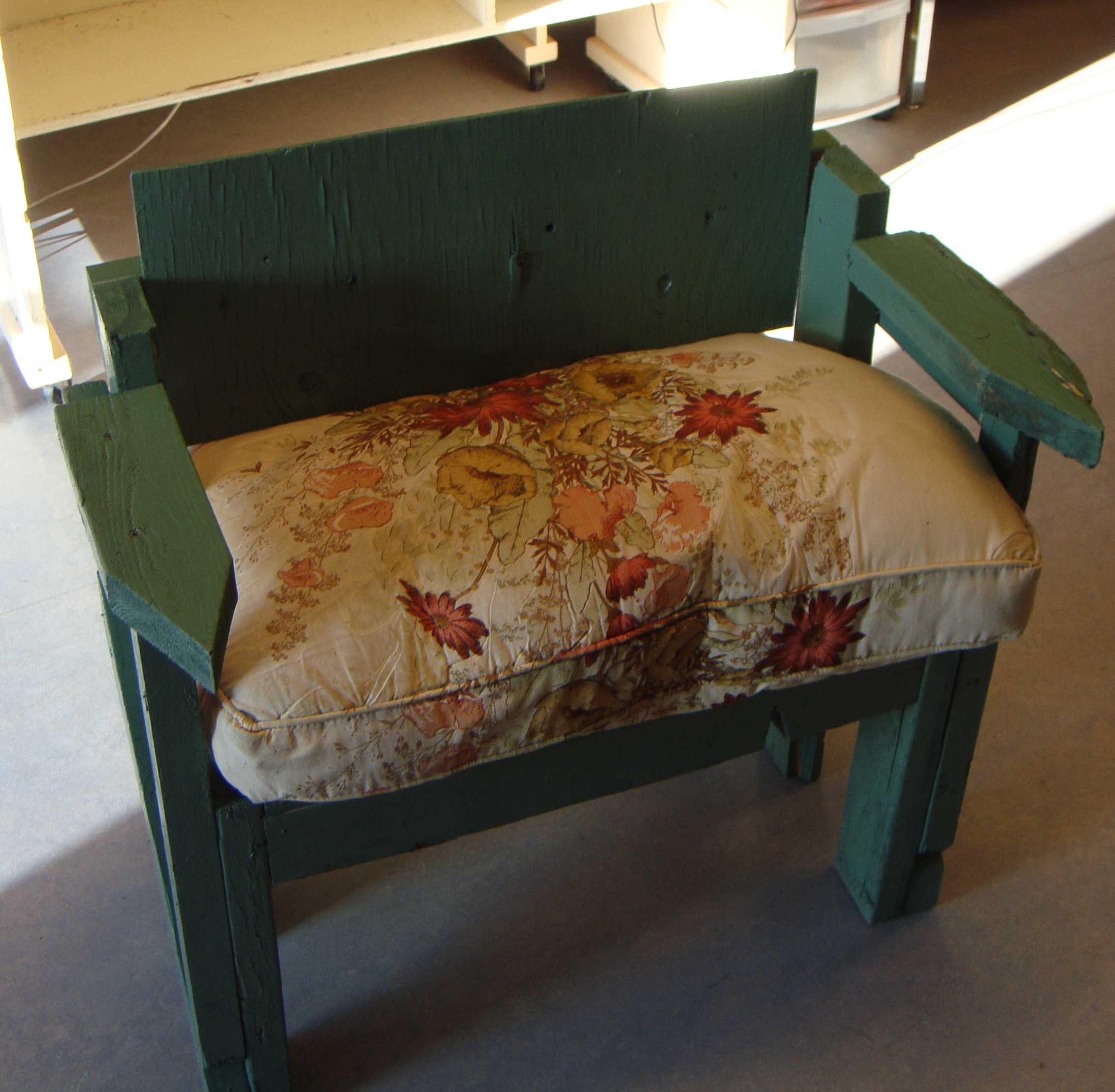
This chair is built from recycled wood and a discarded cushion. The students gathered the wood from the neighbourhood and a neighbour helped. He drilled tap holes for the screws.

Here is a great idea for other teachers following us. This has been around the world. Thanks to Elke for bringing it to this network’s attention.

elketeaches's avatarelketeaches

Through the awesome-ness of Twitter I saw @davidwees tweet about this great site: Computer Science Unplugged  I spent some time navigating through this site and I’m loving it!  There are lots of activities to help explain/learn the concepts involved in computers/technology.  It also includes loads of resources for teachers.

The activities are great.  I have used some of these activities in the past (either stumbled on the idea myself or learned from other people), so it’s great to have all of these activities in one place and with added Youtube videos too.  These activities are great as a back-up plan if the computers are “down”, server crashes etc; but they are also great activities to supplement the computer-based learning.  One of the things I dislike about most computer classes is how immobile students are and I think getting students to move around to experience learning is an awesome idea. …

View original post 18 more words

Leadership Is a Conversation – Harvard Business Review

Leadership Is a Conversation – Harvard Business Review. Here is an excellent article form Harvard Business Review. Leading is about a conversation. Leaders need to recognize the importance of listening mindfully and attentively otherwise their role is one of management.

Are educators ready for this? Conversations are much harder work than using glib commentary.

In Praise of Slow

In a world full of busyness and artificial flavouring for the day, this is a solid message of what brings peace to each of our lives. Slow down, you move to0 fast. Sounds like a song I heard somewhere.

Poetry Arises

To begin the day in a quieter, peaceful, and wiser place, I meditate each morning. .Elizabeth Myhr commented about creativity in her writing. She “does not jump into creativity. Creativity bumps into her on its way through the world.” As I sat, I realized I was writing poetry in my mind. Words, phrases, and images were floating in a stream. I recognized I felt calmer and quieter in those moments.

Francesca Zelnick offered advice in a recent post. She suggested, when ideas emerge or bump up against me as I move through life, write them down. I did and edited later. Here is the product.

Sit quietly,

5:30

AM.

Can’t sleep

wait

listen

pay attention

be patient

meditate

contemplate

focus on breath.

Gently return

to a quiet space

solitude

like a river

single words

phrases form

metaphors arise

images appear

in the current.

Discover a gentle smile

on the corners of lips

face softens.

Fresh day

creates space

for voice

words observed

soul speaks

asks to be heard.

Tranquil,

bump into creative moment

Poetry written.

Enjoy!

Deb Meier is a pioneering educator in New York. I posted about the Finnish system recently. The key thing to remember is the Finns do not have a word for accountability. It is what is left when we are done with being responsible!

debmeier's avatarDeborah Meier on Education

Dear friends.

The poor get poorer, and more get poorer. Meanwhile college tuitions keep rising. Meanwhile the media declare that no one who hasn’t got a BA can possibly qualify for a living wage. Something’s rotten in this proposition. It’s a catch-22. And it doesn’t have to be that way. It isn’t that way in Finland, for example.

Finland didn’t do it overnight, but they built it around critical democratic habits: competence and trust. They didn’t trade off one for the other. They joined competence and trust—just as we do when we hire a baby-sitter. I often go back to this metaphor because it seems so odd that we understand trust when it comes to a babysitter (even when our children are so young that we can’t really get “their side” of the story) but keep looking for a trust-proof solution to system-wide public schooling.

Trust and skepticism go fine…

View original post 1,221 more words