Every mom has a gallery

This will be a busy day. I am in Spokane to defend my research proposal and head home, hopfully to begin research shortly.
Kathy and I recently lost our mothers. They were much different ladies and their galleries would be so different. My mother would have a rosary, a religious image with prayer, and her prayer book. Kathy’s mom would have knickknacks she found on the farm, berry picking, or while camping. Her gallery might include small stones, pine and spruce cones, and shells.

nimi naren's avatarSimple Moments of Life

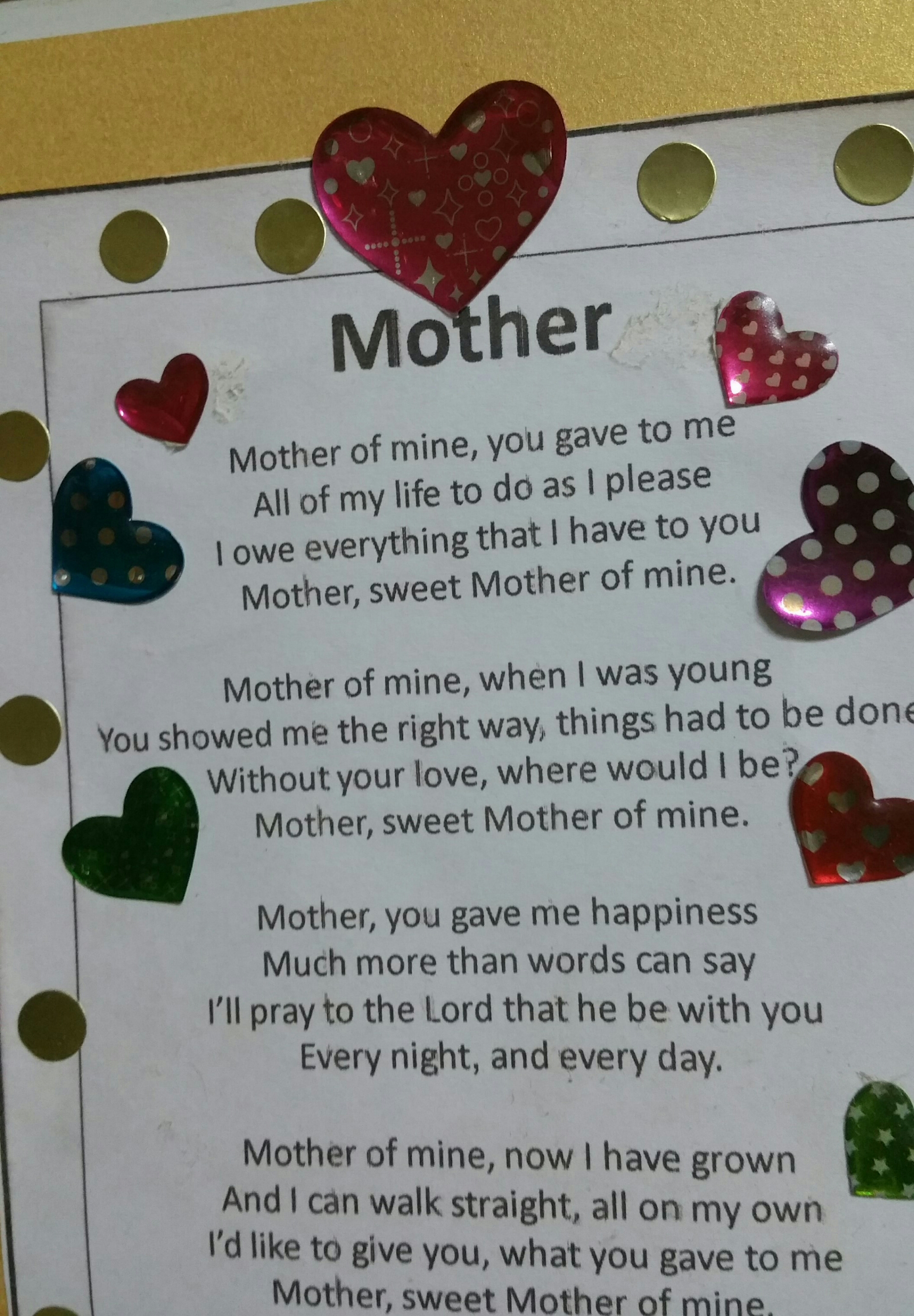
Every mom has an art gallery or a collection box. The walls of the gallery could be a refrigerator or steel cupboard, or a pin-up cork board. Then again, the collection box could be a humble plastic bag  or a small box, both of which have pride of place in her wardrobe or cupboard.

Every mom carefully preserves her own gallery and collection box. Why? Because they contain works of art and gifts from her children –  cards for her birthday, mom’s day cards, doodles and squiggles, thank you notes or stick figure drawings.  The collection boxes probably contain sea shells, pebbles from the road,  hand-made earrings, a paper rocket, a sweet poem, an old photo and many, many such wonderful things.
image

These are rare treasures indeed that bring back snapshots of the children’s growing up years, and the crazy passage of time.

Where did that child go, who drew…

View original post 91 more words

Give Much, Much More Than We Take, says Hill

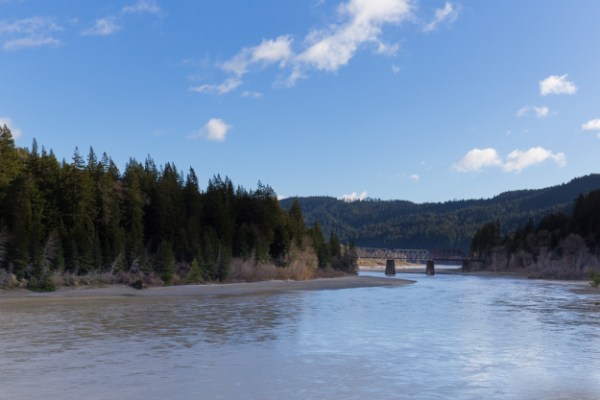
A great way to close the week off and head into Sabbath. I can feel myself sink into the images of filled with water, trees, and sky. When we are in the presence of someone or something, big and small, it is proper to be attentive and mindful. To be present and attentive demonstrates kindness and love for people and things that show themselves to us.

smilecalm's avatarsmilecalm

Kindness in words creates confidence
Kindness in thinking creates profoundness
Kindness in giving creates love. ~Lao Tzu

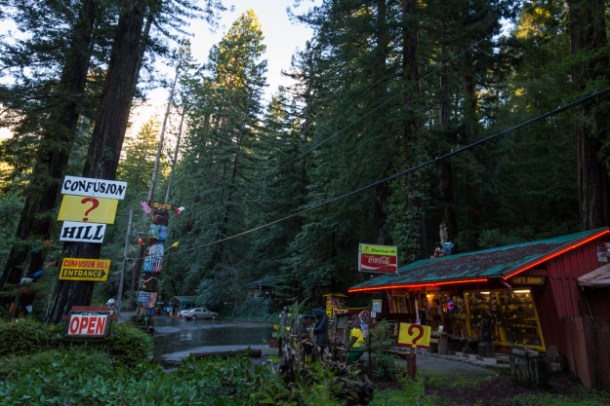
Who’s Confused? ~d nelson

Sitting quietly with a perfect
view of hilltop
I was looking for a sign
of confusion.
But no matter how hard
I looked there
was no sign
of Hill being confused.

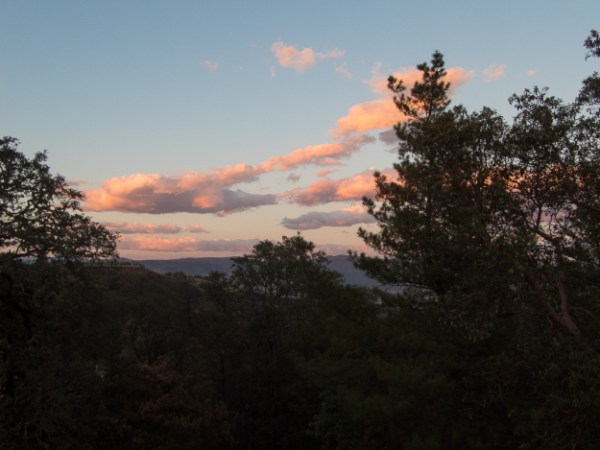
sunset clouded hill sunset clouded hill
Stable as a mountain
firm as the earth
Hill confidently
conveyed that
it’s not the one
confused.

bridge across the Eel

In hundreds of millions of years
I’ve witnesses many beings come & go.
While most  primates scurry
around digging things up,
hoarding to themselves,
disheveling the earth,
it’s refreshing to experience
expressions of a burgeoning wisdom
which conveys the oneness of all,
softly said ancient Hill.

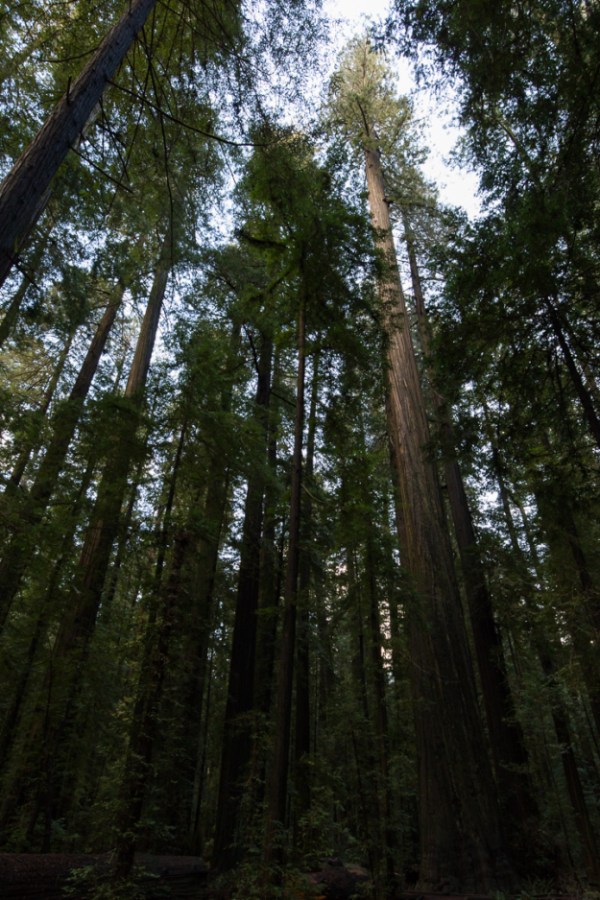
biggest trees of the forest

See how tree’s do nothing
but give; beauty, oxygen,
shelter, food, and more.
Rivers & streams seem to rush
but look deeper and see
how they…

View original post 139 more words

When the Shoe Fits

The Trappist Monk Thomas Merton is better known for his spiritual prose, but he was an artist and poet, as well. Eastern philosophies, including Buddhism and Taoism, inspired his writing, including his poetry, and his theology.

When we are at ease with our actions and speech, we work with remarkable dexterity. We understand technology as tools, however the etymology includes techne which is art and craft and logos has to do with speaking, discourse, and the rules that guide that speaking. Craftspeople and artists take time, gather their thoughts (become full of thought), and speak with and through their tools in creating artifacts which in turn call us to gather our thoughts in their use.

Merton’s poem speaks of the ease and knowing one’s craft so well that conversations with and through tools feel right as the craftsperson experiences tools and creating intimately. The human and their tools form a mindful and caring relationship. John Dewey proposed that mind was a verb. We mind, care for, appreciate, and attend to our tools and they respond to this mindfulness.

From the Chinese of Chuang Tzu

Ch’ui the draftsman
Could draw more perfect circles freehand
Than with a compass.

His fingers brought forth
Spontaneous forms from nowhere. His mind
Was meanwhile free and without concern
With what he was doing.

No application was needed
His mind was perfectly simple
And knew no obstacle.

So, when the shoe fits
The foot is forgotten,
When the belt fits
The belly is forgotten,
When the heart is right
“For” and “against” are forgotten.

No drives, no compulsions,
No needs, no attractions:
Then your affairs
Are under control.
You are a free man.

Easy is right. Begin right
And you are easy.
Continue easy and you are right. The right way to go easy
Is to forget the right way
And forget that the going is easy.

Photo Challenge # 98: February 2, 2016

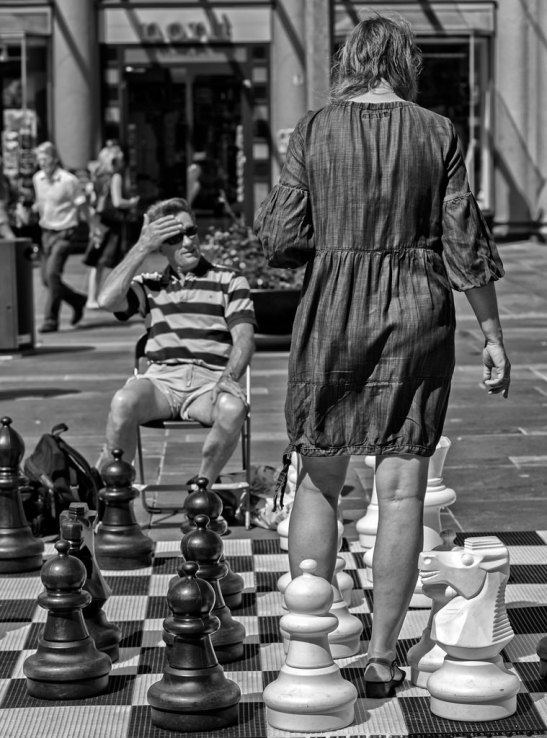
The picture drew me first. I read the caption, “Mate” and recognized its double-meaning. The poem is rich and speaks to the life-long committment we make to each other. Part way through the line, “The only geometry worth the commute

is the human heart,” catches my eye. It captures the give and take in strong relationships that exist because they can and have the right geometry.

mindlovemisery's avatarmindlovemisery

Chess
“Mate” by Anne Worner CC BY-SA 2.0

In the inconstant ravages of midday

I drink of your succulent greys,

of your endless repetitions.

Winning accounts for only a fraction

of our experiences, we lose everyday.

I stand here challenging my failures,

the pawn of my genius watered down.

I will not be made palatable.

I will not be made to adhere.

The only geometry worth the commute

is the human heart. Those slovenly angles

really get me going, even now

in this wrangling heat, the muse seizes hold

shaking me free of my rumpled dress.

We were young once, too young

to appreciate the distress of bones

huddled beneath orgasmic flesh.

Too young to know the intimacy

imposed by silence. I love you

in ways both innocuous and forbidden.

I’d kill for you, an oath not undertaken lightly.

We only seem casual, ordinary

but on the inside we are…

View original post 66 more words

Observing life differently….

In any given moment I have two options:  to step forward into growth, or to step back into safety  –  Abraham Maslow

Source: Observing life differently….

Being mindful assumes an awareness that growth comes with potential risk. We live in a world that is often described in technical ways, and not as one filled with other humans, animals, plants, and objects that we have relationships with When we construct a technical world, we strip the world and us of potential relationships which allow us to grow. Part of mindfulness is to be aware playing it safe includes risk. What did I miss? Who did I miss? Even in playing it safe, there are no guarantees. There are inherent risks.


Tea

Amy Uyematsu wrote this poem for the Zen monk, Thich Nhat Hanh. In several books, he describes the peacefulness of drinking tea, washing dishes, and being a parent. The key to success, and it is hard to accomplish, is to be present and give one’s self over to the task, the person, and moment being shared.

Carl D’Agostino at I Know I Made You Smile reminded me today that the present is “very trying times for most of us.” It is. I find it easier to fictionalize the past and fantasize the future, but it is demanding to be present to the moment I share with someone else, a task, and/or an object.

The poem suggests this living in the present is not a task to be mastered, but something we engage with throughout our lives and it is hard work. Reading the poem gives me a sense of what a great role model Thich Nhat Hanh would be as he makes time for the present moment.

I read articles about mindfulness as a corporate strategy for leaders and followers alike. The authors often treat mindfulness as if it is something we can turn on and off at will, that there are 5 easy steps to follow. I know, from personal experience and missteps, that it is not that easy to live in the present moment each and every moment. The sunset I watch, the tea I drink, and the smiles I share with loved ones are not always easy to capture in the moment. It takes a life time of practice that is never complete.

How many years of suffering
revealed in hands like his
small and deliberate as a child’s

The way he raises them
from his lap, grasps the teacup
with sure, unhurried ease

Yet full of anticipation
for what he will taste in each sip
he drinks as if it’s his first time

Lifts the cup to his mouth,
a man who’s been practicing all his life,
each time tasting something new.

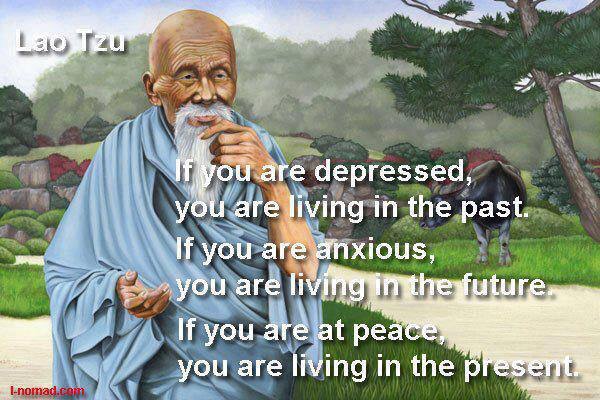
Lao Tzu

When I live in the present moment, that is when I can find peace. #mindfulness #LaoTzu

nelsonRN's avatarA Dose A Day

View original post

Change

Yesterday I was clever, so I wanted to change the world. Today I am wise, so I am changing myself. ― Rumi

Source: Change

I enjoy Rumi. He wrote poetry that yielded lasting messages.

We live in a world where people want to change the world, rather than themselves. However, the world changes when we change ourselves. I transform and move beyond who I was, even the second before. As I change, my view of the world shifts and the world appears new to me.

It reminds me of Marcel Proust‘s quote: “The real voyage of discovery consists not in seeking new landscapes, but in having new eyes.”

Leaders who believe they can change the world for others are mere managers. Leaders change the world for themselves and invite others to join them in sharing their view of the world. There are not two identical views.

Looking for the Differences

Tom Hennen wrote about the differences that can fill our senses each day. Sometimes, humans do not notice what is different as differences can hide in nooks and crannies of our daily lives. When we do sense the differences, they can excite our senses and call us to take care around them. In their daily existences, these things are “royalty in their own country.”

The words thing and objects used in the poem can be replaced by persons and subjects. How many people do we miss and avoid, because they look, speak, and act differently? There is a strangeness in the royalty of the other that calls upon us to question not them, but our self.

Hans-Georg Gadamer suggested that when some one or something different shows itself humans pull up short. Jacques Derrida and Emmanuel Levinas wrote that when the stranger appears at the door the host is faced with a paradox of unconditional responsiblity and risk. When we greet the stranger and what is different, we do so with uncertainty. The words host, hospitality, and hostile share etymological roots. We cannot know in advance who and what strangers represent when we greet them, but in Abrahamic tradition (Judaism, Christianity, and Islam), the host is responsible for the care and well-being of that stranger.

Perhaps in being attentive and mindful to the world we exist in, we can better serve the stranger and what is strange when they appear.

I am struck by the otherness of things rather than their sameness.

The way a tiny pile of snow perches in the crook of a branch in the

tall pine, away by itself, high enough not to be noticed by people,

out of reach of stray dogs. It leans against the scaly pine bark, busy

at some existence that does not need me.

It is the differences of objects that I love, that lift me toward the rest

of the universe, that amaze me. That each thing on earth has its own

soul, its own life, that each tree, each clod is filled with the mud of

its own star. I watch where I step and see that the fallen leaf, old

broken grass, an icy stone are placed in exactly the right spot on the

earth, carefully, royalty in their own country.

Sonnet XIV from The Sonnets To Orpheus by Rainer Maria Rilke

Reblogged on WordPress.com

Source: Sonnet XIV from The Sonnets To Orpheus by Rainer Maria Rilke

The last two stanzas challenge us to think about whether our roles are submissive and passive affairs or ones where we have some mastery and active choice. My mother used to tell us that we had free choice and had to accept responsibility for the consequences of those choices. She told us we are not empty vessels created by God, whatever that belief is, but responsible people with free choice.

The liberty of others and their choices constrains our personal liberty. Without differences, life would be a boring space without room for creativity and growth, a moving to the surface that is fraught with potential challenges.

Similar to the plants in Rilke‘s poem, we face obstacles and constraints. We exist and flourish within those constraints when we find the proper paths to live lives fully. It is no easy task, but one that can bring great fulfillment. When care for and tend to those paths, our lives become filled with vigour, often flourishing because of the lessons learned from finding those paths.