Tag Archives: conversational journey

Dreamers

I thought about some violence we experience in the world. The last few days it is that theme that has drawn me in my writing.

The word compassion comes from sharing a love of something and the suffering that comes from sharing. The word companion comes from sharing a meal, usually on a journey with others.

We have more in common than makes us different. It is differences that make us unique. The ancient concept of common sense (sensus communis) was what a community shared and held in common, to be passed on to the next generation.

With violence, what do we think we are passing on to the next generation? I would like to think we pass on the good we have in common, the sharing of things we love and suffer with, and we will stop for a meal with each other in times we feel strife.

New emerges and we replace what is outdated and unnecessary, but more remains than we replace when we are mindful and attentive to the world we share.

We are dreamers,

Imagining what might be,

Wondering what could be,

Wondering, “who do we share with?”

In suffering and loving,

Experiencing (com)passion.

In moments of passion,

We share with one another,

Delighting us in one moment,

In the next, suffering together

(Com)panions sharing our daily bread.

The Real Work

I was laid up for the last few days. I have allergies and this time of the year is always a challenge. I think I picked up a bug to give me a double-whammy. I slept a good part of Friday and Saturday and, on Sunday, was upright for most of the day.

I am not sure if I will post later. While sitting upright and not doing much else on Sunday, this Wendell Berry poem kept poking at me.

Living is paradoxical. Parker Palmer described how this creates tension in living. Just as we think everything is as it should be, something pokes at us and unsettles us, calling on us to begin our real work and commencing the real journey. Being mindful and attentive remind us to be still and look below the surface of what is happening.

It may be that when we no longer know what to do
we have come our real work,

and that when we no longer know which way to go
we have come to our real journey.

The mind that is not baffled is not employed.

The impeded stream is the one that sings.

This is Athabasca Falls. The river upstream is quite wide and as it comes around the corner suddenly narrows. In Wendell Berry’s poem, it is impeded and creates a great force that carves out solid granite.

Silence of Poetry

Current shares the same etymological roots as curriculum: currere.

How we make meaning of living is like the spaces between words in a poem. It is in silence that meaning emerges. It flows between the words and stanzas.

We need silence in our lives to find meaning. It is standing on the edge of a mountain lake without others. There is a peace there.

“We are all visitors to this time, this place. We are just passing through. Our purpose here is to observe, to learn, to grow, to love… and then we return home.” Aboriginal Proverb

Living is a text,

Traveling through time and space,

Leaving others to ponder meaning;

A meaning that is never whole.

Engulfed in silence,

Emerging from a peace(ful) moment,

One’s inner voice speaks;

As if an other speaks.

Wrapped in meditative moments

When silence is a poem,

Bringing the text to life;

Sending it on its way again.


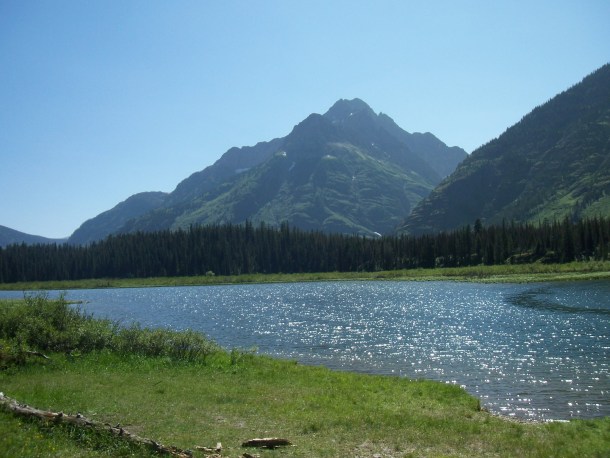
This is a small lake we walked to in Glacier National Park.

Eloquence of Ambiguity

Language matters. Yesterday, I read a post on an educational blog. Essentially, the person argued that “data driven education” was stupid and education was “child driven.” I accept children make choices about what they learn. As a teacher, I used data, including their choices, to inform how I taught.

What I understood demeaned anyone who spoke differently than this person. It is in pluralism and diversity the essence of eloquent ambiguity that we appreciate the world and receive gifts.

Most people accept a world that is grey and their language appreciates the eloquence of ambiguity. Language has a way of fixing things as if they were more permanent. It is the capacity of humans to interpret and re-interpret that brings forth the elegance of the world.

Appreciate the world as it is

It does not arrive pre-packaged.

Embrace uncertainty and ambiguity

Let its eloquence emerge.

Open your heart

Receive unimaginable beauty.

There are no pat answers

Only an internal compass that guides you.

This is a path in Waterton Lakes National Park. A person only sees a short distance ahead when walking a path. What comes next is uncertain.

Driftwood

I am back. The retreat was enjoyable and tiring. Although it was called a retreat, it was different in the sense that it involved research, writing, and lots of conversation. I find retreats invigorating. They are not sit, listen, and try taking notes as a speaker blasts through their presentation.

Retreats have a conversational part. Parker Palmer counsels people at his retreats not to take notes. Instead, we spend time writing and conversing how we feel about various prompts. That was a purpose of this retreat. It is the Currere Exchange.

Currere is the etymological root of curriculum, meaning to run the course of one’s life. It is a subjective way of interpreting a planned curriculum in a school. Whether teachers understand it or not, they are doing this continuously. As one of my co-researchers told me we make decisions about what to teach and leave things out we really like.

In a sense, currere is polishing a planned curriculum. It is a multi-faceted and complicated conversation between a person (re)membering their lived-experiences, aspire to a particular way of teaching in the future, and synthesize those two moments into the present. Each moment acts as a curriculum to inform the other, complicating one’s teaching in a dialogic way. Others enter the classroom and add to the complicated nature of the conversation, each adding their curriculum to the dialogue. It is like a piece of driftwood, being polished by the forces it comes in contact with.

My story being polished,

I (re)member and imagine;

Washed up on a new shore,

Who I am reflected anew.

I am a character in my story,

I pause a moment,

Noting lustre and matte,

Interpreting new meanings.

Soaking in the contours of living,

Experiencing new awakenings,

Running the course of my life,

Each new moment polishing me afresh.

Kathy took this picture in Waterton Lakes National Park.


Think Different

This poem, writen by Rob Siltanen, was part of an early Apple advertising campaign. He was a creative director for the company.

It stands out for me, because it echoed a phrase that emerged from my dissertation: “Differences make a difference.” It is in difference we discover what makes us each exceptional. Without the differences, we blend into an indistinguishable mass mere copies of one another. Worse yet, we might only copy the worst of the people we see succeeding.

The poem reminds of the Michelangelo quote: “Every block of stone has a statue inside it and it is the task of the sculptor to discover it.”

To be a teacher, is to inspire and allow each student to discover who they are. It is to be mindful and sensitive to what makes each of them different. It is to both serve and lead at the same time. It is to be different one’s self, as a teacher. How else could a teacher inspire?

The misfits.

The rebels.

The troublemakers.

The round pegs in the square holes.

The ones who see things differently.

They’re not fond of rules.

And they have no respect for the status quo.

You can praise them, disagree with them, quote them,

glorify or vilify them.

About the only thing you can’t do is ignore them.

Because they change things.

They invent. They imagine. They heal.

They explore. They create. They inspire.

They push the human race forward.

Maybe they have to be crazy.

How else can you stare at an empty canvas and see a work of art?

Or sit in silence and hear a song that’s never been written?

Or gaze at a red planet and see a laboratory on wheels?

And while some may see them as the crazy ones,

While we see genius.

Because the people who are crazy enough to think

they can change the world, are the ones who do.”


On Wiesel’s Night

Several years before I retired from teaching, a family approached me and asked me to tutor their child. Usually, I don’t tutor. Too often, it is about prepping for a test and is too rote for me.

After talking with the family and student, I agreed. The student was behind in some courses and wanted to be ready to transition from home schooling to attending high school full-time.

I helped her mostly in Math and Language Arts. I approach Language Arts through a cross subject method. I choose a novel and prepare a novel study. The students demonstrate comprehension, writing, grammatical, and other skills, instead of drill and kill method.

We discussed several possible choices for a novel study and decided on Elie Wiesel‘s Night, which is an autobiographical narrative of his time as a teenager in Nazi concentration camps with his family. I warned the student it was a tough read, but she insisted on the book. I asked her to read only assigned chapters and keep a journal.

The next week, she asked a question and confessed she read the whole book in one sitting. She asked if was OK to cry when doing a novel study. I said it was. We adapted and went through the book in a different way.

What I learned from that experience, is as hard as we try, as parents and teachers, there are things we cannot prepare children for in advance. This poem by Thomas E. Thornton, who was a teacher, echoed those sentiments. The poem is hard to read, but he wanted to impress upon students an appreciation for the horrors and violence of war.

I cannot teach this book.  Instead,

I drop copies on their desks,

like bombs on sleeping towns,

and let them read.  So do I, again.

The stench rises from the page

and chokes my throat.

The ghosts of burning babies

haunt my eyes.

And that bouncing baton,

that pointer of Death,

stabs me in the heart

as it sends his mother

to the blackening sky.

Nothing is destroyed

the laws of science say,

only changed.

The millions transformed into

precious smoke ride the wind

to fill our lungs and hearts

with their cries.

No, I cannot teach this book.

I simply want the words

to burn their comfortable souls

and leave them scarred for life.


A Vision

I am preparing to go to Miami of Ohio to attend a writing retreat. It is a curriculum theory called currere, which is the root word for curriculum and is an infinitive verb meaning to run the course of one’s life.

Currere overlaps with the methodology, hermeneutic phenomenology I used in my writing my dissertation. The two are reflective, explore one’s lived-experiences, and interpret them as data . After a person reflects on a lived-experience, they imagine how it might inform their teaching. They create a vision of the past and future in a way to create a vision for the present.

William Pinar compared this process to photographs that gain clarity as they develop. I had not used the method, but referenced Dr. Pinar’s work and he was on my dissertation committee.

Part of the process of preparing has been to use the method of currere. As I wrote, read, and reflected this Wendell Berry poem came into my view. Even though I am not teaching, I wanted to create a vision of what the wisdom might be like. As a young teacher, I can envision having used the process as a way to survive, to be still, enrich my teaching and student learning, and creating a memory native to my teaching. As Wendell Berry says, it was a paradisal dream. Hard work never is. It is its own reward.

If we will have the wisdom to survive,

to stand like slow-growing trees

on a ruined place, renewing, enriching it,

if we make our seasons welcome here,

asking not too much of earth or heaven,

then a long time after we are dead

the lives our lives prepare will live

here, their houses strongly placed

upon the valley sides, fields and gardens

rich in the windows. The river will run

clear, as we will never know it,

and over it, birdsong like a canopy.

On the levels of the hills will be

green meadows, stock bells in noon shade.

On the steeps where greed and ignorance

            cut down

the old forest, an old forest will stand,

its rich leaf-fall drifting its roots.

The veins of forgotten springs will have

            opened..

Families will be singing in their fields.

In the voices they will hear a music

risen out of the ground. They will take

nothing from the ground they will not

            return,

whatever the grief at parting. Memory,

native to this valley, will spread over it

like a grove, and memory will grow

into a legend, legend into song, song

into sacrament. The abundance of this

            place,

the songs of its people and its birds,

will be health and wisdom and indwelling

light. This is no paradisal dream.

Its hardship is its possibilities.

“CO-EXISTING”

Source: “CO-EXISTING”

After I posted There was a time I would reject those, Jonathan wrote this poem and shared a similar view of the world that Ibn ‘Arabi presented in his poem.

Jonathan is a prolific blogger who has re-blogged many posts of other bloggers. I was happy he wrote this poem, because it gave me an opportunity to return his kindness.

When I am aware of and accept differences around me, the possibilities of violence diminish. I do not control the other and their actions, but turning swords into ploughshares (Isiah 2:4) can reduce the possibilities.

Living in community means to reach out to one another in good and bad times. Each person is called on to lead in their particular way. They are mindful and attentive to the other person and communicate with them in meaningful, thoughtful ways.

Miracles

Again, today I jotted some notes in a small coffee shop while sipping tea. I thought how  counsels that each moment reveals the extraordinary. When we are mindful and sensitive to those moments we lift them up and they are miracles happening around us all the time.

I taught a student who had Fetal Alcohol Syndrome. He was a sweet young man and I made sure I was at school to greet him each morning as he got off the bus. One morning, he got off the bus and was wearing a fedora. I greeted by saying “hi boss!” I told him looked like Frank Sinatra. He had no idea who that was, so I found videos and played Frank Sinatra. Whenever that student wore his fedora, I greeted him as the boss. He smiled as it seemed to mean something more than ordinary.

When I am not attentive and mindful, I miss many opportunities. It reminds me of Maya Angelou‘s quote: “A friend may be waiting behind a stranger’s face.”

What do I walk past?

It seems ordinary in passing;

Yet, looking deeper

I see it:

The (extra)ordinary.

The ordinary unfolds

Revealing its extra-ness

Its depth and breadth

Richness hiding in plain sight.

A moment holds miracles

Waiting to show themselves off

Asking to be seen with new eyes

Sharing their more-ness.

I took this picture in Glacier National Park. The driftwood was polished and on the beach of the lake we were hiking around. What do I not see and hear? It is in the story of how this driftwood ended up here.