Tag Archives: education

Teaching on the Margins

Last week, I wrote Mojo Gathers Momentum. A gift of my journey to Bainbridge was the realization I had lost the belief I was a good teacher. I have never believed this was my place to speak to that. There is a certain humility a teacher should have and extends beyond patting myself on the back. What I do know and recognize is I am different teacher. I have modeled my approach after teachers I believed operated on the margins and accepted that is their place. It was a place that they could do more good for students and the communities we live in.

false security

when hidden

yet, fully surrounded–

paradox of my humanness.

stand out

reveal blemishes

make them obvious

revel in them.

great teachers

found comfort on the margins

not hidden in the crowd

stepped out with pride.

humanness lived;

so fully

it reveals imperfections

for I am human, after all.

Do Pigs Have Udders?

I had some serious fun today with students. I was alone which is not the norm, but, on short notice, the parent helper could not make it. It is extra demanding on those days where I learn alone with the kids, but it is, many times, the  most interesting times. While I was away a most interesting question came up: “Do pigs have udders?” Apparently, this was a hotly debated topic and it was brought up again today. I laughed. It was funny and pointed to an irrevocable truth: human curiosity and eloquent questions lead the way as we learn.

A simple question

Eloquently posed

Curiosity fueled;

The energy behind learning.

What does that mean?

Is it true?

Many more queries;

We seek and fill gaps–

Not with certitude;

Uncertainty prevails.

Years later

I am sure I will smile and chuckle;

I recall–

Appreciate the quality

A simple, provocative question–

Do pigs have udders?

As best as we can learn, they do and it was fun trying to figure it out. Adolescent children ask the darnedest things. Laughter is a great cure for even the most challenging moments.

Dance of the Soul

Kathy and I went to the farm yesterday and shared Thanksgiving with Kathy’s niece. We took advantage of a nice day for a walk to the old house and down to a slough on the property. Along the way, we came across a doe. She was skittish and it took time and effort to get a picture. It is hunting season in Alberta so that might be part of the skittishness, but, also this doe has a young one. We did not see the spring fawn, but the mother would stand, watch us, and, then take off, probably reassuring herself the fawn was safe and she served as a distraction.

It reminded me of Parker Palmer‘s book,The Hidden Wholeness. He compared the soul to a shy animal. Last Friday, during professional development, after a reference to the spiritual nature of life, I pointed out to a person spirituality is personal and private tentatively shared with our self first and, afterwards, with those we are closest to. I persisted and hope I left food for thought.

As Kathy and I walked, the deer reappeared several times and, despite attempts at being quiet and still, the deer remained shy and reluctant.

I sit quietly, with occasional great stillness, and my spirit, like the deer, runs for cover. In the midst of strangers and intruders, what else could be expected at moments of vulnerability like the hunting season or when we look to protect that which is closest to us.

Quiet and still

Camouflaged and vigilant

Remains in safe haven

Hidden from view

Protects the important

Distracts the intruders

Returns to its child.

I sit

Wait patiently

Soul peeks shyly

Moves tentatively

Waits for safety

Reveals itself in that moment

A dance repeated.

Look closely. The poplar and the spruce in the foreground frame her in the background.

From Earth, Fire and Water by William Butler Yeats

Today, an interesting thing happened. All three grades are at key points in Science. The Grade 8 class was learning and applying the equation for density. They were completing a worksheet, but got bogged down with the equation when it was not straightforward and had to think algebraically. I was moving between the Grade 7 and 9 tables and looked up. There was a colleague who had stopped by on her day off helping the Grade 8 students and the parent helper. I had not asked for help; it arrived in the quiet and I thought of this poem.

We can make our own minds so like still water

that beings gather about us that they may see,

it may be, their own images,

and so live for a moment with a clearer,

perhaps even with a fiercer life

because of our quiet.

The Soul’s Choice

It was cool, rainy, and windy at times today. We are going to go through a couple of days of below seasonal and bounce back on the weekend. Today, a new parent was the parent-helper. She did a wonderful job and told me how much her child was enjoying our little corner of paradise. It warmed the heart on a dreary day.

The day broke

Cool and wet

Grey.

Able to dampen one’s spirit;

If allowed–

And let the dull prevail.

A glow emerged

Warmth radiates

Revealed in community.

In communal spirit

Discover my world

Leads me forward.

The Root of Extraordinary

Friday I spend without students, at least for now. There are rumours teaching four core junior high subjects is not enough. Apparently, I don’t need time to plan, mark, complete report cards, and other sundry tasks which keep the classroom humming.

I work hard to stay positive. Sometimes the tendency is to create negative narratives rather than let each moment live itself fully. I find this is hard work, but it grows easier to set aside the dis-ease.

Alone is different

Not loneliness.

In solitude

Gifts of deep silence

The presence of presents

I grow whole

Energize the spirit

Recollect the ordinary in extraordinary–

Not just a root word;

It is the root.

The Unplanned, yet Orchestrated

I promised as I approached the school year:”I would experience the year and live it to the fullest with the students.” Today, this resolve was tested. Due to illnesses and other situations, the number of students dwindled to a handful. I decided to set lesson plans aside and just went with the flow this afternoon. It was an excellent choice. We enjoyed ourselves.

I used Kerpoof Studio, a site for reluctant writers. Students created stories as short animated films. At times, we were silent; while other times we shared and laughed. They helped each other with new technology and I learned right along with them. We had fun.

As I walked the river valley today, I reflected on the unplanned and the rewards offered in and by those moments.

Life–

What is it?

Moments separate;

Yet connected

Unplanned;

Yet orchestrated somehow

Beyond understanding.

Life–

An unmarked journey

Occasional missteps.

Hope against hope

Can I see around corners?

Over hills?

No,

So, accept faith

Feel, sense, rather than see

A gentle hand

A soft light illuminates each experience;

Each step in life.

A Time of Rest

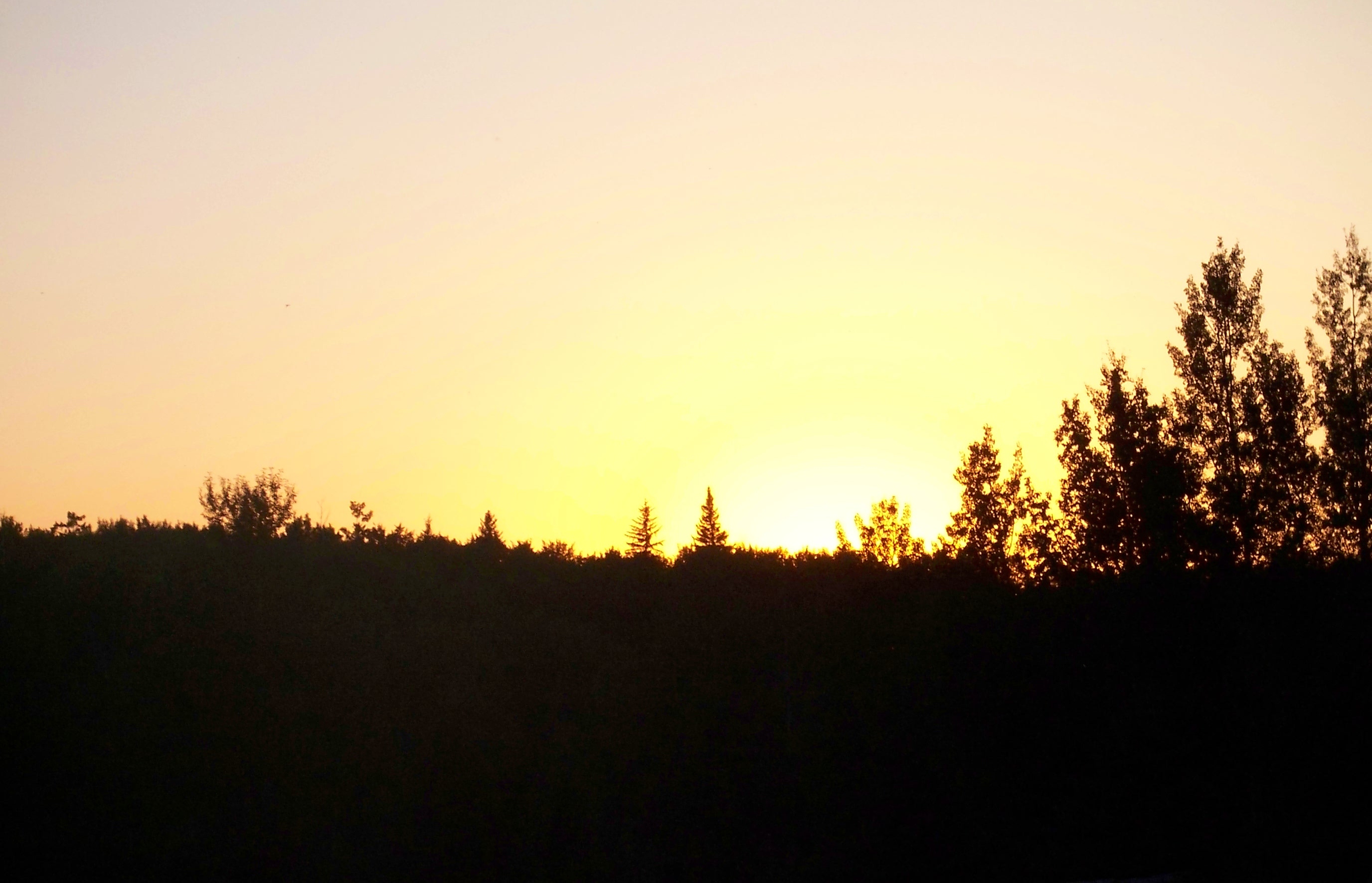
Kathy took this picture last weekend. They finished a day cleaning the farmhouse and it is livable. The sun, after a dreary day, appeared and the sky was awash with golden rays. I feel this way in the classroom. I love what I do. I am whole and find voice. I am a learner, a teacher, and the two are inseparable, but I remind my self to be mindful and give thanks.

Fleetingly framed

Trees against golden skyline

Nature paints day’s end.

Glorious moment

Sky awash with golden light

I am fulfilled.

Conversation Circles

In our classroom, we use a conversation circle. I use it as a time to clarify things from my perspective and allow students to speak about what they would like to do. At other times, we talk about upcoming events. Today in the conversation circle, each student introduced themselves to the group, which seems like a small thing, but sometimes goes unattended in classrooms.   I also asked the students about what they want for complementary courses. This is an outgrowth of the conversation circles we held last year. Students want a voice in their learning.

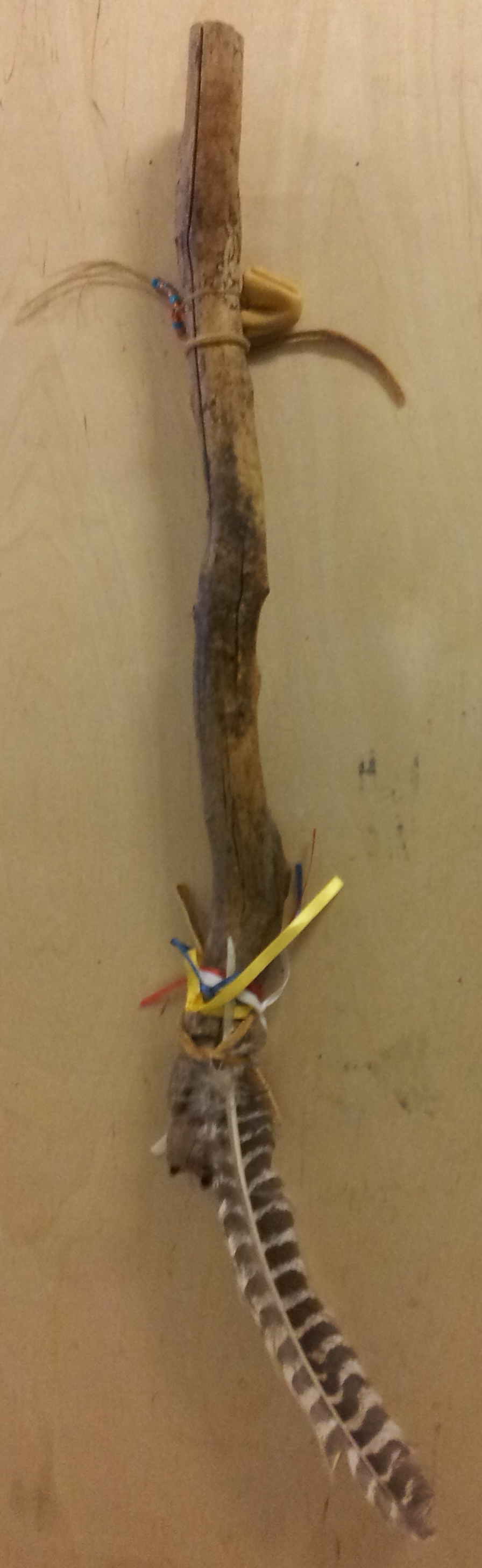
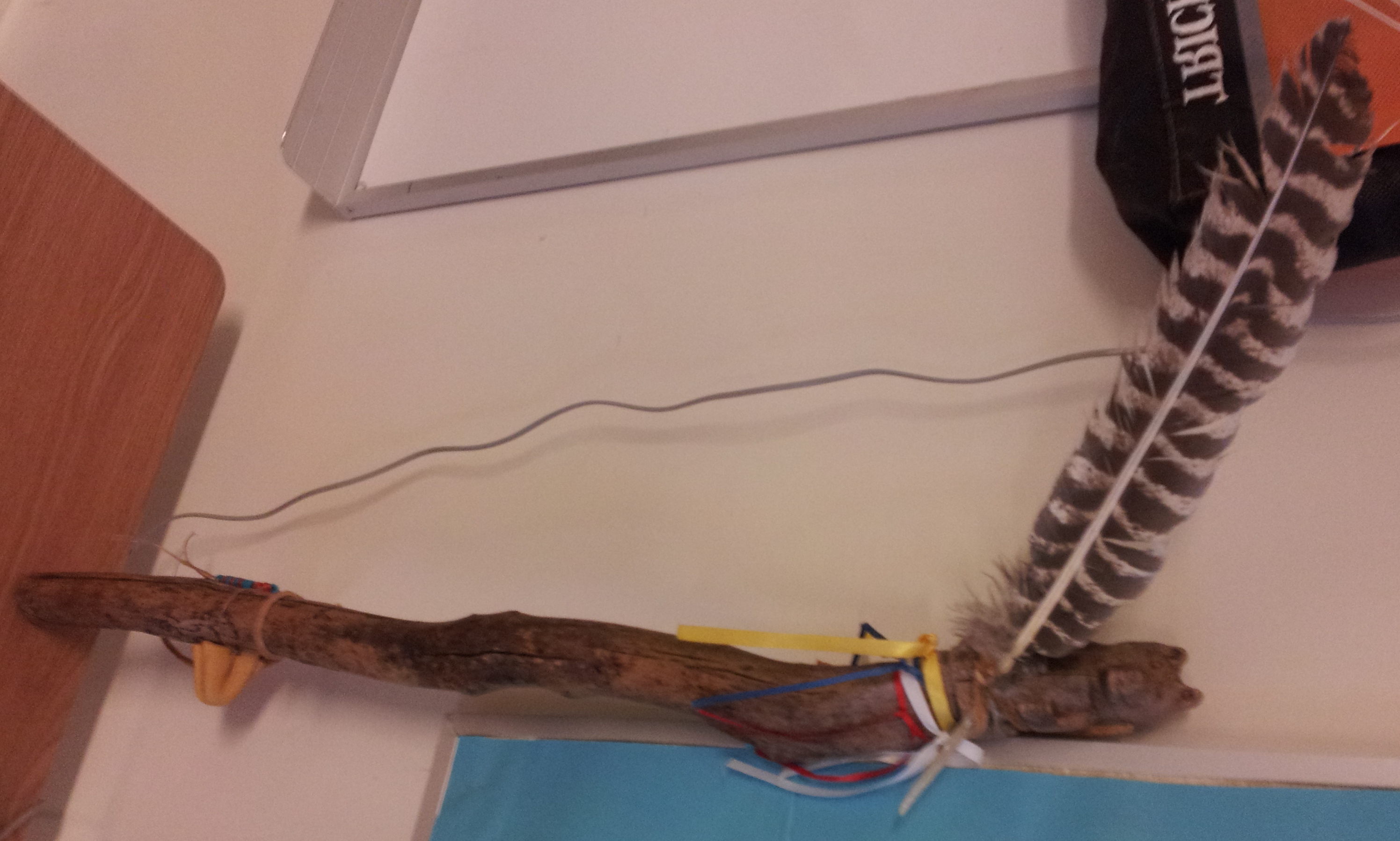
We use a ‘talking stick.’ The person with the ‘talking stick’ is the speaker and others listen. In an era of digital technologies, the stick reinforces a protocol of face-to-face conversation which we increasingly need in our world. The ‘talking stick’ was a gift from a parent last year. She is a member of a First Nation so it has some traditional meaning attached to its design.

The wood is driftwood which came from a local lake and reflects nature’s contributions to the circle. Someone carved a bear head into the top of the stick. In some traditions, the bear symbolizes courage, freedom, and power. The feather is from a hawk. Hawks are visionary and guide the person. The coloured ribbons represent the four directions in the circle. The parent attached a medicine bag. The medicine bag heals, guides and protects, and has materials or objects of value to its carrier.

Why Write Poetry

Yesterday, I read a haiku written by someone who appeared to not enjoy writing haiku. Despite this, the person wrote an interesting, amusing, and thought-provoking poem.

I am not sure this is verbatim but it goes somewhat like this:

Here are five syllables

And here I write seven more!

Are you happy now?

The person who presented this poem indicated that despite having written haiku they were unsure why teachers wanted them written. I think there are good reasons, but I could be wrong.

1. Poetry calls for the best possible word choices. Most poetry is simultaneously spare and spacious. The spareness is in the number of words; the fewer the better. The space allows the reader room for interpretation. What did the poet mean? What senses are invoked through the word choice.

Words chosen

Describe my moment.

No two experiences identical

A jungle of meaning revealed.

Each sense sameness different

Worlds bridged.

2. Students learn about figures of speech and their importance in expressing what we want to say. We can compare unlike things and make sense of a complex world.

3. I tell students who struggle with reading and writing poetry is an alternative way of expressing themselves. I use ee cummings as a model so they overcome their worries about grammar, spelling, and capitalization.

i dig ee cummings

no punctuation

no capitols

won’t worry about spellin either

no sweat

aint no problem

i write poetry

4. I enjoy poetry. I always have. I remember a poem, The Elevator, I memorized in Grade 4. I think it Walter de la Mare wrote it. My friend memorized a poem called Douglas Fir, because his name was Douglas. What my enjoyment means, is I bring enthusiasm to the process.

I believe we need to tell students what they are learning and the reasons they are important. But, then it might just be me.