Tag Archives: education

Ode to Grandma’s Socks

They are really my socks. They do not fit inside of any shoes or boots I own, so, technically, they might not qualify as socks, but as slippers. On cold winter mornings, I wear them around the house. What makes them interesting? I am glad you asked.

These were Christmas gifts. Kathy’s grandmother made them for us. We always knew after the first person opened their gift from Grandma what we were each receiving that year. That part never changed. What made each year’s gift deserving of an ode, was the time and generosity sewn, crafted, or knitted into the gifts. We also wanted to know what package our gift came in that year.

Grandma was a thrifty, frugal woman, not cheap. She lived and raised children in cabins almost her entire adult life. Their isolated homestead was on the McLeod River south and west of Edson, Alberta. She worked a trap line into her 80’s with the help of children and grandchildren. She worked hard and had little in terms of material wealth, but she gave gifts made by hand and given from the heart. Part of her thrift was the packaging of each gift. I think, after several years, it became part of a game, too. She packed gifts in macaroni, spaghetti, and cereal boxes. Even the adults thrived on this part of the gift-giving. What was our gift packed in that year?
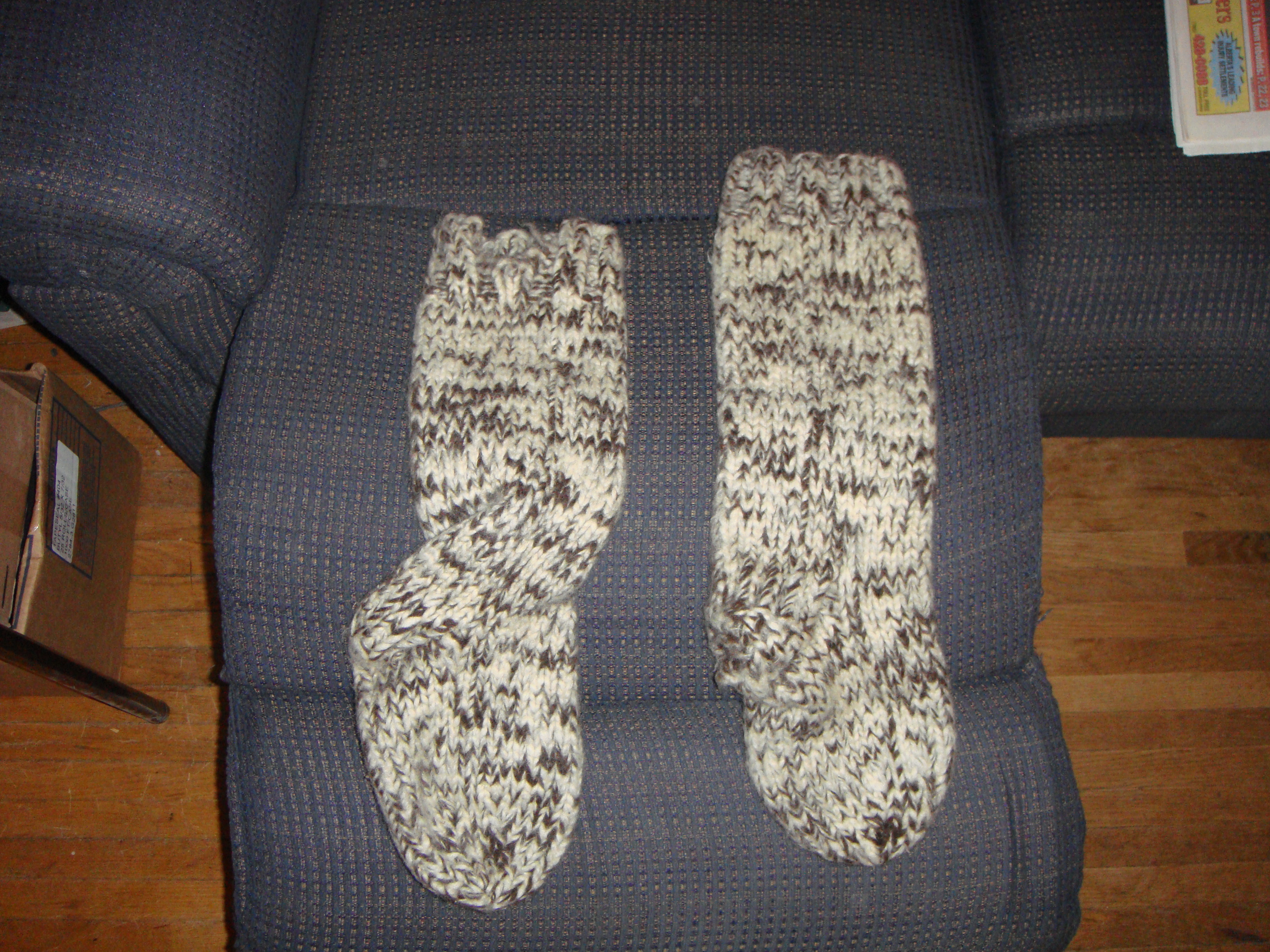
When I share Pablo Neruda’s Ode to My Socks with students, I tell this story. Children and adolescents need the figurative message made concrete. This poem is about moving life’s supposedly ordinary events to the extraordinary. Students often recount a gift given or received from the heart after my story. It moves the context of daily life forward from the ordinary, and makes it rich. Beauty is twice beauty, after all.

Ode to My Socks

Mara Mori brought me
a pair of socks
which she knitted herself
with her sheepherder’s hands,
two socks as soft as rabbits.
I slipped my feet into them
as if they were two cases
knitted with threads of twilight and goatskin,
Violent socks,
my feet were two fish made of wool,
two long sharks
sea blue, shot through
by one golden thread,
two immense blackbirds,
two cannons,
my feet were honored in this way
by these heavenly socks.
They were so handsome for the first time
my feet seemed to me unacceptable
like two decrepit firemen,
firemen unworthy of that woven fire,
of those glowing socks.

Nevertheless, I resisted the sharp temptation
to save them somewhere as schoolboys
keep fireflies,
as learned men collect
sacred texts,
I resisted the mad impulse to put them
in a golden cage and each day give them
birdseed and pieces of pink melon.
Like explorers in the jungle
who hand over the very rare green deer
to the spit and eat it with remorse,
I stretched out my feet and pulled on
the magnificent socks and then my shoes.

The moral of my ode is this:
beauty is twice beauty
and what is good is doubly good
when it is a matter of two socks
made of wool in winter.

Pablo Neruda

Diane Ravitch is a leading American educator. Although what happens south of the border is not important to us, this article poses a great question. Who is advantaged; those with resources or those without resources? Servant-leadership, which is lost in education, asks the leader to serve those around him or her and help them grow. That focus increases for the most disadvantaged. When will politicians, bureaucrats, and technocrats allow teachers in the classroom to become leaders who serve students and the community?

dianeravitch's avatarDiane Ravitch's blog

Mitt Romney launched his foray into education by visiting the Universal Bluford charter school in West Philadelphia, an impoverished, largely African-American neighborhood. He went to tout his plan for vouchers and charters as the new civil rights crusade of our era.

While there, thinking he was in friendly territory, he made some unfortunate remarks. First, he asserted that class size wasn’t important. That is no doubt the advice he had received from his advisors, who like to claim that having a “great teacher” is far more important than class size reduction. Then, he advised his listeners that one of the keys to education success is to be a child of a two-parent family. He got called out on both comments.

A music teacher rebuked him on the class size issue, saying: “I can’t think of any teacher in the whole time I’ve been teaching, over 10 years — 13 years —…

View original post 292 more words

Words for the Wise – Partie Deux

Words for the wise was a product of an incident yesterday. I was left exasperated, exhausted, and feeling somewhat unintelligent. I calmed down and found the wisdom shared by Winnie the Pooh helpful in creating a new lesson plan for today’s poetry time, but, first, let me explain the back story from yesterday.

About two months ago, a student brought their scooter to school and was riding it up and down the sidewalk in front of the building we occupy. Our school is located in what was a commercial building our school division acquired. There is no space to scooter in the front of the building, because there is a sidewalk and a parking lot immediately in front of the building. Usually, both are busy so it is an unsafe pastime. Second, students must wear proper equipment i.e. approved helmet, knee pads, and elbow pads. The young man in question is proficient, or so I have been told, so he took the equipment rule as a problem. Frankly, I would to, if I was any good at riding my scooter.

Yesterday, another student brought their scooter to school. While I was occupied, two students, including the aforementioned young man noted, borrowed the scooter and rode it in the parking lot and on the sidewalk while others watched. I was angry; that is the polite way of putting it. I gave some students credit. They recalled explicit instructions about the conditions a scooter could be used i.e. equipment, supervision, and location. Others had forgotten, but it was more likely a situation they were not listening for any number of reasons. This morning I received an email from the young man’s parent saying he informed her he could ride the scooter out back. I am not sure where out back is, because there is no place to ride out back. He left out the equipment and supervision.

Listening, which I think is essential to being responsible for one’s actions and words, seems limited to what a person wants. We listen when we are motivated by words or sounds that are we want to hear. I think that might be human nature. We lack mindfulness and being in the present moment. As luck would have it, sitting on my desk was a William Stafford poem entitled Listening. We had a great conversation after reading it, reflection time, and sharing in pairs.

Listening

My father could hear a little animal step,

or a moth in the dark against the screen,

and every far sound called the listening out

into places where the rest of us had never been.

More spoke to him from the soft wild night

than came to our porch for us on the wind,

we would watch him look up and his face go keen

till the walls of the world flared, widened.

My father heard so much that we still stand

inviting the quiet by turning the face,

waiting for a time when something in the night

will touch us too from that other place.

Thank you William Stafford. Winnie, I was brave and strong enough to tell my students I was listening, but I cannot always do what they want. I simply do not have the power some days and am smart enough to recognize this.

Daily Poetry Lesson Idea

I set aside 30 minutes each day for poetry. A typical lesson plan for junior high or middle school might be as follows:

  • Read the poem and have the students follow along as they listen to it for the first time.
  • Read or ask students to read the poem a second time. Students listen for words, phrases, or elements which catch their ear.
  • Students quietly take a few minutes to highlight or underline key words, phrases, or literary elements.
  • Students quietly share the key words, phrases, or literary elements with one or two classmates. Did they enjoy the poem? Why or why not? I ask them for specific responses. It sucks or was interesting needs support.
  • We come together and share. What stood out? What literary elements did the poet use and what did they add to the poem?
  • What were the literal and figurative messages of the poem?

Students are invited to share their favourite poems.  One student shared Do Not Go Gentle into that Good Night by Dylan Thomas and another Mr. Nobody by Walter de la Mare. I used the latter poem for a conversation about responsibility.

Students sometimes are reluctant to write poetry. I use Pablo Neruda’s Ode to My Socks as an example of a poem about a mundane object, a pair of socks, and how this poem transforms the socks with rich and vibrant language, similes, and metaphors into something quite extraordinary. A person needs to read or be read this poem to appreciate what makes socks worthy of an ode by a Nobel Prize winner and how everyday objects become subjects for poetry.

When we read The Road not Taken by Robert Frost, the students worked in triads and created collages about the themes they found in this classic poem. The end products were well thought out.

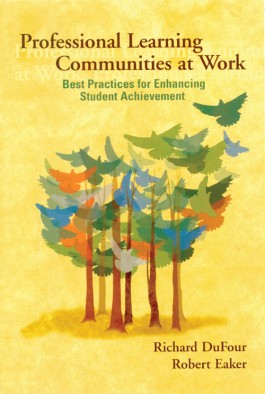
Professional Learning Communities at Work by Dufour and Eaker

I read Professional Learning Communities by Richard Dufour and Robert Eaker several years ago and attended conferences about the concept. We implemented Professional Learning Communities (PLC) in our school with early, but unsustainable success.

Thesis: The authors proposed “the most promising strategy for sustained, substantive school improvement is developing the ability of school personnel to function as professional learning communities” (p. xi).  Professionally, educators need awareness of emerging research to fuel personal learning and support student learning. Communities form and they foster “mutual cooperation, emotional support, and personal growth as [people] work together to achieve what they cannot accomplish alone” (p. xii). Teachers safely move from isolation and risks are taken extending personal and collective learning when a PLC is effectively implemented, integrated, and supported in a school.

CharacteristicsThis is an annotated version, but successful and sustainable PLCs have six characteristics:

  • Shared mission or purpose, shared vision or what we hope to become, and shared values guiding the process. Shared mission advertises purpose outward. Shared vision energizes staff. Values are personal and community attitudes, behaviours, and commitments which are normalized over time.
  • Collective inquiry fuels the process. What do we want to change? What ways are things as they are challenged? There is collective conversation and personal reflection. The latter is the oxygen that breathes new life into the dialogue and provides fuel through new questions.
  • Collaborative teams provide renewal. Collaboration acknowledges the dysfunctional nature of communities. What do we do when there are dissenting voices and disagreement? What value will we name here?
  • Action and experimentation are always in evidence. “Even seemingly chaotic activity is preferred to orderly, passive inaction” (p. 27). Teachers experiment with emergent ideas making innovation essential in a PLC.
  • Everyone commits to continuous improvement. Questions emerge and are actively sought out, but there are touchstones principles such as “What is our fundamental purpose?”
  • With continuous improvement and action orientation there is an iterative process in the form of quantitative, qualitative, or mixed research. The object is to shake up the status quo and find new ways of safely supporting both staff and students. What are we doing that we want to change? (pp. 25-29)

Questions: Who has had success in implementing a PLC in their school or jurisdiction? What were the important takeaways including what worked and what did not work? What did you do to overcome the bumps along the way? What can a school starting or restarting the process do to sustain energy and get early work done successfully while recognizing the achievements even when they are small?

Recommendation: The book is about 300 pages, but is an easy read. The authors synthesized leadership literature inside education i.e. Lezotte, Sergiovanni, and Fullan and outside education i.e. Bennis, Senge, and Deal and Kennedy and saved some reading.

I recommend the book for those ready, willing, and patient enough for a transformative journey. The process requires time and immediate classroom benefits to sustain it. Cultural change is messy and requires leadership, perhaps previously untapped in education. Effective support and communication are required for sustainable, successful results to emerge. Early conversations focused on mission, vision, values and normative behaviours are uncomfortable, but necessary. My questions attempt to flesh out these concerns, as we are embarking on this journey again.

I know schools in Canada, the USA, and internationally have successfully implemented PLCs and I want to draw on the experience and wisdom already in place. I am looking for process and product, but not a cookie cutter formula per se. I look forward to hearing from many of you.

Dufour, R. and Eaker, R. (1998). Professional learning communities at work: Best practices for enhancing student achievement. Bloomington IN: National Educational Services.

Why School by Mike Rose

Why School: Reclaiming Education for All of Us by Mike Rose was a follow-up read to his earlier book Lives on the Boundaries. The latter book explored, in an autobiographical way, Mike Rose’s ascent from growing up in a working class neighbourhood with little support for education at home. He found support from educators along the way and became an educator himself. Professor Rose used a similar biographical method in the current book and explored the purpose of education, different views of intelligence, learning, and knowledge, and the humbling, yet hopeful work, that results from learning.

The general thesis examined a need for a new conversation about the role of public education, one “not dominated by a language of test scores and competitiveness” (p. 4). Professor Rose presented a case for a good education being designed to help us make sense of the world. He argued that parents historically “sent their kids to school for many reasons: intellectual, social, civic, ethical, and aesthetic. Historically, these justifications for schooling have held more importance. Not today” (p. 4). If these reasons no longer hold a time-honoured place in educating our children, then it begs, “What is the purpose of school?”

Questions: What purpose does school serve in a democratic society? I find the object of school reform is not to change school or its purpose, but to simply layer one more fad on an already overloaded system which is ill-equipped to handle it. The result is we are failing many, serving few, and leaving a huge hole in the middle. What should school reformation or transformation look like? I believe this requires a conversation about purpose of school and its structure. Is the present hierarchical, industrial-age model a suitable mechanism to deliver education in the early 21st Century?

Recommendation: I enjoyed the book. It is short and easy to read. Professor Rose provides a view which is different from the mainstream educational reformer and challenges the reader with questions and not answers. I would recommend it to anyone searching for a different view of educational reform.

Responsibility

I wrote about requiring a new culture in education which can lead to a new structure. I created a link to an article in that post and part of the article was an interview with Pasi Sahlberg.

Sahlberg stated, “There’s no word for accountability in Finnish. … Accountability is something that is left when responsibility has been subtracted.”

I understand responsibility as internalized and roles or tasks are conscientiously attended to and accountability is external and forced into place leading to feelings oppressed or alienated. Responsibility is personal or professional competency gained through maturity in a role. Accountability is personal or professional incompetency and immaturity which can  potentially be a result of change or newness in a role. Responsibility emerges in an organization when there is trust and a belief people can grow into and learn their roles. People become responsible because they are supported and cared for while they learn. A collaborative, compassionate culture emerges and subsequently a new structure for relationships to exist emerges.

Do Not Go Gentle Into That Good Night – Dylan Thomas

I sat quietly this morning after another poor night’s sleep. Initially, my ‘monkey mind’ chattered and cast blame to roil the waters and it difficult to find calm. Slowly, my mind became quieter and ideas flowed more easily. First, I asked, “What is causing these uneasy feelings?” I turn to that question more often in times of discomfort and dis-ease and I am often surprised by the answers.

I posted last night about my growing belief a different culture and conversation is needed for educational transformation. We need ‘safe containers’ for conversation about real and lasting change to occur. The change will not duplicate another educational model or be ordered from on high. We serve community needs and needs of children. I am fortunate. I learned and taught in just such a setting alongside colleagues, parents, children, and community members and real change happened through wonderful conversation. The words learned and taught signify a feeling that I rarely felt what we did was work. Life is transient and this place no longer exists except as a cherished memory.

I read a posting through a group I follow on LinkedIn about saying good-bye. The author quoted Dr. Seuss and I know the social commentary this subversive children’s author provided. The message was when the end comes we need to celebrate the accomplishments that led to that ending.  Mark Anielski, an economist, suggested teachers should conduct satisfaction surveys as students graduate, even between grades. When something or someone changes, and this is life, we should celebrate it as a new chapter in life. I can choose the positive over the negative and make a difference in the world I choose as Gen Y Girl suggested. After all, I am not a tree.

Yesterday, a Grade 7 student brought the Dylan Thomas poem in the title to school and asked if I would share it with the class. I asked what it meant to this Grade 7 student, but got no clear answer. I wondered what metaphor of life it offered me? Dylan Thomas wrote it for his dying father, but that is not my case. I sat quietly and the lines “Do not go gentle into that good night” and “Rage, rage against the dying of the light” did offer a life metaphor. When something good changes, my response is critical. Is it one of blame or fault? Was I silenced, or did I choose silence? Did I excommunicate my self. A sad lament of death I see as a request to live my life fully. I lose what I allow to be taken. Is it possible to raise one’s voice in silent protest? I think so, but it is not a silence of retreat, despair, and oppression.

I sat and waited for my inner teacher to share my truth while honouring the truth of others. I leave you with the poem. Choose your metaphor. I choose one of celebration otherwise I live a death, instead of life, due to my choices.

Do not go gentle into that good night,
Old age should burn and rage at close of day;
Rage, rage against the dying of the light.

Though wise men at their end know dark is right,
Because their words had forked no lightning they
Do not go gentle into that good night.

Good men, the last wave by, crying how bright
Their frail deeds might have danced in a green bay,
Rage, rage against the dying of the light.

Wild men who caught and sang the sun in flight,
And learn, too late, they grieved it on its way,
Do not go gentle into that good night.

Grave men, near death, who see with blinding sight
Blind eyes could blaze like meteors and be gay,
Rage, rage against the dying of the light.

And you, my father, there on the sad height,
Curse, bless me now with your fierce tears, I pray.
Do not go gentle into that good night.
Rage, rage against the dying of the light.

Transform Educational Culture and Restructure

Andy Hargreaves introduced me to the Finnish education system, its successes, and what it offers to those educators who believe we need to transform education in our schools and classrooms. It is easy to believe what is done in one setting is a model we can overlay in our schools. There is merit in examining their educational system and applying ideas that might work and make an impact. Pasi Sahlberg, a leading Finnish educator, suggested we, and I include Canada, need to see what equal opportunity in education looks like in What the US can’t learn from Finland.

“Finland can show [us] what equal opportunity looks like, [we] cannot achieve equity without first implementing fundamental changes in [our] school system.” He included equal funding of schools, holistic and equal attention for each child and education as a fundamental human right. Teaching is a valued profession in Finland, local schools write their curriculum, and teachers are given autonomy and trusted to carry out classroom responsibilities.  Although he never openly states it, the implication is that without reimagining education, teacher roles, holistic care of children as the central purpose of education, and the role the entire community plays educating children, real, sustainable change is unattainable. I think it is as important to realize that shifting towards a model of equal opportunity still will not mean our system, whether in Alberta or elsewhere, can or should look identical to Finland’s. What are the needs of our children? This is a central question to the needed conversations.

I think articles, such as What Americans [Canadians] Keep Ignoring About Finland’s School System and From Finland, an Intriguing School-Reform Model, provide more grist for the necessary conversations about transformation in education. With caution, we can use strategies which proved successful in Finland. Linda Darling-Hammond said in the second noted article. “Thirty years ago, Finland’s education system was a mess. It was quite mediocre, very inequitable. It had a lot of features our system has: very top-down testing, extensive tracking, highly variable teachers, and they managed to reboot the whole system.”

Whether as a preemptive strike or to resuscitate a failing system, there is a call to engage communities, reduce competition in schools, recruit and support the best, and trust the people we place with children in classrooms.  We can learn a lot from the Finnish education system.

Junior High Creative Writing Activity: A Fractured Fairy Tale

Children hear and read fairy tales at a young age. When they reach late elementary and junior high school age, they can explore and discover inconsistencies in fairy tales i.e. Goldilocks breaks into the Bears’ house and vandalizes it. Here is a creative writing activity in the form of a parody.

This is the most popular creative writing activity in our junior high class. This plan has worked well for me as a junior high teacher, but I think could be used with upper elementary students. I think it can be modified and meet the needs of younger and older students.

We use Jon Sczieska’s The True Story of the Three Little Pigs by A. Wolf as a model of a parody.

The unit plan includes:

Process

Reading the story to the class and brainstorm differences between the original and this version? Most students are familiar with the original story of The Three Little Pigs, but have it on hand if someone is unfamiliar with the story.

What fairy tales are students familiar with? Brainstorm and create a list. What parodies of fairy tales are they familiar with? Have they seen Shrek? What makes Shrek different from other fairy tales? Students may recognize Shrek as a parody of the genre and has features and structure of a fairy tale while it spoofs the genre in various ways.

What twists can be used to rewrite a fairy tale i.e roles of antagonist and protagonists or plot events? Some examples students have shared include what if the third little pig refused his siblings refuge to teach them a lesson where would they stay?  Could the pigs organize a pig posse to run the wolf out-of-town?  Would they have become ‘ham jam’?  What about the story from the wolf’s perspective?  What if the wolf were a vegan?

What other fairy tales are students familiar with?  Brainstorm and make a list. This helps students choose a fairy tale to rewrite. Choose a familiar fairy tale and brainstorm ways to ‘fracture.’ We have used Cinderella. The list can offer starters for students and could also be used in the parody of another fairy tales. What if…

  • Cinderella has beautiful step sisters?
  • The prince cannot dance?
  • Cinderella is a homebody who likes to cook, sew, and clean and is not interested in attending the ball?
  • The magic wand is defective and does not get the spell right?
  • Cinderella does not want to get married?
  • Cinderella wants a car and not a carriage?
  • Etc…

Brainstorm elements fairy tales share and create a graphic organizer to hand out. Some features have included:

  • Once upon a time…
  • Good vs. evil
  • Beautiful heroine and handsome prince
  • Magic/supernatural
  • Personification
  • …live happily ever after
  • Etc…

Students can ‘fracture’ a fairy tale and change stories in unexpected, clever, and humourous ways by altering characters, modifying language, using a modern context, etc. The fairy tales still remain true to their original forms despite changes.

Here are sites to find fairy tales or refresh memories about the fairy tales students choose: Story Nory, Grimm’s Fairy Tales, and Ivy Joy. Some sites include other genres i.e. fables. Stick to fairy tales as they are well-suited for this project.

Students include an outline or web and a rough draft. Peers or teachers can proofread the story so students can edit.

Final Product

A picture book format is popular. The authors of the picture book can read to their stories to younger students.

Words of caution

  • This is not a yearlong project
  • Students  need to choose something of a manageable length.
  •  Usually the audience is younger. Students should use appropriate language and images, keep the book short i.e 20 pages, and use large font.

Assessment

I use this activity to assess creative writing, sharing orally, and finding appropriate images for the story and the audience. As well, there are brainstorming, proofreading, and editing.

Questions

What engaging writing activities do other teachers use in their classrooms? What changes can be used for older and younger students? What other assessment purposes can you think of for this type of activity?