Tag Archives: eloquent questions

Is It Art?

Last night, I went for a short walk and on the way back sat on a bench overlooking the Spokane River. There are two benches there. I glanced over at the second bench and noticed three pine cones. There is a pattern emerging here: one of me, two benches, and three pine cones. The cones were neatly organized and I wondered who left the art behind. The wonder was strong enough I share the picture and a few lines of poetry.

A gift received

Left by nature in some form

Maybe urban art.

Have a great July 11th, 2012

Cartoon Time along with an Ivon Rant

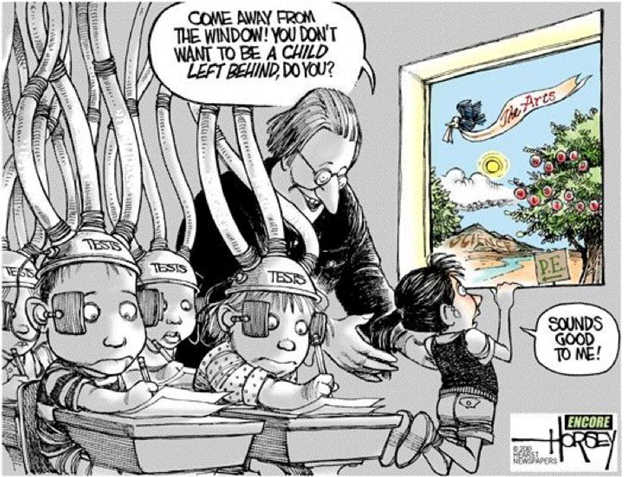
Another Alberta-based educator at The Love of Learning posted this. It reminded me of a Ken Robinson video The Educational Revolution…Why? Because Schools Kill Creativity posted by Gen Y Girl. The video is worth watching several times. The first time I watched the video several years ago an administrator informed me the message was a need to add layers of technology on top of what we are doing.

I am not a neo-Luddite. The original Luddites were not opposed to technology. They opposed potentially catastrophic outcomes blind, thoughtless implementation of technology might have on British society of the time. A message I gleaned was a positive correlation between ADHD/ADD diagnosis and an increase in various forms of imposed, standardized, high stakes testing.

The second message is statistical evidence the highest levels of creativity in school are at the kindergarten levels. After that, it is all down hill.

These are not technology issues, but simply change for the sake of change.

Technology is the artful use of the tools available to us.

Questions: What changes would you suggest for education to make it more child-friendly and child-focused? What can we do to increase the creativity for children in classrooms?

A bit of an American slant to it, but where do Canadian educational systems take their lead from? Is this what we want?

Two Wolves Inside Me Movie – Which Values Will You Feed?

A colleague passed this link on to me and asked I share it. It resonated as I recently posted Naming Values which is similar in theme.

I’m sure you’ve heard it before, but I couldn’t agree more; Life is merely a series of choices. Where you are now can all be linked back to every choice that you’ve made in your life to date. Every day we all make countless choices and each one counts. This is what this short movie is all about via Two Wolves Inside Me Movie.

Enjoy and share.

Are You Okay, God?

I read Seven Lessons of Chaos by John Briggs and David Peat last summer. They used a koan about a ‘hole in the whole’ describing what we do when we analyze things and lose the mystery of the wholeness in life. We break life and its events down, analyze them, and forget to put all the pieces back and lose something vital in the connectedness to the world, leaving a “hole in the whole.” Humans attempt to explain the mystery of life and not embrace it and the richness of our existence. Mystery and spirituality work together. We cannot intellectually explain the fullness and mystery of life. Thomas Merton and Shunryu Suzuki spoke of this attempt as human arrogance.

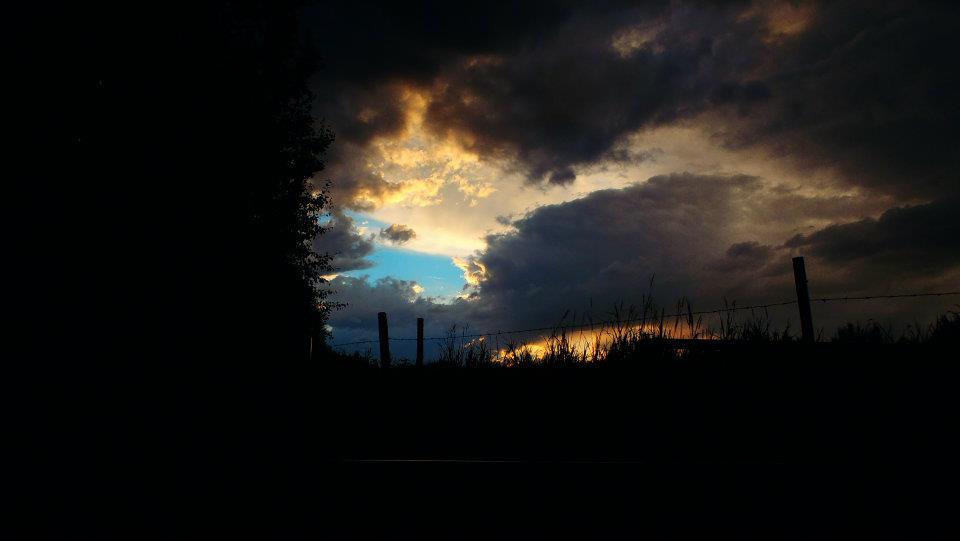
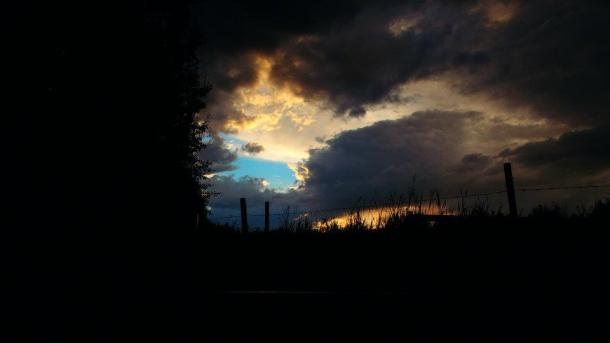
A former student took this picture, again with pretty straightforward phone technology, and the beauty, the richness, and the wholeness it conveyed is powerful. It reminded me of the song we learned as children There is a Hole in My Bucket. The hole in the clouds or bucket could be there for a reason we do not understand. Despite the potential arrogance, I wrote a short poem that might explain the hole.
Sprinting, scrambling, scurrying

Hoping, praying

Feeling hard, cold raindrops

Burning through my clothes

Smelling rain and fear.

Suddenly, blue and gold in the blackness

A light shone

A candle gently flickering.

I whispered, “Thank God!”

I am startled by a voice

“Are you OK, Ivon?”

“I think so.”

“Is that you God?”

“Is the hole to find my way?”

“By the way, thanks for asking. Are you OK?”

A pause

I thought a heard a smile

A sigh for sure, before

“I am now.”

Silence returned

Not falling, just silent

Embracing, reassuring, supporting,

Opening my eyes,

I looked up

I was home

A light shone through the window,

A second haven

Warm, well-lit, welcoming

With voices asking, “Are you OK?”

Saying, “We were worried.”

I wonder if we ever wonder if God is OK?

We should ask every now, and

Listen quietly in the storm for an answer,

It is there.

The 4th of July – An Outsider’s Perspective

Kathy and I spend part of our summers in Spokane and other places south of the US-Canada border. The first time we experienced the Fourth of July, the celebration, camaraderie, and heart-felt patriotism readily evident amazed me.Whatever differences Americans have with each other, are set aside for this day and more. The 4th begins several days before and lasts several days after the 4th. I use the code. One doesn’t say the phrase; saying the 4th is enough. Have a Good 4th means something more than just have a good day.

One summer, in Portland, celebrations continued for several days after the 4th with fireworks displays in the river valley. Another year, we met a family in Yellowstone who had just left Mount Rushmore where about 250, 000 people gathered for the 4th. In Canada, that requires every member of some provinces or territory gather and, sometimes, more invitations need to be sent out to reach that number.

I glanced through Parker Palmer’s latest book, Healing the Heart of Democracy, and found a passage from Leonard Cohen’s song, Democracy. I have listened to this song many times, but re-seeing the words made rethink their meaning, with a beginner’s mind. I often wondered if Cohen portrayed American democracy in a negative light, but seeing the words again I saw something different. It is a hopeful message acknowledging the messiness and awkwardness of democracy at work and that America is a place where the democratic experiment is still happening. America is a place where family exists in the broadest sense and the heart is full and open to democracy.

Imagine if you could make the 4th an every day event, engage everyone, and export the message of hopefulness, patriotism, and democracy well and fully lived, based on the model of the 4th? What a world we would live in!

It’s coming to America first,

the cradle of the best and the worst.

It’s here they got the range

and the machinery for change

and it’s here they got the spiritual thirst.

It’s here the family’s broken

and it’s here the lonely say

that the heart has got to open

in a fundamental way:

Democracy is coming to the U.S.A

This is a picture of some early fireworks we took on the 3rd, 2012.

Have a great 4th

A Little Sunday Morning Humour

While traveling through the Crowsnest Pass. we took a picture of this sign and wondered what was for sale. We were left wondering where the river front was? We have driven by this sign many times and it has never been on dry land. In fact, it has been submerged so only the first two lines were in view: “For Sale 80 Acres.”

I wonder how the sale is going?

Just a little to the east of the sign we noticed two horses grazing, sort of grazing. They seemed OK with the situation.

Enjoy!

pedagogy of the oppressed by Paulo Freire

I read pedagogy of the oppressed by Paulo Freire during my undergraduate experience and return to it as a source of reflection and when I write. Similar to Parker Palmer, Paulo Freire left an indelible mark on my life’s practice. Education is an uplifting, liberating experience which shines light on each step Antonio Machado described: “Wanderer, your footsteps are the road, and nothing more; wanderer, there is no road, the road is made by walking.” Freire’ s contention was everyone can act as an agent in their learning thus freeing them and transforming the world they live in.

Freire used the Portuguese word conscientização which “refers to learning to perceive social, political, and economic contradictions and to take action against the oppressive elements of reality” (17).   Humans become mindful of and present in the world and act to transform it. Freire used a banking metaphor and described traditional education where  knowledge is deposited into students. Teachers and the system act oppressively in determining what is important to learn. Freire felt education uplifted people and their learning. “Liberation is a praxis: the action and reflection of men and women upon their world in order to transform it” (p. 60).  Learning occurs when  compliance and conformity are rejected in favour of dialogue based on love which allows each human to name their world and what is of value in it. The student is a teacher and student; the teacher both student and teacher.

Questions: What can we do to truly bring a new pedagogical structure into our schools and communities of learning? What function would school play in this pedagogical structure? What is dialogue based on love?  What role do educators and communities play in liberation education?

Recommendation: I love the book. It is a challenging, but I return to it often and find something new each time. Today, I became aware of the following: “Concepts such as unity, organization, and struggle are immediately labeled as dangerous. … These concepts are dangerous—to the oppressors” (p. 122). What does this mean in supposedly modern, liberated, and affluent societies?

A second point was the similar language used by Freire and Martin Buber. There is a shared understanding of respectful dialogue using the words I and Thou to describe the uplifting, liberating, loving dialogic process.

Freire, P. (1993). pedagogy of the oppressed. (M. B. Ramos, Trans.).  New York: Continuum.

ivonprefontaine's avatar

Father Day’s

I subscribe to a daily meditation written by Father Richard Rohr. a Franciscan priest.I talk and write about the concept of common sense, which I understand as local and global. Father Rohr cast it from a theological perspective, I think the explanation provides an insight gained without reading Gadamer’s Truth and Method. I believe there is a universal truth or common sense (Vico called this sensus communis), something that makes us all brothers and sisters bringing us together in community. I think Father Rohr offers an explanation though his meditation on Father’s Day helping us to live in community each day. Certainly, Rilke does.

“It is this sense that founds community” (Gadamer, 1989, p. 19).

Gadamer, H-G. (1989). Truth and method. (J. Weinsheimer & D. G. Marshall, Trans.).  New York: Continuum.

Catch only what you’ve thrown yourself, all is

mere skill and little gain;

but when you’re suddenly the catcher of a ball

thrown by an eternal partner

with accurate and measured swing

towards you, to your center, in an arch

from the great bridgebuilding of God;

why catching then becomes a power–

not yours, a world’s.

–Rainier Maria Rilke

Fragmentation

Fragmentation.

This is an interesting, albeit American-based view of the charter system and the overall fragmentation issue of public education. I am not an advocate of reform. That tends to tinker at the edges. I advocate transformation. This requires new conversations at the grassroots. What does public education mean to you, your family, and the community you live in?

Human Resources – A Poem

I often wonder about the language of the workplace. We refer to students as clients and staff in schools as human resources. Reminded me of a song from my youth, The Five Man Electrical Band. They wondered about the increased proliferation of signs and wrote a short note to Jesus about it while stopping in at a church along the way. Enjoy!

A human resources expert appeared

out of a shroud

mist-like.

I recoiled

What’s wrong?

Pleasantly enough asked

seemed off somehow

May be a sinister tone?

Did I say the wrong thing?

Or things?

I wonder

didn’t get the job

not even interviewed for that matter, plus

I got a security escort

wasn’t the first time

Human resources, you say.

Humph

I have questions

to hell with yours

I’ll ask mine

Are we compatible?

Can we date?

Where are humans mined?

do they mind?

What are they worth?

Raw and finished versions

Where is the human factory?

Are they reliable?

Can I get a warranty?

Can you exploit them?

or do they have a mind of their own?

do they mind?

Can we drill for them?

Do they fit in a pipe

To ship them, not smoke them

Do they depreciate?

Like a car, factory, or another normal asset?

a write-off?

or right off?

She seemed confused

perplexed perhaps

That must not have been in the book

I guess?

Tough to get a job

As a human being,

Not a human resource.

No offense intended to human resources people. You have a job to do. I guess.