Here are words to live by offered to us by the German poet Rainer Marie Rilke. Enjoy.
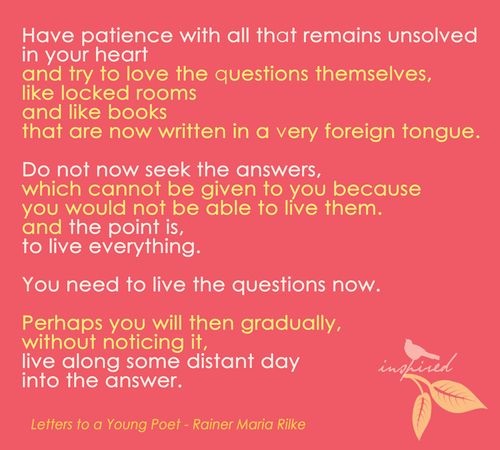
Here are words to live by offered to us by the German poet Rainer Marie Rilke. Enjoy.
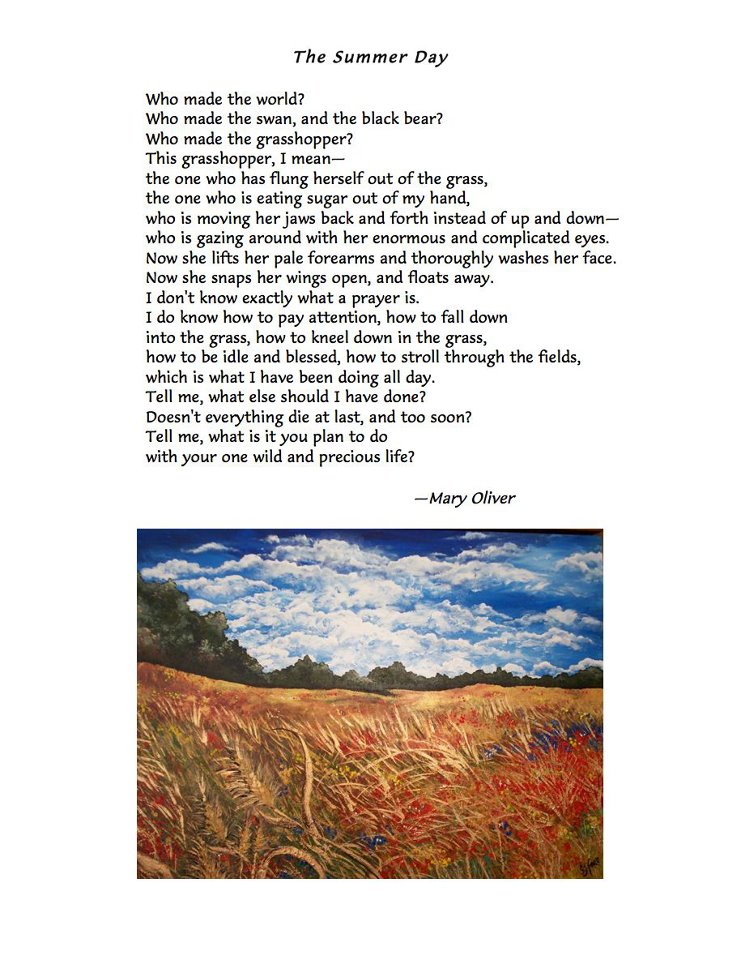
One of my favourite poets is Mary Oliver. Here is one of her poems called A Summer Day. After a weekend of not great weather, it was a timely poem to receive, read, and reflect upon. Mary Oliver, through her poetry, poses such great questions and asks us to take time to enjoy our life. It is the only life we have. Live it well.
I went back and checked my first blog posting of February 2011. Blogging began as a tentative venture and, at times, I felt apprehensive, unsure of my writing and topics. Over time, there is a different feeling in my writing, perhaps simply finding my voice in this medium. The Internet provides a new forum for publishing. We can publish and then edit.
The reversal of publishing and editing roles was a challenge. I want a high quality product when I post for others to read. In those early months, some people advised me that just being out there and taking the risk to be less than perfect was enough. That goes against the grain for me. Recently, I explored and read other blogs with regularity which pushed me to look at other people’s postings and ask questions. Were other bloggers posting with little concern for grammar, spelling, and clarity of message? The answer is an unequivocal, “No!” I toured, read, and saw others’ passion and was impressed with the professionalism with which they approached blogs featuring everything from text to mostly visual to all points in between.
I felt I had something to offer and the blogosphere served a purpose. I enjoy both learning and traveling. It is affirming and energizing to read others’ entries, communicate on them, and receive responses. Pictorial essays people provided took me back to my childhood in Northern Alberta, reading encyclopedias for fun. Even a die-hard hockey fanatic would not venture out when it was -50 degrees below zero with a wind chill. In a pre-TV and computer era, books served as a window to the world. Blogs with pictures of faraway places i.e. Fort Lauderdale, Miami, and Yosemite take me back to the living room in Rycroft reading an encyclopedia and exploring the world.
I am enjoying blogging and I think, most of the time, I am finding it a space that fits my communication. On those occasions, when I slip into dull, pedantic, or obtuse writing, point me back to this cartoon.
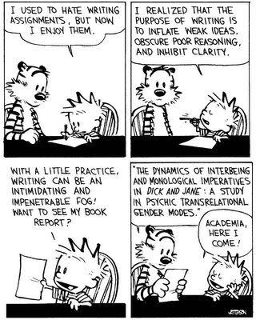
I do tend to stray and can become this writer.
A question was posed about the role of eloquent questions and how they might apply to the concept of Godly Play. I chose to flesh out my thinking on eloquent questions in that context. Eloquent questions lead inquiry into what is important within a community and shared by a community, big or small. Access to the wisdom of past generations gained through questions posed by members of a group. Gadamer in Truth and Method suggested the prudence and eloquence derived from eloquent questions “gives the human will its direction, is the concrete universality represented by the community of a group, a people, a nation. … [Therefore, its] youth demands images for its imagination and for forming its memory.”
I am not expert on the concept of Godly Play, but the questions posed by children in that setting could be understood as eloquent questions. Eloquence, as it relates to language, suggests capacity to articulate questions about those things that are important and people are curious about in their lives. Yes, it could mean being persuasive and convincing, but I think as it applies to inquiry, eloquence has to do with articulating questions crucial to the existence and survival of the group. With this curiosity and wonder, children participating in Godly Play are encouraged to ask wondering questions and are provided with open-ended response time. This last description suggests there is time to consider answers and, over time, to reconsider them.
Gadamer proposed that prejudice guides understanding, but we are aware of the prejudice and the role it plays in understanding. An open-minded stance allows people awareness of their prejudices or personal agendas and not be attached to them. We stay open to accepting new evidence and there is a constant maturing of views and understanding of the world. This stance brings to mind the Buddhist concept of the Beginner’s Mind which Senryu Suzuki defined as “in the beginner’s mind there are many possibilities.” Children benefit from the beginner’s mind and constantly seek to make sense of the world while remaining open to the many possibilities the emerging world holds for them.
This openness and questioning stance leads to the prudence or wisdom that is important to the existence of the group, not only in its present form, but recognizable with each ensuing generation. St. Thomas Aquinas considered prudence in this sense as benevolent and based upon a supernatural good. The community hopes that the children, through their inquiry, will gain the prudence and wisdom to sustain the community through the rhetoric and the words they speak and the intent of their actions. Prudence is not driven by self-interest. That is deceit and cunning. Prudence takes the form of actions that would be well-intended and for the greater good.
Although I lack in-depth expertise in both eloquent questions and Godly Play, Godly Play does seem to encourage children to ask eloquent questions to better understand their community and grow with their community in a prudent way.
Since attending the Servant-Leadership conference at Marylhurst University in Oregon, I am thinking more about eloquent questions in education. Eloquent questions assume no obvious answers and grew out the work of Giambattista Vico, an 18th Century Italian philosopher. Eloquent questions were expanded on by Hans-Georg Gadamer, a 20th Century German philosopher. Without obvious or assumed answers, dialogue and community take on new and important roles in responding to eloquent questions. When asked eloquent questions, I have to be aware of, mindful about, and attentive to my thoughts and feelings and to those of others who are present in conversation.
Several things contributed to this rethinking. Firstly, Dr. Shann Ferch, a keynote presenter at the conference and author of Forgiveness and Power in the Age of Atrocity: Servant-Leadership as a Way of Life, spoke about eloquent questions. “Gadamer’s notion of the eloquent or elegant question forms a philosophical bridge into the kind of assured personhood that opens real dialogue, develops authenticity in self and others, and forwards a view of human relationships that helps us transcend our own hidden self- and other-annihilation” (Ferch, 2012, p. 29). Dialogue and community set aside the personal agendas that so often drive discussions. Setting aside agendas calls forth authenticity that helps reveal a safe space and path forward to share what is important and common within a community centred on eloquent questions.
Secondly, Gen Y Girl Kayla Cruz began following my blog, for which I am grateful. She triggered questions with postings touching on generational differences that impact society in general and education specifically. I was already asking, “What reasons are there to build 400 new schools over the next 10 years in the province of Alberta? What areas will these schools serve? What conversations yielded those numbers to Thomas Lukaszuk, the Minister of Education and the workers at Alberta Education? What costs will result from building these trophy-schools? What does that mean in terms of school closures? Was there a conversation about the need for school as a building?” Initially, I thought these questions might be strictly based on infrastructure, but, thanks to Kayla, I am increasingly aware of other questions based on generational differences. “What impact will a different understanding of personal and professional life for Gen Y adults have on teachers in the classroom (I use that word classroom guardedly, because what the classroom will look like or be is also an important question)? If, as Kayla pointed out, there is a blending of life expectations for Generation Y or the Millennial Generation, “what does that mean in terms of teacher preparation, teacher recruitment, teacher retention, teacher satisfaction, etc?”
I have no concrete evidence, but, as I talk to members of Gen Y, including our sons, I get the impression that work of any form, without meaning and a feeling of real input, is not in the cards. The questions here are, “What purpose does work serve? Do we work to live? Or do we live to work?” Kayla, in several blog entries, linked articles that provided insight. One that caught my attention was The Beginning of the End of the 9-to-5 Workday in a section called Work-Life Balance at Time.Com Moneyland.
It seems an education degree prepares young people for more possibilities than just being a teacher. What should this uncertainty suggest to the movers and shakers who think they can predict a need for 400 schools over the next decade? The above-noted article inferred going to school will not be going to school for everyone. What will school look like in the next ten years? What role will the increasing ubiquity of technology play? These are not simple questions to be answered with a mechanistic process that has been failing for some time. Eloquent questions ask us to not have pat answers, but to continue to ask each day, “What does this mean today?”
We drove back from Sedona to Phoenix yesterday. In spite of my terrible fear of heights, it was an enjoyable three days touring the Sedona and Grand Canyon areas, with the spectacular scenery and their Native American ruins. The visits to three ancient Arizona dwelling sites of Native American Indians were interesting and provided yet another source of rethinking the need for eloquent questions. During an explanation at one of the sites, I was struck by the uncertainty around the possible reasons that led to that village being deserted.
Retrospectively, we look back and speculate and pose eloquent questions, knowing and accepting we can not provide an answer. Looking forward, we are ready to ask eloquent questions “in order to gather greater understanding” (Ferch, p. 29). There is no certainty looking forward just as there is no certainty looking back. Eloquent questions do seem to fit an unfolding, emergent, increasingly complex and uncertain world.
Attached is the summary of the Table Posters March 17, 2012 table posters world café event. I was able to share some of our experience over the past 2 months at the Servant-Leadership conference in Portland this past weekend.
I devoted a slide to some of the descriptors that emerged at our tables. These descriptors serve as a nexus for the servant-leader, mindful practice for all leaders, and the necessary building of community that is so vital in education today.
Last night, I was re-reading an interview with Parker Palmer conducted by Mike Seymour for his book Educating for Humanity. This line stood out for me: “The professional context in school allows very little reflective time for the important questions of selfhood and meaning.” This lack of time extends to adults and children in schools. Without caring and open conversations, the purpose of education remains a question unanswered. The questions about the purposes of education need to placed in the middle of our conversations, attended to carefully, allow spaces to open up for truly democratic participation to emerge, and not assume there are pat answers. That is what I have taken from our time together. There is so much gained from purposeful conversations framed around appreciative and eloquent questions. We took time and reflected on what we felt was important.
What can we do to extend these conversations? What can we do to bring these conversations to schools regardless of how they are organized? Children and adults will benefit from conversations that allow reflective spaces to take root and grow in their schools.


 ivonprefontaine
 Teacher as Transformer