Tag Archives: leadership

Working Together

I read and heard about innovation several times over the the past few days. I was professionally developed yesterday and it came up again. The person indicated innovation is half-formed ideas bumping up against each other as we share them. I wondered about that, because it suggests we work together, collaborate, and recognize the interdependent nature of humans and the world they live in together. I rarely see this and I doubt a bureaucratic mindset is one that embraces those features of innovation. I read recently, and I apologize about a lack of reference, that it is not enough to show up. We need to do something when we get there. David Whyte summarized this beautifully in the following poem.

We shape our self
to fit this world
and by the world
are shaped again.
The visible
and the invisible
working together
in common cause,
to produce
the miraculous.
I am thinking of the way
the intangible air
passed at speed
round a shaped wing
easily
holds our weight.
So may we, in this life
trust
to those elements
we have yet to see
or imagine,
and look for the true
shape of our own self
by forming it well
to the great
intangibles about us.

To be of use

Yesterday, I spoke with a frustrated parent. Our little school thrived because parents contributed in meaningful ways to their children’s education. This parent said she was felt like an unpaid employee whose efforts were no longer valued. Now, she could have been just being nice, but she told me she felt welcomed and appreciated in my classroom.

When we ask people, of all ages, to do something they should feel welcomed and worthy of the effort they give. Marge Piercy wrote about this human need to do real work. We find purpose, worth, and identity in our calling. Voice and vocation come from the same etymological roots. We find voice in the work that chooses us. Real work calls us and makes us whole.

The people I love the best
jump into work head first
without dallying in the shallows
and swim off with sure strokes almost out of sight.
They seem to become natives of that element,
the black sleek heads of seals
bouncing like half submerged balls.

I love people who harness themselves, an ox to a heavy cart,
who pull like water buffalo, with massive patience,
who strain in the mud and the muck to move things forward,
who do what has to be done, again and again.

I want to be with people who submerge
in the task, who go into the fields to harvest
and work in a row and pass the bags along,
who stand in the line and haul in their places,
who are not parlor generals and field deserters
but move in a common rhythm
when the food must come in or the fire be put out.

The work of the world is common as mud.
Botched, it smears the hands, crumbles to dust.
But the thing worth doing well done
has a shape that satisfies, clean and evident.
Greek amphoras for wine or oil,
Hopi vases that held corn, are put in museums
but you know they were made to be used.
The pitcher cries for water to carry
and a person for work that is real.

Birdfoot’s Grandpa

A student read this poem today as part of their Language Arts and we discussed the underlying meaning of the poem. It reminded me of a story I heard several years ago. I am unsure whether the story is true, but the underlying idea is one teachers should consider.

A long-time teacher went and sat in a small park next to her school each day during lunch. One day a colleague asked why she spent every lunch break in the park quietly by herself. Her response was “I ask myself whether I want to go back and continue to do what I do. So far, the answer has always been yes.”

Joseph Bruchac’s wonderful poem reminded me of this story. Similar to the toads, each student we come in contact with has places to go to too. It is what should motivate us each day to return to the classrooms we teach in.

The old man
must have stopped our car
two dozen times to climb out
and gather into his hands
the small toads blinded
by our light and leaping,
live drops of rain.

The rain was falling,
a mist about his white hair
and I kept saying
you can’t save them all,
accept it, get back in
we’ve got places to go.

But, leathery hands full
of wet brown life,
knee deep in the summer
roadside grass,
he just smiled and said
they have places to go, too.

When Someone Deeply Listens to You

John Fox wrote this beautiful poem. He is part of an organization called The Institute for Poetic Medicine. When people feel deeply listened to they feel cared for, cradled lovingly, and able to speak their truth. When we listen to each other this it is magical and peaceful. I know I feel wanted.

When someone deeply listens to you
it is like holding out a dented cup
you’ve had since childhood
and watching it fill up with
cold, fresh water.
When it balances on top of the brim,
you are understood.
When it overflows and touches your skin,
you are loved.

When someone deeply listens to you
the room where you stay
starts a new life
and the place where you wrote
your first poem
begins to glow in your mind’s eye.
It is as if gold has been discovered!

When someone deeply listens to you
your barefeet are on the earth
and a beloved land that seemed distant
is now at home within you.

Children Will Listen

I tell people when I facilitate workshops we do not teach human qualities, we model them. Good sportsmanship, integrity, and kindness, to name a few of those qualities, are prime examples. We seem to live in a world of “do as I say, not as I do”. Children are observant and intelligent and see through this so easily. They know when things do not add up and are inconsistent. In a world that changes so rapidly, adults need to be vigilant, authentic, and careful about the modeling they do.

Stephen Sondheim wrote this song for the musical, Into the Woods. I enjoy songs with deep meaning in the lyrics and this one is a prime example

How do you say to your child in the night?
Nothing’s all black, but then nothing’s all white
How do you say it will all be all right
When you know that it might not be true?
What do you do?

Careful the things you say
Children will listen
Careful the things you do
Children will see and learn
Children may not obey, but children will listen
Children will look to you for which way to turn
To learn what to be
Careful before you say “Listen to me”
Children will listen

Careful the wish you make
Wishes are children
Careful the path they take
Wishes come true, not free
Careful the spell you cast
Not just on children
Sometimes the spell may last
Past what you can see
And turn against you
Careful the tale you tell
That is the spell
Children will listen

How can you say to a child who’s in flight
“Don’t slip away and i won’t hold so tight”
What can you say that no matter how slight Won’t be misunderstood
What do you leave to your child when you’re dead?
Only whatever you put in it’s head
Things that you’re mother and father had said
Which were left to them too
Careful what you say
Children will listen
Careful you do it too
Children will see
And learn, oh guide them that step away
Children will glisten
Tamper with what is true
And children will turn
If just to be free
Careful before you say
“Listen to me”

The Lame Goat

I feel better; more tired and listless than sick today. I lack of creative juices today, opened one of my poetry anthologies, and came across this Rumi poem. It depends on my perspective whether I lead or follow. Perhaps, I can do both and even at the same time?

You’ve seen a herd of goats

going down to the water.

The lame and dreamy goat

brings up the rear.

They are worried faces about that one,

but now they’re laughing,

because look, as they return,

the goat is leading!

They are many different kind of knowing.

The lame goat’s kind is a branch

that traces back to the roots of presence.

Learn from the lame goat,

and lead the herd back home.

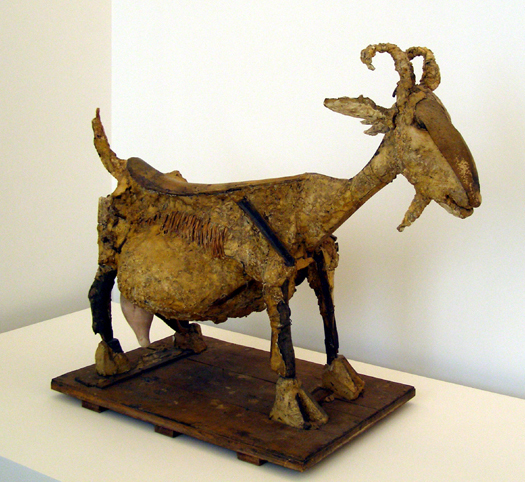
Goat sculpture from found objects, by Picasso.

The Drum Major Instinct

I found a few minutes to check my blog and post. We visited and are ready to head home early tomorrow morning.

This is an excerpt from a Martin Luther King Jr. passage. Being a servant is a significant part of being a leader.

If you want to be important–wonderful. If you want to be recognized–wonderful. If you want to be great–wonderful. But recognize that he who is greatest among you shall be your servant. That’s your new definition of greatness. And this morning, the thing I like about it…by giving that definition of greatness, it means that everybody can be great. Because everybody can be serve. You don’t have to have a college degree to serve. You don’t have to make your subject and your verb agree to serve. You don’t have to know about Plato and Aristotle to serve. You don’t have to know Einstein’s theory of relativity to serve, you don’t have to know the second theory of thermodynamics in physics to serve. You only need a heart full of grace. A soul generated by love. And you can be that servant.

Two Kinds of Intelligence

We enjoyed a restful Christmas. We head out tomorrow night for a trip to British Columbia where my 88-year old mother lives. Over the past few days, I thought about what I hold true and came across this Rumi poem. I will be working more on the literature review for my dissertation and I need to assure myself that I distinguish between two types of intelligences: one that grounds me and one that is simply the currency of the day.

There are two kinds of intelligence: one acquired,

as a child in school memorizes facts and concepts

from books and from what the teacher says,

collecting information from the traditional sciences

as well as from the new sciences.

With such intelligence you rise in the world.

You get ranked ahead or behind others

in regard to your competence in retaining

information. You stroll with this intelligence

in and out of fields of knowledge, getting always more

marks on your preserving tablets.

There is another kind of tablet, one

already completed and preserved inside you.

A spring overflowing its springbox, A freshness

in the center of the chest. This other intelligence

does not turn yellow or stagnate. It’s fluid,

and it doesn’t move from outside to inside

through the conduits of plumbing-learning.

This second knowledge is a fountainhead

from within you, moving out.

We Prepare for the Messiah

I leave you with this and hope, whatever your faith and beliefs are, you enjoy your holiday at or close to this time of the year. Take care, enjoy those closest to you, and together we make the world a better place.

O Wisdom,
O holy Word of God,
you govern all creation with your strong yet tender care:
Come.

 O Sacred Lord of ancient Israel,
you showed yourself to Moses in the burning bush
and you gave the holy law on Mount Sinai:
Come.

 O Flower of Jesse’s stem,
you have been raised up as a sign for all people;
kings stand silent in your presence;
the nations bow down in worship before you:
Come.

 O Key of David, O royal Power of Israel,
you [not the systems of this world] control

at your will the gate of heaven:
Come break down the prison walls of death.

 O Radiant Dawn,
splendor of eternal light, sun of justice:
Come shine on those who dwell in darkness

and the shadow of death.

 O, King of all the nations,
the only joy of every human heart;
O Keystone of the mighty arch of humankind:
Come and save these creatures you fashioned from the dust.

 O, Emmanuel,
God-With-Us, king and lawgiver,
desire of the nations, Savior of all people:
Come and set us free. d
The Spirit and the bride say, “Come.”

 Amen.

Father Richard Rohr is a leading ecumenical teacher who transcends religious and spiritual boundaries.

Stay human my friends.

Questions

Questions, real questions, are scary. They need me to face the unknown. What don’t I understand? It is easy to chase real questions away and deal with the easy ones.

Each day I ask:

What is my question?”

What wonder is there?

Can I live curiously?

Can I touch my questions?

Be honest,

Be awake,

Open my heart.

Refuse false questions–

Those I obsessively chase,

Leave me unfulfilled,

Sullied and dirty.

Real questions raise turmoil—

They cause fear–

Am I ready?

Can I navigate turbulent,

Uncharted seas?

Can I delve deeper?

Lay a foundation–

Not on sand;

On rock;

Where I am grounded.