Tag Archives: leadership

Santiago by David Whyte

The road seen, then not seen, the hillside
hiding then revealing the way you should take,
the road dropping away from you as if leaving you
to walk on thin air, then catching you, holding you up,
when you thought you would fall,
all the way forward always in the end
the way that you followed, the way that carried you
into your future, that brought you to this place […]
David Whyte
from “Pilgrim”

Friday Morning’s Thought

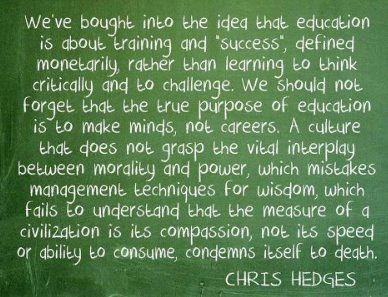
I received this from someone yesterday and thought I would share it. Public education is in need of a make over. What does that mean? That is a hard question to answer without a new conversation and a pause to fully understand what our children need. Here is a starter. Chris Hedges is a Pulitzer Prize winning author and a source of this quote is George Takei the actor who played Sulu in Star Trek. I am not a Trekkie, but I like this quote. The points that stand out are the purpose of education, the interplay between power and morality, and the need for wisdom. I follow several on-line forums about leadership. Even there, the leadership experts frequently confuse knowledge, information, and wisdom often using those words loosely and interchangeably. Wisdom emerges from values named and held within community–sensus communis or common sense. What passes from generation to generation is its common sense, what it holds and names as values in a society. This takes a compassionate conversation which is rare.

Take care and enjoy those you come in contact with today.

Dance Like No One is Watching

Children do this so well; adults, not so much. Enjoy your day.

I hear conflicting stories about who to attribute this quote. Somewhere I heard or read that Satchel Paige, the Hall of Fame pitcher, said this in response to questions about his phenomenal longevity in the game.

You gotta do what you gotta do to be what you are!

Human Resources – A Poem

I often wonder about the language of the workplace. We refer to students as clients and staff in schools as human resources. Reminded me of a song from my youth, The Five Man Electrical Band. They wondered about the increased proliferation of signs and wrote a short note to Jesus about it while stopping in at a church along the way. Enjoy!

A human resources expert appeared

out of a shroud

mist-like.

I recoiled

What’s wrong?

Pleasantly enough asked

seemed off somehow

May be a sinister tone?

Did I say the wrong thing?

Or things?

I wonder

didn’t get the job

not even interviewed for that matter, plus

I got a security escort

wasn’t the first time

Human resources, you say.

Humph

I have questions

to hell with yours

I’ll ask mine

Are we compatible?

Can we date?

Where are humans mined?

do they mind?

What are they worth?

Raw and finished versions

Where is the human factory?

Are they reliable?

Can I get a warranty?

Can you exploit them?

or do they have a mind of their own?

do they mind?

Can we drill for them?

Do they fit in a pipe

To ship them, not smoke them

Do they depreciate?

Like a car, factory, or another normal asset?

a write-off?

or right off?

She seemed confused

perplexed perhaps

That must not have been in the book

I guess?

Tough to get a job

As a human being,

Not a human resource.

No offense intended to human resources people. You have a job to do. I guess.

Thought and Haiku for Saturday

Last night, just before I went to bed, I was watching the news from one of the Spokane TV stations. Washington State completed an audit for public education. One of the conclusions was that simply moving 1%of funding from central offices and administration would add about 1000 classroom teachers states-wide. I am not suggesting this could be done across the board in every jurisdiction but it is food for thought. What if we moved 10% from school administration and central office administration? What would the benefits be? Right off the top of my head I thought of additional classroom teachers and effective professional learning could be undertaken.

Will this even be considered or are we merely protecting an antiquated and bloated status quo?

I am working on the World Cafe summaries from several months ago trying to find software to organize, analyze, and present the data in a meaningful way. The March 17, 2012 event yielded what was very close to a haiku. I massaged it a bit this morning and came up with the following:

schooling as a place

can just be interrupting

learning for children.

It sounds a bit like Mark Twain.

Blueberries | Jamie Vollmer

Blueberries | Jamie Vollmer.

This is worth reading. It fell into one of my email boxes this morning. In theory, I agree with the idea that we cannot, as teachers, return our students like Mr. Vollmer could return his blueberries. Fundamentally though, there is still a problem. In the province of Alberta. there are over 25% of students who will not finish high school. Those are the ones who leave our schools. What about those who do not leave and finish? There are still some amongst them who are on the margins and school has not served well. The 25% is an average.What about students who live in First Nation communities, in the inner city, or face any number of other life issues?

Education needs an overhaul. There is a genuine need for a different conversation and not sticking our heads in the sand. Please take a few minutes to read.

Professional Learning Communities at Work by Dufour and Eaker

I read Professional Learning Communities by Richard Dufour and Robert Eaker several years ago and attended conferences about the concept. We implemented Professional Learning Communities (PLC) in our school with early, but unsustainable success.

Thesis: The authors proposed “the most promising strategy for sustained, substantive school improvement is developing the ability of school personnel to function as professional learning communities” (p. xi).  Professionally, educators need awareness of emerging research to fuel personal learning and support student learning. Communities form and they foster “mutual cooperation, emotional support, and personal growth as [people] work together to achieve what they cannot accomplish alone” (p. xii). Teachers safely move from isolation and risks are taken extending personal and collective learning when a PLC is effectively implemented, integrated, and supported in a school.

CharacteristicsThis is an annotated version, but successful and sustainable PLCs have six characteristics:

  • Shared mission or purpose, shared vision or what we hope to become, and shared values guiding the process. Shared mission advertises purpose outward. Shared vision energizes staff. Values are personal and community attitudes, behaviours, and commitments which are normalized over time.
  • Collective inquiry fuels the process. What do we want to change? What ways are things as they are challenged? There is collective conversation and personal reflection. The latter is the oxygen that breathes new life into the dialogue and provides fuel through new questions.
  • Collaborative teams provide renewal. Collaboration acknowledges the dysfunctional nature of communities. What do we do when there are dissenting voices and disagreement? What value will we name here?
  • Action and experimentation are always in evidence. “Even seemingly chaotic activity is preferred to orderly, passive inaction” (p. 27). Teachers experiment with emergent ideas making innovation essential in a PLC.
  • Everyone commits to continuous improvement. Questions emerge and are actively sought out, but there are touchstones principles such as “What is our fundamental purpose?”
  • With continuous improvement and action orientation there is an iterative process in the form of quantitative, qualitative, or mixed research. The object is to shake up the status quo and find new ways of safely supporting both staff and students. What are we doing that we want to change? (pp. 25-29)

Questions: Who has had success in implementing a PLC in their school or jurisdiction? What were the important takeaways including what worked and what did not work? What did you do to overcome the bumps along the way? What can a school starting or restarting the process do to sustain energy and get early work done successfully while recognizing the achievements even when they are small?

Recommendation: The book is about 300 pages, but is an easy read. The authors synthesized leadership literature inside education i.e. Lezotte, Sergiovanni, and Fullan and outside education i.e. Bennis, Senge, and Deal and Kennedy and saved some reading.

I recommend the book for those ready, willing, and patient enough for a transformative journey. The process requires time and immediate classroom benefits to sustain it. Cultural change is messy and requires leadership, perhaps previously untapped in education. Effective support and communication are required for sustainable, successful results to emerge. Early conversations focused on mission, vision, values and normative behaviours are uncomfortable, but necessary. My questions attempt to flesh out these concerns, as we are embarking on this journey again.

I know schools in Canada, the USA, and internationally have successfully implemented PLCs and I want to draw on the experience and wisdom already in place. I am looking for process and product, but not a cookie cutter formula per se. I look forward to hearing from many of you.

Dufour, R. and Eaker, R. (1998). Professional learning communities at work: Best practices for enhancing student achievement. Bloomington IN: National Educational Services.

The House Guest by Rumi

I was going through my various accounts and Parker Palmer posted this on Facebook. After a challenging week, I read it and realized this was what my week had been like, very up and down. What do I say to those emotions which temporarily move in and shake my confidence? Or what do I say to those emotions which mislead me with their false promise of all things gold and glittery?

Thank you to Parker Palmer for this sharing.

Responsibility

I wrote about requiring a new culture in education which can lead to a new structure. I created a link to an article in that post and part of the article was an interview with Pasi Sahlberg.

Sahlberg stated, “There’s no word for accountability in Finnish. … Accountability is something that is left when responsibility has been subtracted.”

I understand responsibility as internalized and roles or tasks are conscientiously attended to and accountability is external and forced into place leading to feelings oppressed or alienated. Responsibility is personal or professional competency gained through maturity in a role. Accountability is personal or professional incompetency and immaturity which can  potentially be a result of change or newness in a role. Responsibility emerges in an organization when there is trust and a belief people can grow into and learn their roles. People become responsible because they are supported and cared for while they learn. A collaborative, compassionate culture emerges and subsequently a new structure for relationships to exist emerges.

The Mindful Teacher by Elizabeth MacDonald and Dennis Shirley

Last year, I was in a challenging situation and sought a path to continue my teaching and learning journey. Elizabeth MacDonald and Dennis Shirley wrote a book called The Mindful Teacher. I read the book during September 2011.

A thesis was teachers feel alienated working in a system where few “possibilities remain for ethical, caring teachers to hone their craft and to inspire their students with the sheer joy and delight that is found in learning” (p. 2). The authors used teacher stories and personal reflections obtained through The Mindful Teacher Project which involved public school teachers in Boston. MacDonald and Shirley cautioned this was not “a recipe that can be followed, or  a ‘silver bullet’ … it is a form of teaching that is informed by contemplative practices and inquiry that enables teachers to interrupt their harried lifestyles, come to themselves through participation in collegial community of inquiry and practice, and attend to aspects of their classroom instruction and pupils’ learning that ordinarily overlooked in the press of events” (p. 4).

As I read the book, I realized how inattentive I had grown in classroom instruction and about personal growth. Collegial mindfulness has not appeared in a conventional sense, but I discovered alternative spaces i.e. daily meditation, spiritual retreats, World Café Events, and blogging which filled some of the void. I try to pay closer attention to “Who is the self that teaches” advocated by Parker Palmer. I completed a guided study into mindfulness in daily life. Each aspect added mindfulness previously absent in my life.

Amazon Books

Gains: I  have slowed down, reflect more often, and try respond and not react. It is a journey and that is why we call it practice. Each school day, I spend 20-30 minutes meditating. When I am flustered in the classroom, and it happens, I try close my eyes, take a deep breath, and clear my mind before I respond. I refer to those successful moments as the new Ivon. An important gain was teaching is a calling, a vocation. As I read, I was reminded of that.

Questions: What do we do when adults do not trust between one another and that appears irreparable? I assume the authors wrote the book due to a perceived need by the authors. I imagine there are environments lacking trust. What do we do then?

Recommendation: This is short, easy read filled with stories and ideas. From a veteran teacher perspective, it helped me tend to long overdue internal work. A new teacher could use ideas to shape their career. I would recommend it for all teachers and, when done, find a group and have open, joyful, non-judgmental conversations. What brought you to teaching and learning?