Tag Archives: mindfulness

Imperfection/Perfection

Jacques Derrida wrote about deconstruction, which is about thinking in paradoxes. Instead of thinking about binaries i.e. perfection or imperfection, we consider the opposites as being part of each other. We are unable to think of one without the other and continuously deconstruct the meaning.

This continuous making of meaning is a hermeneutic task of  interpreting. Paul Ricoeur wrote about deep or radical hermeneutics, which considered context as part of the meaning-making process. Radical means to go the roots of something, so it requires the person look below the surface and turn things over.

I took a stab at writing a poem. after reading Mary Oliver today. I am reading a book of her essays called Upstream. She writes prose in a poetic way. I love walking in the mountains. Beauty and perfection of mountains reveal themselves in their lack of symmetry and imperfection. As well, there is always something hidden from sight, on the back side of a mountain and in the crevasses we cannot get close enough to.

Inspired by other’s words

I seek my own.

To discover meaning

I sit quietly and receive.

Meanings hold no meaning,

There can be no certainty.

Always something hidden,

On the backside, underneath.

Imperfection exists,

Making perfection complete.

It awaits my mindfulness,

The extraordinary in the ordinary.
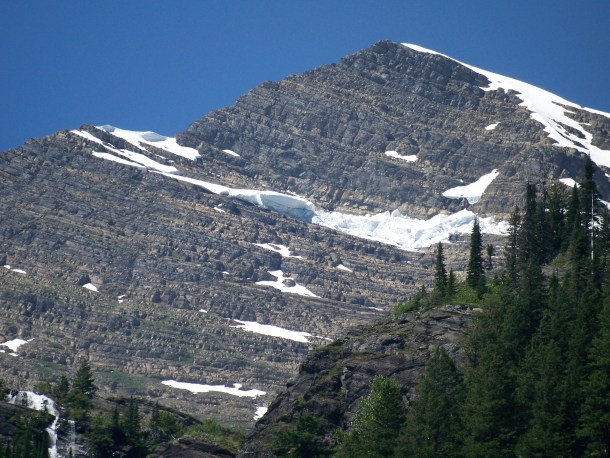
I took this picture unsure of why at the time. Later, I used it in a presentation about environmentalism. Today, it adds depth and meaning to what I am trying to say.

Fog

Our spring is arriving in spits and spurts. There have been spring blizzards with accumulating snow. Another part of our spring is fog. It is unusual in Edmonton and could be due to the warming and cooling that has occurred.

In keeping with the slow arrival of spring and the fog, I wrote this poem. When we lived in Prince George, BC, fog was more common. The city is in a valley at the confluence of the Fraser and Nechako Rivers. Edmonton has fog around the North Saskatchewan River, but the valley is not the same.

In Prince George, if I drove out of the bowl, I looked back and saw the fog hanging over the city. Its lines were not clearly drawn, but blurred and uneven.

Look back into the valley’s bowl

Fog hangs;

The city evaporates,

Gray lines blur my vision.

The road ends at the next curve,

Below, the top of bridges;

Suspended on the still grayness.

Across the rivers,

Mills’ stacks and building tops peek out;

Heads hanging on a gray pillow,

Severed from the city’s body.

Image result for prince George bc and fog images

Image from A Place for Things is taken in Prince George.

Our True Heritage

I am reading The Art of Communicating by Thich Nhat Hanh to remind myself of to listen mindfully to others. When I am fully present to the other, I show compassion and understanding for their suffering.

Thich Nhat Hanh writes beautiful poetry, which reminds me to see the extraordinary in the ordinary. This poem reminds me that, when I am present, I experience the cosmos and its precious gems with all my senses.

In the busyness of living, I miss hearing birds singing, the pines chanting, and smiles of those around me. When I am happy, I share that with the world.

The cosmos is filled with precious gems.

I want to offer a handful of them to you this morning.

Each moment you are alive is a gem,

shining through and containing earth and sky,

water and clouds.

It needs you to breathe gently

for the miracles to be displayed.

Suddenly you hear the birds singing,

the pines chanting,

see the flowers blooming,

the blue sky,

the white clouds,

the smile and the marvelous look

of your beloved.

You, the richest person on Earth,

who have been going around begging for a living,

stop being the destitute child.

Come back and claim your heritage.

We should enjoy our happiness

and offer it to everyone.

Cherish this very moment.

Let go of the stream of distress

and embrace life fully in your arms.

Breath, You Invisible Poem

Rainer Maria Rilke compared a poem to living and who we are each becoming as a person. We each experience continuous and invisible interchange between who we are and the world beyond our seeing.

Parker Palmer compared this interchange to a Möbius strip and, when we place our fingers on the strip, we slide them in and out without lifting them. There is a rhythm to this movement, like a tide moving in and out from the beach continuously shifting the sands.

Each of our place in the cosmos is small, but I think essential to the cosmos. It is in the mindful interchange with the cosmos, being present to one another, imprinting ourself on the cosmos in a unique way that makes us each irreplaceable. We cannot see what that will mean, only experiencing it by being present and attentive to each breath we take.

Breath, you invisible poem!

A constant interchange between our clear being

and the world space beyond our seeing

in which I rhythmically become.

Solitary wave whose

gradual sea I am.

Of all possible seas you are parsimonious,

winning the cosmos, with me one gram

in it. How many realms of space have been

inside me already! The multiple wind

is like my son.

Air, do you know me? You are full of places

once mine. A uniquely smooth rind,

a leaf of my words among roundnesses.

Work Around Your Abyss

Henri Nouwen wrote about the essential nature of being present, attentive, and mindful to our needs. Like Thomas Merton, he cautioned against being caught up in the quick fixes and materialism of contemporary society to heal the wounds we have.

When we feel pain and are suffering, it is essential to come close to those the wound, working around it until it heals. Unlike contemporary organizations, which are often described as teams, this is the work of community. Frequently, we share pain and woundswith others and it is in sharing our journey we discover solace and healing, making us each whole again.

There is a deep hole in your being, like an abyss. You will never succeed in filling that hole, because your needs are inexhaustible. You have to work around it so that gradually the abyss closes.

Since the hole is so enormous and your anguish so deep, you will always be tempted to flee from it. There are two extremes to avoid: being completely absorbed in your pain and being distracted by so many things that you stay far away from the wound you want to heal.

How Poetry Comes to Me

Gary Snyder wrote this short, accurate description of how poetry comes to a person. It is not an easy process.

It comes blundering over the
Boulders at night, it stays
Frightened outside the
Range of my campfire
I go to meet it at the
Edge of the light.

Snyder spent time in Japan where he immersed himself in Zen Buddhism and poetry, some of which he translated and used to guide his writing. One of the poets he studied was Han Shan who wrote the following poem called LX.

I see similarities between the two poems. Snyder wrote about how poems wait for us at the edge of the just out of range of our campfire. Han Shan suggests, if we move during sunny times, we might not move at all. Like moving to the edge of the light, we move timidly to find what awaits us and searches for us. It takes being present and mindful to our world and others.

Han Shan has so many strange, well-hidden sights,

Every climber climbs a little timidly . . .

Moon shines in the dripping water;

wind brings the very grass alive.

Freezing trees flower with snow,

dead, bare trees leafed out in cloud.

Gored by cold rain, the liveliest soul turns away.

Unless it stays sunny, you’ll never get through.

Hope

This Emily Dickinson poem reminds me of Langston HughesDreams. There are  direct and indirect metaphors to birds and a sense hope and dreams feed to lighten one’s spirit.

Being mindful of one’s dreams can give a person hope and something to look forward to. It is not to say we lose ourselves in our dreams, living in a fantasy. Our dreams nourish a hope essential to sustain our spirit and who we are becoming as a person.

Dreams call to us, even in challenging times. We share them with others and they bring hope, not to one person, but to a larger collective. Dreams and hope exist as questions, which we can reflect on alone and together.

Hope is the thing with feathers
That perches in the soul,
And sings the tune without the words,
And never stops at all,
And sweetest in the gale is heard;
And sore must be the storm
That could abash the little bird
That kept so many warm.
I’ve heard it in the chillest land,
And on the strangest sea;
Yet, never, in extremity,
It asked a crumb of me.
Here is the Langston Hughes poem.

Hold fast to dreams
For if dreams die
Life is a broken-winged bird
That cannot fly.
Hold fast to dreams
For when dreams go
Life is a barren field
Frozen with snow.

From the Book of the Samurai

When one writes, mindfulness and attention to the choice of words. Tsunetomo Yamomoto offered the following advice in the Book of the Samurai. He quoted the Zen priest Ryōzan, concluding the result of a well-written letter, even a short one, would lead to the recipient making “it into a hanging scroll.”

Mindfulness and attention are used in all facets of one’s life. Living mindfully is celebrating one’s life fully, living each moment to the fullest.

“Practice in letter writing goes to the extent of taking care in even one-line letters. It is good if all the above contain a quiet strength. Moreover, according to what the priest Ryōzan heard when he was in the Kamigata area, when one is writing a letter, he should think that the recipient will make it into a hanging scroll.”

Nothing Left to See Through

This poem arrived today. I waited for it and did not chase after it. When I read it, the words spoke to me.

The Zen Master Ryōkan reminded me that change is inevitable. It happens. Like yesterday’s post, chasing after and holding things, as if they were permanent, is done in vain.

To take time, to be mindful, and sit quietly can bring peace in which one can discover the essence of things and understand mistaken views. Hans-Georg Gadamer said dialogue begins not through shared understanding, but mis-understanding. This includes inner dialogue one has with ones’ self.

Past has passed away.

Future has not arrived.

Present does not remain.

Nothing is reliable; everything must change.

You hold on to letters and names in vain,

forcing yourself to believe in them.

Stop chasing new knowledge.

Leave old views behind.

Study the essential

and then see through it.

When there is nothing left to see through,

then you will know your mistaken views.

2 By Lao Tzu

Through the concept of deconstruction, the philosopher Jacques Derrida argued we do not live in a world of binaries. Derrida contended between words that appeared to be opposites there was no space and they appeared as long/short. One cannot think of long without understanding short.

Lao Tzu made a similar argument in the first part of this poem: “is and is not produce one another.” Ted Aoki, who was an Alberta-based educator, described the essence of things as being embedded in their “isness.” In the second part, Lao Tzu spoke about a teacher being a person who teaches without a need to possess the words he/she speaks and receiving merit for their teaching.

While I was journaling this morning, I thought of teaching’s essential nature, which is less about the words we speak as teachers and the way we comport ourselves.

As a Frenchman, Derrida used the proper to describe how one comports themself. A person can have rhetoric to fool people, but they do not possess good character if their actions are improper and incongruent with their “good speech.” A person of good character is mindful of the words they use and how they sometimes betray their character.

Beauty and ugliness have one origin.

Name beauty, and ugliness is.

Recognizing virtue recognizes evil.

Is and is not produce one another.

The difficult is born in the easy,

long is defined by short, the high by the low.

Instrument and voice achieve one harmony.

Before and after have places.

That is why the sage can act without effort

and teach without words,

nurture things without possessing them,

and accomplish things without expecting merit:

only one who makes no attempt to possess it

cannot lose it.