Tag Archives: spirituality

Joining the Circus

Yesterday, this poem by Mark Nepo found me. I was checking some emails and a site I subscribe to had this poem on it.

For the first time in 30 years, I will not teach and/or learn in formal way this fall. It crept up on me. Yes, I want to teach. I prefer that to joining a circus. In a sense, I am joining the circus. The theme of the poem is how to deal with ups and downs in life. I applied at several universities and received one interview, but came up short.

My challenge is what will we I do in lieu of teaching in some conventional way? As Nepo says, I ready to kiss anything as I hover like a mystical molecule between one stage and another. Like the dozen beginners, I am learning how to juggle and have to begin somewhere.

Each day, I focus on reading and writing and hope to publish in academic journals.  A colleague suggested I write and shed a different light on teaching. As well, I may take some of my poetry and bundle it together in a book. Perhaps, my smile will be so magical I will asked to teach something I did not expect.

I just saw a handwritten note from

Galileo. He was under house arrest

for believing we’re not the center of

everything. Now behind me, in the park,

a dozen beginners, of all ages, learning how

to juggle. We have to start somewhere. The

young man who’s so magical at this is asked

to instruct. He smiles, “You have to keep

trying. Just not the same thing.” Earlier,

I leaned over a letter from Lincoln to a

dead soldier’s mother. This, just weeks

after losing Susan’s mother, sweet

Eleanor. I keep saying her name to

strangers. You see, we all have to

juggle joy and sorrow. Not to do it

well—we always drop something—but

when the up and down of life are

leaving one hand and not yet land-

ing in the other, then we glow, like

a mystical molecule hovering between

birth and death, ready to kiss anything.
 

Pointers to Non-Duality

I am back to post. I am reading and writing. I am working to intersect hermeneutic phenomenology, which I used as my research methodology for my dissertation and the method of currere. The latter is an autobiographical method, in part, based on existential philosophy to explore curriculum through one’s lived-experience. As well, it uses Freudian psychoanalytic theory as part of its foundations. It is this latter aspect I am contrasting with hermeneutic phenomenology as both are interpretive methods.

I moved to radical hermeneutics, linking it with my writing. What I found is there is an overlap with poetry and non-duality.

Bill Pinar developed the method of currere and used Zen philosophy as a third leg for the method. The voice in hermeneutics is poetic, seeking to understand the world in non-dualistic ways and subvert binary thinking.  As I looked for a poem, I found this one by Wu Hsin.

When I am mindful and present to the world in its past, present, and future moments the text I live comes to life with new meaning.

Just as the honey is not sweetness,

The words of Wu Hsin are not

The truth.

However, time spent with these words is like

The aftermath of rain.

In due course, a sprouting of

Understanding will occur and

Will bear fruit at a pace

Outside of one’s control.

Saint Francis and the Sow

This poem by Galway Kinnel reminds me everyone is blooming. There is something hidden inside of us we cannot fully know and understand. It is the inner voice that calls us to what we are fully human to do.

It is essential to be mindful and attentive to that voice and find moments of silence. Unlike the sow, humans are able to pause and reflect, pray and listen to the response. Having said this, it is not something that is intuitive and instinctual. It is something we have to remind our self of from time to time.

The bud

stands for all things,

even for those things that don’t flower,

for everything flowers, from within, of self-blessing;

though sometimes it is necessary

to reteach a thing its loveliness,

to put a hand on its brow

of the flower

and retell it in words and in touch

it is lovely

until it flowers again from within, of self-blessing;

as Saint Francis

put his hand on the creased forehead

of the sow, and told her in words and in touch

blessings of earth on the sow, and the sow

began remembering all down her thick length,

from the earthen snout all the way

through the fodder and slops to the spiritual curl of the tail,

from the hard spininess spiked out from the spine

down through the great broken heart

to the sheer blue milken dreaminess spurting and shuddering

from the fourteen teats into the fourteen mouths sucking and blowing beneath them:

the long, perfect loveliness of sow.


Sand Castles

Children live in each moment. Their inexperience allows them to be in a world that seems novel. They build sand castles in those moments. As adults we think we lose that ability to build our sand castles.

Being mindful and present to the world and others is a way of building sand castles, perhaps in some metaphoric way. How can I think about this person and that thing differently? How do I bring less suffering and pain to the world in understanding “differences make a difference?” Unlike children, adults often understand differences as threats.

It reminds me of Tolstoy‘s quote: “if you want to be happy, be.”

A child, playing in sand,

Building sand castles,

Absorbed in that moment.

The world is immediate,

Demanding one be present,

To embedded in this very moment.

As a child,

We know nothing different,

Our castles are real and momentous.

To outgrow our castles,

That is a tragedy,

To lose being mind(ful).

Let me return to that world,

To build castles in the sand,

As only a child can.

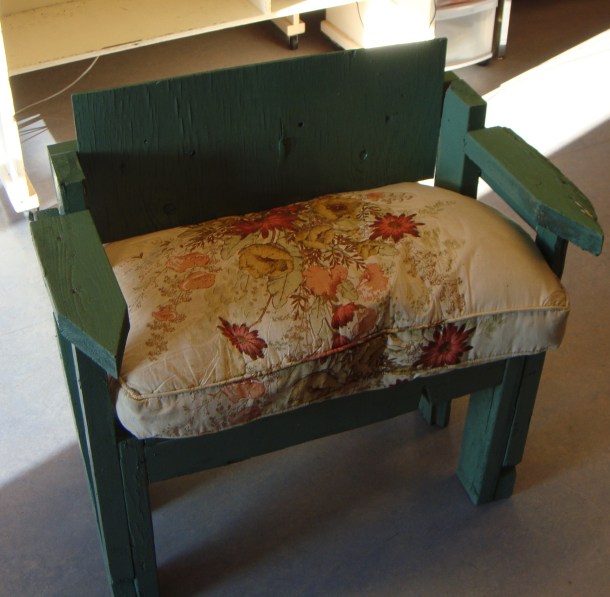
When I taught, the Grade 7 students built chairs for Science class. A criterion was they had to use recycled materials. They always built terrific chairs with little help from adults.

Anarchy

I felt a touch of sadness the last few days of school. I think it goes back to my first year teaching. The students told me they wanted school to continue into the summer. My last year teaching students sent me off with the message it was not the content that was meaningful, but the life lessons they learned.

Etymologically, anarchy comes from repeatedly new beginnings. Thought of that way, each new beginning is an opportunity to dance.

Rumi said “We rarely hear the inward music, but we’re all dancing to it nevertheless,
directed by the one who teaches us, the pure joy of the sun, our music master.” New beginnings are a dance that we do not always hear the music to.

As an end draws near,

Beginnings emerge,

In the anarchy of living.

One is drawn,

Not by the familiar,

By mystery.

In silent moments,

Stillness calls,

Reaching deep into one’s soul.

In silent moments,

The unseen radiates,

Touching one’s spirit.

Mystery lurks,

Pointing the way,

Deep wonder draws one forward.

The Prayer of St. Francis

Today is a special day in our lives. 41 years ago, Kathy and I were married. We chose The Prayer of St. Francis was one of our readings and have a simple plaque on our bedroom wall of the prayer.

The prayer is a reminder of how we affect the world, beginning with those closest to us. It is a reminder of how being mindful and present are essential in relationships.

Lord, make me an instrument of your peace.
Where there is hatred, let me bring love.
Where there is offense, let me bring pardon.
Where there is discord, let me bring union.
Where there is error, let me bring truth.
Where there is doubt, let me bring faith.
Where there is despair, let me bring hope.
Where there is darkness, let me bring your light.
Where there is sadness, let me bring joy.
O Master, let me not seek as much
to be consoled as to console,
to be understood as to understand,
to be loved as to love,
for it is in giving that one receives,
it is in self-forgetting that one finds,
it is in pardoning that one is pardoned,
it is in dying that one is raised to eternal life.

Silver Star

When I looked for a poem, this one by William Stafford found me. Mountains appear to be immovable and unchangeable, yet as people do they do so without immediate notice. Yet, when we revisit them, we realize the changes that occurred.

In the case of teachers, Parker Palmer speaks about asking the question “who is the self who teaches?” We are each teachers in our own particular ways, so asking this question is essential. We often overlook this question in pursuit of easier to answer questions about the what, when, where, why, and how.

When we ask who we are, we explore the values that anchor us in living life. In times of crisis, those values guide us and help us through those tough times. Attending to them in mindful ways each day as a gardener would her/his garden grounds us in them in times of real need. They have spiritual meaning that come to life in living and expressing them daily through who we are as a human being.

If we serve our values well, “we will hear the world say, ‘Well done.'” The patience of living a good life, which in Aristotle‘s terms, is indefinable will be the reward. Like a mountain guiding us on our journey, the values we live and express guide us and others on a shared journey.

To be a mountain you have to climb alone

and accept all that rain and snow. You have to look

far away, when evening comes. If a forest

grows, you care; you stand there leaning against

the wind, waiting for someone with faith enough

to ask you to move. Great stones will tumble

against each other and gouge your sides. A storm

will live somewhere in your canyons hoarding its lightning.

If you are lucky, people will give you a dignified

name and bring crowds to admire how sturdy you are,

how long you can hold still for the camera. And some time,

they say, if you last long enough you will hear God;

a voice will roll down from the sky and all your patience

will be rewarded. The whole world will hear it: “Well done.”

Fluent

I am on the road the next two days so I am tired at the end of relatively long day. John O’ Donohue‘s poetry has a light feel to it, much like a small river that flows easily along its way.

He often wrote blessings and a blessing is something that catches us by surprise. It unfolds in surprising ways, never taking the same path twice. Like the river and, as expressed by Heraclitus in his quote: “No man ever steps in the same river twice, for it’s not the same river and he’s not the same man.”

We cannot live the same moment twice, because we cannot return to it and, even if we could, we would not be the same person. We would return with an understanding of what it meant to step in the river in the first place.

The beauty of living is filled with the richness of uncertainty and complexity. The best we can expect is to be mindful of each moment as we live in it and as it unfolds.

I would love to live

Like a river flows,

Carried by the surprise

Of its own unfolding.

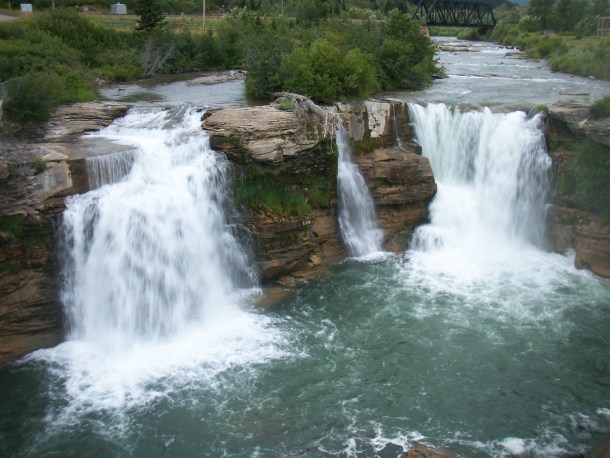
We took this picture several years at Lundbreck Falls. Today, I drove past them and, like me, the river has changed.

For the Children

Gary Snyder wrote this beautiful poem about children being adult’s saving grace in the world. What is new fascinates and they wonder about the newness. For a small child, most of what they encounter is new and calls out to the child to explore and wonder over it.

There is zen and mystical quality to the poem with a reference to meeting in peace somewhere in the future. The essential part of peace is staying together, learning the flowers, and going lightly.

It is not learning about flowers, but learning flowers and going lightly, which I think will take a different way of teaching. This is not a new way of teaching. Instead, it is more likely we have forgotten it, being together and living gently in a world that only has so much to offer us.

The rising hills, the slopes,
of statistics
lie before us,
the steep climb
of everything, going up,
up, as we all
go down.

In the next century
or the one beyond that,
they say,
are valleys, pastures,
we can meet there in peace
if we make it.

To climb these coming crests
one word to you, to
you and your children:

stay together
learn the flowers
go light.

“Natural objects should be sought and seen as they are, not to suit observers, but respectfully as if they were divine beings.” — Goethe

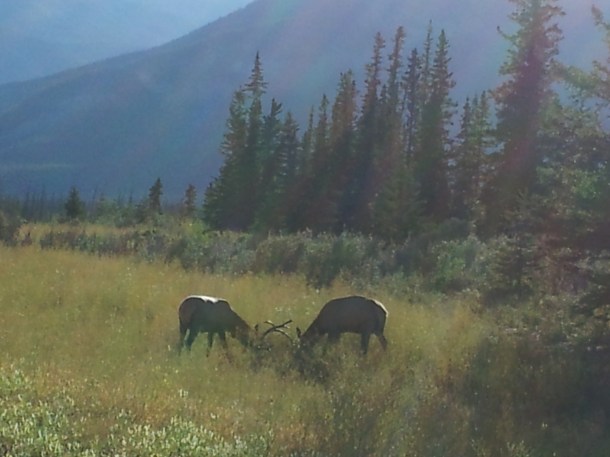
I took this picture several years ago as I drove through Jasper National Park. It was late August before the rutting began, but the bulls were trying to assert dominance. Despite this, people ran into the ditch and talking loudly. I kept my distance and got some great shots from about 100 feet away. As Gary Snyder counseled, I went light.

Character of Teaching

While having tea in a small coffee shop I inhabit, I jotted down the beginnings of a poem.

A phrase that repeated itself in my dissertation and the interviews was “differences make a difference.” When I began teaching, people asked “what made me go into teaching, particularly at 32 years of age.” It was the sentiment that I might make a difference, maybe not for every student, but for some. It reminds me of the Crosby, Stills, and Nash song: Teach Your Children Well, but it is more than teaching. It is serving them and whatever I do well.

Someday, whether we are teachers or not, we feel a desire to be lost. Responsibilities weigh on us whether we are parents, at our work, partners in a relationship, etc. In our relationships with the weight of responsibilities, something calls us each back. It is more of a whisper. It can only belong to each of us. Teaching was this way for me.

I experience a desire to be lost,

Weighing down on me,

Responsibilities cloak me like a vapour

Covering me with their many coats,

They arrive without being asked.

From the multitude, one desire arises;

A clarion call from the cosmos,

It carresses my soul;

It whispers “be useful and kind.”

A flower sharing its pollen,

Spread on the wings of others;

Teach what is possible–

What is possible of each of us?

Save them from glory seekers and profiteers;

Gently, send them away

Pollinating a new generation,

Flowering anew with compassion,

Rejoice as they float around the corner,

Knowing not what they will sow,

Trusting your character.

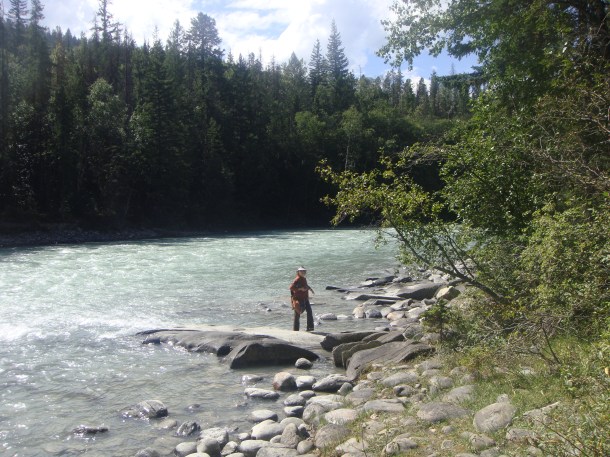
I took this picture on the upper reaches of the Fraser River. Around the corner from Kathy, the river narrows quickly and there is a waterfall.