Tag Archives: spirituality

There was a time I would reject those

Ibn ‘Arabi wrote “My religion is love. Whichever the route love’s caravan shall take, That shall be the path of my faith.” He speaks of a journey and shared path.

I recalled the statement attributed to the German Lutheran pastor Martin Niemöller:

First they came for the Socialists, and I did not speak out—
Because I was not a Socialist.

Then they came for the Trade Unionists, and I did not speak out—
Because I was not a Trade Unionist.

Then they came for the Jews, and I did not speak out—
Because I was not a Jew.

Then they came for me—and there was no one left to speak for me.

When we reject others because of ethnicity, religion, skin colour, politics, gender, etc, we lose sight of what makes us human, our common humanity. This humanity is deeper than any of the markers we have that identify and group us.

Shunryu Suzuki compared mindfulness to a compassionate space that expands and contracts depending on the needs of the moment and the people we share that space. When we reach out to others, we acknowledge we are pilgrims on a shared journey where we speak for and on behalf of each other.

There was a time I would reject those
who were not my faith.
But now, my heart has grown capable
of taking on all forms.
It is a pasture for gazelles,
An abbey for monks.
A table for the Torah.
Kaaba for the pilgrim.
My religion is love.
Whichever the route love’s caravan shall take,
That shall be the path of my faith.
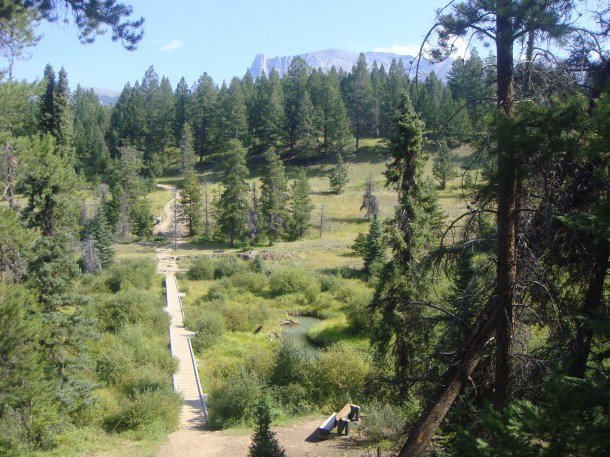
I took this picture in Jasper National Park. Kathy and I walked for several hours on this path just enjoying being there.

i thank You God for this most amazing

When I taught, I used e. e. cummings not just during poetry lessons, but to point out to students we did not always have to follow rules when writing. Following Cummings’ writing, I told students to get thoughts down on paper and we could edit later.

Cummings did not break rules of writing in his poetry. As we see in the first line of this poem, he capitalized two words.

I took the message as opening my eyes and ears to the world around me. As I walked this morning, I noticed birds chirping. One scrambled to hide under a truck parked along the street. In another place, there was a smell of something rotting, maybe someone fertilizing. The wind was chilly, but, when the sun emerged from hiding, i warmed me.

The sounds, sights, smells, touches of the world awaken my senses on those walks. They are like the flow of water I hear from a distance as I approach the river that tumbles over the edge. When I am mindful, I sense nature in a fuller way.

i thank You God for most this amazing
day:for the leaping greenly spirits of trees
and a blue true dream of sky; and for everything
which is natural which is infinite which is yes

(i who have died am alive again today,
and this is the sun’s birthday; this is the birth
day of life and of love and wings: and of the gay
great happening illimitably earth)

how should tasting touching hearing seeing
breathing any–lifted from the no
of all nothing–human merely being
doubt unimaginable You?

(now the ears of my ears awake and
now the eyes of my eyes are opened)

We took this picture in Yellowstone.

Breath, You Invisible Poem

Rainer Maria Rilke compared a poem to living and who we are each becoming as a person. We each experience continuous and invisible interchange between who we are and the world beyond our seeing.

Parker Palmer compared this interchange to a Möbius strip and, when we place our fingers on the strip, we slide them in and out without lifting them. There is a rhythm to this movement, like a tide moving in and out from the beach continuously shifting the sands.

Each of our place in the cosmos is small, but I think essential to the cosmos. It is in the mindful interchange with the cosmos, being present to one another, imprinting ourself on the cosmos in a unique way that makes us each irreplaceable. We cannot see what that will mean, only experiencing it by being present and attentive to each breath we take.

Breath, you invisible poem!

A constant interchange between our clear being

and the world space beyond our seeing

in which I rhythmically become.

Solitary wave whose

gradual sea I am.

Of all possible seas you are parsimonious,

winning the cosmos, with me one gram

in it. How many realms of space have been

inside me already! The multiple wind

is like my son.

Air, do you know me? You are full of places

once mine. A uniquely smooth rind,

a leaf of my words among roundnesses.

Work Around Your Abyss

Henri Nouwen wrote about the essential nature of being present, attentive, and mindful to our needs. Like Thomas Merton, he cautioned against being caught up in the quick fixes and materialism of contemporary society to heal the wounds we have.

When we feel pain and are suffering, it is essential to come close to those the wound, working around it until it heals. Unlike contemporary organizations, which are often described as teams, this is the work of community. Frequently, we share pain and woundswith others and it is in sharing our journey we discover solace and healing, making us each whole again.

There is a deep hole in your being, like an abyss. You will never succeed in filling that hole, because your needs are inexhaustible. You have to work around it so that gradually the abyss closes.

Since the hole is so enormous and your anguish so deep, you will always be tempted to flee from it. There are two extremes to avoid: being completely absorbed in your pain and being distracted by so many things that you stay far away from the wound you want to heal.

Hope

This Emily Dickinson poem reminds me of Langston HughesDreams. There are  direct and indirect metaphors to birds and a sense hope and dreams feed to lighten one’s spirit.

Being mindful of one’s dreams can give a person hope and something to look forward to. It is not to say we lose ourselves in our dreams, living in a fantasy. Our dreams nourish a hope essential to sustain our spirit and who we are becoming as a person.

Dreams call to us, even in challenging times. We share them with others and they bring hope, not to one person, but to a larger collective. Dreams and hope exist as questions, which we can reflect on alone and together.

Hope is the thing with feathers
That perches in the soul,
And sings the tune without the words,
And never stops at all,
And sweetest in the gale is heard;
And sore must be the storm
That could abash the little bird
That kept so many warm.
I’ve heard it in the chillest land,
And on the strangest sea;
Yet, never, in extremity,
It asked a crumb of me.
Here is the Langston Hughes poem.

Hold fast to dreams
For if dreams die
Life is a broken-winged bird
That cannot fly.
Hold fast to dreams
For when dreams go
Life is a barren field
Frozen with snow.

Nothing Left to See Through

This poem arrived today. I waited for it and did not chase after it. When I read it, the words spoke to me.

The Zen Master Ryōkan reminded me that change is inevitable. It happens. Like yesterday’s post, chasing after and holding things, as if they were permanent, is done in vain.

To take time, to be mindful, and sit quietly can bring peace in which one can discover the essence of things and understand mistaken views. Hans-Georg Gadamer said dialogue begins not through shared understanding, but mis-understanding. This includes inner dialogue one has with ones’ self.

Past has passed away.

Future has not arrived.

Present does not remain.

Nothing is reliable; everything must change.

You hold on to letters and names in vain,

forcing yourself to believe in them.

Stop chasing new knowledge.

Leave old views behind.

Study the essential

and then see through it.

When there is nothing left to see through,

then you will know your mistaken views.

The Archer’s Need to Win

To just be in the moment and be present to what one is doing takes us beyond the need to win and not lose. In the last line of this poem, Chuang Tzu reminds us that the need to win or not to lose drains the archer of his power.

Several years ago, we visited our son and his family. At the time, our grandson was about 5 months old. We went for dinner our last evening and, after I finished eating, I took him. I was in front of a mirrored wall. When he noticed there was a little boy in the mirror, our grandson played with that little boy for about 5-10 minutes, until he became tired. He had no other goal than to play and just be in that moment.

We lose that childlike way and those purely phenomenological moments of just being in the world. Remembering is being mindful and calling something to mind. When we do so, Parker Palmer wrote that to re-member is to make and keep one’s self whole.

When an archer is shooting for fun
He has all his skill.

If he shoots for a brass buckle
He is already nervous.

If he shoots for a prize of gold
He goes blind

Or sees two targets –
He is out of his mind.

His skill has not changed,
But the prize divides him.

He cares
He thinks more of winning
Than of shooting –
And the need to win
Drains him of power.

Two Kinds of Intelligence

Rumi‘s words remind me, as a teacher, that my teaching is more than just providing information for students to learn in a rote way for recall on a test.  If what children and adults learn does not have meaning to them, it becomes “yellow or stagnates.”

On the last day I taught, my students gave me a card and gift, but it was the words they offered that meant the most. They told me it was not learning from an official curriculum, but the “other things” that would mean the most to them in later years.

Curriculum comes from the Latin currere and means “running a course” and relates to living one’s life. In running the course and living one’s life, the other tablet comes to life. It is who and what that are close to our hearts that mean the most. As we live life, we discover what that means in sometimes surprising ways.

It is what we reflect upon and are mindful of, reflecting who we are, that brings the greatest joy to our running and recounting the course of our lives.

There are two kinds of intelligence: one acquired,
as a child in school memorizes facts and concepts
from books and from what the teacher says,
collecting information from the traditional sciences
as well as from the new sciences.

With such intelligence you rise in the world.
You get ranked ahead or behind others
in regard to your competence in retaining
information. You stroll with this intelligence
in and out of fields of knowledge, getting always more
marks on your preserving tablets.

There is another kind of tablet, one
already completed and preserved inside you.
A spring overflowing its springbox. A freshness
in the center of the chest. This other intelligence
does not turn yellow or stagnate. It’s fluid,
and it doesn’t move from outside to inside
through conduits of plumbing-learning.

This second knowing is a fountainhead
from within you, moving out.


I look into your eyes and see the universe not yet born.. &.. Gözlerinin içine bakıyorum ve henüz doğmamış kainatı görüyorum. – Rumi

Source: I look into your eyes and see the universe not yet born.. &.. Gözlerinin içine bakıyorum ve henüz doğmamış kainatı görüyorum. – Rumi

Rumi had a wonderful way with words that touched the soul. Semra Polat shared two quotes in this post. When I read them, I easily understand as speaking about another person who means the world to me. As well, Rumi might have spoken about God, as a divine entity I experience by looking into the majesty of what God created.

In each moment, I witness what was created. I come to imagine the universe not yet born as I look into God’s eyes. In those moment, I am mindful and attentive to who and what I encounter and experience.

Part 2, Sonnet X

Rilke wrote romantic and philosophic poetry was ahead its time. In a time, when our tools are often taken-for-granted appendages, it is essential to take time and recall the mysteries of life. I think he reminds us that the systems we create act as a machine, too.

When we take time and meditate over living, we find those extraordinary moments lifted from the ordinary. To live in proper relationship with our world and each other, is to (re)member there are always things we cannot understand.

Remember comes from the Latin, meaning call to mind and mindful. John Dewey proposed the word mind was a verb. It is a way of caring and tending to the world much like a gardener takes time to care for their garden.

The Machine endangers all we have made.

We allow it to rule instead of obey.

To build a house, cut the stone sharp and fast:
the carver’s hand takes too long to feel its way.

The Machine never hesitates, or we might escape
and its factories subside into silence.
It thinks it’s alive and does everything better.
With equal resolve it creates and destroys.

But life holds mystery for us yet. In a hundred places
we can still sense the source: a play of pure powers
that — when you feel it — brings you to your knees.

There are yet words that come near the unsayable,
and, from crumbling stones, a new music
to make a sacred dwelling in a place we cannot own.